

Ian McMillan's band recording presents some challenging drum parts this month, and there are also tips for better mixing of bass, guitars, and backing vocals.
Steve Morano set up his band so he could start playing his own songs around the Oxfordshire and Berkshire area, and they have already had some interest from a few promoters, including one in New York. The track 'Believe' sent to Mix Rescue was made in Ian McMillan's studio (everyone knows him as Mac), called Groutfinger (don't ask!), which is mainly used by acoustic singer-songwriters from around the area.
Original Recording Setup
This song turned out to be from Mac's first band recording session involving acoustic drums, but as he could only record four audio streams at a time into his PC, he pre-mixed some of the drum mics, which gave me a few headaches at the remixing stage. He's currently looking for an audio interface with more I/O, which seems sensible for this kind of work. According to Mac, he used a single AKG Solidtube as a drum overhead, augmented by a Shure SM58 hung above the hi-hat. The toms were recorded via a stereo pair of SE Electronics SE3s, while the snare was recorded using a Shure SM57. The bass drum was picked up using a borrowed AKG mic, which was probably a D112. Dynamic mics are less than ideal for cymbals and hi-hats, because of their limited high-frequency sensitivity, but sometimes you just have to use what you have. For vocals, Mac used two SE3 mics routed via a Behringer DDX digital desk.
When the track was recorded, there were several vocal overdubs (all recorded using the AKG Solidtube) and extra electric-guitar parts, some of which the band didn't seem to have used in their own mix — they sent me everything anyway. The two electric guitars were courtesy of a Gibson Les Paul and a Gibson SG, both through Vox amps that were subsequently miked, though I have no details on exactly how. There's also an acoustic guitar part that forms the backbone of the song, and from the sound of the audio files I received, this was both miked and DI'd. Of the two tracks, I preferred the sound of the miked guitar, and so used mainly that for my remix. Given that the recording system could only handle four audio streams at a time, I assume a lot of overdubbing took place in making this recording, something which may account for some parts of the performance not being as tight as they might have been had the band been playing all together.
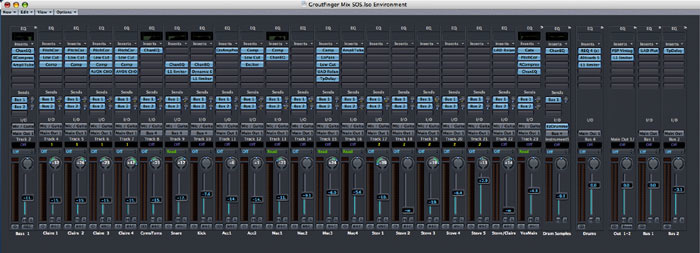
 The drums had been recorded on only three tracks, and had real problems with spill and phase-cancellation, so Paul needed to get fairly heavy-handed with the EQ, as you can see in the screenshot.The track itself has an American pop feel to it and, given the source material and the recording I/O limitations, Ian had done a pretty good job on the mix, but I identified a few problems with the individual tracks once I auditioned them and felt I could make the mix a bit cleaner and tighter sounding. Firstly, some tracks were recorded at incredibly low levels, so I had to normalise them before I could start work, and where noise became a problem, I cleaned up the tracks manually by destructively silencing all pauses and fading out any decaying notes prior to pauses, so that any background noise also faded rather than stopping abruptly.
The acoustic guitar had a slight tuning problem that wasn't really evident when everything else was playing, but in the intro to the song, where nothing else was happening, it was very obvious, so I simply cut it out. I suggested to Ian that he get Steve to replay just the intro and send it to me to edit onto the song if he felt strongly about keeping it, but in the end he decided not to.
The bass guitar part seemed to suffer from a lack of picking confidence, so the sound wasn't quite as solid as I would have liked, and there were also some fluffed phrases and slight timing errors. Fortunately I managed to find good bits elsewhere and copy them in place of the dodgy bits, so getting a bass part free from obvious mistakes wasn't a problem.
As mentioned earlier, the acoustic guitar came as two audio files, one DI'd and one miked. The miked version suffered a bit of spill and noise from other sources in the room, but it sounded rather sweeter than the DI'd version from a musical viewpoint, so I used that with just a little of the DI'd version added in underneath, after processing the DI track through a clean guitar-amp model to give it a bit more focus.
 In order to get better-defined kick and snare sounds, Paul triggered samples from Toontrack's EZ Drummer in time with the live performance.
For the drums, I was given three tracks called Kick, Snare, and Cymbals Plus Toms. As it turned out, the kick track had an awful lot of spill on it, and sounded almost like a single-mic recording of a complete kit, so I'm not sure where the mic was positioned. Similarly, the snare channel was almost overwhelmed by ride cymbal when the ride cymbal came in. The remaining track was also a bit of a mixture of the kit sounds, but it had a hard, filtered sound to it as well, as though it was the result of two or more mics at different distances being mixed to mono, causing some phase cancellation.
All the electric guitar parts were recorded with varying degrees of distortion and, from my viewpoint, the amount and type of distortion wasn't really ideal for this kind of song. I felt it was a bit thick and impenetrable, and perhaps a thinner-sounding guitar such as a Strat or Telecaster might have suited the song better, as it would have left more space in the mix for the other parts. However, the least-distorted guitar part also seemed to be the main one, so I was fairly confident I could make that fit with a little tweaking.
In addition to Steve's main vocal, there were also four tracks of backing vocals by his friend Claire (who'd apparently never sung before), more done by Steve, and one track of Claire and Steve singing together. To my ears, Steve's main vocal and Claire's backing vocals were enough to create the right feel, and on scrutinising Claire's four vocal parts I felt that some sections worked really well while others sounded a bit weak, so I simply muted the bits I felt didn't work.
Rescued This Month...
The Steve Morano Band is based around Steve Morano, a singer-songwriter who also plays acoustic guitar, electric guitar, and harmonica. Although originally based in Oxford and London, he has toured and performed extensively in Australia and now takes his 'country punk' songs out to audiences around the South of the UK, playing in the Reading, Brighton, and Aylesbury areas. The rest of the band comprise Ian 'Mac' McMillan (acoustic/electric guitars, backing vocals, percussion), Ross Nelson (bass), and Mark Acres (drums), but their friend Claire also helped out with backing vocals on this project. The band have just released a seven-track EP.
Drums Overhaul
 Some over-prominent notes in the bass track were brought under control with Apple Logic's Compressor, and the signal was then reamped using the Bass Amp model from IK Multimedia's Amplitube 2 to firm up the overall sound.While EQ could help me improve the drum sounds, I couldn't achieve the balance between the drums and Cymbals that I was looking for, due to the way the drum mics had been mixed prior to recording. In the end I resorted to loading in some kick and snare samples from Toontrack's new EZ Drummer, painstakingly lining these up, one beat at a time, with the drum hits I could see in the audio waveform display. Initially I used Logic 's Audio To Score facility to find the beats, but, because of the amount of spill, I had to add and remove a lot of beats manually as well as change the timing of individual hits.
I brought the EZ Drummer kick and snare up beneath the existing sounds rather than tying to replace or drown them, and this sufficed to restore some semblance of balance to the kit sound. I simply followed the timing of the original drum part rather than trying to improve anything. The original kick track then formed the main basis for the rest of the drum mix, with the snare track and, to a lesser extent, the phasey tom/cymbal track brought up to a level where the cymbals sounded reasonably well balanced. A gentle application of an Audio Ease Altiverb short ambience made the original drums sit more believably in the mix without making them sound over-treated. The addition of the sampled kick and snare left the toms sounding a little weak, but as these weren't available separately, there was little I could do about it and the song didn't seem to suffer much because of it.
Bass & Guitars: Reamping, Processing & Effects
To firm up the bass track, I reamped it via IK Multimedia's new Amplitube 2 plug-in using the Bass Amp model, but switched the EQ section for a British EQ. I'm pretty sure the bass amp part was originally miked, and there seemed to be some slight resonance issues that caused certain notes to dominate, so I put a Logic Compressor before Amplitube 2 to level things out a bit.
 For the acoustic guitar, I again used Logic 's Compressor to even out the sound and followed this with a low-cut filter just to take some of the low end out of it (190Hz cutoff) so that it would sit more comfortably in the mix without clouding the low mid-range area. A touch of Logic 's Exciter plug-in added a bit of sparkle, but nothing too radical here.
From the available electric-guitar tracks I settled on using the two main parts, with some odd emphasis chords taken from a third. The first part was treated to a little compression and both high- and low-cut filtering, and I then passed it into the UAD1 model of a Roland Dimension D chorus before adding a touch of Logic 's Tape Echo. This gave it a nice swirly, almost 12-string feel that suited the song well, but was spoiled slightly by the presence of clipping on some loud notes which was very obvious when the part was soloed. I tackled this using a 24dB/octave low-pass filter set to 5.3kHz, and used the mix automation to dip this to around 2.2kHz on the overdriven peaks, which hid the worst of the clipping without having any detrimental effect on the guitar tone.
The other main guitar part, which comes in around halfway through the song, was a bit more crunchy, so I opened another Amplitube 2 and used something approximating a Fender Twin model to give the sound some bite and definition. I felt it sounded a bit muddy as it was. The two main electric guitars were panned slightly either side of centre.
Mono Or Stereo?
In his email to me, Ian said that he wasn't sure whether to record in stereo or in mono, or what the benefits were. In my view, instruments in a multi-layered mix like this (other than drums and stereo keyboards where used) are best recorded in mono, as it eliminates the risk of phase problems that can occur when you use two or more mics on the same source. I suspect that the odd sound of one of the drum tracks was caused by mixing two mic signals to mono — possibly the overhead and the hi-hat mic.
Acoustic guitars are essentially mono sound sources made stereo by their interaction with reflective surfaces in the performance area, so in the studio it makes perfect sense to record them in mono and then add stereo reverb or ambience when you mix. It is possible to use two mics to make a stereo recording, but the results are rarely natural, and you can end up with mono-compatibility problems unless you record using a coincident pair. The same is true of electric guitar, but because the electric-guitar sound is essentially artificial anyway, it is quite common to record using two mics at the same time, adjusting the relative mic positions so that the phase differences between the two contribute to the sound in some useful way. Once you add stereo reverb or ambience and pan the sound within the mix, it takes on an adequate sense of space without losing its focus.
Where you do record in stereo, as you would normally do in the case of a drum kit, it helps to limit the left-right panning to avoid the drum kit sounding as wide as the entire band. I tend to keep the pans between the 10-o'clock and two-o'clock positions for this reason. This argument also holds true for stereo keyboards or pianos miked in stereo, though you may want to offset the pans slightly to place the instrument to the left or right of centre.
Sorting Out The Vocals
I ditched all the backing vocals other than those provided by Claire, and I only used the phrases from those that I felt worked best. This was a purely personal choice, but sometimes I feel the 'less is more' adage really is true. There were a couple more doubled parts that were bounced onto the main vocal track, but I couldn't do anything to change those, as the parts were not sent to me separately. Claire had done her parts in four layers, so I tightened up the pitching using Logic 's Pitch Correction plug-in set to chromatic mode, then used the Antares Choir plug-in (part of their Avox suite) on two of them to split them into four parts each, producing what I hoped would be a ten-part choral effect. Without the pitch-correction, the vocal parts were still pretty good, but I could just hear them going off in places. The combination of pitch-correction and Choir actually worked pretty convincingly and gave a very lush and believable choral sound that worked nicely against Steve's main vocal line.
For Steve's lead vocal, I again tightened up the pitching using Logic 's Pitch Correction plug-in, this time set to an 'F'-minor scale and with a medium correction speed. This actually worked fine, except for on the short sections where there were two vocals on the track. These sections it ignored and left as they were. As usual, the vocals were compressed to keep them sounding dense and even, this time using the Waves Renaissance Compressor set to emulate an opto-compressor, and I also added some EQ that comprised mainly some broad high-end lift with some 200Hz cut in the mid-range to take out a boxy 'honk'. A little very low cut was also added just to take care of any low-frequency wind noise or other unwelcome low end that might have crept into the mic. By way of effects, I added both UAD1 plate reverb and a little tape-style delay (both set up on busses so I could access them from the channel sends) as this seemed to help the vocal gel with the backing. As there was a bit of crosstalk and noise on the vocal track I also gated it before processing it.
The ever-popular PSP Audioware Vintage Warmer was used to pump up the mix energy slightly, but the settings were quite subtle, as you can see from the screenshots. Other than that, I used some level automation to nudge up the vocals a hint in the chorus sections and to feature a couple of prominent guitar riffs, but otherwise the track almost mixed itself. I also did a second mix with more top cut on the electric guitar parts on the Vintage Warmer to try to emulate a typical '70s mix, as that's the kind of vibe I thought the song had. I feel that the track is now a pretty good demo, and if the band were to re-record it paying more attention to the tightness of the performance and the pitching/tuning of the various parts, they could make it sound very polished and professional. I'm also amazed at how good a mix Ian had done given his four-input limitation, so he's going to be off and running when he gets a bigger interface that lets him record most of the band in one go.
Need Help With Your Mix?
If you're having trouble with a mix, then you can submit your track for the Mix Rescue treatment. Contact us via the email address below. Please include a daytime contact telephone number, some information about how you recorded and mixed your version of the track, and your views about what aspects of your mix are causing you most concern.
Remix Reactions
Steve Morano: "The song sounds really together — it's captured what I am trying to say on the record. I love my vocals, which are a lot cleaner, and taking out the acoustic intro really works. The backing vocals and reverb guitar riffs are also great."
Mark Acres: "I'm impressed with how the various drums have been cleaned up to tighten the sound, particularly the bass drum. The snare is a lot less cutting, and the cymbals are light and distinctive — they've clearly been kept at a constant level."
Mac: "I think I've been sacked! Really though, the mix is great, and it gives me something to aim for now. It'll be useful to practice on the original recordings and make use of the experience which Paul has passed on. The song is tight, together, and really clean. The band are really happy with the result and we're honoured to be in the magazine. Thanks a million!"
Hear The Differences For Yourself!
Listen to the effects of my mixing decisions by checking out the following audio examples available for download at www.soundonsound.com/sos/jul06:
- /audio/
 originalbass-0706.mp3
A few bars of the bass-guitar track as provided, but after normalisation.
- /audio/ processedbass-0706.mp3
The bass-guitar part after compression and treatment by Amplitube 2 's Bass Amp.
- /audio/ originalclairebv.mp3
This is the backing-vocal section that we decided to use, prior to my adding any processing.
- /audio/ processedclairebv.mp3
The backing vocal again, after processing with Logic 's pitch-correction and Antares Choir. There's also some added plate reverb.
- /audio/ originaldrums-0706.mp3
A best mix of the three original drum parts, which leaves us with a cymbal-heavy sound.
- /audio/ originalcymbalstoms.mp3
This is the original drum track with the phasey sound.
- /audio/ processeddrums-0706.mp3
The final drum mix comprising a mix of the three original parts plus kick and snare samples from Toontrack's EZ Drummer. Audio Ease Altiverb was used to add some short ambience to the kit.
- /audio/ originalelecgtr.mp3
The main electric guitar part prior to processing, showing the clipping problem.
- /audio/ processedelecgtr.mp3
The same guitar part after filtering and the addition of simulated Roland Dimension D chorus and tape delay effects.
- /audio/ originalmix-0706.mp3
Ian's original mix with acoustic-guitar intro.
- /audio/ remixversion1.mp3
My remix, which isn't subjectively as loud as the original because it's not so heavily limited.
- /audio/ remixversion2.mp3
Slightly less bright version aimed to match vintage US mixes from the '70s. This sound was achieved mainly by cutting high end from the electric guitar parts, the cymbals, and the master processor settings.