

Roland already have one of the best-loved vocoding keyboard instruments to their name, in the shape of the vintage VP330 Vocoder Plus. Is their 2007 take on the same concept destined for similar classic status?
Way back in January 1979, on my first professional album-recording engagement and in an excited and adventurous frame of mind, I hired one of EMS's revered Vocoder 3000 units for the sessions. A Mellotron (with choir and custom vocal loop tape-frame installed) was used as the carrier signal for the vocoder, while I sang, somewhat nervously, into the microphone that was connected to the modulator input. The Vocoder 3000 was an imposing and arcane device, yet with concerted tweaking and experimentation some rather wonderful and ethereal vocal textures came forth — definitely not of this earth, and certainly not human in nature. We loved it. Frustratingly, I couldn't afford one of my own.

Later that same year, Roland announced the release of the VP330 Vocoder Plus, a four-octave, self-contained keyboard instrument featuring an easy to use, built-in vocoder that required no specialist knowledge to operate. Moreover, it also generated a highly respectable string-synth sound (still admired by many to this day) and featured a unique vocal ensemble sound, playable from the keyboard. Much as I will always love Mellotrons, mine was becoming a bit of a liability on stage, and the VP330 offered a possible replacement in such circumstances. I could barely contain my excitement (bless...) and simply had to have one — but little did I realise just how important an addition the VP330 would become to my keyboard rig. Why? Not only did it replace the Mellotron sounds on stage (and eventually in the studio too) but it provided a unique voice of its own: not only for string and choir sounds, but for the numerous creative applications vocoding had to offer.
Let's wind forward to the present day and Roland's new VP550, their first dedicated vocoding keyboard instrument since the VP330. The VP550 revisits the VP330 concept, but with the benefit of nearly three decades of technological development. Essentially, it is a vocoder that employs virtual modelling techniques developed for the VC2 Vocal Designer card that forms part of Roland's V-Synth, V-Synth XT and VariOS systems. Virtual modelling, according to Roland, is the key to significantly more realistic vocal timbres and greater clarity of diction than were previously possible. While the older VP330's vocal stylings were great effects in themselves, they were nevertheless synthetic in nature, even by 1979 standards — so it's particularly interesting that Roland's main claim for the VP550 is that it can be used as a viable alternative to real backing vocalists and choirs. To complement these flagship vocoder functions, an enhanced sample-playback engine provides additional string and vocal keyboard sounds. Further performance controls include the pitch/modulation lever, D-Beam and external control pedal (more of which later), and the total output is lent extra depth and polish courtesy of three types of reverb (two 'Hall' varieties and one 'Studio').
The VP550 is fairly unassuming in appearance — smart, yet sombre-looking, with a modestly populated control panel and a four-octave keyboard. Simplicity and ease of use are Roland's aims with the design, and the VP550 is indeed very straightforward to operate. The instrument comprises three tone-generating sections named Vocal Designer, Ensemble and Bass/Percussion, which can be used individually or in combination with each other. Let's begin by examining each of the three sections.
What's A Vocoder?
A vocoder continuously examines the frequency content and amplitude of one audio signal and imposes those characteristics upon a second audio signal. Vocoders rely on two sound sources: a modulator (typically a voice) and a carrier (typically a synth sound or waveform.) The modulator signal is split into a number of discrete frequency bands (the more bands, the more detailed the final sound). These frequency bands feed the same number of envelope followers, whose output voltages in turn feed VCAs that control the individual frequency amplitudes of a second, identical multi-band filter. The carrier signal, which passes through this second multi-band filter, mimics the amplitude and timbral changes of the first, hence the synth appears to 'talk' in response to the vocal modulations.
Vocal Designer
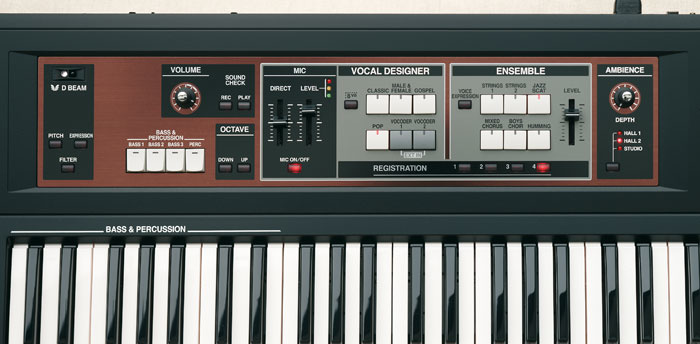 The front panel of the VP550 is exceptionally simple, with a control for pretty much every function and no need even for an LCD screen.This is the real heart of the VP550, where any one of six vocal models can be selected as the carrier for the vocoder (see 'What's A Vocoder?' box). The name of each model suggests a musical genre to which it might best be suited, although these may be considered simply as 'serving suggestions'.
- Classic: A rich, full ensemble singing in unison, with male voices in the lower range gradually 'morphing' to female in the upper range. Drenched in Hall reverb, this is highly suited to classical choral music, but also works well with less reverb in a rock/pop context.
- Male & Female: As the name suggests, these are male and female voices pitched an octave apart in a rich ensemble. At the lower end of the keyboard only the male voices sound. The females gradually fade in as you travel higher up, to produce an equal mix for the mid-range. The males fade away for the upper range, leaving only the females. Male voices are biased to the left of the stereo field, with females to the right. This is an interesting choice, as many real-life classical choral ensembles favour an even spread of males and females across the stage.
- Gospel: A variation on the Classic model, featuring random internal pitch variations giving the impression of some rather 'enthusiastic' individuals within the ensemble. This model can sound very rich and impressive for a cappella renditions, with additional character being provided by an upward pitch-scoop for each new note that is played.
- Pop: A smaller vocal ensemble with very little vibrato compared to the first three models, also featuring an upward pitch-scoop that is rather more subtle than with the Gospel model. Perhaps the least convincing model when singing lyrics, this is nevertheless well suited to contemporary-sounding non-lyrical vocal backdrops and chordal textures. (See the 'VP550 Vocalising Tips & Techniques' box.)
- Vocoder 1: A thin, wiry-sounding robotic voice model with no pretensions to realism! Just the thing for chillin' wid da funky, lo-fi urban massiv, innit. Or perhaps for just pretending you're a Cylon.
- Vocoder 2: This is a fuller bandwidth version of Vocoder 1, which is highly reminiscent of the un-Ensembled vocoder sound of the original VP330.
VP550 Vocalising Tips & Techniques
In attempting to coax realistic vocal performances from the VP550, a number of factors should be borne in mind. Firstly, choose a suitable microphone for the situation: a good-quality headset mic (with a foam windshield) is fairly essential for live use, as you'll probably be moving around and won't want to be anchored to the spot by a static mic. It also ensures a reasonably consistent vocal level, which in turn makes the VP550 feel more under control. In the studio, a static mic offers the advantage that you can use a nylon mesh pop-shield with it. This is most effective for reducing noises caused by breathing across the mic, plosives and other undesirable oral artifacts, to which the VP550 can be fairly sensitive.
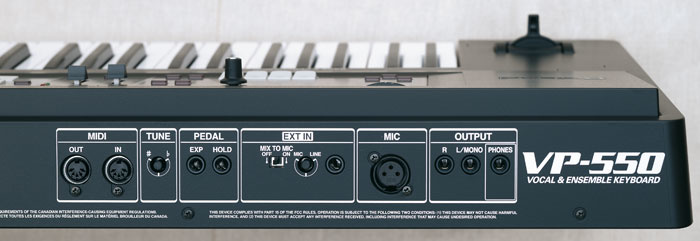
The VP550 has two mic inputs: a balanced XLR and an unbalanced standard jack (which also doubles as the external synth/audio input). No phantom power is supplied by the VP550, and if you're using the jack socket to input an external synth, you're obliged to use the XLR socket as the mic input, so you'll need either a separate phantom-power supply for condenser mics, or to use a self-powered or dynamic mic. It goes without saying that unless you're going for an intentionally trashy effect you should avoid using a cheap and cheerful cassette-recorder mic. The VP550 can only sound as good as the source signal, so pick a quality mic that suits your voice.
The VP550's vocal models each respond quite differently depending on your style of vocal delivery. Now, I'm not the best singer in the world — indeed it's probably safe to say that I number amongst the very worst — but during the time I spent with the VP550 I learned some useful approaches for each model that I shall now pass on, for what they're worth! Of the first four 'realistic' models, 'Classic' is perhaps the most forgiving of poor technique, responding well to a wide dynamic range, and sounding at its very best when you sing 'oohs', 'aahs' and other non-verbal sounds, especially while playing in the low to mid pitch range and singing softly. Vocalising phrases such as 'Domine', 'Kyrie Eleison' and 'Agnus Dei' can produce truly epic-sounding results worthy of the soundtrack to The Da Vinci Code. Loud singing can occasionally evoke odd, phasey timbres that sound synthetic and unnatural. I subsequently found that singing at quiet to moderate volume sounded more lifelike, especially when expanding the back of the throat to make a deep, 'plummy' tone, particularly when singing words. Also, keep your tone as smooth as possible, as any raspiness or croakiness is magnified and can spoil the illusion.
Much the same approach can be taken with the 'Male & Female' model, but I found that the most realistic effects are produced when playing smaller chord clusters and avoiding the very high registers, where the females begin to sound a little hysterical and the males are straining rather painfully! The 'Gospel' model is the most complex of the six, and responds well to lyrical content across a wide dynamic range. The upward pitch-scoop at the start of each note means that particular care must be taken when co-ordinating your keyboard playing with vocal performance. When you sing in sync with or ahead of the keystrokes, the scoop will be audible, but if you play the keyboard slightly ahead of your singing, the scoop can be intentionally avoided. Of course, if you're playing legato and singing all the while, the scoops will be heard for every new note played.
The 'Pop' model requires the most restrained approach, and is really at its best when lyrics are avoided. It's ideal for tight, modern-sounding backing 'ooh' and 'aah' pads, but I found it less believable with lyrics because of a distinctly robotic character I found hard to overcome.
As regards Vocoder 1 and Vocoder 2, there is little advice I can give, as realism is hardly a consideration. Madcap silliness is going to result no matter what you do, and in this regard they're totally serendipitous and all the more fun for that. In the case of all six models, the intelligibility of lyrics is astonishingly good. Consonants and sibilants are clear as a bell — in fact, sometimes I wished I could turn them down a bit! You'd really have to mumble your words in order not to be understood, which is a major step forward from the VP330.
I have one final observation to make about technique, and it regards singing in tune. The pitch at which you choose to sing has a profound effect on the final vocoded tone, and intuition suggests that following the dominant melodic line of your keyboard part will produce the best results. Surprisingly, I found that this wasn't necessarily the case — in fact, the higher I sang, or the more I jumped around in pitch, the less consistent and realistic was the end result. I frequently found that singing at a low pitch sounded the most natural, and in some cases not even singing — simply speaking the lyric in a monotone — sounded better. Interestingly, the opposite approach worked best for the old VP330, where you could really hit the 'sweet spot' by singing the dominant line.
Ensemble Section
More than simply a selection of add-on sounds, the sample-based Ensemble section comprises six tones offering some interesting performance features. With the exception of Strings 2, each tone is made up of two or more timbral layers, typically soft and loud variations. Three methods of controlling the timbre of these sounds are provided, these being key velocity, foot controller and Voice Expression, though not all the sounds utilise all three. Voice Expression can be switched on from the front panel and is really a variant on the breath-control concept — except rather than the force of your blowing down a tube being used as a controller, it's the volume of your voice that provides the controller data.
- Strings 1: This is a moderately restrained, medium-sized ensemble with a light vibrato. An extremely expressive tone, Strings 1 employs some clever performance tricks. Key velocity progressively 'morphs' through soft to loud sample layers, although it never quite reaches the intensity of an orchestra at full tilt. As such, it lends itself more to slow, legato passages with a pastoral flavour. Attack and release times are controlled not only by velocity, but also by the speed (frequency) at which notes are played, enabling fast, yet softly played legato runs to be articulated clearly. Clever stuff! When you're playing legato in the upper violins' range, a portamento effect typical of the way string players slide between notes is added — again, controlled by the speed of your playing. Real expressive control comes through use of a continuous-type footpedal. Pedal movements work in conjunction with velocity, allowing (with a little practice) internal lines within a polyphonic part to seemingly have a life of their own. The foot controller also has an ingenious lag-time feature that has the effect of 'cushioning' overly fast pedal movements, producing more natural-sounding phrasing. I've not encountered a string preset of this kind on any other instrument, and it has to be experienced to really grasp how expressive it can be. Voice Expression works similarly to the foot controller, and all three methods of control can be used at once.
- Strings 2: A synthesized string tone, apparently derived from the JP8000. This is also controllable using velocity, footpedal and Voice Expression, but instead of moving through different sample layers, these modulate a low-pass filter, controlling volume and brightness. Velocity affects the attack time, but the other esoteric functions of Strings 1 are not implemented here. Being thicker in texture than Strings 1, this sound is most effective for chordal parts.
- Jazz Scat: You might know this one — it's the infamous velocity-switched 'Doo-Bap-Doww' jazz vocal ensemble found on a number of other Roland products. Its three sample layers are controlled only by velocity, and it does exactly that — it goes 'Doo', 'Bap' and 'Doww'.
- Mixed Choir: When played without the footpedal or Voice Expression, this is a gentle-sounding unison choir singing 'oh', that brightens slightly with higher key velocities. Apply the pedal and/or Voice Expression, and you can morph from 'oh' through to a gloriously full-throated 'aah'. The 'aah' element is also progressively filtered with a low-pass filter towards the quieter end of the controller range.
- Boys Choir: Soft through to loud 'aahs' employing the same dynamic behaviour as Mixed Choir, featuring a horde of angelic mop-heads, no doubt driven to the sampling session in their mums' 4x4s. Perhaps a little too perfect in the tuning department, this might have benefited from the same sort of random modulations as the Gospel model.
- Humming: A mellow humming choir when played in its basic form, this transforms into the same throaty 'aah' as the Mixed Choir when the pedal or Voice Expression are used. Move the pedal quickly and they go 'Mmwaah' — indispensable for Hollywood celebrity gatherings.
Features In Brief
- 49-note keyboard, velocity sensitive.
- 128-voice maximum polyphony.
- Vocal Designer section with six models.
- Ensemble section with six models.
- Bass & Percussion section with four models.
- Ambience Processor (Hall 1, Hall 2, Studio, Depth control).
- D-Beam controller, pitch-bend/mod lever.
- Sound Check function (records keyboard output for 10 seconds and replays it).
- Headphone output; quarter-inch stereo outputs; XLR mic input; quarter-inch input (switchable mic/line, for use as mic input or external audio source input); MIDI In and Out; Hold pedal input; Expression pedal input.
- Approx 865 x 346 x 99mm (35 x 14 x 4 inches).
- Weighs 8.5kg (18lbs 12oz).
Bass Section
When activated, the lowest 17 notes of the keyboard are dedicated to the Bass section. The four tone presets are derived in part from the Jazz Scat sounds: Bass 1, a short 'Dum'; Bass 2, a sustained 'Doo'; Bass 3, velocity-switched 'Doo-Bap-Doww; and 4, Percussion. Not your normal percussion, but vocal beatbox-style percussion sounds such as 'Derr' 'Tch' 'Tsss' 'Ugh' and even 'Doh' (Homer? Is that you?), plus others that are not so easy to articulate in print. Superficially entertaining as these are, they offer no threat to accomplished beatboxers (I don't think Shlomo should have any cause for concern). If there's any real problem with the Bass/Percussion, it's that it's far too quiet relative to the other sections, even at the highest of its four selectable volume levels.
In The Studio
The sequencing DAW is a great environment in which to create highly polished VP550 vocalisations. The VP550 is tri-timbral over MIDI: the Vocal Designer, Ensemble and Bass sections transmit and receive data on three fixed channels (1, 2 and 3 respectively). This allows keyboard parts for each section to be recorded individually on their own MIDI tracks and played back simultaneously. Note, however, that the VP550 has no MIDI Local Off setting, so if you're using both MIDI In and Out connections, be sure to turn MIDI Thru off in your sequencer, otherwise you'll end up with duplicated notes on your MIDI tracks. MIDI also provides the very useful facility to record your Vocal Designer keyboard performance and audio vocal 'driver' in separate passes, providing the opportunity to fine-tune each of these elements. Recording the vocal first seems to be an effective method, after which the recorded vocal part is routed to the outside world, and into the VP550's mic input, instead of a live microphone. This drives the Vocal Designer, and you can then concentrate on getting the keyboard parts right, recording them into the sequencer and editing note values to synchronise exactly with the vocal. Any unwanted vocal artifacts, such as lip smacks, swallowing and unwanted breaths, can be removed from the vocal part using your DAW's audio editing tools, leaving a pristine vocal track with which to drive the VP550.
Many people find it useful to compress a vocal before sending it to a vocoder, and indeed that does help considerably in maintaining a consistent vocal level. However, the VP550 offers six selectable sensitivity levels for the Vocal Designer, allowing greater or lesser dynamic variations in the vocoded output. The end result is similar to using a compressor, but without the need for additional outboard processing. The manual also suggests contriving backing vocals by using the lead vocal performance as the 'keystone' for driving the Vocal Designer. I tried this on a track featuring a fine lead vocal, but found it rather disappointing. There's something about having the backing vocals so totally 'hard-sync'd' to the lead that sounds, well — wrong. Not only that, but every timbral nuance of the lead vocal is mimicked precisely by the VP550, which only serves to cloud the issue and sounds very artificial. There's no doubt that infinitely better results come from writing a well-constructed backing vocal arrangement that utilises counterpoint and independent phrasing, and driving it with a custom vocal track that features the appropriate dynamics!
The VP330: A Brief Recap
The VP330 comprised three tone sections: Vocoder, Human Voice and Strings. Although the waveform generator used for the String tone was 'hard-wired' as the basis for the Human Voice and as the carrier for the Vocoder section, any external input could optionally be used as the carrier signal for the Vocoder. The Human Voice tone offered two variations: Male voice in the 8' register, and Female voice in the 4' register. Vocoder, Male voice, Female voice and Strings could be deployed in various combinations to the upper and lower keyboard halves. The Male and Female voice tones were achieved using fixed-frequency formant filters applied to the basic waveform.
In their naked form, the Human Voice and Vocoder sounds were flat, nasal and rather unflattering. However, the VP330's trump card was its classic Ensemble effect, which 'multiplied' the sound to simulate a large choir spread across a wide stereo soundfield. Used judiciously, fairly convincing choral textures could be created with the Vocoder, especially if you restricted yourself to singing non-lyrical sounds such as 'ooh' and 'ahh'.
Vocoder users the world over have discovered many creative, non-vocal applications for vocoders, the most popular being the use of drum machines and percussion loops as the modulating source (instead of a voice) to produce chordal, rhythmic grooves. The VP330 excelled at this trick, foreshadowing the wave-sequencer stylings of the Korg Wavestation by several years. In one recent recording, I used the vocoder in conjunction with a pair of Ikea cereal bowls to provide the 'voice' for a mythical beast — but I'm afraid the exact details of this technique are going to remain a trade secret!
Further Functions
In addition to the six vocal models, any external audio signal can receive the vocoding treatment. Pressing the Vocoder 1 and Vocoder 2 buttons simultaneously, and sliding the Mix To Mic switch on the rear panel to the 'off' position, causes the jack mic socket to become an external line input. Input gain for this external signal can be adjusted for optimal level using the small trim-pot on the rear panel. The XLR connection now becomes the microphone input, necessitating the use of a dynamic (or other non-phantom powered) microphone. The model used to perform the vocoding appears to be the Vocoder 2 type, which is very similar to the classic VP330 style of vocoder sound. As you'd expect, the tonal character of the external audio has a fundamental influence on the character of the vocoded sound, with harmonically rich tones offering the most flexibility and the best lyrical clarity.
Elsewhere, the D-Beam infra-red controller globally affects pitch (over a one-octave downward range), expression (downward volume) or low-pass filter, but does not operate on the Bass section. The range of the keyboard can be extended by one octave up or down (but, again, not for the Bass section), while the Vocal Designer has a dedicated button to raise its pitch by one octave relative to the Ensemble section. This is very effective for creating huge-sounding textures when layering the Vocal Designer with the Ensemble section. To this end, four user-definable presets are provided for instantly recalling your favourite combinations, although these recall only the sound combos themselves, not the microphone or Ensemble level-slider positions or reverb amount. The combined pitch-bend/modulation lever likewise affects only the Vocal Designer and Ensemble sections. Pitch-bend is fixed at a two-semitone range, while modulation adds global vibrato at a fixed LFO speed and is probably more usefully applied to the two Vocoder models rather than the four 'realistic' ones.
Conclusion
Roland's bold claim that "no longer will you need to call multiple vocalists to your live performances or recording sessions" is understandably bound to raise an eyebrow or two — and in that regard they could be seen as overselling the VP550. But before we accede to angry Luddites carrying burning torches, just remember how the Mellotron was greeted back in the 1960s, with all the accompanying talk of orchestras being put out of work — yet we now look back at the paranoia and short-sightedness of that attitude with wry amusement. In the same way, I'm sure that anyone who can afford a full choir or backing singers will continue to do so, while those who cannot may welcome the VP550 as a means of adding luscious vocal textures that they could not otherwise easily realise.
Does it sound as good as the real thing? It can sound astonishingly lifelike in the right context and with a following wind. However, the VP550 is perhaps more dependent on the individual performer for successful results than almost any other keyboard I can think of. Let's just say that for every person that 'gets it' and develops an approach that really works for them, there will be someone else for whom it amounts to little more than a swarm of mutant killer bees. But when it works well it does sound quite beautiful — and I can think of no better way of signing off than to recommend visiting www.rolandus.com and watching the video of Roland demonstrator Don Lewis performing 'Swing Low Sweet Chariot' on the VP550. Yes, practice really does pay off.
Alternatives Past & Present
Vocoders have been fairly plentiful over the years. Here is a selection of the great, the good and the brave. Those marked as synth/vocoder featured vocoder functions as a sub-set of an otherwise more complex synthesizer instrument.
| Year | Make/Model | Type | Format |
| 1977 | EMS 3000 | vocoder | rack |
| 1978 | Korg VC10 | vocoder | kbd |
| Sennheiser VSM201 | vocoder | rack | |
| 1979 | Roland SVC350 | vocoder | rack |
| Roland VP330 | voc/strings | kbd | |
| Bode 7702 | vocoder | rack | |
| Moog Vocoder | vocoder | rack | |
| Synton Syntovox 221 | vocoder | rack | |
| 1981 | Synton Syntovox 222 | vocoder | rack |
| Dynacord SRV66 | vocoder | rack | |
| Echolette SEV66 | vocoder | rack | |
| 1986 | Korg DVP1 | voc/proc | rack |
| 1987 | Roland VP70 | voice proc | rack |
| 1988 | Krok 2401 | vocoder | rack |
| 1990 | Electronica EM26 | voc/strings | kbd |
| 1992 | Korg Wavestation A/D | synth/voc | rack |
| 1997 | FAT PCP330 | vocoder | rack |
| 1998 | Quasimidi Sirius | synth/voc | kbd |
| 2000 | Korg MS2000/2000B | synth/voc | kbd |
| Korg MS2000R/BR | synth/voc | rack | |
| Prosoniq Orange Vocoder | vocoder | plug-in | |
| 2002 | Logic EVOC20 | vocoder | plug-in |
| 2003 | Korg Microkorg | synth/voc | kbd |
| NI Vokator | vocoder | plug-in | |
| 2005 | Analog Lab X32 | vocoder | rack |
| 2006 | Korg Radias | synth/voc | kbd |
Notes: The VP70, although marketed as being capable of 'vocoder effects', was in reality a vocal harmony processor — an entirely different beast to a vocoder. Like the VP70, the DVP1 was a vocal processor, producing pitch-shifted harmonies from a single voice. However, it did also function as a genuine vocoder, and was unusual for a rackmount vocoder in having its own internal synth waveforms to act as a carrier signal. Synton licensed their Syntovox 222 model to Dynacord, who marketed it under their own name as the SRV66. The similarly named Echolette SEV66 was identical to both of these.
Pros
- Vocal Designer sounds gorgeous under the right conditions.
- Expressive and useful Ensemble sounds.
- Very simple to operate.
- Fantastic tool for sonic experimentation.
Cons
- No MIDI Local Off.
- Bass/Percussion section too quiet.
- Don't expect miracles — Vocal Designer takes some practice!
Summary
The VP550 takes the vocoder concept to the next level. The Vocal Designer offers 'real' and classic vocoder tones, and with care and patience can produce very lifelike ensemble vocal textures. Verbal articulation of vocoded performances is exceptionally clear, setup and operation is extremely simple, and together with the Ensemble section and external audio input facility, the whole package offers almost limitless scope for experimentation.