

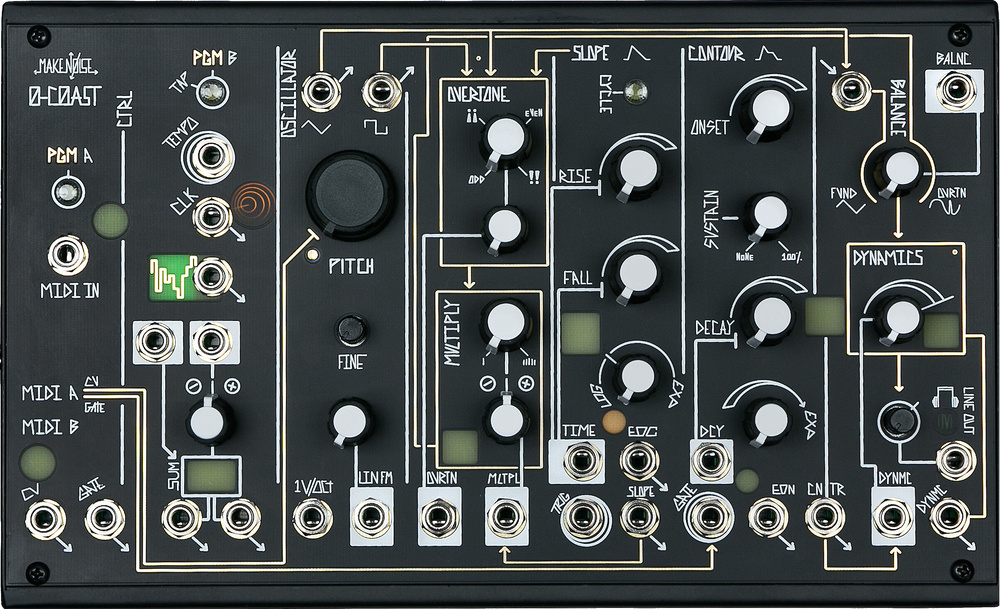
It’s 10 years since we reviewed the Make Noise 0‑Coast. Back in October 2016 Paul Nagle was impressed, likening it to his Synthi AKS as an instrument for experimentation and predicting that it would win a lot of friends (click here to read the full review). He was certainly right about that. A decade on and the 0‑Coast is still in production and has certainly won itself a lot of friends. Indeed, it’s a classic of the modern era, and that’s why we thought it was worth revisiting here to mark the anniversary.
The thinking behind the 0‑Coast is probably well understood at this point; that it would be coast‑agnostic, taking inspiration from both the East and West Coast schools of synthesis. Outwardly, the 0‑Coast is a fairly straightforward‑looking semi‑modular desktop synth, slightly cryptic Make Noise house‑style notwithstanding, and it’s this apparently simple approach combined with a relatively modest price tag that has drawn a lot of users in. Appearances can be deceptive, though, and what initially seems to be straightforward can become really quite complex. Perhaps it’s this approachable learning curve that’s the key to the 0‑Coast’s success: it’s easy to get started, but also rewards long‑term users, offering more and more possibilities as your understanding grows. It also packs an awful lot into a small space — it’s as useful as a utility module as as a sound source — and obviously makes a great introduction to Eurorack as well as giving you a plentiful supply of tools to get you started. It also just sounds really good, and that obviously helps!
Inspired by spending a couple of months with a Buchla Music Easel last year, I mounted my 0‑Coast in a 6U 84HP briefcase along with an 0‑CTRL, a filter, VCA, reverb and an ever‑changing second voice that’s often patched into the 0‑Coast’s audio input to share its Dynamics circuit. Things get swapped in and out of this system, but the 0‑Coast is staying put. There’s no way I could replicate the functionality in 45HP of modules. Currently it’s performing uneven clock duties: the Slope EOC is patched to the Clock input, and the Slope Fall is being controlled by the attenuated S&H, triggering irregular events and making early‑Autechre‑ish noises with the Pitch control at zero. This patch draws inspiration from Walker Farrell’s near‑legendary Krell patch in the manual, which must have also inspired countless others. And the manual itself deserves a special mention — it’s well written and gently leads the reader from the basics to the advanced, encouraging experimentation and exploration along the way.
The more you get to know the 0‑Coast the more you appreciate what a brilliant bit of design it is.
The more you get to know the 0‑Coast the more you appreciate what a brilliant bit of design it is. An amalgam of so many different parts, but still very much an instrument rather than a collection of bits. It’s extremely well judged. Tony Rolando has been responsible for any number of inspirational designs before and after the 0‑Coast, and perhaps it’s because the 0‑Coast is an instrument rather than a module that it seems so distinct in the Make Noise line‑up, but it’s not difficult to imagine that this is his magnum opus. Unless of course he makes something even better, which on past form is entirely possible!
In the meantime, though, let’s celebrate the 0‑Coast for what it is — a true 21st Century classic.