

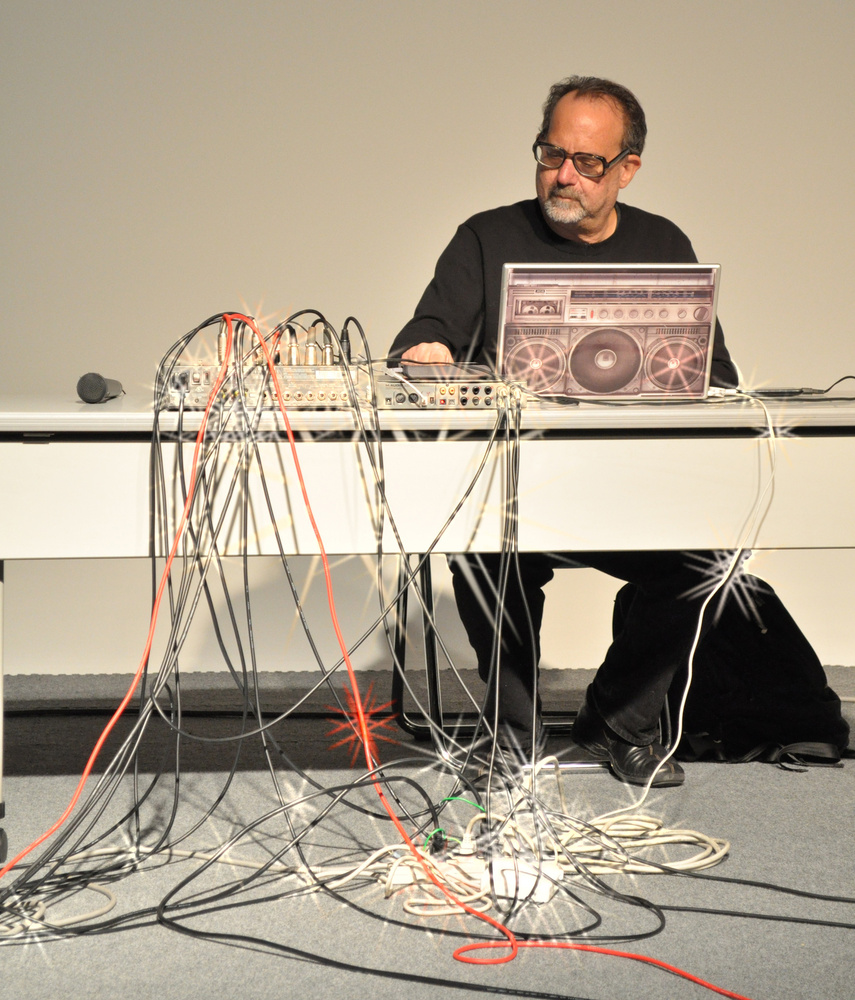
 Photo: Tomohiro Ueshiba
From his early tape experiments to his trailblazing use of computers for live performance, electronic composer Carl Stone’s approach to music has always marked him out as a pioneer.
Born in Los Angeles in 1953, Carl Stone occupies a singular position in contemporary music. For more than five decades he has quietly but profoundly reshaped our understanding of what composition can be in the digital age. Often described as one of the pioneers of live computer music, Stone transformed the computer from a passive playback device into a responsive, expressive instrument in its own right. His computer‑based performances, which he has presented live since 1986, remain remarkable not for technological spectacle, but for the extraordinary sensitivity with which he manipulates sound in real time. To begin our conversation, I was curious to learn how much exposure to electronic music played a role in his creative makeup.
“I was in the seventh‑grade Glee club, and for some reason the teacher brought in an album of electronic music, something that had just been released, and she played it for the students. The thing is that there weren’t that many recordings out in those days. I think the Columbia‑Princeton Electronic Music Center LP had come out [1964] and it could have been this, with music from Vladimir Ussachevsky, Otto Luening and others. This was 1965 when she played it for us. The other students were like, ‘Oh, this sounds like music from outer space,’ but somehow, I found value there and I kept it in the back of my head, even though I didn’t, like, go and seek out more electronic music at that age.
What happened then was, because I became so fascinated with all this music that I hadn’t heard before — 20th Century classical, modern music, music from all over the world, etc — that I tuned out of pop culture for 30 years. The ’80s and ’90s, pretty much up to the present day, I just don’t listen to any of that. The music that means a lot to friends of mine, people that grew up in the ’70s or ’80s, or even a little bit later, it’s just a total blank to me.”
Education
Stone studied composition at the California Institute of the Arts with two towering figures of experimental music, James Tenney and Morton Subotnick, whose 1967 composition Silver Apples Of The Moon introduced a new sonic language to generations. Yet while their influence can be felt in his curiosity towards electronic sound and formal experimentation, Stone quickly developed an unmistakable voice of his own. Given this new world opening up, did he have any idea as to how this new sonic world seemed to suddenly emerge?
“At college I hung with Z’ev (Stefan Weisser) and we discovered lots of music together. He came with open ears and got me listening to Mothers Of Invention and Captain Beefheart, and together we discovered Terry Riley, Steve Reich, Harry Partch and others.
“These artists were kind of just breaking through because they had releases on major labels, with Riley signed by Columbia and Steve Reich releasing music on Odyssey in 1967. They weren’t mainstream, to be sure, but they were getting more attention than a lot of other people who were labouring in complete isolation. Riley’s A Rainbow In Curved Air [1969] was a big influence, and minimalism really resonated with me.
“I saw them live at the time, with Reich at CalArts in the main gallery with his Music For Eighteen Musicians, and Philip Glass with his Music In Twelve Parts and Music With Changing Parts, which remain my favourite works from these artists.
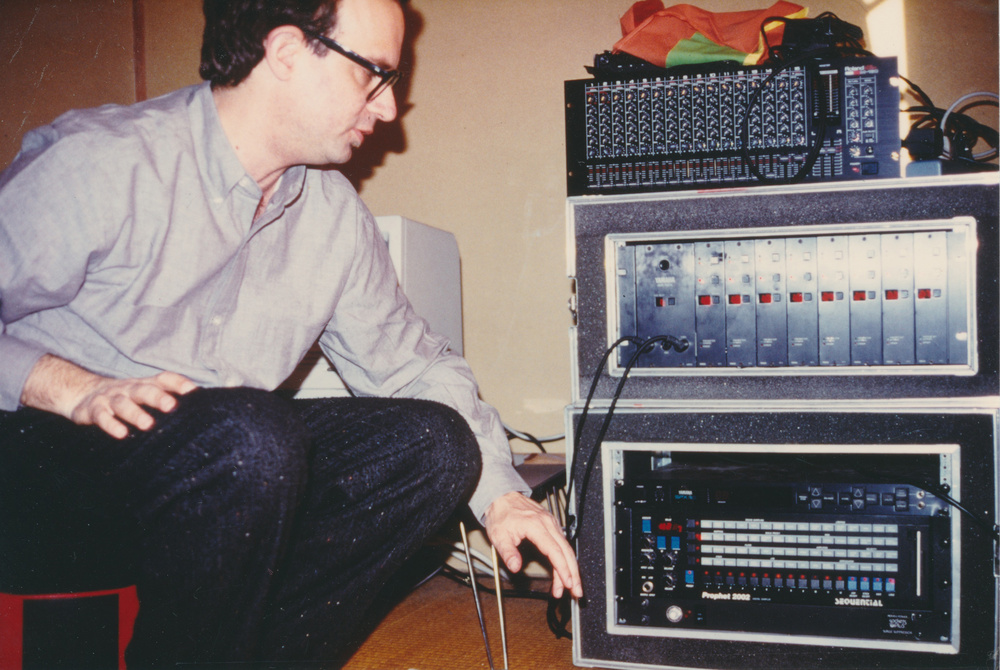 In 1989 Carl Stone’s studio and performance setup was based around an Apple Mac running an early version of Max, a Sequential Prophet 2002 sampler and a Yamaha TX816 synthesizer.Photo: Shunichi Kurita
“I thought that they had just sort of come sui generis out of nowhere, but Subotnick scolded me and said, ‘No, no, no, Philip Glass studied with Nadia Boulanger in Paris and Steve Reich studied with Milhaud at Mills. They came from a trained, educated, classical background. This did not come out of nowhere. This came as a reaction.’”
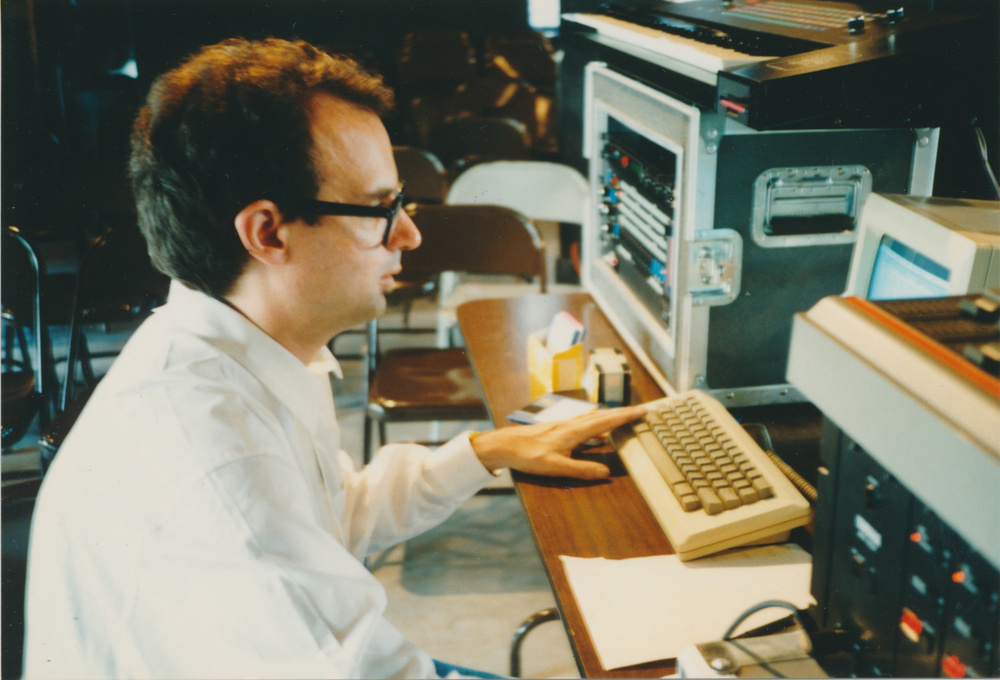
Interestingly, Stone’s education unfolded as much through chance encounters and curiosity as it did through formal study, but what proved equally transformative was an extraordinary immersion in music from across the globe. It’s inspiring how an unassuming student job became the unlikely foundation for his distinctive approach to sampling and collage.
“When I became a student at CalArts, I was originally rejected by Subotnick, but he let me use the studios anyway, and I did good work. And he noticed. And then when it came time to limit the number of users for the studio, because it had been open to everyone, they pared it down to just 12. But I was on the list even though I wasn’t a student, so they had to make me a student.
“Subotnick’s first impression of me was that I was very green, and that I hadn’t had any exposure to music other than the freeform radio of the ’60s that I had been listening to. It was true that there was a lot of music that I hadn’t encountered and my world view was kind of constrained. He found a number of clever ways for me to come to music and experience a very broad swathe of creativity both in Western music and non‑Western music.
“He helped me get a job at the library at CalArts. They had a great LP collection and a lot of rare stuff from all over the world and they wanted to preserve it, but they wanted students to have access to it. They knew that they would eventually get broken or chipped or stolen or scratched or whatever, so the idea was to dub every LP in the library collection, tens of thousands, onto cassette.
“I quickly realised that if you were to try to dub one record at a time serially it would be like Sisyphus, you know, it would never end. So, they set me up in a room with three turntables and three tape recorders, and the idea was just to keep three rolling all at the same time. And you could monitor any one of them, but you could also monitor two or more, and that’s what I got into doing. I’d have a string quartet on one turntable and some Pygmy music from Central Africa on the second turntable, and maybe some electronic music from the Institute Of Sonology in the Netherlands on the third.
“I would sort of do this mixing and notice the connections and do mash‑ups. I didn’t think of it as composing at the time, but it had a big influence on my work, which is all about combinations of disparate material.”
1024 Harpsichords
Stone’s work focuses on tiny gestures and fleeting sonic details that are stretched and reimagined until their origins become almost incidental. Familiar sounds dissolve into intricate rhythmic webs or shimmering harmonic textures, creating music that constantly hovers between recognition and surprise. I was keen to find out what tools he had at hand to begin creating his own compositions at this time.
“Upon...
You are reading one of the locked Subscribers-only articles from our latest 5 issues.
You've read 30% of this article for FREE, so to continue reading...
- ✅ Log in - if you have a Digital Subscription you bought from SoundOnSound.com
- ⬇️ Buy & Download this Single Article in PDF format £0.83 GBP$1.49 USD
For less than the price of a coffee, buy now and immediately download to your computer, tablet or mobile. - ⬇️ ⬇️ ⬇️ Buy & Download the FULL ISSUE PDF
Our 'full SOS magazine' for smartphone/tablet/computer. More info... - 📲 Buy a DIGITAL subscription (or 📖 📲 Print + Digital sub)
Instantly unlock ALL Premium web articles! We often release online-only content.
Visit our ShopStore.