

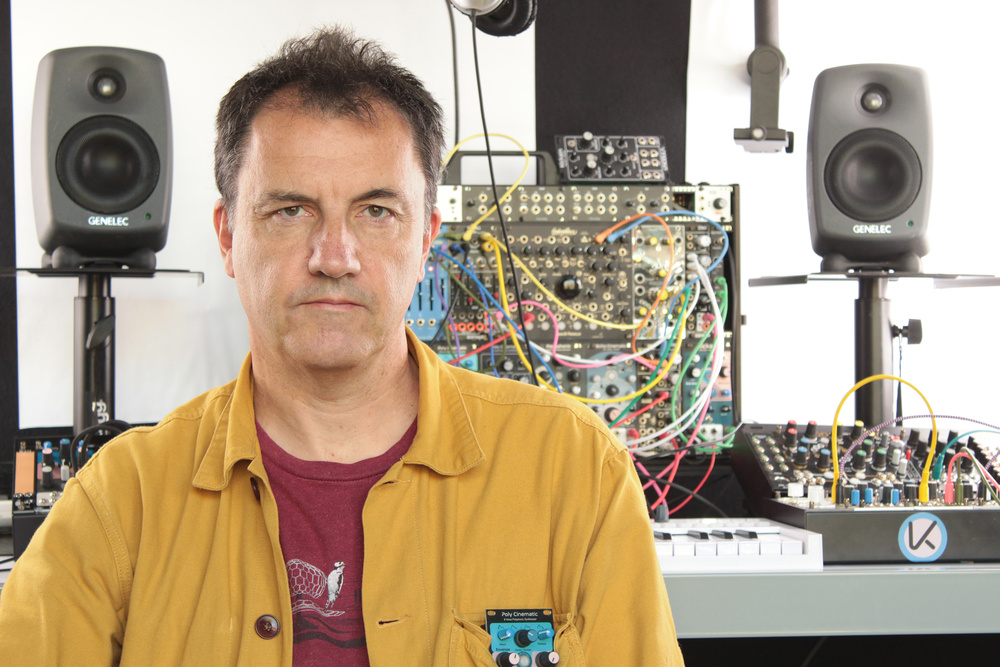
Jason Mayo’s company Knobula is far from his first adventure in the world of music and production. As a producer and founding member of the band F.A.B. during the 1990s, he produced numerous remixes and collaborated with the likes of Adam Freeland, Layo & Bushwacka and Neneh Cherry; it’s the same creative zeal that would eventually lead him into the world of module design, with a maxim dictating “no screens, just big‑screen sounds”.
On his entry into modular
Aged 14, I built my first synth from a kit: a Powertran Transcendent DPX electronic piano. It took months to assemble, sounded terrible, and taught me a whole lot about synth design! By the ’90s I was buying ready‑made synths, working as a music producer from a studio in Ladbroke Grove. Doepfer’s new modular system was top of my wish list, but starting a family soon changed my priorities and I swapped the studio life for a steady career in computer animation. Years later, I stumbled into Moog Music in Toronto and had an epiphany. After years of making music on a DAW, I’d lost some of my enthusiasm for it. Eurorack now offered me a hands‑on route back into music production, and suddenly I was inspired again. I returned to London, bought a case and filled it with a great set of modules, and I’ve never looked back.
On his go‑to modules
I design modules primarily for my own needs, so Knobula now dominates my rack; two Monumatics for lead and poly voices; two Drum Farms for hats, snares and percussion; Echo Cinematic for dub delay effects. I also love ALM’s Tyso Daiko and the TINRS [This Is Not Rocket Science] Wobbler2 for pure, hands‑on percussion synthesis. They’re both uniquely quirky and enjoy being modulated by Timo Rozendal’s Automator, a very precise knob recorder featuring a full‑size DJ fader. I use 1010’s Bluebox hooked up to a 32‑knob Shik [MIDI] controller, set up as a custom seven‑channel mixer with high‑ and low‑cut EQ, effects send on each channel and a compressor on the main output. Finally the whole mix passes through Kickain, which adds a kick drum and side‑chains the stereo mix around it. I also like to leave room in the case for a guest module or maybe a prototype I’m working on.
On the story of Knobula
When Covid hit in 2020 I was suddenly out of work. I decided it was time to make synths again. Combining my coding skills from computer animation, the soldering skills I learnt as a teenager and my background as a music producer, I began designing Eurorack modules that I needed but didn’t yet exist: a dub delay with integrated EQ, a fully polyphonic synth voice with MIDI, all with lots of knobs but no screens. I soft‑launched the synth voice, Poly Cinematic, hoping to sell a few spare units I had made. Within a week I had 300 back orders. It was a baptism of fire and I had to form a company overnight. I had grown up around my father’s business, which made electronic equipment for the food industry. Knobula came much later, but I like to think of it as an unexpected continuation of his legacy.
On the Drum Farm
I had this idea about building a drum module that could self‑generate its own drum library; wouldn’t it be great if we could create sample sets using only CVs and gates? And to play the results back on a playback module like the vpme.de Quad Drum. So I set about developing a sound generator with a sampler, and it sort of evolved from there through various conversations with other modular users, including Vlad [Pantelic] at vpme.de, which is why our sound libraries are compatible. The hardest challenge was to design a sampler without a screen; I wasn’t going to break our ‘no screens, no menus’ philosophy and the user experience of Drum Farm definitely benefits from this — it keeps you in that flow state. The other challenge was coming up with 16 drum algorithms.
After the success of Kickain I had intended to build a series of drum modules to complement it: snare, hi‑hat, clap, etc. In the end I just thought, let’s gift them all into one mega module. Developing the sounds alone took over a year, but it was a fun journey, I didn’t want to do the typical drum machine line‑up, although I did include perennials like the 909/808 snares, hats and claps, but with my twist on them. I also wanted to debut some new sounds, like the Double Shaker, which has two separate forward and backward elements, and add some quirks to traditional sounds. For example, on the Drum Farm Hat 808 model, the hi‑hat can morph into a cowbell because on the original 808 both circuits shared the same oscillators. Finally I wanted to include a factory library: I rented about 30 drums and sampled them in various acoustic spaces, also I had some great contributions from Starsky Carr — who has an insane drum machine collection — and Nadia Struiwigh, who created these beautiful ambient and techno samples.
On the culture of modular
Each year I visit Superbooth in Berlin I’m reminded of the wonderful diversity of people who enjoy owning modular synthesizers. It is like we all knowingly share this secret about how electronic music should really be made, and more importantly how the experience is so enjoyable. It’s really the antithesis of modern tech culture insofar as you can’t save or undo your work, so you value the moment and there are no monthly subscriptions. It’s not corporate or competitive; there’s lots of camaraderie between manufacturers and also a close relationship between them and the end users. How often can you buy a product nowadays and email the designer for tech support or request a feature?