

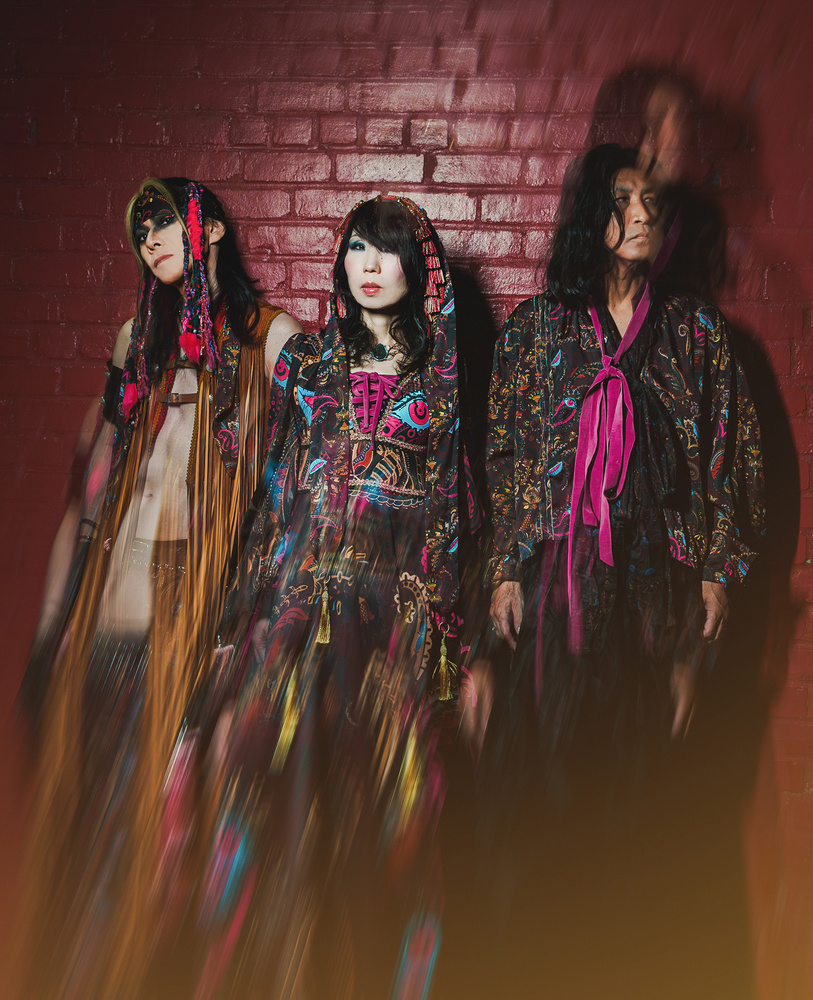
 Photo: Ekaterina Gorubacheva
Boris are among the most important Japanese rock bands of the last two and a half decades. Known for their mammoth guitar tones, explorative albums and staggering live shows, their records are entirely self‑produced. Band member Takeshi’s responses were translated by Greg Mudarri.
Takeshi: From the get‑go we pretty much kept recordings of most of our jam sessions and live shows. So we come across tapes of stuff that are so old, we ourselves don’t even remember them!
At the moment I can’t stop listening to
Recently I haven’t really been listening to music. Of course, I do check out new artists and music from time to time, but I just don’t have the time to the extent where I can really get into something. We are so busy with work, arranging our audio archives and preparing to make new material that ultimately it sort of becomes a situation where we’re only listening to our own music! But, to be clear, we’re not listening intently to stuff from our past just for nostalgia. It’s a spark, to create something new. We’ve been a band for so long. From the get‑go we pretty much kept recordings of most of our jam sessions and live shows. So we come across tapes of stuff that are so old, we ourselves don’t even remember them! In that sense, recently there have been a lot of new discoveries. There is also the technology now that allows us to realise some things that weren’t possible in the past, but there are still a lot of things left undone, within us: a lot of music that we still have to make together.
The artist I’d most like to collaborate with
I’ve said this in many interviews, but I can only say that our encounters with all of the bands or artists we’ve collaborated with thus far have truly been fate. Sometimes these collaborations start from an inevitable, supernatural ‘chance meeting’ course of events, and others are naturally fostered out of a long‑term relationship of mutual respect and regard for one another. Collaboration is meaningful precisely because it’s not a one‑sided approach, and I think that’s what gives it validity. It means our collaborators — and we ourselves — are able to have an objective, bird’s‑eye view when it comes to looking at or listening to Boris, which can become a pretty significant indicator of what our next work might be like. Until the next fate moment comes, we ourselves don’t even know who we’ll collaborate with next!
The first thing I look for in a studio
The studio we use is the same one we’ve been using for many years, where we bring in our own instruments and recording equipment, so technically speaking there is really nothing in particular we look for. It’s a very finely tuned process at this point. I think that each member’s mood at the time, understanding what each other is thinking, is the most important thing, I suppose. For the most part, we make songs from studio jam sessions, but there may be a key word or phrase that becomes a theme, something may emerge from guitar pedals and such, something that we’ve newly added to our setup... The joy in creating something out of these elements makes our time in the studio very meaningful. It can be a challenge, bringing all of our own equipment in, but once we’re assembled in the studio and producing a huge sound, it’s great. We’ve been self‑recording for decades at this point, so we have no need to be concerned about the presence or opinions of a third party [producer].
The person I would consider my mentor
In my teenage years I listened to a lot of punk and hardcore. That influenced me the most. And among that music it was a guitarist called Zigyaku, who led the bands Gudon and Bastard, who was the biggest influence on me. Some years back, I had the pleasure of interviewing him, and I could really identify with his way of thinking and his way of life. Even though he is not a technical player by any means, he’s the person who taught me that the most important thing is to play a song with the utmost feeling. In my most impressionable years, it was his riff work and tone that I copied the most. Sometimes he comes to Boris shows, and I still feel nervous playing in front of him.
My go‑to reference track or album
In my case, the sound I want to make depends on my mood at that time. I don’t have a specific reference for sound or tone. If I use something as a reference, it tends to lead me to an ambiguous tone quality while unconsciously trying to get close to that reference — and besides, for a long time I’ve had the same equipment and same playing style, so if it’s always the same then it just means that it has become my sound!
Whether it’s in studio jam sessions or shows, my reference is that first surge of Wata, unleashing her guitar sound. That’s first and foremost. If her guitar isn’t huge, we can’t get started. With that focus on Wata’s guitar, we let the other instruments find their sound: how we should play them and sing. Because generally speaking, a huge guitar sound is undeniably cool.
My secret weapon in the studio is
Probably my modded Boss MT‑2 Metal Zone. I commissioned the mod from the same place that built the custom loop switcher incorporated in my pedalboard, Soul Power Instruments (or SPI). It’s just a small, one‑man‑operated workshop based in my hometown in Shizuoka, but he’s an extremely reliable source for any modification orders.
The SPI loop switcher itself is also something that likely no other musical equipment maker would build. It just has a unique circuit and specs — I’d consider it another secret weapon, but I do really love my SPI Metal Zone mod! When people request mods, their usual requests are “Make the sound hi‑fi” or “Improve the functionality”, or the like. But I wanted to transform the Metal Zone into a noise machine, so I got him to modify it so that it can produce just the most extreme, heinous sound possible. Other equipment makers might usually shy away from an order like that one, but he really took it in his stride — and with amusement! So it’s thanks to SPI that that became the ultimate noise pedal. You just need to add some reverb to that very finely detailed texture of noise and distortion from the Metal Zone mod, and suddenly you’ve reached the underworld. The element of noise in Boris songs always ends up being pretty important. So I can’t be without that pedal.
The studio session I wish I’d witnessed
I’m really interested to know what the circumstances around recording Earth’s Earth 2 were like. I’ve met [guitarist and Earth founding member] Dylan Carlson many times, and Boris have toured with Earth before. But I’ve never had the chance to hear about their past recording sessions. That album had a big influence on me. With its grand legacy in drone metal, it still feels as fresh and relevant as ever. I wish I could have laid on the floor of that recording studio, and let the waves of guitar drone coming out from the mega‑loud amps just wash over me.
Additionally — and this isn’t a studio session — but I wish I could have been present at the live show by the Melvins that was recorded and released as Your Choice Live Series Vol. 12. That was in 1991 and just had the perfect set list. Their sound and their performance were possessed with this feeling of tension — the Melvins have truly been a monster since that era.
The producer I’d most like to work with
Well after years of self‑recording and self‑producing in the same way, we don’t really have any renewed desire or anything like that to work with a producer. We have worked on post‑production with musicians who influenced us and with whom we’ve had deep friendships, like Shinobu Narita of Urban Dance and SuGar Yoshinaga of the band Buffalo Daughter. And sure enough, because they are vigorously active right at the forefront of what they do, their outlooks and capabilities had shown through. The way they shared their aesthetic sensibilities regarding sound from a musician or band perspective, the speed of mutual understanding, was truly remarkable.
Rather than producing or being produced, that sense of making an album together was really wholesome, and I think it’s the ideal way to make an album. In the future, even if we meet someone new who we could build a relationship of mutual trust with, I’m pretty sure we’ll still continue with our method of handling everything ourselves, without completely entrusting everything to someone else.
Takeshi: Somehow there is always a new discovery, every time we’re in the studio: something to be learned.
The studio experience that taught me the most
Somehow there is always a new discovery, every time we’re in the studio: something to be learned. It may be something trivial, like finding a new functionality in a pedal I’m using. Well, I guess I should say that it’s important to read the manual before using a pedal! But, I’ll arbitrarily fiddle with something and get it set up, and there are times when I suddenly realise a hidden — or not really hidden — useful function which then has a positive impact on the song or my playing.
When recording, we’ll of course change up the position of mics or amps, try various drum sizes or heads, things of that nature. I never learned any proper music theory or recording techniques from anyone, so it’s just a repetition of trial and error through my own ability and self‑study. In other words, I’ve made it this far without using equipment the ‘normal’ way, or without knowing that techniques I’ve used would be considered taboo in an ordinary recording situation. But anyway: it is better to read equipment’s instruction manuals before use.
The advice I’d give myself of 10 years ago
To myself 10 years ago — who, after repeated physically and mentally demanding long‑term tours, always pondered at the end of each one, “How many more years? How much longer will this continue?” Unfortunately, 10 years later, your touring will further increase pace. But do not worry. There will be no major accidents or injuries, and everyone is healthy. You will be able to visit countries and cities you’ve never been to before while on tour, and try cuisines you’ve never experienced before, and enjoy local beers. You’ll gain new fans and new friends and spend very full days. However, cranking out a huge sound is good and all, but don’t neglect taking care of your ears. And you’ll have twice as many amps, so train your lower back. Many people will continue to support you from here on out. So, have peace of mind. And continue to make riffs.