

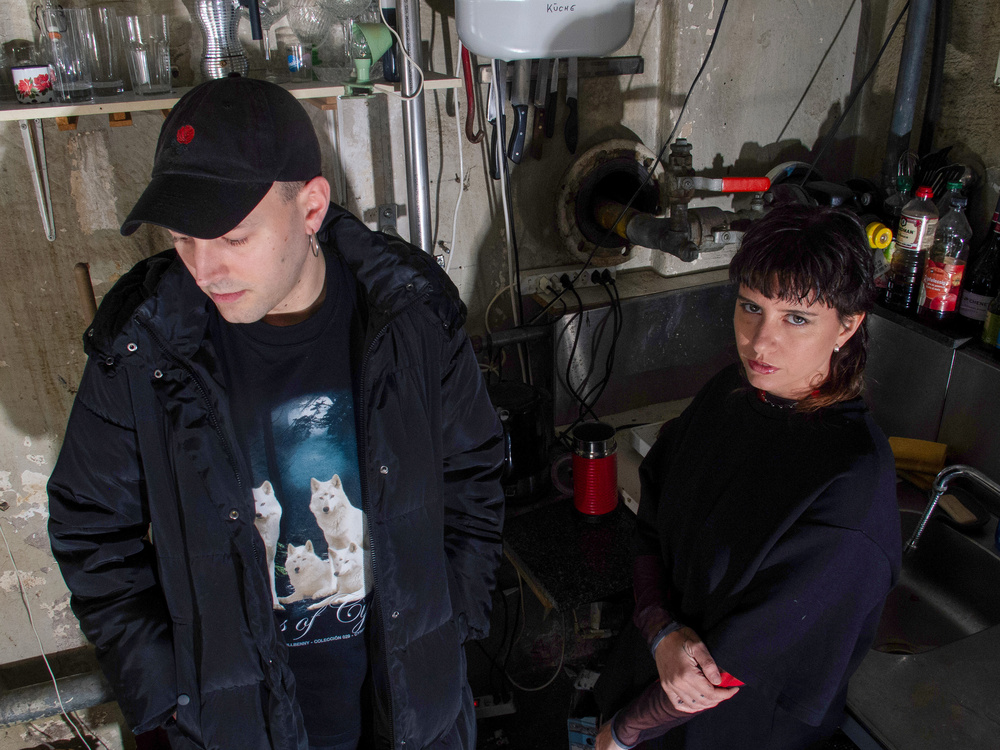
 Photo: Binta Kopp
Argentinian cellist, improviser and composer Violeta García and Swiss musician and composer Hora Lunga have recently released their second collaborative album, titled 4ever. The duo’s unique electroacoustic palette is unsettling and beautiful in equal measure.
At the moment I can’t stop listening to
Violeta García: Asociación Juvenil Puno Sicuris 27 De Junio. It’s an album by a group founded in Lima in 1970, by university students originally from the Altiplano [a plateau in west‑central South America]. They primarily perform the traditional sikuris style of the Altiplano, playing panpipes in large ensembles using the hocket technique, where each musician plays only part of a melody and the full line only emerges when the parts interlock together.
Hora Lunga: alma blindada by nudo. I’ve read that they work a lot around the topic — and the musical world — of the US‑Mexico border, and I find it fascinating how much of that is in the music but in this very fragmented way. I like how all these different references, samples and genres sort of collide without being explained or completely resolved. There’s also something about the production, the distortion, the way things suddenly shift, that I find really inspiring.
The last studio item I bought
VG: The Roland SP‑404 MkII. I wanted to start composing and improvising with sampling, so I decided to explore the classic SP‑404, an instrument that has been central to sampling culture for years. At the moment I’m using it mainly live with my band Blanco Teta, feeding it loops, textures and found sounds that I then trigger and manipulate on stage. I am still getting to know its logic, but I already love how physical and immediate it feels compared to working on a computer! Little by little I’m starting to bring it into my solo compositions as well, thinking of it as a tool for building rhythm out of sampled and processed material.
HL: I haven’t bought any proper gear in a while. I recently got a Boss wireless footswitch for my live set, which has actually been really useful, but the very last order was six patch cables from Doepfer! So, not very exciting. I think I’ve reached a point where I’m much more interested in small things that make the setup or workflow easier.
The first thing I look for in a studio
VG: The smell and the energy of the room. Of course, after that, the microphones and the technical setup! But for me the space itself has to feel special enough to actually connect with the crew and properly record the kind of music I compose. As a woman working in this field, I have to say I have not always had comfortable experiences in studios, sometimes the energy in the room, or the way I am treated by the people running it, makes it harder to feel comfortable and chill. So when I look for a studio now, I’m also looking for a place where I can trust the people I’m working with.
HL: The vibe, definitely. I’m really not that interested in gear. For more intense work there are some workflow things that matter to me, like that I’m able to record with just a few clicks and that everything is already connected. That I don’t have to think too much about the technical side. And of course I care about how a room sounds. But mostly it’s about how I feel in there: if I actually want to spend time in the room, if I can imagine staying there for a long time, and if the space has some kind of character. If it’s too clean, too controlled, it can make it harder for me to work.
The person I would consider my mentor
VG: Genosidra‑Carlos Quebrada. He plays bass in Blanco Teta with me, and he also runs the experimental music label TVL, which we actually co‑manage together. We’re like family. We have known each other and made music together since we were 18 years old, and over all those years have built a language that lets us understand each other almost instantly — in the studio and on stage. He is one of the most inspiring and curious artists I have close to me, always exploring new textures and ideas without any fear. On top of all that, he is a fantastic DJ and producer in his own right, always pushing his own sound forward mixing experimental music with club and traditional music from Latin America.
HL: I don’t really have a mentor, in the classical sense. If I had to drop a name, maybe [Swiss saxophonist and electroacoustic musician] Tapiwa Svosve. I’ve learned a lot from watching how he integrates musically into different situations, but also vibe‑wise, how he reacts to people and to the room. I found that really inspiring.
My go‑to reference track or album
VG: It feels completely crazy to have to give only one track or album as a reference. I honestly don’t think I have a single one, but lately I keep coming back to Dreamcrusher, ‘Fever’. I really love the way the project mixes noise, harsh distortion, screamed vocals and melodic composition all at once, without ever losing intensity. It feels chaotic and controlled at the same time, and that balance is something I’m always chasing in my own work too, moving between abrasive noise and moments of real melody.
HL: It really depends on what I’m working on. But something I definitely come back to are Mica Levi’s solo albums. There’s a lot in the way they sound that I find really interesting: how close and raw some things feel, but also how strange and detailed the production can be. I keep noticing little decisions in the arrangements, the processing, just how much space certain sounds are given. But yeah, that’s true for pretty much everything they produce. There’s always something in there that makes me listen again.
My secret weapon in the studio is
VG: My secret weapon is honestly my home studio itself! I love experimenting there. One thing I keep coming back to is processing the cello through different synths, distortion pedal chains or no‑input techniques, turning the acoustic sound into something completely transformed and unrecognisable. I also love spending hours inside Ableton, discovering new sound‑design methods using Operator and different native Ableton plug‑ins, pushing simple sounds into strange new textures. That combination of an acoustic instrument and deep, patient digital processing is where a lot of my own sonic identity comes from.
HL: Probably compressor chains. I use compression a lot, on individual sounds, on groups, on effects: basically everywhere. I like stacking compressors that all do slightly different things, sometimes very subtle, sometimes pretty extreme. At some point it becomes less about controlling dynamics and more about shaping the sound, the movement and how everything sits together. I also like that it can make very different elements feel somehow connected, even if they come from completely different sources.
The studio session I wish I’d witnessed
VG: The White Album by the Beatles. I know: maybe a bit of a classic choice on my side, but I do wish that so much anyway! I still remember when I was super young and heard The White Album for the very first time, and all the emotions and feelings that came with it. It felt like discovering a whole universe of contrasts inside one record, from tenderness to total chaos, and I would have loved to be in the room while all of that was being invented, argued over, and recorded. Four such different personalities all pulling the songs in different directions.
HL: Any session with Lee Scratch Perry. There’s some footage of him working at Black Ark on YouTube, and also interviews with him and people around him talking about how he worked, and I think I could watch that forever. I find the whole approach really inspiring, because it seems so much about flow, intuition and reacting to what is happening in the room, rather than following a fixed idea of how a recording should be made. And then there’s obviously the sound itself, which is just insanely good. I would have loved to see how all those decisions actually happened in real time.
The producer I’d most like to work with
VG: Arca. I would love to record a song together where she produces the sound design around my cellos, taking that sound into other musical genres I don’t usually get to explore in my own work. To me she is one of the most special, unique and creative producers and composers working in Latin America today, someone who is constantly reinventing what production and live performance can even mean.
HL: Mica Levi! I really like how they produce things without making them feel overly produced, if that makes sense. There’s often something very raw and direct in the sound, but at the same time the decisions are incredibly precise. It can be orchestral, super‑reduced, noisy, pop, very digital or almost falling apart, and somehow it all makes sense. I also work in quite different contexts myself: with bands, duos, solo projects and ensembles, for film and stage, so I think that exchange would be especially interesting to me.
The studio experience that taught me the most
VG: I’m thinking of my last two records: IN/OUT and a still‑unreleased one. Site‑specific album recordings, outside of traditional studios. The possibility of recording and composing to actually play with the architecture of a space, rather than against it, taught me so much. I had to learn the acoustics of each place almost by ear, and through that process I discovered new sides of my own instrument that I hadn’t found in a closed studio room. I also loved being able to capture how the whole surrounding environment sounds, letting the space itself become part of the composition instead of just the backdrop for it.
HL: I think working with my ensemble WIRREN taught me the most. Musically, how to deal with decisions, but also personally: working with a big group, with space, with different ways of listening and reacting. I’m pretty much a computer‑producing kid, and the ensemble is kind of the opposite of that, so it forced me to think about production in a much more physical way. When we mixed the recordings, we actually had to do very little in post, because most of the studio work had already happened in the room.
Violeta Garcia: Nothing is as important as you think it is, and honestly, nobody cares about it as much as you do.
The advice I’d give myself of 10 years ago
VG: Nothing is as important as you think it is, and honestly, nobody cares about it as much as you do. Ten years ago I was dreaming of having exactly the life and the career I have now, and somehow that dream actually came true, so I would tell her not to stress so much about the small stuff along the way. Maybe I would also tell her to exercise more, drink less alcohol, and eat a bit better.
HL: I think I would tell myself to put free days in the calendar and take them as seriously as studio days, rehearsals or deadlines. I’ve always been quite good at filling every empty space with something: another project, another session, another thing that somehow feels urgent. For a long time I probably thought that being busy also meant that things were going well. Now I think having actual time off is just as important. So yeah: don’t wait until you’re completely exhausted before deciding that you’re allowed to do nothing.