

I found this by accident, and for a long time I thought I was doing it wrong.
I was working on a feature film, building atmospheres for scenes where nothing happens on screen but the pressure has to keep growing. Four men in a room, talking. No action. All the tension had to come from underneath.
I had a synth pad going into a big reverb and it sounded fine. Clean, wide, professional. And completely dead. It sat behind the scene like wallpaper. You could remove it and nothing would change.
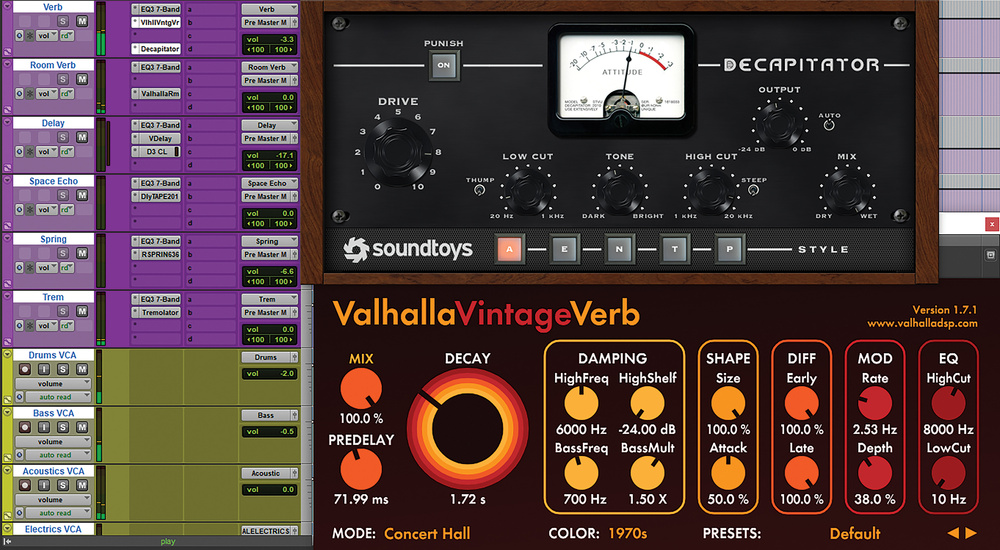
So I started moving things around in the chain, and at some point I put the saturator before the reverb instead of after. I think I did it by mistake. But the sound changed completely.
Here is what happens. When you saturate after the reverb, you are distorting the whole thing — the source and the tail together. It gets louder and dirtier, but the shape stays the same. When you saturate before, you are feeding the reverb something that has harmonics in it that were not there before. The reverb then builds its tail out of that material. The tail gets warm. The edges get rough. It stops sounding like a room and starts sounding like a substance.
That difference is small if you listen to the sound alone. In a film it is everything. A clean reverb tail tells the audience where they are. A dirty one tells them how to feel.
I use it most on pads. A simple patch from a microKORG or a Roland JU‑06 — nothing special, just a slow evolving thing — into a saturator, then into a long reverb with the pre‑delay automated. The saturation gives the tail a body that a clean reverb never has. Then the automation moves the perceived distance while the note is still ringing, so the space keeps changing but the listener cannot identify what is moving. That is exactly what you want in a scene where somebody is about to do something bad.
I do the same with guitar. Distortion first, then reverb. Not the amp‑in‑a‑room sound — something in between a guitar and a texture. It stays physically present, but you stop hearing it as guitar. In the mix it functions as atmosphere while still having the weight of a real instrument.
A clean reverb tail tells the audience where they are. A dirty one tells them how to feel.
The order matters more than the plug‑ins. I have done this with expensive saturators and with free ones, and the character of the effect is more or less the same. What matters is that the reverb receives harmonic material rather than generating a tail from a clean signal. Any decent saturator will do it. Some tape emulations do it very well because they also soften the transient, so the pad enters without an edge.
One warning: it eats low mids very fast. If you have a full arrangement, you will find your atmosphere fighting the bass and the kick before you notice it. I usually high‑pass the saturated signal and keep a clean version underneath for weight. On a film mix, where dialogue owns the middle, you have to be even more careful.
I still hear people say saturation goes at the end of the chain, as the final colour. Sometimes it does. But putting it at the front turns it from a finishing tool into a compositional one. You are not making the sound louder or dirtier. You are deciding what the reverb is going to be made of.
That is the part I like. Most of the time in sound design you are choosing between things that already exist. This is one of the few places where you can change the material itself.