

If you caught my feature in the September 2026 issue on integrating Eurorack into the wider studio environment, you might remember me mentioning the new LEQA from 4MS. An EQ‑compressor combo designed to add punch and polish to your patch à la top‑drawer outboard, it’s the type of thing that promises to make a patch sound like a track. The prospect of being able to apply that in a purely modular environment is, for me, an exciting one.
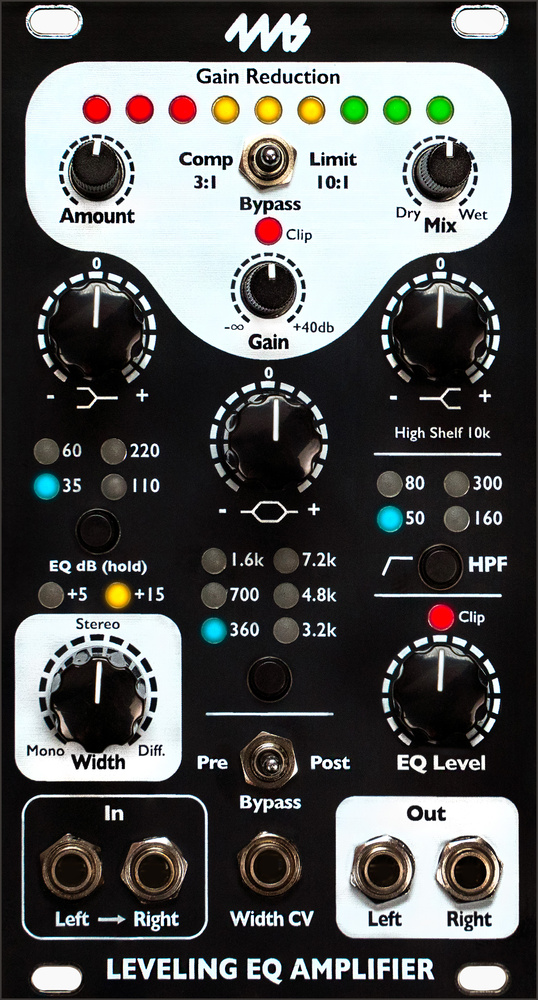
Measuring a modest 14HP, the LEQA offers a compressor, an EQ and a stereo width section. The EQ and compressor both have bypass switches so the LEQA can be used as either one or the other, and there is also a switch to place the two in either order, which — as anyone even remotely interested in mixing will know — is very handy indeed.
The world of synthesis is one where clones and throwbacks to classic designs abound — ‘Moog‑style’ ladder filters and so forth — so it’s actually rather refreshing to see an alternative school of emulation enter the picture here, rarely seen in Eurorack: the LEQA’s EQ is based on the Neve 1073, while its compressor is based on the Teletronix LA‑2A. If you’re a user of the 4MS MetaModule, those might sound familiar to you: an EQ and compressor based on the very same is also available in MetaModule’s Producer Pack of plug‑ins as the 70sComp and 70sEQ. The overlap between the algorithms at work in this digital module and the ones in those is unconfirmed. But fair to say that even if you do already have access to those, part of the appeal of the LEQA is its choice features and its workflow, designed, in short, to help you make better decisions.
...the LEQA’s EQ is based on the Neve 1073, while its compressor is based on the Teletronix LA‑2A.
In this respect its options are, depending on where you stand, either limited or streamlined. I generally prefer the latter: since modular is so replete with choice, I tend to welcome a little tradition‑steeped guidance.
The two main sections emulate their forebears with reasonable accuracy: the EQ has the same choices of frequency response per band as the 1073, although worth noting is that the high shelf is fixed at 10kHz instead of the 1073’s 12kHz. A hugely useful inclusion here is the option to switch the gain range for each EQ band between ±5dB (better for careful adjustments) and ±15dB (better for broad‑brush tonal shaping). An EQ Level knob allows for holistic adjustment of the section’s output, meaning it can push harder into the compressor or act as a master volume, depending on how the two are ordered.
The compressor’s controls, meanwhile, will also be fairly familiar to those who know the LA‑2A: there’s a choice of two ratios in the form of 3:1 (‘Comp’) or 10:1 (‘Limit’), there’s ‘Amount’ (that is, threshold) and there’s ‘Gain’; a counter‑intuitive label in my opinion, as it works on the output and not the input of the compressor. But we’ll allow it since the original LA‑2A’s Gain knob does the very same. This, alongside EQ Level, makes for a two‑stage gain structure in the LEQA which is mighty useful.
As with its EQ, the LEQA’s compressor occasionally deviates from the path of pure emulation. I very much welcome the presence of an actual LED array to indicate the compression amount — it’s not only highly useful but lots of fun to watch pumping away in my system. There’s also a wet/dry knob to allow for variable parallel compression, which in my opinion is an excellent inclusion since it opens up the starker 10:1 ratio setting to far more applications than it might have otherwise. The LEQA’s Gain knob has a useful LED of its own to indicate clipping; it’s certainly possible to punish this a little and achieve some very nice saturation effects and, with the option to place the EQ after the compressor, shape the tone of that saturation, too.
The bipolar Width knob essentially implements a combination of the delay‑based Haas effect and Mid‑Sides processing to achieve its ends: fully anticlockwise, the left and right channels are summed to mono, with the middle position representing default stereo. Fully clockwise, the Sides component is turned up and a delay applied to one side of the stereo signal, for ‘super stereo’ width. The delay element means it can be used to stereo‑ise mono signals, which is useful, but more creative is the fact that this parameter also represents the module’s sole CV input, so it’s possible to give signals an undulating sense of movement though the stereo image: use an envelope to make the reverb on a drum sound explode outwards, for instance, or send the steps of a sequencer to it to have a melody dance around the stereo field.
From its look to its sound, this neat package leaves little to be desired.
Admiration
One thing I very much admire about the LEQA is that each of its three sections offer subtle, moderate or quite extreme degrees of processing. In this respect it by no means has to be placed at the end of your patch, although to this end I would like to have seen the option to unlink the left and right channels, which apart from anything else would have allowed the LEQA to be used as two mono compressors in parallel. But aside from this, there isn’t much else one could want from a module like the LEQA. There are all manner of designs out there that do what it does to various degrees and in various combinations, but from its look to its sound, this neat package leaves little to be desired. Approve.