

EFNOTE keep it real with a fresh approach to electronic drums.
EFNOTE may be a comparatively new name in electronic drums, but this Japanese company have built a reputation for stylish, premium kits that place equal emphasis on appearance, playability and functionality. Founded in 2018 by former ATV and Roland engineers, Efnote have quickly positioned themselves as a serious alternative to longer‑established rivals, with a focus on realistic shell sizes, responsive cymbals and streamlined operation.
The Efnote 7 sits towards the top of the company’s standard line‑up. With large‑diameter shells, substantial cymbals and a compact, touchscreen‑based control module, it aims to bridge the gap between the feel of an acoustic set and the convenience of an electronic one. It also enters a highly competitive price bracket alongside established options from Roland and Yamaha.
So will the Efnote 7’s emphasis on playing experience and visual appeal be enough to distinguish it in a market where control module features, connectivity and long‑term flexibility often matter just as much?
Keeping It Real
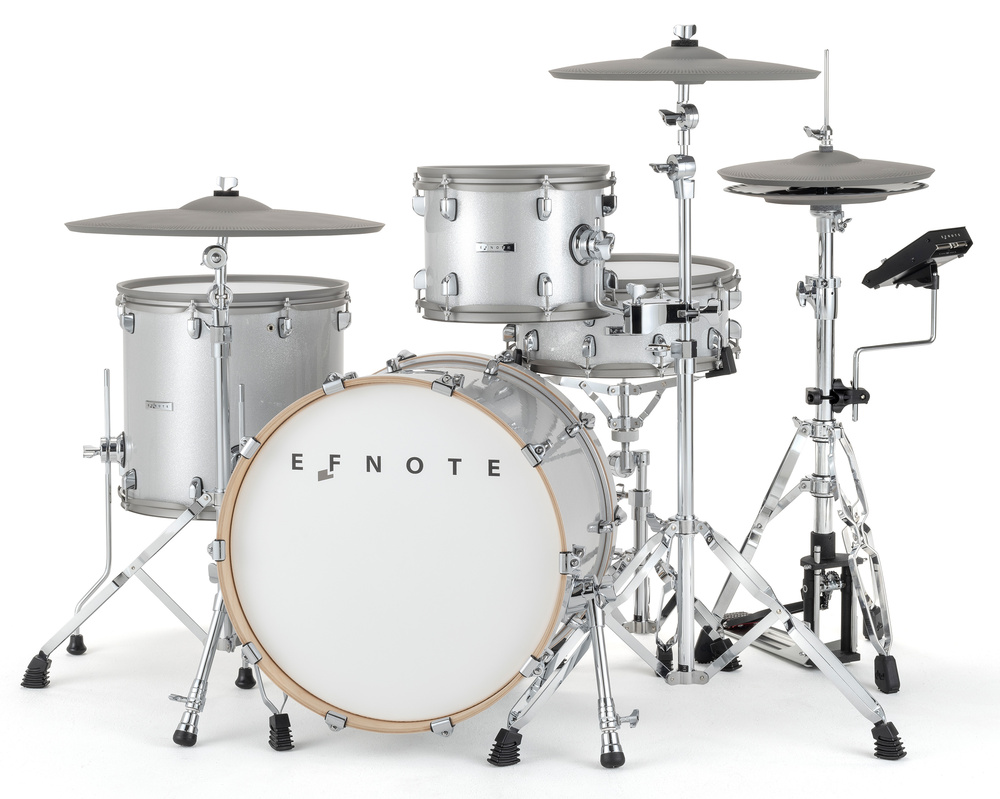
One of this brand’s strengths is presentation, and the Efnote 7 certainly makes a compelling first impression. Shipping as a standard four‑piece kit, it has a shell configuration that includes a 20‑inch bass drum, 14‑inch snare, 11‑inch rack tom and 15‑inch floor tom. All the drums are constructed from birch, which, while largely a redundant factor on an electronic kit, does add a reassuring sense of weight and quality. The tom sizes are also slightly larger than those found on Roland’s VAD516, and the Efnote 7 projects a noticeably bigger overall presence, with a sense of scale that exceeds what a modest increase in dimensions alone might suggest.
The 14 x 5.5‑inch snare mirrors the size and visual aesthetic of a traditional acoustic snare, with its 10‑lug design featuring both top and bottom heads. A fully adjustable side‑rim trigger is fitted to the top right of the drum, and neatly follows the contour of the hoop. Connecting to the control module independently from the snare, the rim trigger allows for side‑stick articulations to be played in a very natural way.
The 20‑inch bass drum likewise has the dimensions and build of a standard acoustic kick drum, and features a full mesh head on the batter side, rather than the centrally mounted trigger pad found on the Roland VAD series. Incidentally, the front head is a standard mylar resonant type, which gives the drum a natural resonant ‘boom’ when played, to the point where it benefits from acoustic‑style dampening. All the drums are finished in an attractive white sparkle wrap, which harmonises with the grey hoops and grey rubber rim guards and gives the kit a very professional look.
The cymbal complement is equally substantial, with 14‑inch hi‑hats, a 16‑inch crash and a 20‑inch ride contributing to the sense that this is intended as a premium instrument. The optical hi‑hats have a two‑piece design, mount on a standard hi‑hat stand, and are equivalent in size to their acoustic counterparts.
Both the crash and ride cymbals offer 360‑degree multi‑sensor play/choke ability, which, in practical terms, means that you can hit them or grab to choke anywhere around the circumference. In addition to the edge and bow triggers, both cymbals can add a bell‑zone trigger by way of an additional cable to the module. Obviously, the bell trigger is a necessity on the ride cymbal, but it’s a welcome and surprising option for the crash cymbal. A grey rubber coating with virtual hammer markings gives the cymbals a distinctive look that sets them apart from the usual plain black offerings.
The Thin Controller
The Efnote 7 drums certainly make a strong visual statement but, by contrast, the accompanying module is one of the smallest I’ve encountered. Measuring only 7 x 4 inches, its compact form and minimalist design are in stark contrast to the full‑sized shells it controls. The front panel is dominated by a monochrome touchscreen display occupying roughly the upper half of the unit, while the lower section features a slim LED strip that indicates pad activity and click tempo, alongside a small, illuminated knob that serves both as a power switch and rotary data encoder.
At the rear, the layout is similarly pared down. Two D‑Sub connectors handle the multicore looms that connect to the drums and cymbals via standard stereo jack leads. In addition to the drum inputs, the loom also provides a MIDI out connection and a left and right main output via a pair of quarter‑inch jack sockets.
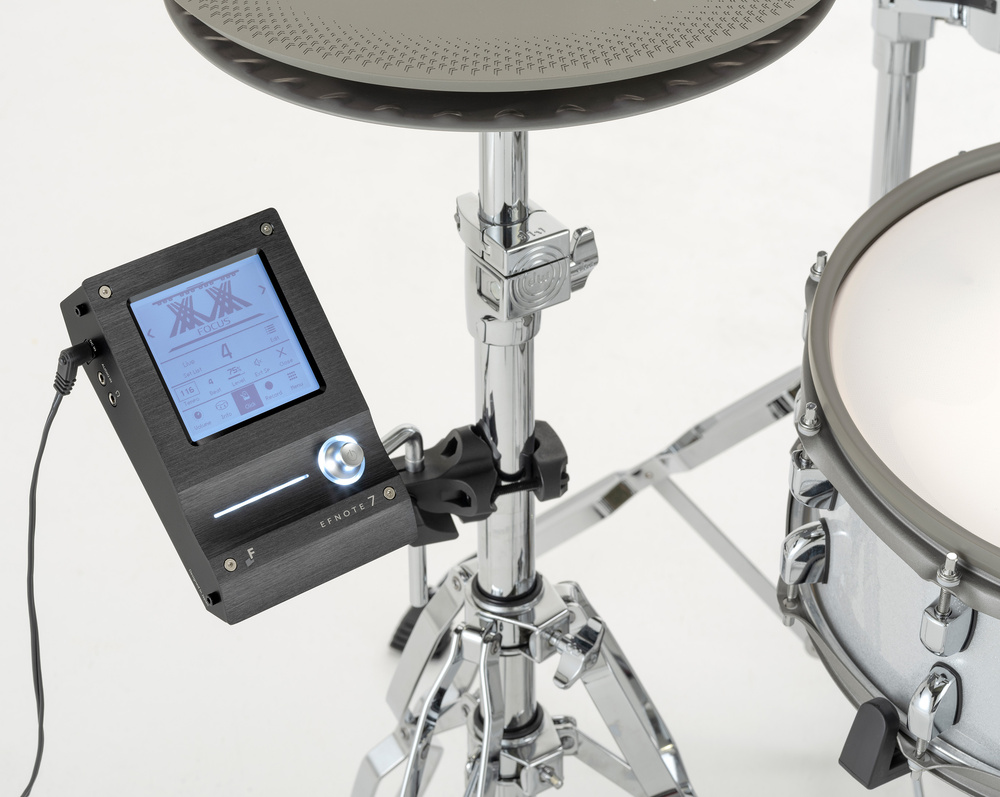 The sound module is compact and uses twin D‑Sub looms for connections to the drums and cymbals.
A 3.5mm headphone output and auxiliary input are located on one side of the module, allowing for direct monitoring and also facilitating playback from external devices such as MP3 players. The opposite side houses a micro‑USB port, which provides eight‑channel audio and MIDI connectivity to a Mac or PC, along with a stereo return path back to the module. In practical terms, and given the limitation of stereo main outputs, USB provides a more flexible output option and is the only method of capturing individual drums in a recording environment.
The inclusion of multi‑channel USB audio also makes the Efnote 7 an attractive partner for software drum instruments such as Superior Drummer 3 and BFD. In that context, the combination of full‑sized shells, responsive triggering and realistic cymbals provides an excellent playing platform.
Touch & Go
The module is built around its touchscreen interface, which presents information in a clear and largely uncluttered format. Efnote describe the main menu items as ‘widgets’ — simple graphic icons representing functions such as Kit Edit, Trigger and Levels — and these form the basis of navigation throughout the system. The graphical style is functional rather than decorative, with simplified icons and a presentation reminiscent of an older mobile phone. Compared with some competing modules, the display feels understated and the touchscreen response, while perfectly usable, is not especially fluid. That said, navigation is generally intuitive, with most functions reachable within only a few presses.
The editing architecture is similarly restrained when set against comparably priced alternatives. A basic mixer page allows for individual level adjustment, while instrument editing itself is limited to a small set of parameters, primarily tuning and muffling. For users accustomed to more comprehensive onboard processing, the Efnote 7 is comparatively minimal. Effects are limited to a single Ambience processor offering Hall, Room, Stage and Plate reverbs, alongside a simple EQ, both of which can be applied to instruments individually.
Although basic, the two‑band EQ is effective, and Efnote’s ‘Virtual Pads’ feature allows instruments to be layered to further expand the module’s sound‑shaping capabilities. In keeping with Efnote’s emphasis on playing experience over sound design, the trigger settings are more developed. Parameters such as sensitivity, threshold and velocity curve are provided, along with individual crosstalk suppression and hi‑hat calibration controls, allowing the kit to be tailored to the player’s technique and setup.
The module also offers a selection of practice tools and a basic multitrack recorder. Their presence feels slightly at odds with the otherwise stripped‑back nature of the system, and the implementation is pretty utilitarian, but they nevertheless provide useful standalone functionality for practice and sketch recording without the need for external software.
Play Station
The playing experience is where the Efnote 7 feels most convincing. Once you’re seated behind the kit, your attention shifts towards response, feel and overall playability.
The factory sound set is modest in quantity, with 20 preset kits supplied, but Efnote have clearly prioritised realism over sheer variety. Rather than offering heavily processed or overtly stylised drum sounds, the presets focus largely on natural acoustic kits with a polished, mix‑ready character. The result is a more cohesive and usable sound set than some much larger preset libraries.
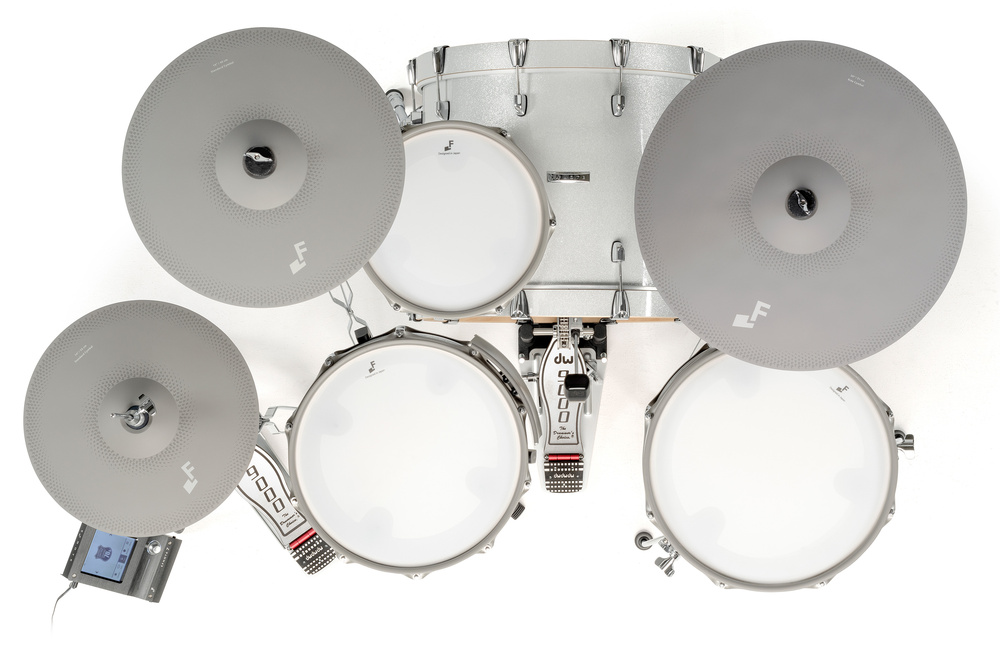 The sensation of playing a real kit is very much at the heart of the EFNOTE approach.
The kits draw upon a limited but well thought‑out internal instrument library comprising 12 bass drums, 12 snares, 29 toms, four hi‑hats, 16 cymbals, five rides and 23 percussion instruments, all of which can also be reassigned to create and save unique kit configurations in one of 80 user locations.
Efnote provide relatively little technical detail regarding the recording process behind the instrument library, but the emphasis is clearly on natural acoustic drum tones rather than heavily processed or synthetic sounds. Instrument names such as ‘GR Brass’, ‘YM Beech’, ‘LW Classic 13 x 9’ and ‘SL Vintage 12 x 8’ (my guess is Gretsch, Yamaha, Ludwig and Slingerland) reinforce the impression that the library has been assembled with traditional acoustic drum identities in mind.
Underpinning the overall playing experience is Efnote’s ELISE sensing technology, which combines with the multiple cone sensors in the drums to improve response and triggering consistency, and reduce hot‑spotting. The result is a playing feel that remains impressively natural across the kit, with an excellent dynamic response and accurate tracking even during lighter ghost‑note work. While the system doesn’t offer positional sensing in the manner of Roland’s latest digital snare and ride pads, the overall response feels convincingly drum‑like in use. The only small issue I found was that triggering became inconsistent at the very edge of the drums, but with most normal playing I wouldn’t consider this an issue.
Cymbals remain one of Efnote’s strengths and continue to be a defining part of the kit. The larger physical sizes contribute significantly to the impression of playing a full acoustic‑style kit, and the response itself feels smooth and predictable. The 14‑inch hi‑hats, in particular, offer convincing transitions between closed, half‑open and open positions, thanks largely to Efnote’s optical Tru‑Motion sensing system, which uses light sensors to detect the precise distance between the cymbals rather than relying on the potentiometer‑based mechanisms more commonly found elsewhere. In practice, the system works extremely well and, while perhaps not quite matching the refinement of Roland’s latest digital hi‑hat implementation, it comes surprisingly close.
The Efnote 7 feels like an instrument designed to be played rather than programmed. The combination of larger shell dimensions, natural kit spacing and responsive triggering creates a setup that encourages you to hit it.
The Efnote 7 feels like an instrument designed to be played rather than programmed. The combination of larger shell dimensions, natural kit spacing and responsive triggering creates a setup that encourages you to hit it — and that’s one of the kit’s most persuasive qualities.
A Kit To Hit
The Efnote 7 occupies an interesting position in the current electronic drum market. While many rivals focus on increasingly deep editing and expanding feature sets, Efnote have taken a more focused approach centred around realism, simplicity and playing feel.
The larger shell sizes, substantial cymbals and acoustic proportions give the Efnote 7 a genuine physical presence. The cymbals themselves are a standout feature, both in terms of response and sheer scale, with the optical hi‑hat system proving particularly convincing in use.
The module presents more of a mixed picture. Its compact format and simplified interface make it approachable and immediate to use, but anyone expecting deep editing, extensive processing or comprehensive output options may find it comparatively limited. Nevertheless, the available tuning, layering, EQ and ambience controls provide a surprisingly broad degree of sound‑shaping flexibility in practice, and will likely prove more than sufficient for players primarily focused on performance rather than deep sound design, while multi‑channel USB audio helps offset the lack of individual outputs. It also provides a straightforward route into software‑based drum instruments, where the quality of the pads, cymbals and triggering can really shine and any limitations of the onboard sound library and editing architecture become much less relevant.
Although the kit is supplied in a four‑piece configuration, Efnote also offer a broad range of expansion options, including additional toms and specialist cymbals, allowing the system to grow into a larger and more visually complete setup.
The combination of acoustic‑style ergonomics and responsive pads, alongside an impressive, cohesive sound set, creates a particularly engaging and musical experience. While it may not offer the technical depth or connectivity of some similarly priced rivals, it succeeds in delivering something that many electronic kits still struggle to achieve: the sensation of simply sitting down behind a convincing drum kit and wanting to continue playing it.
Take A Stand...
The hardware pack shipped with the kit includes two double‑braced cymbal stands, a tom bracket and snare stand. It’s nice to find a snare stand as part of the pack but, as seems typical with many electronic kits, a hi‑hat stand is not provided, nor is a bass drum pedal.
For mounting the control module, a simple L‑rod and clamp are supplied, which are designed to mount directly to a hi‑hat stand. In keeping with the rest of the system, the approach is straightforward and functional, avoiding the need for additional stands or more elaborate mounting hardware. It positions the module within easy reach and helps maintain a relatively uncluttered setup.
The mounting system also incorporates a small tray beneath the module, intended to accommodate a smartphone, which can be used to run the Efnote app (see other box). While perfectly stable, it lacks the adjustability and refinement of some dedicated module mounts, and its simplicity sits slightly at odds with the otherwise polished aesthetic of the kit.
The EFNOTE App
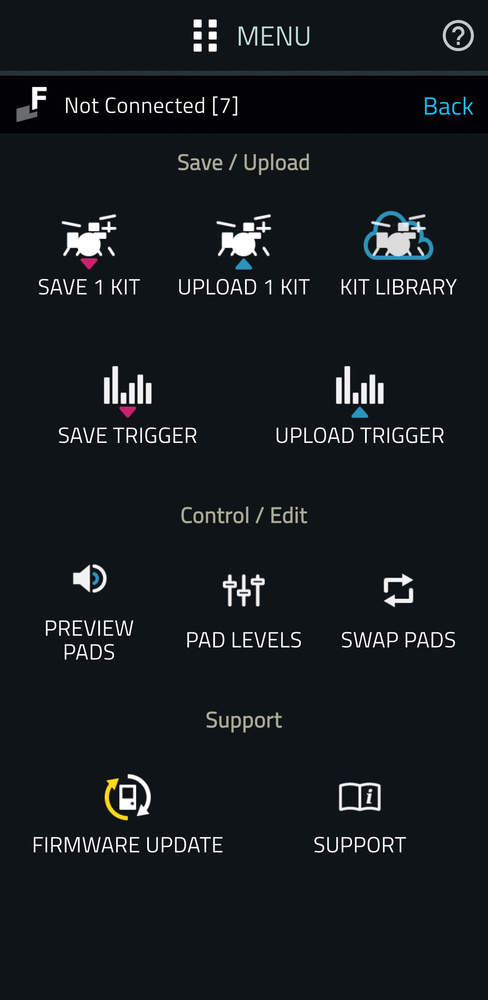 EFNOTE’s companion app (available for iOS and Android) provides a remote interface for the module, extending functionality and, in some respects, providing a more immediate and visually accessible way of interacting with the system. Connected via Bluetooth, it allows kits, trigger settings and module parameters to be viewed and adjusted from a smartphone, with the colour interface offering a clearer overview than the module’s monochrome display.
In addition to remote editing and backup/management functions, the app also provides access to Efnote’s online kit library, allowing new preset kits to be downloaded directly to the module. Whilst not quite in the same league as Roland’s Cloud, it does allow for expansion of the factory sound set without requiring manual file management or computer‑based transfers.
While it does not fundamentally change the somewhat simplistic nature of the Efnote workflow, the app does make navigation and editing more comfortable and adds a useful layer of convenience.
Pros
- Well made and looks fantastic.
- Large‑size cymbals and highly effective optical hi‑hats.
- Small but realistic acoustic‑focused sound library.
- Straightforward and intuitive touchscreen workflow.
- Multi‑channel USB audio and MIDI integration.
- Extensive expansion options with additional drums and cymbals.
Cons
- Limited onboard editing and effects processing.
- No individual direct outputs.
- Touchscreen graphics and response feel somewhat dated.
- No positional sensing.
Summary
A highly playable electronic kit with an impressively realistic sound set, strong acoustic‑style feel, excellent cymbal performance and a streamlined, performance‑focused module.