
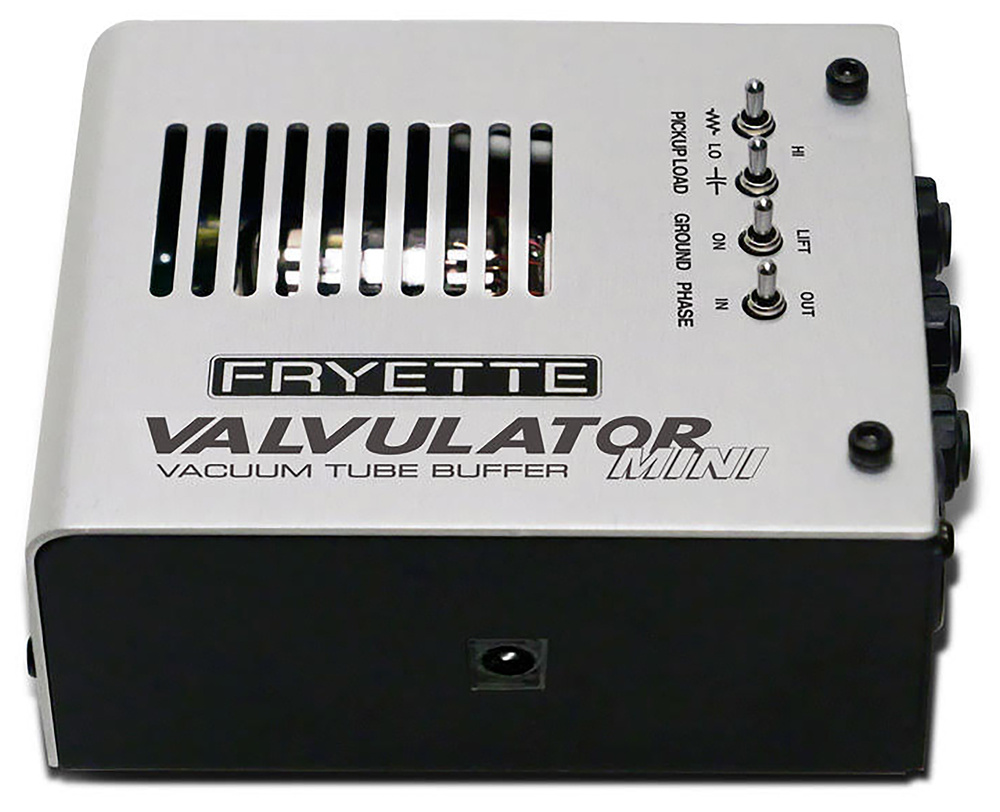
The original version of the Fryette Valvulator (launched around the year 2000 as a VHT‑branded product) was designed to solve the problem of the loss of high‑frequency detail and ‘feel’ that occurs when passive guitar pickups are connected to long cables and chains of effects. Whilst this could have been achieved with a simple solid‑state buffer, designer Steve Fryette chose a high‑voltage valve circuit instead, with the aim of more faithfully preserving the feel and dynamics of plugging directly into a quality valve amplifier.
Although still something of a cult classic, the original model was inconveniently mains powered, a bit large for most pedalboards, and perhaps even a little noisy by modern standards. The new Mini version reviewed here addresses that. It has been slimmed down to conventional pedal size, and whereas the original model actually included some DC power outputs for pedals, this one can now be powered from a 12 Volt DC supply. At its heart is still a buffer circuit built around a 12AX7 valve running at a similar high voltage to a guitar‑amp preamp valve, using a DC‑DC converter, with the surrounding circuitry redesigned for lower noise and increased clean headroom.
The Valvulator Mini offers a number of additional facilities, including switchable pickup‑loading options that allow players to fine‑tune the interaction between the guitar’s pickups and the input stage, recreating some of the subtle tonal variations normally introduced by different cable lengths or input impedances. It also offers multiple outputs: standard unbalanced jack input and output, plus a transformer‑isolated additional output, and a balanced XLR output, allowing it to function as a high‑quality, tube‑buffered direct box as well as a pedalboard or modeller front end. You don’t have to use it at the start of your signal chain, of course: you could just use it as a tube‑based line driver on the output side, where its isolated second output would be great for running two amps, but that would render the subtleties of the pickup loading and capacitance switches irrelevant.
Both the latter employ three‑position mini switches, with the Pickup Load settings offering a choice of 1MΩ, 470kΩ and 220kΩ input impedance, and zero, 100pF or 220pF of ‘virtual cable’ capacitance. Fryette describe these as equivalent to a 20‑foot cable with 5pF or 10pF per foot capacitance, which seems a bit low to me. I’d reckon a ‘typical’ cable to be more like 30 to 40 pF/foot. But, of course, there will always be a real cable involved as well — so maybe this is only ‘fine‑tuning’ on top of that. A conventional passive guitar pickup is essentially an inductor with resistance and a small amount of inherent capacitance. When connected to a cable, the cable’s capacitance becomes part of the circuit, while the input impedance of the first device determines how heavily the pickup is loaded. Those three elements — inductance, capacitance and resistance — combine to create a resonant peak in the treble region that determines much of the fundamental tonal character of the sound.
By preserving the interaction at the front of the chain, you are able to keep the touch response for the player and the fundamental tonality right through to the final output.
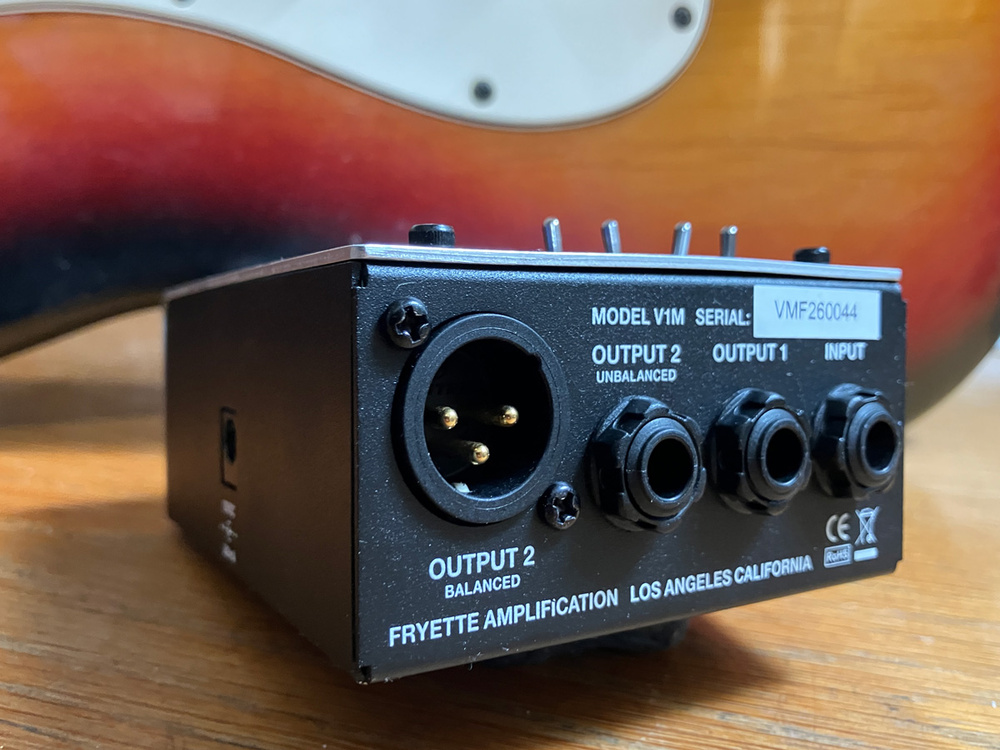 Fryette Valvulator rear panel connections.In theory, the highest input impedance and the least added capacitance would preserve the greatest voltage, widest bandwidth and highest resonant peak, but in practice that’s not always what you want to hear. Many classic guitar sounds rely on the warmer sound of reduced bandwidth from input loading or capacitance shifting the frequency of the resonant peak downward and reducing its amplitude. A transparent buffer at the front of the signal chain removes much of that normal interaction, and although people working with complex rigs have got used to it and worked out various tonal compensations, many players still feel it isn’t as satisfying as plugging directly into an amp — it’s just something they’ve learned put up with. By preserving the interaction at the front of the chain, you are able to keep the touch response for the player and the fundamental tonality right through to the final output. Ground lift and phase (polarity) switches complete the line‑up of this rugged steel box with a flat base ideal for attaching to a board.
What Does It Sound Like?
It sounds fundamentally like what you put into it, given any sensible input level. It has unity gain so it doesn’t significantly alter the behaviour of things downstream of it, but there are subtle tonal and compression changes that you’ll appreciate most if you take the unit out of circuit after a period of using it. In this context, subtle is good: we are talking about keeping the best of what you already have rather than trying to create something that was never there. Most buffers just aim to eliminate pickup loading, whereas this one very effectively recreates controlled amounts of user‑determined pickup loading to help replicate the feel of playing directly into an amp. A highly recommended problem‑solver.
Information
£199 including VAT.
$199
When you purchase via links on our site, SOS may earn an affiliate commission. More info...