

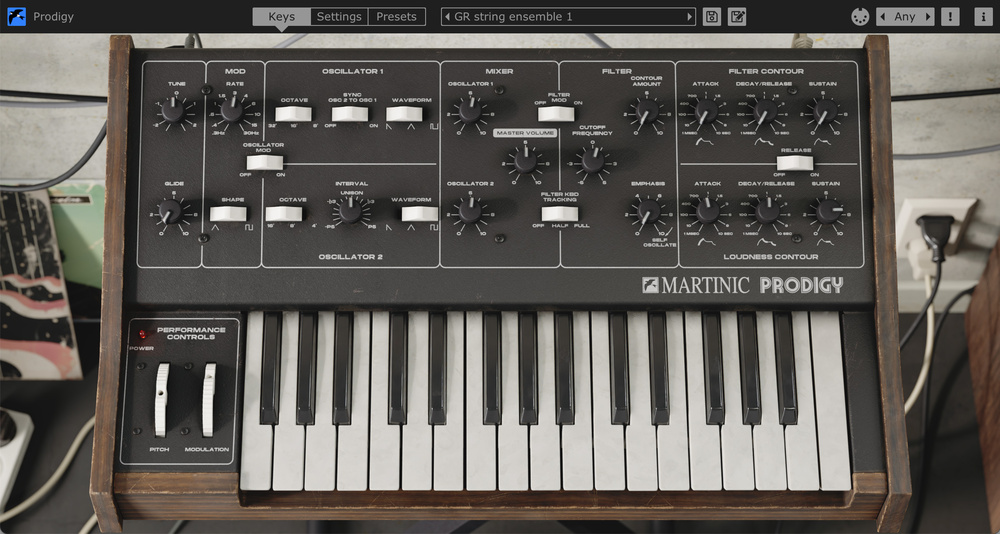
Martinic revisit the Prodigy with a software version this Moog classic.
I find it surprising that, despite there being myriad imitative soft synths, the Moog Prodigy has been almost entirely overlooked. So when Martinic contacted me to say that they were developing one and asked whether I would like to try a pre‑release version, I was more than happy to do so.
As is usual for Martinic, the soft synth is supplied in a range of plug‑in formats but not as a standalone application. Once installed, it offers a faithful representation of the original, but with an additional Settings page that offers access to several enhancements.
Oscillators
To perform my tests, I placed my Prodigy next to a small MIDI controller that offers the same 32‑note F‑C keyboard configuration. I then assigned some of the soft synth’s voice parameters to the controller’s knobs and sliders, and I was ready to go. In truth, I could have used my Roli Seaboard 2 because the soft synth supports a subset of MPE functions including glide, velocity, aftertouch and key repeat, but I wanted to mimic the original.
I started by comparing the two synths’ oscillators. The sawtooth, triangle and square waves were similar across all ranges and I wasn’t concerned by the small differences that I encountered; the engineers at Martinic modelled their Prodigy, not mine, and I have no doubt that the two have aged differently. In addition, Osc 1 now offers the Minimoog’s shark’s‑tooth wave while Osc 2 has an added ramp wave, and both oscillators offer a pulse‑width control so you’re no longer limited to fixed widths for the pulse and square waves. Hard sync’ing of Osc 2 to Osc 1 is again provided and, as on the original, the mod wheel affects the pitch of Osc 2 alone in this mode. However, you can hear stepping as you sweep sync’ed sounds. It’s not awful, but it’s not the same as the analogue synth.
The signal now passes to the Mixer which, as well as mixing the oscillators, adds a square wave sub‑oscillator derived from Osc 1, and a pink/white noise generator. There’s also a Drive knob, but this is placed in a misleading position in the Settings page because the overdrive affects the signal after it has passed through the filter, not before it.
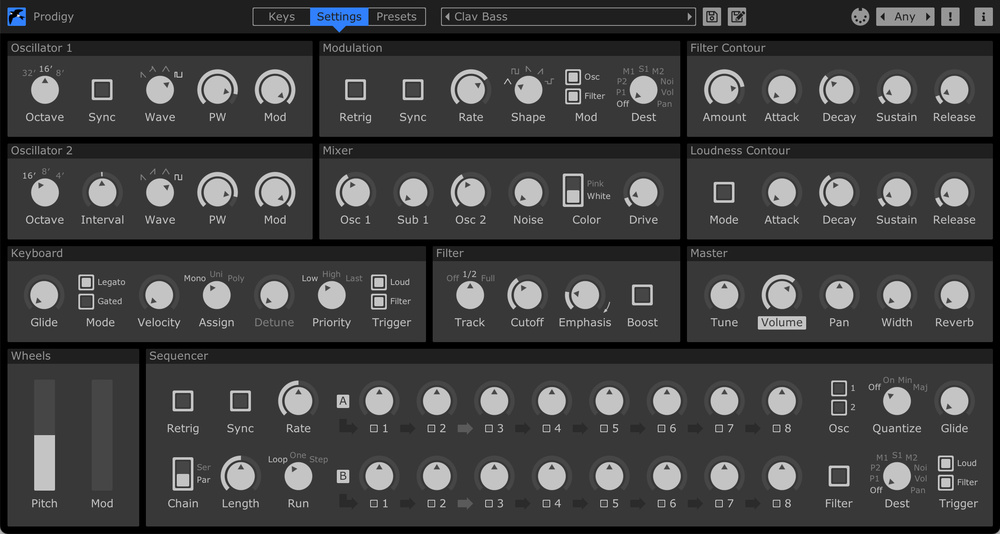 The Settings page adds much to the original Prodigy, including a dual‑row step sequencer.
Filter &...
You are reading one of the locked Subscribers-only articles from our latest 5 issues.
You've read 30% of this article for FREE, so to continue reading...
- ✅ Log in - if you have a Digital Subscription you bought from SoundOnSound.com
- ⬇️ Buy & Download this Single Article in PDF format £0.83 GBP$1.49 USD
For less than the price of a coffee, buy now and immediately download to your computer, tablet or mobile. - ⬇️ ⬇️ ⬇️ Buy & Download the FULL ISSUE PDF
Our 'full SOS magazine' for smartphone/tablet/computer. More info... - 📲 Buy a DIGITAL subscription (or 📖 📲 Print + Digital sub)
Instantly unlock ALL Premium web articles! We often release online-only content.
Visit our ShopStore.