

Rating: ★ ★ ★ ★ ★ 5/5 Stars
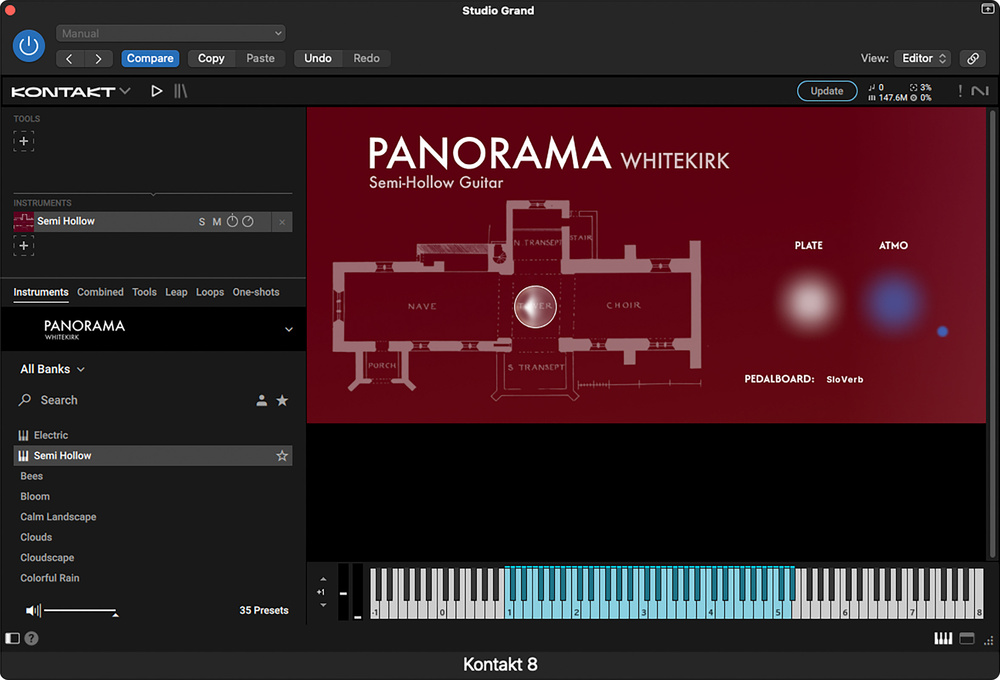
If the idea of yet another sampled guitar instrument leaves you feeling unenthused, don’t turn the page just yet, as this library really does offer something different. Sonora Cinematic's Panorama Whitekirk runs on NI’s Kontakt (including the free Kontakt player v8.9 or later) and was recorded in the 900‑year‑old St Mary’s church in the Scottish village of Whitekirk. A key element of this instrument is that the GUI allows the user to change the listening position within the church, which provides a variety of natural acoustics. A floor plan of the church is shown in the GUI.
The source sounds were created using two electric guitars, a solid‑body model and a thinline semi‑hollow model, recorded using two amps and an impressively large pedalboard. The recordings produced two distinctive room sounds from two separate stereo mic arrays, the blend of which can be controlled from a keyboard’s mod wheel or by dragging the round cursor from left to right in the GUI. The change in the church acoustics as the cursor is moved is very noticeable, with the Choir end sounding much drier than the Nave end. As with other instruments in the Panorama series, there are also Plate and Atmo effects with two different Atmo options shown as blue or pink. Blue adds a long, shimmery ambience while Pink leans towards modulation and granular processing, again adding a textural tail to the sound.
There are separate NI instruments for the electric and semi‑hollow guitars along with 35 presets that show off the range of sounds that can be achieved, most of which sound quite unlike guitars. The combination of effects and the natural acoustics of this old stone church is key to the way the sounds were shaped, with the effects include fuzz, reverb and granular processing. Clicking on Pedalboard brings up a list of seven different processing options, from slow‑attack reverb to granular octaves, with other variations utilising tremolo, reverse delay, modulation and so on. The subjective sound blends the character of a keyboard instrument with the more organic nature of the guitar, while the effects and natural acoustics add a lush wash of reverb. Many patches feature a slow attack producing tones that can sound like distant choirs, ghostly oboes, bowed instruments, ethereal pianos or lush synth pads. This dreamy quality fits right in with cinematic, ambient and shoegaze styles but has wider applications too.
The beauty of this instrument is that it is possible to coax a wide range of very usable and musical sounds out of it with the bare minimum of controls.
If you want to create your own patches, it pays to start off with the Pedalboard set to Clean and with Pale and Ambi dialled to zero, as that way you hear the original recorded sound enhanced by the church acoustics. Bringing in Plate and Atmo lengthens the tail and adds texture. Once you’ve tried those two controls it’s time to explore the different pedalboard presets, which have a dramatic effect on the end result. It is also interesting to note that although the added reverbs may be much longer than the natural reverb decay of the church, moving the position cursor still brings about a noticeable change in the character of the final sound. The beauty of this instrument is that it is possible to coax a wide range of very usable and musical sounds out of it with the bare minimum of controls, so there’s no tedious learning curve. Panorama Whitekirk is also sensibly priced.