

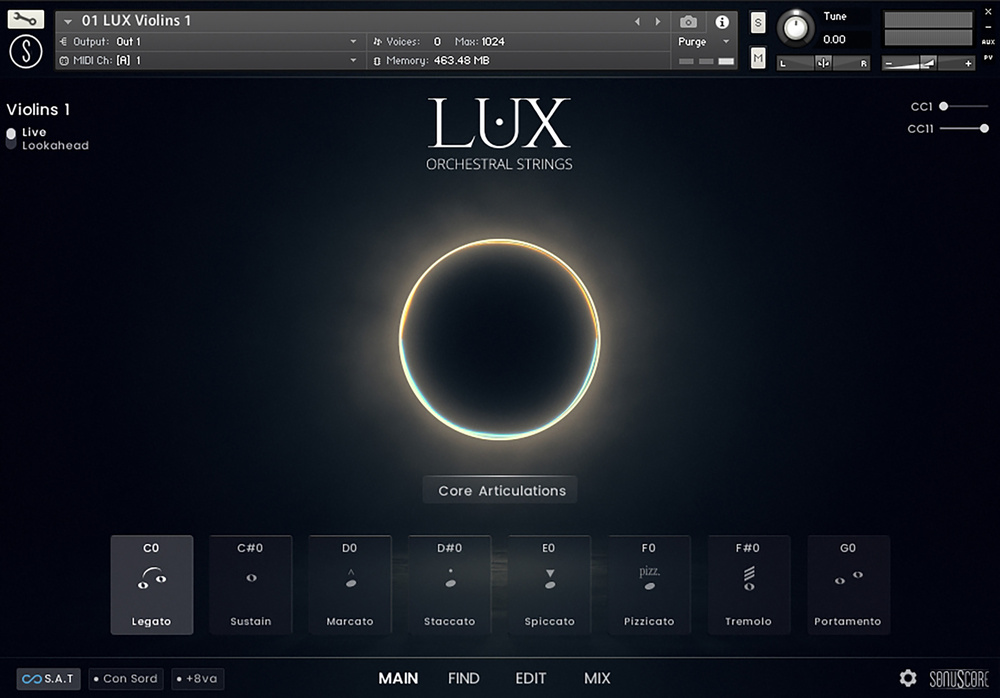
 The Main page, showing the core articulation set. Choose from 12 preset articulation sets (13 for Violins 1), or you can create and save your own custom selections.
Sonuscore’s latest instrument offers luxury in both sound and features.
Renowned for their multi‑faceted compositional tools The Orchestra, Elysion and The Score, LUX is Sonuscore’s first deeply sampled orchestral library dedicated exclusively to strings. LUX is very much a ‘no expense spared’ passion project for Sonuscore, its aim being to evoke the sound and experience of a grand Hollywood‑style string orchestra playing right in front of you. There are no arpeggiators, sequencers or other generative compositional aids. Together with its sonic aspirations, LUX’s compelling attractions include performance‑enhancing features rarely, if at all, found in other string libraries.
Core Blimey
All section instruments load by default, with the Main page showing a set of eight Core articulations that can be selected by keyswitches in the C0‑G0 range, or by clicking on the articulation buttons on screen. Just above these buttons is one labelled Core Articulations. This opens a drop‑down menu of 12 preset collections of articulations (13 for Violins 1), each offering a selection of techniques appropriate to various musical applications such as Action Scoring, Special Textures, Shorts — you get the picture. You are not restricted to Sonuscore’s choice, though; you’re free to create custom articulation sets and save them as snapshots. Just select an existing articulation on the Main page, open the Find tab and choose a different one from the extensive list. Repeat as required to replace other articulations. Completing the Main page are options to engage a simulated Con Sordino effect, a button labelled SAT (which we’ll come to later) and a +8va button to add a layer one octave above. If such doubling of players is the opposite concept to divisi, maybe it could be called raddoppiati?
Jamboree Bag
To say ‘extensive’ is no exaggeration. The first violins alone offer 115 articulations! Other instruments are only slightly less detailed. If I’ve counted correctly, the second violins offer 87, violas 109, celli 108 and basses 106. Core articulations (legato, sustains, various shorts, tremolo, etc) are present for all instruments, with appropriate variations for particular instruments across the different sections. For example, only Violins 1 include tempo‑sync’ed octave runs; Celli feature tempo‑sync’ed triplet arpeggios. Violins 1 and Celli each provide eight types of legato; the others five or six. Fluid, natural‑sounding legato is a pivotal aspect of any orchestral library; the full range of eight options are Full Legato, Whisper Legato, Legato, Adaptive Legato, Legato Acc Marc, Portamento, Whisper Portamento and Harmonics Legato. Some are essentially variations on the Core legato, for example focusing on a particular timbral dynamic range, or by overlaying shorts that adapt to your playing for accented detaché notes. Harmonics Legato is a welcome texture not often seen in string libraries. This one is delightfully slithery, ideal for scoring scenes of insidious microbial infestation.
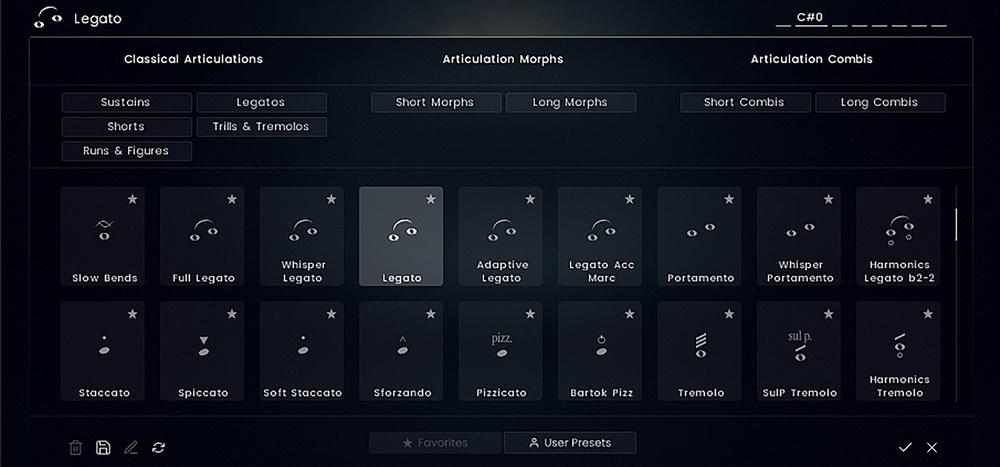 Customise your articulation sets on the Find page — shown here are 18 articulations from the first violins’ array of 115.
LUX has an additional trick up its sleeve called Natural String Change Legato. When an interval would require players to change string, the ‘departing’ string resonates for a moment longer, creating a more naturalistic flow between notes, rather than immediately cutting off that previous note. It’s subtle, yet adds to the realism. As for the fluid aspect, legato transitions across all instruments feel clean, smooth and natural — subjectively on a par with the best legatos found in other libraries.
Specialised performance articulations include Soft Interval Trills (any interval from a minor second to a perfect fourth), Harmonics Tremolo, Soft Motion, Triplet Trill Figures (fixed speed, not tempo sync’ed), the very eerie Pendulum Gliss (up or down) and Slow Bends (sustains that droop threateningly by a semitone on key release). Essential articulations naturally include Sustains, Staccato, Spiccato, Pizzicato and Tremolo (although there’s no col legno) with Marcato, Sforzando, Bartok pizz, Trills, sul pont Tremolo, Flautando, Whisper Sustains and Harmonics all providing a diverse range of expressive gestures and textures.
Bridging The Gap
Found in the bottom‑left corner of the GUI is a button labelled SAT. It stands for Seamless Articulation Transitioning, LUX’s solution to the problem of gradually changing from one articulation to another (typically sustaining sounds) without interrupting the flow. A common example would be changing from sustain to tremolo — normally you’d have to release the sustain notes, hit the tremolo keyswitch and start playing again. With LUX, you don’t have to interrupt the flow. Just press a keyswitch while still playing and it morphs smoothly from one articulation to the other. Light keyswitch presses morph slowly (up to four seconds) while harder presses morph more quickly — almost instantly if required. It’s certainly effortless compared to contriving crossfades between two different patches, and it sounds jolly convincing. Instruments load with SAT active by default; I’d be surprised if anyone would want to revert to classic keyswitch behaviour by turning it off!
Articulation Morphs & Combis
Articulation Morphs (long or short) combine up to four sub‑articulations using the modulation wheel (CC1) to morph between them, allowing for the performance of crossfade timings with precise manual control. Slowly shifting from sustain to sul pont tremolo is a classic device for suggesting impending peril in horror movies, and sounds terrific here. The preset Articulation Combis are more straightforward, layering two sub‑articulations and playing them in tandem. For the Long Combis, modulation wheel movement controls overall volume, and timbral dynamics vary according to a layer’s set dynamic range. Dynamics for Short Combis are controlled by key velocity.
I Did It My Way
Whilst the preset articulations cover many applications, sometimes you’ll need something to behave differently — the way volume responds to the mod wheel, or restricting an instrument to a specific timbral range, for example. You might need an Articulation Morph to transition right at the end of the mod wheel’s range, rather than sooner. All this and more can be customised on the Edit tab, where each layer that makes up an articulation can be edited individually. Volume response is adjusted via the graphic on the left, dynamic layer range and fade‑in and fade‑out slopes on the right. Volume sliders balance each layer’s level relative to the others.
Short articulations include a tightness control and a choice of ordered or random round‑robins. Legatos and Portamento include a transition volume control, best left in the middle 0dB position — too little results in a gappy sound, too much becomes uncomfortably lumpy. Transition speed is also adjustable, with the option to let LUX vary the speed according to your playing. With all this flexibility it’s good to know that whatever changes are made can be saved as User articulations. This is powerful stuff! The caveat here is that custom articulations created for one instrument remain unique to that instrument. To make them available to others, they must be recreated instrument by instrument. Perhaps Sonuscore might consider adding the ability to copy/paste articulations’ settings between instruments in a future update.
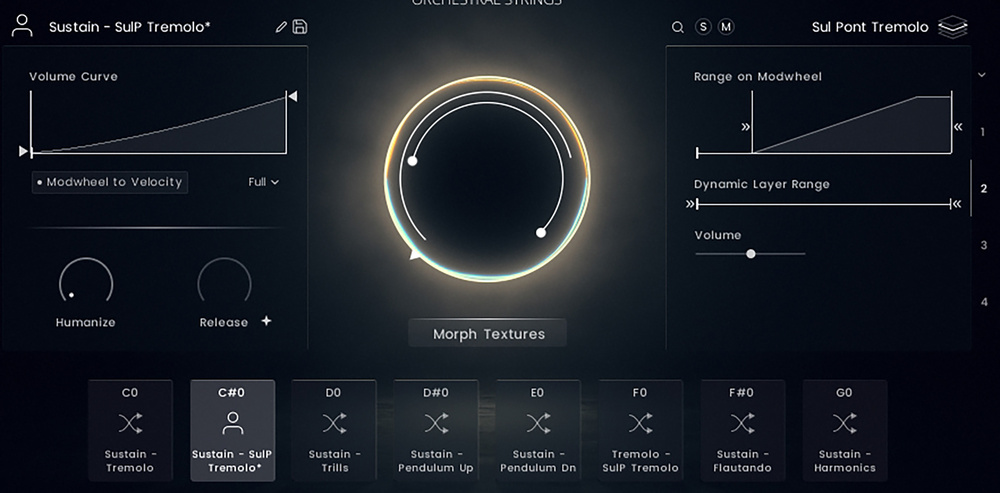 The Edit page. Overall volume response, dynamic range, crossfade slopes and more can be edited for each layer of any Articulation Morph or Combi.
Is It Live Or Is It Memorex?
LUX instruments operate in one of two modes, Live or Lookahead. For laying down tracks in a DAW, Live mode gives the most immediate response to your playing. Certain articulations understandably take time to ‘speak’ — notably shorts with soft starts (staccato and spiccato) and sustains at lower dynamics. Playing faster legato phrases accurately in time can be quite tricky; a recent 1.0.1 update has improved the legato’s responsiveness, nevertheless be prepared to do some post‑editing, or perhaps (shock horror) consider recording with step input for faster phrases. Lookahead mode unifies all sample start times and delays notes’ onset by 250ms, so by quantising parts and offsetting a track’s playback by ‑250ms, everything will play perfectly in time.
Magic Mics
On the Mixer page are five microphone channels: a Full mix (curated by veteran mixer Peter Fuchs), plus Close, Decca Tree, Far and Bleed. Bleed adds that elusive element of ‘glue’ often missing from orchestral samples. In a full orchestral session, all the mics are open, with an inevitable spill from each section being picked up by the others. LUX’s Bleed samples were taken from 22 additional close mics set up in the positions brass, woodwind and percussion would occupy. Adding some of this signal to the other mics brings a sense of cohesiveness — not so much a reverb as a warm resonance bonding the orchestra together.
The Full mix does not include Bleed, leaving you to add that yourself if desired. The Bleed mics also include the option to use the spill from the entire orchestra, or only that generated by the strings alone. Rounding out the Mixer page are an EQ with three fixed bands, a compressor with mix control for parallel compression, and a convolution reverb with three room sizes.
Tous Ensemble Maintenant
Most libraries include an Ensemble patch, typically spreading all five sections across the keyboard, with positional crossfades from one section to the next. This is handy for quick sketching, but tonally unrealistic when sections double parts in the crossfade areas, with no choice of which instrument plays which note. LUX’s Ensemble patch attempts to mitigate this by adopting a feature employed in Sonuscore’s generative libraries (The Orchestra, The Score, etc) whereby notes of a chord are assigned to individual parts according to a specified low‑to‑high note order.
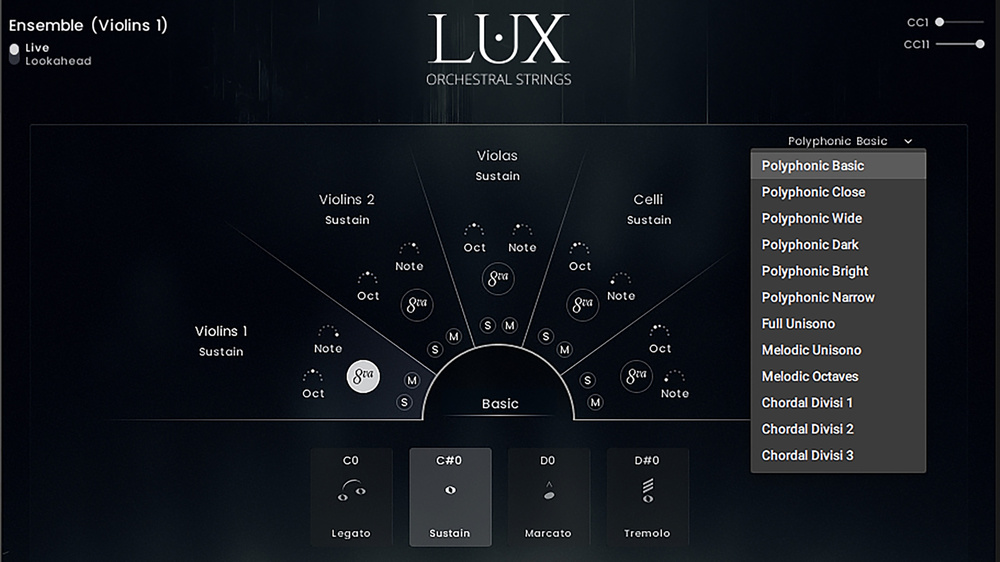 The five sections in the Ensemble instrument are set out in classical seated positions. Twelve preset voicings are selectable from the drop‑down menu, or create your own voicings with each section’s Octave, Note and +8va settings.
As with the individual section instruments, there are 12 preset articulation sets, but with four keyswitchable articulations available rather than eight. You’re not restricted to the whole orchestra using the same articulation, however. You can assign different articulations to individual sections; these variations are unique to each of the four keyswitches. The GUI presents all five sections in classical seated positions, each with their own solo and mute buttons. Also present are octave dials to offset their pitch by up to minus and plus three octaves, with +8va buttons adding a layered higher octave to any section. The Note dials assign each section to a preferred position in a chord; 14 possible low‑to‑high options allow experimentation with different chord voicings. Twelve preset voicings are provided as starting points; you can edit these as you wish. It’s an interesting approach, although I found it to be hit‑and‑miss, with voicings being somewhat unpredictable, particularly if you happen to overlap notes or use the sustain pedal.
To these ears they have succeeded in creating something special. The sound of all five sections in full flow oozes gravitas...
Conclusion
Sonuscore join an ever‑growing market for orchestral libraries focusing on realism, premium sound quality and plentiful articulations, and glamorous recording locations among their selling points. At £375$499 LUX might be out of reach for some, yet the price compares favourably with other similarly styled ‘A‑list’ libraries. The developers’ objective was to “create something that felt as close as possible to standing on the scoring stage”. Whatever one’s preconception of what that should sound like, to these ears they have succeeded in creating something special. The sound of all five sections in full flow oozes gravitas — the word ‘noble’ comes to mind; big and warm with a moderate vibrato, bags of high‑end ‘air’, clear stereo imaging and an impressive dynamic range. Add to that the creative possibilities of Articulation Morphing, the performance and workflow benefits of SAT and the innovative Bleed mic option, and it’s not surprising it has already been finding its way into top composers’ toolboxes.
What Is LUX?
LUX is a 70‑piece string orchestra that runs in Kontakt and Kontakt Player v7.10.9 and above. It was recorded with multiple mics in a large concert hall, comprising individual patches for the five sections: Violins 1 (18 players), Violins 2 (16 players), Violas (14 players), Celli (12 players) and Basses (10 players), each section recorded in classical seated position. An Ensemble instrument is also included, discussed elsewhere in the text. An additional Singles folder contains individual articulations for each section — a handy RAM saver for when an instrument only needs to play one technique.
Download size is a not inconsiderable 76GB, so cue up a favourite Netflix series to binge while the goodies arrive.
Pros
- It sounds superb.
- Wide range of articulations.
- Customisable articulation sets.
- Seamless Articulation Transitioning.
- Articulation Morphing and Combis.
- Design your own Articulation Morphs and Combis.
Cons
- Relatively expensive.
- Triplet figures not tempo sync’ed.
- Ensemble instrument’s voicings somewhat unpredictable.
Summary
A superb‑sounding ‘Hollywood’ style string orchestra with an extensive selection of articulations. Seamless keyswitched articulation transitions, manually controlled Articulation Morphing and comprehensive editing options make LUX a creative powerhouse that can be harnessed to fit your needs.