

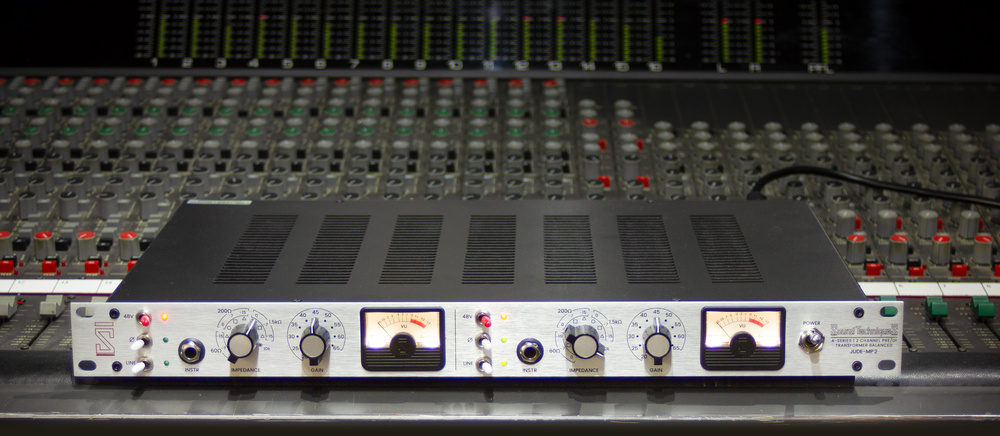
Hey! How many songs do you know about someone called Jude? This collaboration with Warm Audio brings ‘that’ Sound Techniques preamp within reach of us all...
In the late ’60s and the ’70s, as solid‑state electronics displaced the valvetube circuits used in the recording consoles of the post‑war years, the public’s voracious appetite for music over the airwaves and on vinyl meant upgrading recording studios made good business sense. Several console manufacturers emerged, some of which continue to enjoy huge fame today, but others are less well‑known, despite making some wonderful consoles that were used to make countless hits. One of them is Sound Techniques, who were based in Chelsea, London back then, and today make the ZR Console and some associated outboard gear in California.
The subject of this review is a mic preamp range that’s the fruit of an official partnership between Sound Techniques and Texas‑based Warm Audio. There are two models: the single‑channel Jude‑MP, housed in a portable metal case with a carry handle; and the Jude‑MP2, a dual‑channel 1U, 19‑inch rackmount version. I was sent the two‑channel model for review, so that I could test it with both mono and stereo sources, but the same discrete preamp circuit is used in both devices (which, by the way, come with a reassuring manufacturer’s five‑year warranty).
All The Young Judes
While the Judes might be new pieces of hardware, they’re very much designed around an exact replica of the Geoff Frost‑designed preamp stage of Sound Techniques’ original A‑Range consoles. Those consoles found a home in some very famous studios, including Sunset Sound in Hollywood, where one was installed in Studio 2 in 1967, and several in London, most famously Trident. It’s no surprise, then, that lots of famous artists from the golden era of recording are referenced in the marketing material: Queen, Elton John, T‑Rex, Jimi Hendrix, James Taylor, Nick Drake, Led Zep, the Rolling Stones, The Who. The list goes on... and includes arguably the biggest name in recording history, which I’ll get to shortly.
Depending on your knowledge of vintage recording consoles, this may not be the only ‘Trident A‑range’ console you’ve heard of. So, to eliminate any confusion, I’ll start by taking you on a quick recording history tour. (Skip the next paragraph if you simply want to know more about the Judes.)
As I understand it, an eight‑channel Sound Techniques A‑Range console was installed in Trident’s A‑room in 1968, and, when Trident upgraded to a 16‑channel version in January the following year, the smaller one was retained and moved into a new mixing room. The larger mixer remained in service there until 1972, and the smaller one until 1976. This means that a Sound Techniques A‑Range was used on the recording sessions for the Beatles’ classic ‘Hey Jude’ — which, of course, is where the name comes from. And the confusion I referred to? Just the name... Trident later commissioned a completely different console, which would also be called the A‑Range (a trademark now owned by Trident Audio’s parent company). Designed by Trident’s lead electronics engineer Barry Porter with chief recording engineer Malcolm Toft, these also have an interesting story — but that one’s not relevant to this review!
Take A Preamp, And Make It Better
As intriguing as I find the history, the most important questions are how this new preamp sounds, how well it’s built, and whether it’s worth the asking price. The headlines are that it’s a good preamp, with some useful connectivity options, a distinct character, and some useful tonal variety courtesy of a variable input impedance. I’d say it represents good value too. But you’ll rightly want more detail than that so, without further ado, let’s dive in...
The review unit arrived securely triple boxed, with the inner box containing the preamp, an IEC mains lead and a 33‑page multilingual user guide, whose first 11 pages are in English; there’s more information on the Warm Audio website too. My first impressions were of a nicely constructed piece of kit, whose case and transformers give it surprising ‘heft’. The switched knobs and toggle switches lend a pleasing sense of solidity too; there was just a hint of lateral play in the power toggle, but nothing major, and I couldn’t fault anything else.
The main controls are identical for each channel. On the left is a column of three horizontal toggle switches, each with a status LED. These engage 48V phantom power, invert the signal polarity, and switch between the mic and line inputs. A TS instrument jack acts as another switch, this source being selected whenever a jack plug is inserted. The phantom power switch and its LED are coloured red, helpfully differentiating them from everything else. Then there are just two knobs that turn rotary switches: one sets the input impedance (of which more later), and the other is a 10‑position gain control, marked in 5dB steps from +20 to +65 dB, which should be plenty for most scenarios other than perhaps distant miking with passive ribbons.
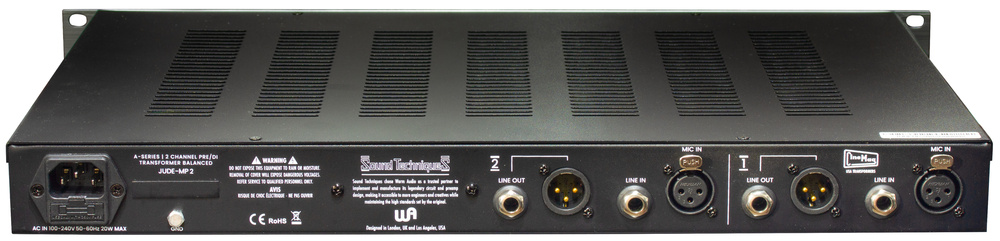 The mic and line inputs are separate, and as the latter is isolated from phantom power you’ll have no problems wiring this into your patchbay.
On the back, the fused IEC power inlet can accept 50/60 Hz mains from 100‑240 V. The main analogue I/O comprise an XLR for each channel’s mic input, a TRS jack for its line input, and both XLR and TRS jack line outputs, paralleled to make connection easy, whatever cables you have to hand. I was pleased to confirm that phantom power appears only on the mic input, not on the line one (an issue that I’ve encountered on more than one preamp sent to me for review, which risks damage to connected line‑level equipment). I also appreciated the provision of separate inputs rather than a combi XLR, since this makes it easy to bring the mic and line inputs out to different patchbays/wall boxes.
The Jude‑MP2 doesn’t seem to run at all hot, but the top panel is in any case generously vented — to the extent that I didn’t really need to remove the lid to be able to see what was inside. There are two main PCBs fitted to the bottom of the chassis, one for power and the other for the audio circuitry, with another PCB for each channel’s front‑panel controls. These boards are populated with through‑hole components, and although they’re not inherently any better than SMDs, that could well make future diagnosis/repair easier.
There are both input and output transformers on each channel, so four transformers in total on the Jude‑MP2. All are custom‑wound by Cinemag and, notably, the mic input transformer is a reverse‑engineered replica of that Geoff Frost used in the eight‑lead, nine‑position Z‑Match impedance‑matching circuit of the vintage Sound Techniques consoles; I’m informed that the metal content and laminations of an original transformer were analysed to enable the specifications to be matched precisely.
Let It Into Your Heart?
I tested the Jude‑MP2 with a few different mics and on a number of different sources, including vocals, acoustic and electric guitar and a snare drum. I also used it as a DI front end with electric guitar and bass. In all cases, it performed admirably, and the channels seemed very well matched too — a benefit of switched controls and closely matched components.
Of course, most of us already have audio interface preamps that can ‘do clean’, so I was more interested in discovering what character this one had to offer. There’s an inherent touch of richness, but not so much that you can’t capture a decently clean and neutral result (except, perhaps, if you’re talking about clean in the sense of classical or jazz). And when you want to move out of ‘neutral’, you can shift gear, as it were, by turning the input impedance switch or cranking the gain to drive the output transformer into saturation.
The input impedance changes are achieved, I believe, by reconfiguring the input transformer’s primary windings, so it’s not just a case of altering the load seen by the mic; the lower the impedance settings, the greater gain from the transformer. The first nine positions of this 10‑position switch are just as on the old A‑Range, with three gain positions (0, ‑7 and ‑15 dB) for three different impedances (60Ω, 200Ω and 1.5kΩ). The gain is also indicated by a circle, square or triangle icon, so you never have to squint! The final 10kΩ setting is useful for line mode, but also easily satisfies the 1:5 ratio rule for modern mics.
Tested at different impedances with Soundelux U99 valve and AKG C414 B‑ULS solid‑state capacitor mics, my recordings always sounded pleasing. The AKG’s performance didn’t seem particularly sensitive to impedance changes, but there were definitely some changes to the U99: as I brought the impedance right down, I heard what I think was a little valve distortion, most evidently on vocals, and a slight softening of transients that I first noted when recording fingerstyle acoustic guitar; that could be a helpful option when recording strident/brash sounds.
With a Shure SM57 dynamic mic, the differences were night and day. A low impedance tames the top and bottom end, to give this mic even more of a midrange focus. This, I felt, could be useful to counter proximity effect bass boost or, say, to help an electric guitar fit into a particular track. Or it might make it sound too ‘honky’! Horses for courses! It’s a similar story with passive ribbons, but because these are typically figure‑8 mics, taming the proximity effect could prove even more useful, even at the cost of making them sound a touch darker. Again, ‘good’ or ‘bad’ is subjective, but the point is that you have options.
Nickel‑core transformers typically sound quite clean, but saturation tends to come on abruptly and its predominantly odd‑order harmonics sound bright and snappy. This can be useful to add an edge to percussive sounds (eg. a snare drum), and while you don’t get the thickening weight attributed to iron‑/steel‑core transformers, they can be just the ticket for trashy vocal distortion. To my ears, this Cinemag output transformer ticks all those boxes. There’s no post‑transformer pad, though, so an external attenuator is helpful when you want to fully explore this character.
The Judes are good value — right up there with preamps that cost rather more!
Verdict
No preamp can turn you or me into a Beatle! But the Jude preamps do sound lovely, they’re well built, they have versatile I/O, and once you figure out how to access it, there’s character in spades. An output pad would be nice, but really I can’t fault it. Not everyone can justify spending this much on one or two channels, but the Judes are good value — right up there with preamps that cost rather more!
Summary
The versatile Jude preamps serve up a slice of character from a console that played a role in so many famous British and American productions of the late ’60s and early ’70s.
Information
Jude‑MP2 £1349. Jude‑MP £699. Prices include VAT.
Warm Audio +1 512 348 6585
Jude‑MP2 $1399. Jude‑MP $749.
Warm Audio +1 512 348 6585.