


UA take their Volt range of affordable USB interfaces to the next level.
The launch of the Volt interfaces in 2021 marked a shift in Universal Audio’s focus. Previous products, such as the Apollo interfaces and the Satellite plug‑in co‑processors, were aimed at serious home studio owners, professional musicians and commercial studios. The Volts, by contrast, targeted the entry‑level buyer. Going head to head with the likes of Focusrite’s Scarlett range, they were affordable, they were simple to use, and the ‘76’ models had a unique selling proposition in the shape of built‑in, preset analogue compressors.
The initial tranche of five desktop Volts has since been augmented twice, both times at the top of the range, with the Volt 476P surrendering the crown last year to a rather more grown‑up sibling. The Volt 876 bulked up the I/O count considerably, sloughing off the desktop chassis to develop a 1U rackmounting carapace. It incorporated a new, recallable mic preamp design with digital control and automated gain setting. And, whereas the earlier models provided only simple onboard direct monitoring, the 876 got its own pane in UA’s Console app, allowing cue mixes to be set up in software.
Higher Voltages
The Volt range has been a success, but competition in this sector is always fierce, and all of UA’s major rivals have refreshed their line‑ups since 2021. No surprise, then, that Universal Audio have now stepped up to the plate with a pretty comprehensive overhaul of the desktop Volts. (The Volt 876 remains unchanged.)
The original Volts came in two different desktop formats. The Volt 1 and Volt 2 had conventional oblong metal shells not unlike those of the Scarletts, while the compressor‑wielding 176, 276, 476 and 476P were more distinctive, with wooden end cheeks and top‑mounted controls. This divide persists in the new generation, but in both cases the look and feel have changed considerably. Wood has been phased out, the models with top‑mounted controls are now wedge‑shaped, and a smart gun‑metal‑grey colour scheme accentuates the Volts’ kinship with the Apollo range. There’s a very neat new Smart Display, of which more shortly.
In the second generation, Volts 1, 2 and 4 are rectangular models with front‑mounted controls, and are almost but not quite named according to the number of analogue inputs each provides. The Volt 1 has a single mic preamp and a separate high‑impedance input for connecting electric guitars, whilst the Volt 2 and Volt 4 both sport a pair of dual‑purpose inputs that fulfil both roles. The 4 augments these with an additional pair of line‑level inputs on quarter‑inch sockets, mini‑jack MIDI I/O, and a single optical input for ADAT Lightpipe expansion.
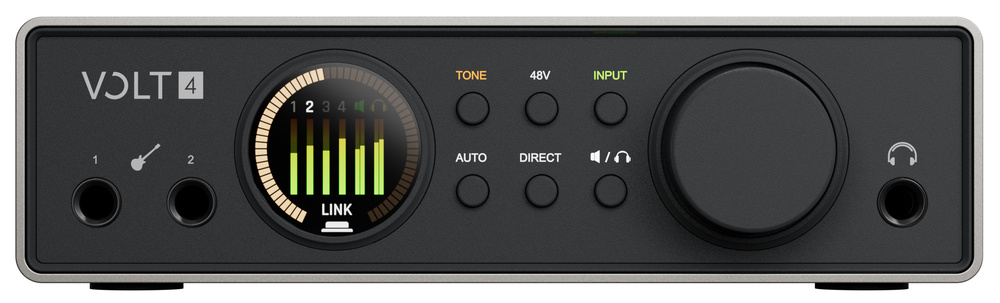 The Volts 1, 2 and 4 employ a conventional oblong metal case design.
The three wedge‑shaped models are the Volt 2 Max, Volt 4 Max and Volt 4P Max. All three have MIDI I/O and an ADAT input, plus a built‑in talkback mic. The 2 Max and 4 Max share the same complement of inputs as their non‑Max brethren, whilst the 4P Max has four preamps plus a pair of line inputs.
On the output side, UA describe the Volt 1 as having two analogue outputs, the Volt 2 and 2 Max four, and the Volt 4 models six. These numbers are achieved by counting the Volt 2s’ and 4s’ headphone feed as an output pair in its own right, which seems reasonable: it can carry its own mix on those models, whereas the Volt 1’s headphone socket simply mirrors the main outputs. The second pair of line outputs on the Volt 4 Max and 4P Max can be used to connect and switch a second pair of monitors if desired, an option not available on the basic Volt 4. And, speaking of headphones, the Max models duplicate the headphone feed on quarter‑inch and eighth‑inch sockets; this allows two pairs to be used simultaneously, although both present the same signal at the same level.
All the second‑generation Volts are intended to be bus‑powered, but UA recognise that not all host devices will be able to deliver enough juice. To this end, a separate USB‑C connector labelled 5V can be used to power the Volt when your laptop or tablet isn’t up to the job. This is thoughtfully blanked off using a small rubber bung by default, to stop you plugging into the wrong socket and wondering why nothing is working. The larger models include a 5V USB supply, and better still, the Volt 4, Volt 2 Max, 4 Max and 4P Max have a third Type‑C socket labelled Hub, which does exactly what you’d hope and is therefore perfect for connecting iLok dongles and the like.
Potential Differences
One of the biggest second‑generation developments is that all of the new Volts apart from the Volt 1 now feature digital control over the preamps. As on the 876, this can be exploited from the front (or top) panel or within UAD Console, as well as in UA’s LUNA DAW. Some preamp parameters are also exposed and adjustable in third‑party DAWs such as Logic. Gain is adjustable in 1dB steps, and both input linking and auto‑gain work exactly as they do on the 876. The preamps are also auto‑sensing, so there’s usually no need to manually select an input type.
If you’re wondering why UA have retired the ‘76’ designation in favour of Max, the answer is that the Volt 2 Max, Volt 4 Max and Volt 4P Max no longer feature analogue compression derived from the classic 1176 design. Instead, UA have equipped them with...
You are reading one of the locked Subscribers-only articles from our latest 5 issues.
You've read 30% of this article for FREE, so to continue reading...
- ✅ Log in - if you have a Digital Subscription you bought from SoundOnSound.com
- ⬇️ Buy & Download this Single Article in PDF format £0.83 GBP$1.49 USD
For less than the price of a coffee, buy now and immediately download to your computer, tablet or mobile. - ⬇️ ⬇️ ⬇️ Buy & Download the FULL ISSUE PDF
Our 'full SOS magazine' for smartphone/tablet/computer. More info... - 📲 Buy a DIGITAL subscription (or 📖 📲 Print + Digital sub)
Instantly unlock ALL Premium web articles! We often release online-only content.
Visit our ShopStore.