

Rating: 4.5 / 5 Stars
It’s OK to judge a sample library by its cover sometimes, as is the case with Westwood’s Rotor Solo Violin, where film grain, motion blur and distressed textures beautifully mirror the kinetic sounds of the solo violin contained inside. The library does away with sustain patches entirely, exploring the more energetic side of the violin instead, with 33.96GB of human‑performed, tempo‑sync’ed loops designed to add movement to your piece. In the hands of Rotor Solo Violin (and yours, as a result), the violin is percussive, urgent, bouncy, bright, gritty, edgy and, most importantly, automatically sync’ed to your project tempo.
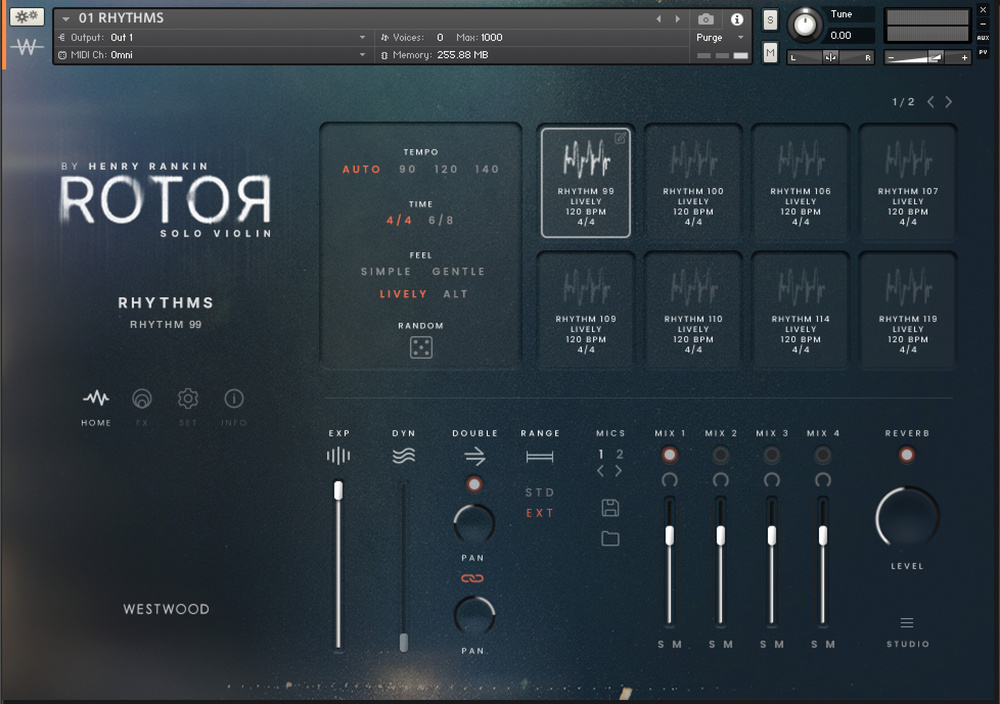
The instrument, which runs in the free Kontakt Player, offers three main categories of samples, the first of which is Rhythms, featuring 160 playable rhythms that automatically sync to the tempo of your DAW. The loops are further subdivided into four playing styles: Simple, Gentle, Lively and Alternative, faithfully keeping a steady beat (either 4/4 or 6/8) in the Simple style and gaining character along the way with the other styles. Shorts provide 15 articulations across the vocabulary of a violin, with spiccato, harmonics, muted pizzicato, col legno, ricochets, sul pont scrapes, and even guitar pick accents. Flourishes are the connectors, with octave and fifth crescendos and decrescendos, chromatic runs, glissandos, bends, fall‑offs and trills adding glue to your passages.
Within each patch, you have four mix choices (from Natural stereo to a more aggressive Hyped), and four mic positions (from a dry Spot to a more distant Ambient), and each sample can be modified in multiple ways using ADSR envelope controls, round‑robin selection and by adjusting in‑built reverb and delay effects.
It’s interesting that the library is called Solo Violin because what it inspired me to do most was layer rhythmic patterns as if I had a steady stream of violinists at my disposal, ready to build upon what the previous player had laid down. It’s not my fault really; the tools lend themselves to such behaviour, starting with the Doubling feature, which lets you instantly incorporate another take of the performance, double‑tracking the part and widening the stereo field. Holding down the Shift key enables you to stack multiple rhythms within a category, and, combined with one of the 24 presets from the Delay engine, it was no trouble at all to make the sound bigger and more textured.
The TransPitch feature on the FX page is a handy tool; at the click of a button, it “allows you to pitch‑shift the samples down, whilst simultaneously transposing them back up by the same amount”. Useful for quickly adding timbre changes to the composition; it’s not a big move, but it adds colour.
Another interesting experience is how well the library lends itself to performance. My first exploration was supposed to be a technical look around, to assess features and tools — instead, I built three short pieces, getting lost in the creative process, rather than focusing on the architecture.
In terms of sound and scope, the library is suitable for pop music (especially country‑pop, the hot flavour of the moment), film score, as well as experimental sound‑design‑based compositions. The core sound of the violin is striking and, combined with the rhythms and articulations on offer, is surprisingly versatile. Based on initial impressions, I thought the library would lean towards abstract and experimental, but having used it for a while, I can imagine creating a commercial action cue quite easily with the sounds contained within the library. At the same time, it is also quite at home in a minimalist composition, with hypnotic repetitive phrases and texture‑stacking of the kind you would create if you were practising your Steve Reich homage.
The design of the instrument is especially suited to exploring rhythmic complexity – a simple repeated pattern, when layered with other patterns or stacked upon itself, transforms dramatically as you make small changes like time‑shifts or add effects. To be able to explore that just by holding down one note or a chord is a gift, especially for new composers.
Rotor Solo Violin is an excellent tool for adding movement to your composition without the hassle that comes with programming movement in a DAW.
Verdict
Rotor Solo Violin is an excellent tool for adding movement to your composition without the hassle that comes with programming movement in a DAW. As a solo violin, it plays well with other instruments, and, as a standalone instrument, is a robust engine for action cues, creative palette for texture, and a handy tool for layering or adding a driving pulse to your pieces.
For a composer, it falls in the category of inspirational instruments that lead you deeper into compositions you may not have planned on creating; the more you play, the more feedback you get, which lays fertile ground for the kinds of happy accidents that can expand your idea of what your musical potential is. Always a bonus.