

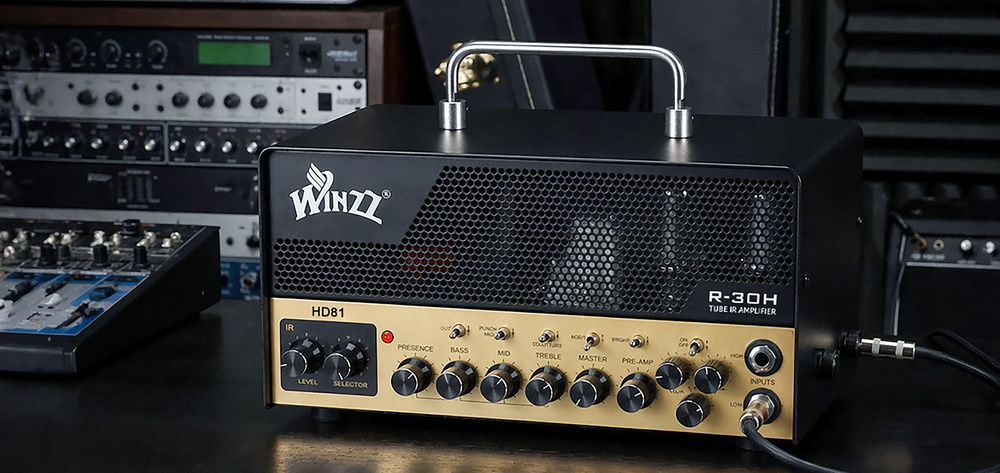
This amp’s neat marriage of analogue and digital technology grants it incredible tonal versatility — not to mention some very handy recording‑friendly features.
Conceived by Winzz’s designer Marty Zheng and electronics designer and professional musician Terry Buddingh, the R‑30H HD81 is essentially a lunchbox‑style guitar amp head — it measures just 24 x 14 x 14cm and weighs only 3.5kg — that employs hybrid valve and solid‑state technology to deliver a wide range of valve amp characters. Unusually, though, this incredibly portable amp also incorporates a digital convolution engine, which means you can run impulse responses taken from a range of popular speaker cabinets, whether commercial offerings or captured by the user. Importantly, these IRs feed a DI output, which can be used for recording or to deliver a miked‑cab sound to a PA, but they don’t affects the amplifier’s signal path when you’re driving a speaker cabinet. Furthermore, the amp has both High and Low input jacks, which have very different gains, the bottom (Low) socket allowing the Pre‑Amp gain control to provide a wider range of clean tones than when using the High input.
Winzz Of Change
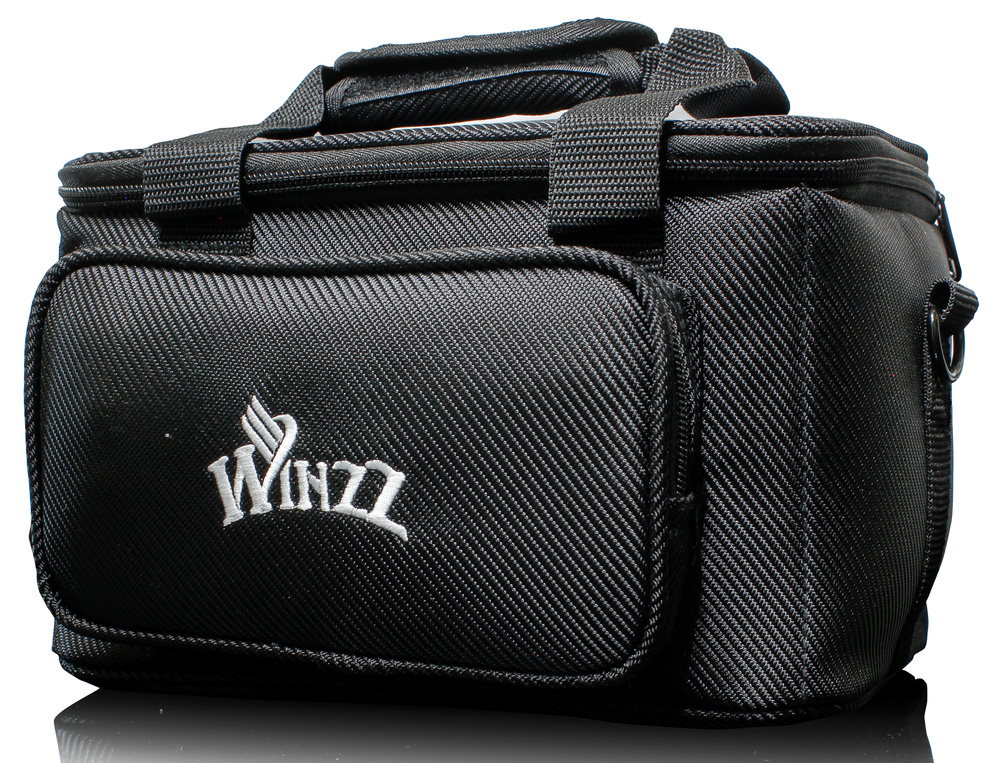 This amp comes with a handy protective soft carry case, with a side pocket for your bits and pieces.Apparently taking its inspiration from British high‑gain amps of the 1980s, the R‑30H HD81 uses a pair of 12AX7/ECC83 valves in its preamplifier. The signal that emerges from this stage is fed into a 30W, solid‑state power stage that can drive speakers down to 4Ω. The casework is all metal with ventilated front and rear panels and there’s a fold‑down, metal carry handle on the top. Two thumbscrews on each side of the case allow the cover to be removed to access the valves. A carrying bag, power cable and USB cable are included.
The amplifier’s topography includes a traditional passive EQ stage with Presence, Bass, Middle and Treble controls, though as I’ll come onto in a moment, there are additional switches that modify the tonal characteristics of the amp. As expected, the Pre‑Amp gain control sets the amount of drive while the Master volume adjusts the overall output level. Because of the way the amplifier is designed, with the overdrive created in the valve preamp stages, it is possible to get a ‘big amp’ sound at studio‑friendly volumes.
Multiple voicing switches further expand the sound palette. Clip is a three‑way switch that sets the character of gain and compression, while Structure, also on a three‑way switch, reshapes multiple parameters: gain level, frequency response, and the overall distortion timbre. The best way to judge these switches is by ear, and there’s a lot of interactivity between controls and settings. Punch/Fat also provides three options for the bass and low‑mid character, while Tight attenuates low bass to enhance the attack and clarity of the sound. A three‑way Bright switch enhances high‑frequency clarity.
The onboard Boost section, which appears to work only in conjunction with the High input, gets you ‘up to 11’ on solos without the need for drive pedals, though naturally this amplifier teams up perfectly well with pedals, especially if you use the Low input. Independent Bass, Treble, and Boost (overall level) controls add to the tone‑shaping capabilities of the amp if high‑gain tones are your thing. These are all accessed using the Boost switch. Given the amplifier’s small size, the front panel is understandably quite busy, with a row of six mini toggle switches and no fewer than 11 knobs. A down side of packing so much into such a small package is that it’s pretty easy to move one control by accident while you’re adjusting another — the Boost section’s Boost, Treble and Bass knobs are particularly cramped.
Other than the two input jacks, all the connections are on the rear. These include the USB‑C port for loading IRs (of which more in the separate box), and both XLR balanced and TRS unbalanced line outputs, whose feed includes the IR stage. A separate line out omits the speaker simulation, so you can have the option of taking clean and miked‑cab feeds from this amp simultaneously.
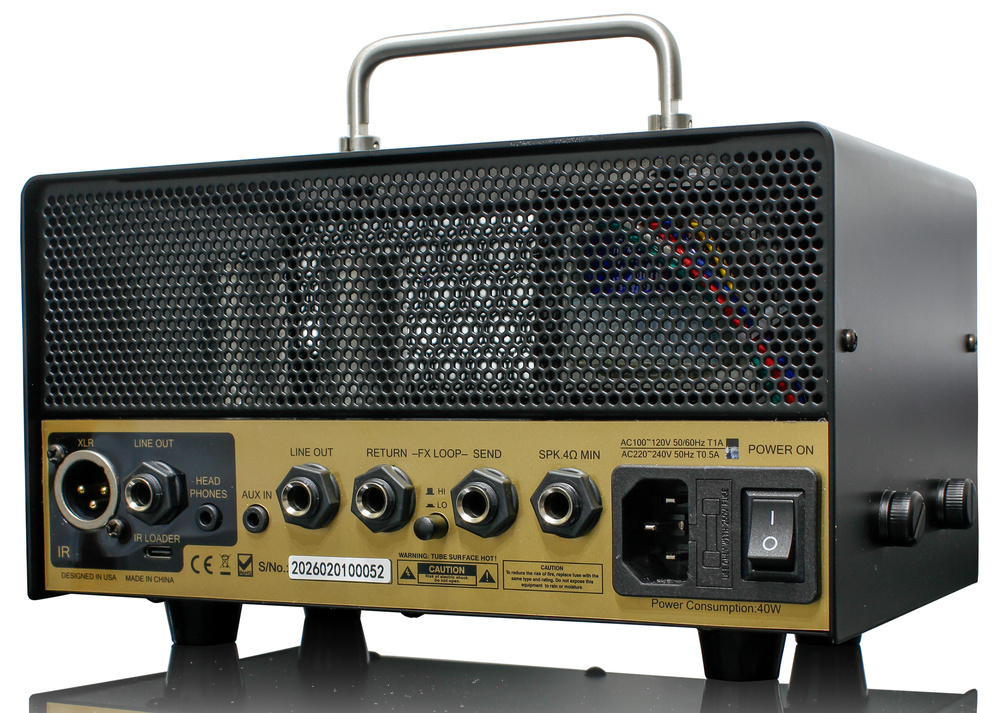 The Winzz R‑30H HD81has lots of I/O, including an aux input that bypasses the valve stage, both balanced and unbalanced direct outputs for the IR feed, a clean line output, a headphone output and separate send and return jacks for a post‑preamp effects loop.
A pair of send and return jacks accesses the effects loop, and nearby are the power inlet, power switch and speaker output. The effects loop is usually used for effects such as delays and reverbs, and to accommodate both pedals and rack effects, the operating level of the effects loop can be switched to +12 or ‑12 dB. A mini‑jack can drive headphones for silent practice, and the designers have also included an aux in mini‑jack for audio playback — this signal bypasses the valve stages, so as to keep the playback sound clean. My only comment here is that it might have been better to have a red plastic nut on the speaker output jack, just as a precaution, to help avoid accidental misconnection.
The valve preamp provides a nice, touch‑responsive feel — you get more breakup when you dig in.
For The Winzz?
So, what’s this thing like to play through? It’s clear that a lot of thought has gone into this amplifier. Indeed, it seems that the designers have tried to plan for every application and tonal requirement. That said, there’s no footswitch facility for adding boost when soloing, which would have been helpful. The valve preamp provides a nice, touch‑responsive feel — you get more breakup when you dig in. And having onboard speaker IRs means there’s already a great choice of characters when you’re recording or feeding a PA system. There’s enough here of a decent quality that you might not even need to load your own, but doing that is straightforward too, as long as you make sure they’re in the correct format.
Using the High input, getting a clean sound is quite challenging as you end up working right at the low end of the Pre‑Amp knob’s gain setting, but there are plenty of driven tones on offer. You can get anything from a blues‑y overdrive to extreme saturation and anything in between. The centre setting of the Structure switch is where you’ll find the least heavily driven tones. As touched upon earlier, you can’t always predict exactly what results you’ll get from those modifier switches, so the best option is to just try everything until you home in on a sound you like.
If clean or only slightly hairy sounds are what you need, then the Low input works best, as it only starts to break up towards the end of its travel with a Strat, but using this input I could hear no difference when moving the Bright and Tight switch settings, and the Boost section is also unavailable. I did find the clean and slightly hairy sounds available via the Low input to be tonally satisfying with a good dynamic feel, though.
The main difference I perceived between this amp and an all‑valve model is that it didn’t seem quite to capture the interaction between a valve power stage output transformer and the speaker, where the low damping factor usually gives the low end a pleasingly loose feel. The Punch/Fat switch on this amp certainly compensates for that to some extent, but it doesn’t do quite the same thing.
It’s worth mentioning that there’s no onboard reverb. In a small room, this means the sound can be rather dry, but of course there’s an effects loop that makes it easy enough to add a reverb pedal or studio effects if you want that. I also felt that some sounds could benefit from a compressor pedal being placed before the amp, as that apparent lack of power‑stage compression means the amp doesn’t have the same springy feel as an all‑valve amplifier.
Of course the end result also depends on the speaker cab you use with the amp while performing, and for my review tests I used a 1x12 cabinet fitted with a Fane driver. By way of volume there’s enough for most small and medium‑sized venue band gigs, as long as you have a suitable speaker cabinet (for maximum efficiency, use a 4Ω speaker). But you’d probably choose to mic or DI the amp anyway where more level is needed.
For live use, the lack of a ‘channel switching’ footswitch means you may have to use your own pedals to get the flexibility you need, and if I were to use it for gigging I’d probably stick with the Low setting, so I could set up a touch‑responsive, almost clean sound and then look to my pedalboard to add drive in front and delay and reverb in the effects loop. Care is also needed when adjusting the closely‑spaced controls.
However, give the affordable nature of this amp, its portability, and the number of tonal variations it offers, it’s definitely worth exploring — especially as a convenient and versatile recording amp, where the lack of channel switching won’t cause anyone a problem.
Impulse Response Engine
This amp’s built‑in impulse response (IR) engine operates at 24‑bit/44.1kHz and utilises 1024‑point processing. This translates to a 20Hz to 20kHz frequency range and a good signal‑to‑noise ratio, of around 100dB. As supplied, there are nine cabinet IRs associated with classic amplifiers by Fender, Vox, Marshall, Orange, Peavey and Mesa/Boogie, and these range from single‑driver cabinets to 4x12s. A straightforward 11‑position IR selector accesses factory options and adds two further user‑loadable slots. An adjacent Level controls adjusts the DI output level. Loading custom IRs is achieved by connecting the amp’s USB‑C port to a computer — the amp appears as an external drive, into which WAV‑format IR files can be copied directly. (Note that these should be in a 24‑bit/44.1kHz mono format; if you have them in another format it’s pretty easy to convert them.) Both balanced XLR and unbalanced jack DI outputs are available to feed a recording setup, a live‑sound console and so on. A separate line out that bypasses the cabinet simulation accommodates the connection of a separate power amp or third‑party cabinet emulator.
Pros
- Flexible tonal options.
- IR speaker emulations for the DI/headphone outputs.
- Generous I/O options, not least the effects loop.
- Very compact and portable.
Cons
- No channel switching.
- Cramped control layout.
- An onboard reverb would be nice.
Summary
A good‑sounding, versatile hybrid valve and solid‑state amp with built‑in IR support and generous I/O, the Winzz R‑30H HD81 isn’t expensive and has a lot to offer on stage and for recording, despite a few minor limitations.