

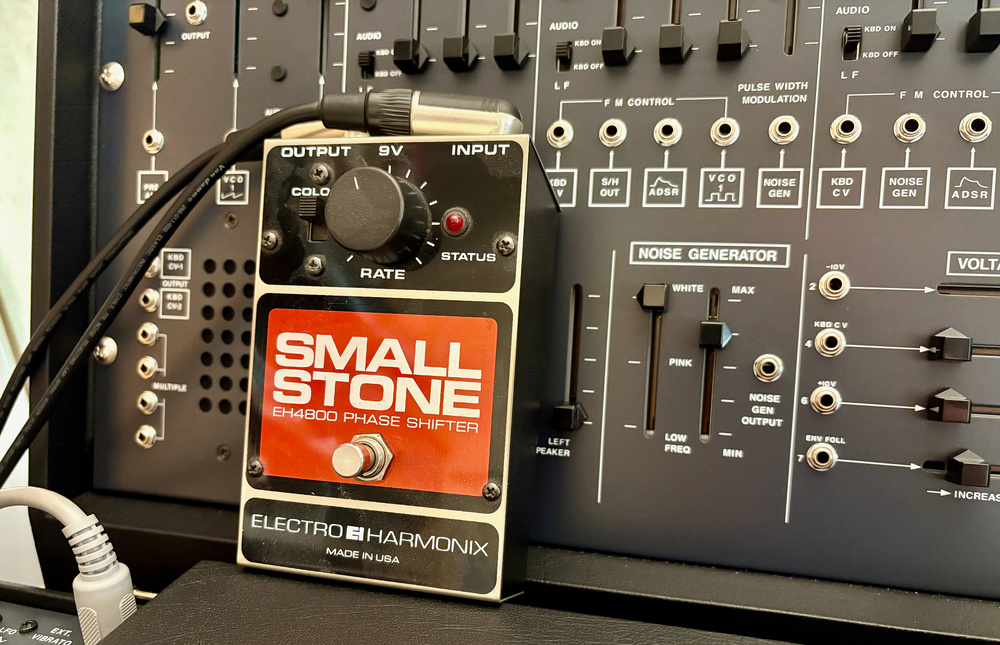
 It’s not vintage, but a modern Small Stone phaser with a noise generator can still sound amazing!
Once seen as only a nuisance, noise can in fact be a useful creative tool in the studio.
If you love the art of creating patches on hardware or software synthesizers, you’re probably well versed with the basics of subtractive synthesis. By and large, oscillators produce the initial tones, filters sculpt those tones, and envelopes assist in shaping and modulating tone and volume.
So far so good, but you’ll also probably have noticed that most synthesizers are equipped with a component known as a noise generator. This small section of your chosen synth will likely offer a sound that we call white noise. It might be located within the oscillator section, or even have an entire section all of its own, but it can often be one of the most overlooked elements that we have in our subtractive arsenal.
Noise Annoys
It’s my belief that one of the reasons for this stems from the generation you occupy; for those of us that grew up within the analogue age, our first exposure to white noise was possibly from an analogue, untuned television set. To add to the general ambience, the noise was accompanied by the visual equivalent, often described as a 'snowstorm'.
With the advent of digital broadcasting, the sound of that static has been entirely replaced by the sound of silence! No longer does the unobtainable radio signal give way to the sound of static when a car drives into a tunnel. This leaves a whole new generation bereft of the white noise soundtrack, accompanying the real‑world wind, rushing through that same tunnel.
More positively, the association of noise with sounds of nature is common. The sound of the waves of the sea or the whistling wind are common bedfellows, and easy to construct from white noise. This might explain the attraction of noise, in its purest form, for musical productions that adopt a passing nod to nature and the elements — just add pan pipes — but eco‑musicians do not have the monopoly on noise.
Given the limitations of many early synthesizers, it’s not surprising that noise was open to experimentation during the earlier years of electronic music production. Nothing exemplifies this more than the use of white noise by Jean‑Michel Jarre on his groundbreaking album Oxygene.
Armed with basic‑but‑glorious equipment, at least by today’s standards, his use of an EMS VCS3 synth, coupled with an original EHX Small Stone Phaser, created a backdrop for much of the album. Even he described it as “boring white noise”, but with a little musical intent and imagination the wave‑like swells that dominate the album prove the point that noise can be incredibly musical, atmospheric and engaging.
It also didn’t take long for synthetic musicians to realise that white noise, if modulated by a decaying envelope, could begin to mimic the sound of a snare drum.
What Is...
You are reading one of the locked Subscribers-only articles from our latest 5 issues.
You've read 30% of this article for FREE, so to continue reading...
- ✅ Log in - if you have a Digital Subscription you bought from SoundOnSound.com
- ⬇️ Buy & Download this Single Article in PDF format £0.83 GBP$1.49 USD
For less than the price of a coffee, buy now and immediately download to your computer, tablet or mobile. - ⬇️ ⬇️ ⬇️ Buy & Download the FULL ISSUE PDF
Our 'full SOS magazine' for smartphone/tablet/computer. More info... - 📲 Buy a DIGITAL subscription (or 📖 📲 Print + Digital sub)
Instantly unlock ALL Premium web articles! We often release online-only content.
Visit our ShopStore.