

This active nearfield monitor offers stunning audio performance from its extremely compact cabinet dimensions.
KRK Systems was founded in the mid 1980s by Keith R. Klawitter — a sound mixer in the American film industry with credits for Brainstorm and The Doors, amongst many others. The story is that he became frustrated with the limited clarity and accuracy of existing monitor speakers and so began designing and building his own. These designs were so successful that he decided to go into business manufacturing them, and so started KRK. One of the hallmarks of the company is its attention to detail both in the design and manufacture of its products. Apparently, the company's 5.1 surround systems employ speakers which are matched to within 0.05dB!
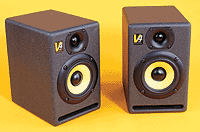 The subject of this review is the latest addition to the KRK V-range, the new V4 miniature monitor, which was launched last August and shown for the first time at the New York AES. In this case, 'miniature' is a perfect physical description — these things are tiny — but the sound they produce is anything but small.
Appearance & Construction
The V4 is a self-contained, active two-way system employing a reflex-loaded cabinet which vents through a slot at the bottom of the front baffle. Each box measures just 9.25 x 6 x 7.75 inches (hwd) — that is 23.5 x 15.2 x 19.7cm for metric types — and weighs about 5kg. The cabinet is finished in a 'fingerprint-proof grey Zolatone' which is a tough kind of mineral-loaded paint finish.
The two drive units are similar to those used in many other KRK products, with a one-inch soft-dome tweeter and a four-inch woven Kevlar bass/mid-range unit — both magnetically corrected to allow use near TV and computer monitors. The bass unit has a very distinctive yellow weave pattern, with a central dust cap which doubles rather cleverly as another radiating dome for mid-range frequencies. The tweeter dome and bass-mid centre dome are vertically aligned for accurate acoustical time-alignment — which means that the tweeter is recessed behind the front baffle and is coupled to the outside world by a flared wave guide. The crossover circuitry operates at 1.7kHz with 12dB/octave slopes, and there is also a 12dB/octave subsonic filter to remove low-frequency rubbish below 32Hz — a very sensible precaution to avoid inaudible low frequencies sapping the amplifier of useful power.
All of the cabinet edges are heavily radiused — and in the case of the front baffle this minimises diffraction and reradiation of high frequencies, which helps to provide precise and stable stereo imaging. The reflex port below the bass driver moves a considerable volume of air with bass notes. Internally, the port slot runs about two thirds of the way towards the rear of the box, maintaining its dimensions all the way. All of the internal surfaces of the cabinet are lined with dense wool damping material.
The amplifier chassis forms the rear panel of the speaker and its metal casing acts as a heat sink — the relatively low power means there is no need for heat-sink fins and the unit becomes only slightly warm to the touch after prolonged use. The amplifiers are based on LM3886 chips providing 15 Watts of power to the tweeter and 30 Watts to the more sensitive woofer. The standard of construction is very good indeed and I would be very surprised if there were any kind of reliability problem with this design.
The rear panel carries the input and mains connections, plus a screwdriver preset control to set the input gain anywhere from +6dB to -30dB. The input socket is a Neutrik combi jack/XLR socket (accepting balanced XLRs and TRS jacks, or unbalanced TS jacks) with a 10kΩ input impedance. At its unity gain setting, a +4dBu input will drive the speaker to full power, which provides a claimed 104dBSPL peak level at one metre.
There are no facilities to adjust the frequency balance, but I didn't find I needed them at all — the balance is remarkably flat and neutral in character and the specifications claim a frequency response of 65Hz to 20kHz ±2dB. It is a delight to find a manufacturer that specifies technical parameters accurately, especially as these are such good specifications for a small box.
Firing Up The V4
The KRK V4 is, in anyone's terms, an impressive speaker, because the sound it produces belies its diminutive size. It sounds big — the sound stage is broad and deep, with good stereo imaging and a pleasing sense of scale and space. Reverberant acoustics are also portrayed particularly well. Most amazing of all is the bandwidth — the bass response is almost unbelievable for a box this size. Several people who (unknowingly at first) auditioned these speakers actually thought they were listening to my reference PMC IB1s, which are considerably bigger and more expensive!
Don't go running away with the idea that these little V4s are better than high-end professional monitors, because they're not. However, they are extremely competent — outstanding, even — for the size and UK cost. The most obvious competition are the Genelec 1029A and HHB Circle 3 active monitors — and I think the KRKs would stand up very well indeed against them. The treble is smooth, detailed, clear and precise without being overly bright or fatiguing, and the mid-range is wonderfully neutral, with excellent vocal clarity which would shame many far more expensive monitors.
The bass end is obviously bolstered by the porting and has traces of that characteristic resonant quality in its sound, but it is not overdone and is very well balanced against the mid-range and treble. I have no doubt that the V4s really do have a flat response down to 65Hz, and the fall-off below that still carries sufficient energy to convey useful information about even lower frequencies.
Bass instruments obviously don't come across with the full weight and scale that can be obtained from larger monitoring systems, but the tonal accuracy is good and low-frequency energy doesn't muddy the mid-range unduly. Again, clarity is the watchword. Kick drums and bass guitars are quite believable, with sufficient weight for most purposes — certainly I had no problems building mixes on these V4s which translated extremely well to all of my other monitoring and hi-fi systems.
And that is the point really, isn't it? Over the review period I grew to really enjoy mixing on the V4s and to trust what they told me. I could hear pretty much everything that I was doing, and the mix sounded much as I expected on everything else. Listening on better monitoring systems revealed more detail, but there weren't any shocks. What more could you ask for?
The V4 is plenty loud enough for nearfield use, and isn't fussy about placement, although you have to keep it away from side and rear walls to avoid excessive bass build-up. The spectral balance is spot on, the sound stage is impressively wide and deep, and there is a remarkable degree of resolution for the size and price. The presentation is detailed but natural — something which was demonstrated well with voices — and overall these little monitors are very hard to find fault with. Highly commended.
KRK S8 Matched Subwoofer
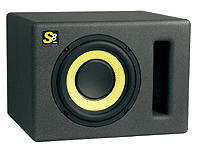 To accompany the V4 in situations which demand more bass and higher SPL, or to help form a compact 5.1 monitoring system, KRK have designed the new S8 subwoofer. Although the S8 wasn't available for review, I understand that it is derived from the larger S12 and S10 units within KRK's range.
Its MDF cabinet measures 10.5 x 14.75 x 12.63 inches (hwd), and contains a single eight-inch woven Kevlar drive unit. A slotted reflex port exits at the front of the subwoofer, much like the partnering V4. The unit incorporates a 100W amplifier with a variable low-pass filter (50-130Hz at 12dB/octave) to enable the user to adjust the crossover frequency to match a variety of satellite monitors, and a polarity reversal switch is also included to help match the phase of the sub with the satellites.
Connecting the S8 into a stereo system is a case of looping the stereo monitoring signal through the S8 via balanced XLR connectors. A second pair of XLRs provide outputs to a pair of satellites through fixed 80Hz high-pass filters. The S8's two rotary controls provide for the adjustable turnover frequency, and set the input gain for the subwoofer (the same +6dB to -30dB range as the V4 input control). This gain control does not affect the level of the outputs to the satellite speakers.
The frequency response is quoted as 43Hz to between 50Hz and 130Hz (depending on the setting of the turnover frequency control). The maximum peak SPL is 107dB at one metre.
Pros
- Stunning sound which belies the price and physical impressions.
- Detailed and precise, but tonally neutral and well balanced.
- Very flat response with superbly extended bass for cabinet size.
- Small size and weight.
- Matched optional subwoofer.
Cons
- None at this price.
Summary
A miniature nearfield monitor with major-league performance. Broad, expansive sound stages and wide bandwidth with remarkable bass, but spectrally flat and neutral in presentation. A true reference monitor.