

Alesis update their cost-effective nearfields.
The M1 Active MkIIs update the design of Alesis' popular nearfield monitors. Measuring 15 x 8.5 x 10 inches, the cabinets are conventionally constructed from heavy MDF with a dark grey laminate finish and internal damping to the side panels. Glass fibre is used for the damping and the upright front edges of the cabinet are rounded to reduce edge diffraction.
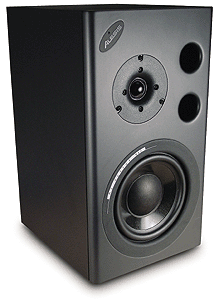 The bass/mid-range unit is a 6.5-inch driver with a 1.5-inch voice coil, and the tweeter is a one-inch silk-dome driver. Unusually, the woofer cones are made from non-woven carbon fibre, making them both lighter and stiffer than conventional cones, while the tweeters cross over at 2kHz and feature vented pole-pieces. The system is specified flat within ±2dB from 50Hz to 20kHz, and the response is 10dB down at 40Hz and 23.5kHz. No provision is made for frequency response adjustment.
The woofer cone is fixed in a damped rubber surround, with the voice coil in a Nomex spider permitting up to 10mm total cone excursion. The recessed rubber ring around the woofer smoothes the transition between speaker and baffle. Both drivers are magnetically shielded using compensating magnets and the cabinet has two small ports. The maximum peak SPL per pair is 118dB at one metre, while the maximum short-term SPL over the range 80Hz to 3kHz is 105dBSPL — this means that they're more than loud enough for nearfield use.
The amplifier packs are inside the cabinets and provide 25W to the tweeter and 75W to the woofer. The amplifier spec shows distortion at less than 0.02 percent THD and a signal-to-noise ratio of better than 112dB at the rated output. The crossover uses 24dB/octave active filters, and electronic time alignment matches the phase of the two drivers at the crossover point. A switching regulated power supply, which is much lighter than a conventional supply, drives the amplifiers. Audio feeds in via a combi jack/XLR connector and there's a level trim control on the back panel.
Listening Test
Testing with a range of CD material showed the Alesis M1 Active MkIIs to be capable of delivering a solid, detailed sound with good tonal balance and excellent imaging. The silk tweeters were crisp and detailed, but without the aggressive edge that often accompanies metal tweeters, and the bass end felt substantial, while still being well-defined and tightly controlled. Clearly the cabinet tuning has been tweaked to keep the bass end nominally flat down to 50Hz, with the result that it rolls off fairly sharply below this, but the internal damping and careful port tuning avoid the 'one-note bass' sound so common in small ported monitors. In all important respects, the M1 Active MkII sounds like a serious monitor and fills the important role of delivering a representative tonal balance, while at the same time providing enough detail to let you listen 'into' the mix without the sound becoming fatiguing.
Not all monitors sound the same, not even the good ones, but experience soon shows which ones are accurate enough to trust when mixing. The Alesis M1 Active MkII delivers everything that's needed from a small monitor, and while there may be more accurate monitors around, it competes very strongly with anything in the same price range. I'd certainly be very happy to use M1s as main monitors in my own studio. They have a tight, revealing sound with first-class stereo imaging and enough bass to work with while not going so low as to stir up room problems in a typical home studio. They're also small enough to form the basis of an excellent surround system. The speaker market is currently very crowded, but these deserve a position on the short list of anyone needing a small two-way active monitor with full-range performance.
Pros
- Well balanced, detailed sound.
- Nicely styled while still putting the money where it counts.
- Sensibly priced.
Cons
- No obvious cons, though some bass adjustment may have been useful to compensate for awkward placement.
Summary
A good project studio speaker at an affordable price.