

One of the original pioneers of electronic music in Britain, David Vorhaus has remained at the cutting edge of the genre for over 30 years.
There is a big difference between musicians who happen to use synthesizers and musicians who make electronic music. Although David Vorhaus started out as a classical bass player working with symphony orchestras, a chance encounter plus his background as a physics graduate and electronic engineer steered him inexorably in the direction of electronic music. "I guess it started around 30 years ago when I met Brian Hodgson and Delia Derbyshire, who were then in a band called Unit Delta Plus," he recalls. "I was on my way to an orchestral gig when the conductor told me that there was a lecture next door on the subject of electronic music. The lecture was fantastic and we got on like a house on fire, starting the Kaliedophon studio about a week later!"
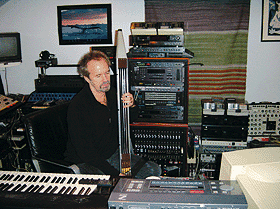 In order to exploit some of his bass‑playing skills in an electronic music environment, David invented the Kaleidophon, a kind of double‑bass‑like instrument using four home‑made ribbon controllers instead of strings. The instrument is played entirely using the left hand, leaving the right hand free to manipulate the sound via a number of controllers and a joystick.Brian and Delia worked with David on his early recordings at the same time as they were working at the BBC's Radiophonic Workshop. David's introduction to commercial recording came about because Island Records' Chris Blackwell was so enthused by their approach to electronic music that he offered them an album deal with what was then a significant advance. In 1969, David released White Noise: An Electric Storm. This was followed by White Noise 2 in 1975 and White Noise 3 in 1980, and David has just released White Noise 5: Sound Mind. As well as being available in record shops, a library version is also available through Music House under the name Science Friction. Between albums, David has written a lot of music for TV and film: his music features on a number of high‑profile TV commercials as well as on TV themes. David also plays live under the White Noise mantle.
Building Blocks
David always designed and built a lot of his own equipment, which was quite an achievement, especially in the early days, as there was very little published information on electronic musical instruments. I remember scouring the pages of Practical Electronics magazine at around the same time, trying to find out how synthesizers and effects worked.
"That kind of information didn't really exist then," says David. "Behind you is the very first synthesizer built in Europe, the Serial Number 001 VCS3 with Veroboard inside. I've got a few others, but that was the very first one. It was possible to come up with some very original sounds back then through experimentation with electronics, very often by accident. I remember one instance where I had built a circuit that was just slightly overloading and was on the verge of blowing a field‑effect transistor, and if you set it on the edge of runaway where it was just starting to avalanche, it would make the most hysterical‑sounding chattering noises. I've used that in tracks and that's really the way I make music — I find little quirks and then find ways of incorporating them.
"One of the first things I built was an analogue sequencer called the Maniac that plays as fast as you like, has variable step lengths and can be configured to do things other sequencers of the time couldn't do. If you used it linearly it worked as a 64‑step, duophonic sequencer, but I also built in the ability to split it into several smaller groups, which gave it the potential for cybernetic serendipity. For example, I might set one group to run around a sequence of seven steps and another eight steps, then add and subtract the control voltage outputs. That's the great thing about voltage control, you can just add and subtract, so I might have one sequence running octaves and fifths with the other running passing notes. That means it would run for seven times eight, or 56 steps before repeating. I could chromatically correct the output if I wanted to. Incidentally, the name is an acronym for Multiphasic ANalog Inter‑Active Cromataphonic (sequencer).
"Bob Moog had already built a 16‑step sequencer with all the steps the same, but it cost a fortune back then which kind of forced you to be creative when it came to building your own gear. CMOS chips were just coming out back then and they made this kind of project possible. I built it with the help of a friend, Johnny Sherrieff, and it could play faster and more accurately than I could. We called it the Maniac and I still use it today, but recently I've built a more sophisticated Maniac entirely in software using Native Instruments' Reaktor."
New Strings
Although David had extensive classical training, his main instrument was the double bass, not renowned as a control source for synthesizers. "I never really liked keyboard playing," he explains. "I had this fascist South African piano teacher as a kid and he put me right off. So, I sat down and came the the conclusion that I'd either have to learn the keyboard or invent some other instrument that would let my utilise some of my existing playing skills. You never succeed entirely in creating something that will let you sound exactly like a great keyboard player, but I knew that I could come up with something a little bit original and different. You can't believe how bad I still am on the keyboard. I use it as an input device — an 88‑note calculator! It's good for working out big chords in step time."
In order to exploit some of his bass‑playing skills in an electronic music environment, David invented the Kaleidophon, a kind of double‑bass‑like instrument using four home‑made ribbon controllers instead of strings. The instrument is played entirely using the left hand, leaving the right hand free to manipulate the sound via a number of controllers and a joystick. David describes the thought processes that went into its design:
"Being a bass player and not liking keyboards much, I wanted it to have a string‑type action, and that suited early synthesizers which were voltage‑controlled and monophonic. It seems to me so obvious that the keyboard is a glaring mistake in the direction electronic music has taken. No monophonic keyboard instrument has survived the test of history, yet all orchestral instruments are essentially monophonic, which enables them to be very expressive. When you try to add expression to an electronic keyboard sound, it just sounds like sine waves being pushed in via a control wheel and I think that's why in the early days electronic music got a reputation for being very sterile. I believe that the range of available electronic sounds is potentially as expressive as anything achievable from a traditional instrument, but what's missing is the means to control it effectively.
"I made the ribbons for the Kaleidophon using thermal paper which has a carbon underlay with a wax coating. I got hold of some of the material before they put the wax on and, amazingly, its resistance was quite linear. Obviously paper wasn't robust enough so I got them to put it on plastic. Eventually these were made for me by the French Space Agency because the person who worked for Ozalid in the UK, who made the original strings for me, died and took the manufacturing secret with him.
"The triggering is activated by pressing on the strings and the fingerboard is velocity‑sensitive so you can hit it harder to get a louder note or a different effect. There are controllers at the bottom for the right hand and other devices such as chromatic switches to make it behave like a fretted instrument. It can also be semi‑fretted, which corrects you if you're close to the right note but still lets you do slides.
"The instrument itself generates voltage control, but I can feed it into my CV‑to‑MIDI converter and use it to control just about anything. At the moment, the MIDI is being fed in to a Zyklus performance sequencer which can do all kinds of tricks. It came out at around the same time as the Atari, which people bought because they wanted a more straightforward sequencer while the Zyklus was rather quirky and weird. It didn't sell well because it was quite expensive, around 2,000 quid at the time, but it's a great tool as it allows you to modulate what you're doing in real time."
David breaks off to demonstrate some Korg Wavestation sounds controlled by the Kaleidophon and the Zyklus, which were then passed through Oberheim analogue filters. "I'd really like to build something like the Zyklus in software that would allow me to combine my real‑time playing and performance control with simple sequences that are modulated by what I'm doing.
"I have thought about trying to make the Kaleidophon commercially available and this one got very close to production. One option is to get a big company to take it on while the other is to get a group of friends to build it. However, it's hard to get the big companies interested because they would rather make products based on something that already exists, so that they know they'll have a market. On the other hand, the group of friends approach means you have to stay closely involved all the time and it would be a full‑time commitment. I had to decide whether to be a full‑time musician or a full‑time manufacturer, and clearly music is what's important to me."
The instrument was a joint winner of an International Electronic Music Instrument Competition in Austria: David shared the prize with the Fairlight CMI, and he soon became close friends with Fairlight designer Peter Vogel, who went on to help David with some of his designs. "Up to then I'd spent half of my life building gadgets to help me make music, but Peter was head and shoulders above me in designing stuff, which meant I could spend six months of the year using it to make music and then spend the other six months of the year in Australia, which is what I tend to do."
David still builds equipment if the device he needs is not commercially available, and his DIY approach has even extended to sophisticated recording hardware: "I still make all sorts of things, though probably not on the same scale as I used to. In the early days I built my own one inch, 16‑track recorder using electronics and Meccano! I even got a 24‑track together using redundant stock from Levers Rich.
"I still have a 24‑track Soundcraft two‑inch recorder but I probably won't be using it for future projects, even though I don't have the heart to sell it. Now I do everything in Cubase running on a PC. When I first got it, I played around with it to find out how it worked, did a few overdubs, messed around a bit and thought I'd send this piece of junk to the record company along with the 'proper' stuff I'd been working on. I didn't even give it a name but that bit of junk ended up being 'Ulster Weather', and was earning me 20 grand a year. PCs change so fast and what is fast one year is obsolete the next, but stuff is so cheap now that you can afford to keep upgrading. It's a complete reversal of how things used to be when a Fairlight was £20,000."
Computer Intervention
David's system continues to evolve, and now combines equipment that goes back to the dawn of electronic music with modern instruments from the likes of Novation, and also virtual instruments. "I used things like the Supernova a lot on my last album and I like the way you can control everything in an analogue‑like way but be able to record it via MIDI. Also, now that computers are so inexpensive and so powerful, I'm convinced that software instruments is the way it's going to go. The discovery of Reaktor was almost a dream come true for me, because it allows me to build the kind of synths in software that would have a taken a lot of time and expense to build using hardware. It's like going back to my early build‑it‑yourself days but without the need for a soldering iron or Meccano, and of course no component costs. It's fantasy — not like hardware where everything takes months and you spend ages debugging. You just connect everything up and it works, straight away."
David demonstrates the latest device he'd built in Reaktor, which seems very typical of the way he makes music in that sequencers, sound generators and human inputs interact, sometimes in not entirely predictable ways. For example, one of the sequencers is linked to a probability generator which determines whether certain notes are or are not played.
"It's all about finding the interesting bits of things that are not predictable," explains David. "You can bias the notes so that the volumes are controlled by probabilities or, in the case of a module that I called the Transmutron, you can take bits of information from one source and then take semi‑random elements of other lines of music to influence the outcome. Of course when you get so many virtual knobs, it's hopelessly clunky trying to control it all with a mouse, so I've hooked up one of the little Fostex MIDI mixer control units to access the main parameters in real time. It's so small and light it looks as though it came in a packet of cornflakes, but all it needs is a MIDI In and Out, and it works. Having physical controls allows you to bring one thing down while turning another up — something you can't do with a mouse. Also, Reaktor can learn control assignments fairly quickly.
"I guess the idea was to complement the Kaleidophon, which is a great lead‑line instrument but at the same time it needs an accompaniment, otherwise it sounds very naked out there. This is really an electronic orchestra that does anything except the lead line, and it started from the idea of the hardware Maniac I made all those years ago to do the same kind of job by driving half a dozen VCS3s. The soft version generates its own sounds and my approach is to experiment to find things I really like and which are musically appropriate, such as some of the rhythm loop things. Some elements are based on samples, but the rhythm loop length can be changed in real time to emulate the variations a real drummer might introduce during performance. However, it gets to the stage where there are so many things to control that you don't have enough hands to manage it all, which is why I've created it so that some of the controllers are automatic, enabling the thing to control itself. That way I can combine the automatic controllers with real‑time input. There's also a sample playback section that can scan and loop around short sections within a sample, which completely changes the sound. It's a very creative way of using vocal samples."
Plug‑in Weirdness
Unlike some pioneers of electronic music, David Vorhaus has embraced the idea of recording and processing sound using a computer, and is enthusiastic about the possibilities that are opened up by plug‑in effects. "GRM Tools is a favourite because you can get effects that aren't achievable any other way, even though the core effects are based on established principles. I also have Spektral Delay, but I haven't got much out of it yet — I'll go on experimenting until I find the magic. It's the same with some of the effects you can connect in [Native Instruments] Reaktor — often you end up with results you never conceived of. I think that part of getting new gear is to force yourself to work in a different way, otherwise you tend to make tracks too much like the last ones. You don't see too much new hardware here as, in a sense, very little is actually new other than different internal sounds or different knobs, but there's some very exciting stuff happening in software. I was reading about Absynth in the latest issue of SOS and look forward to trying it. In fact one of my favourite hardware instruments is still the Korg Wavestation, and for me, everything that Korg has come out with since is a bit of a disappointment. The Wavestation concept could be taken so much further with today's technology, and if you combined it with the interactive sequencer of the Zyklus, you'd really have something.
 David's Soft Maniac built with NI Reaktor."I've just constructed a VST version of my Soft Maniac in Reaktor so now I can put it directly into a Cubase track, whereas before I've often had to record sequences as separate elements and then place them into a song. I had to resize all the knobs to make it fit into the VST window. I haven't used it in a composition yet but I have started to experiment with it.
"Other than Reaktor, there are few soft synths that impress me. It's great that you can get a PPG in software, but it offers nothing new other than convenience, and it's much the same with samplers. That's fine, but I'd also like to see something new, like scanning around within a sampled waveform. You could do this in the old EPS which came out 10 years ago, so I don't know why modern instruments don't offer the same kind of flexibility. Everything seems to be going for convenience, whereas what I'd like to see is just a bit more weirdness."
GM‑Free Zone
You don't have to hear much of David Vorhaus' music to realise that he's not very impressed by the General MIDI sound set or even emulative synthesis of any kind. Most of his sounds are defiantly abstract, and anything that was once real (such as guitar phrases or voices) is usually twisted beyond recognition before it's allowed out!
 "I feel synths have been so misused from the word go, by which I mean the way in which they have been used to attempt to emulate real instruments. It is such a shame because we shouldn't be aiming to put musicians out of work but instead to discover new things. We've been limited to a dozen or so musical instruments since the invention of the orchestra and now we have an infinite range of sounds at our disposal. What a terrible shame not to use them!"
At the same time, David's music is as much about controlling the sounds as the sounds themselves, and nothing is allowed to stand still either spatially or timbrally: "I think you have to do this with electronic sounds, more so than with conventional instruments, because something like a sustained piano note has a constantly changing waveform to keep it interesting, whereas a sustained electronic waveform tends to sound uninteresting. That means you have to build in that variation in other ways.
"Some of my tracks explore what can be done with certain types of synthesis, so the track 'X7' is really an exercise in seeing what can be done using FM sounds. Just as analogue sounds are being used in dance music, FM originally came along because it was better at recreating certain types of real instrument than analogue, then samplers made FM somewhat redundant, but as with analogue, people missed the point that FM can make amazing sounds if you stop trying to imitate real instruments.
"Another track called 'Time Warp' includes some interesting tricks such as making something not sit on a pitch base throughout the track. What I did was arrange the pitch of the whole track to fall continuously, but not enough so you hear it as pitch‑bend — probably around a semitone per half minute or something like that. You can't hear the pitch falling, but you experience a kind of instability as though the ground is falling away beneath your feet. It was achieved simply in Cubase by drawing a long ramp in the Controller window and using that to drive the pitch‑bend on all the instruments.
"The other trick was to use a flanger set up statically so that it didn't sweep. This has the effect of panning all the different overtones to different positions because of the comb‑filtering effect, then part‑way through the song I moved it to another position by changing the delay slightly, which suddenly changes your view on the music. Of course working with a sequencer such as Cubase makes this very easy to achieve technically using plug‑ins which can be automated. I think MIDI is misunderstood, because to some people it's all about notes or GM sounds, but to me, the most important part of MIDI is the controller aspect."
More extreme modulation and distortion techniques seem to be used to hide even the identity of the electronic sources themselves, to make them deliberately new and different. There are no string pads, in fact few soft pads at all, and a lot of the sounds have a challenging, almost industrial edge to them. "It's not a conscious thing," says David. "It's just something I do automatically to try to make things more interesting. There's no point in still doing the things you did 30 years ago. I guess part of the reason the latest album sounded the way it did is because record companies still insist on forcing you into a pigeonhole, so they demand to know what label they can stick on your music. So I called it 'Dark Ambient', because if you don't have a label, you get listed under 'Miscellaneous'. It means I won't be getting on Top Of The Pops, but I felt the category was broad enough that I could redefine it in ways that I couldn't redefine other genres, such as country and western — much as I'd like to! There's a lot of scope for experimentation and on one track, 'Dark Matter', anything that is recognisable is out — no harmony, not pitch, no rhythm. It's so dark, you can't even see the stars! Some of the other tracks are more accessible. There were one or two guitar notes and riffs, but it's mostly electronic. I use voices a lot too, but not as conventional vocals. I always use a lot of voices, and if somebody having an orgasm in the background is used as part of one of the waveforms, it makes the sound more interesting without the listener actually knowing what they're hearing."
 That certainly isn't going to help get David on to Top Of The Pops — although it's always possible he might get banned from Radio One and become an instant hit... "Actually that was the idea on my first album, White Noise 1," laughs David. "There was a track where I created a synthesized electronic orgy and then combined that with the sounds from a real one. I recall we actually had half a dozen people 'at it' and we were going round with a microphone! We used it in loops and stuff, but as it turned out, we only managed to get banned from Harrods! A shame really."
Working Methods
David's music rejects a lot of conventional ideas about structure, but how does he set about creating it? "I have no basic rules on recording methods," he says. "If I'm recording a commissioned piece for somebody, then it has to follow their guidelines and may be put together very differently from something I'm composing for an album. A typical example is the theme I did for Equinox, which had to tie in with the graphics and hit certain cue points. Everything was very mapped out, so I use making albums as a way of exploring new things and the rules kind of evolve as I go along. I tend to get a lot of sounds together first, keep the ones that fit, reject the ones that don't, and often a musical idea will evolve out of the sounds I start with. I also use a lot of controller data alongside my loops. I tend to use an album as a means of exploring new equipment or software, and the album is really a culmination of what I can do with the stuff. At the moment I'm at the stage of exploring the equipment — and I guess Reaktor is the new thing."
The Pros And Cons Of Dance Music
There seem to be some parallels in David Vorhaus' current work with the more adventurous aspects of dance music and related genres. I was keen to find out what he thinks dance has given us that is positive, and in what ways he finds it counterproductive.
"Dance music sees analogue synths being used at last for what they should be used for," he says, "but what I think is unfortunate is that the genre has become very fixed, so one has to have a particular set of sounds. In some ways that's worse in that modern equipment is being used to imitate early synthesizers rather than acoustic instruments, and to me that's equally ridiculous. Is that a 303 sound or a 909? I find that totally pointless and we sometimes fall in love with the idea of a sound rather than the sound itself. Some people will tell you that you have to get a Moog for the definitive Minimoog sound, but that's just a load of bollocks. What people have forgotten is that what really turned them on when they heard a Moog for the first time was that they'd probably never heard a synthesizer before, and it's that experience of hearing the first electronic bass sound that is the turn‑on, not the actual instrument that's being used. If you then reproduce that sound on a [Novation] Supernova or something, people will tell you it's not the real thing, even though it is every bit as good or better than the original. It's just that it doesn't give you the same buzz as when you first heard it 30 years ago."