

The drum kit can be one of the most time-consuming and frustrating of instruments to record, so it's worth taking a structured approach.
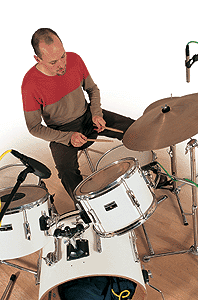 Photo: Richard EcclestoneThe phenomenal advances in integrated drum machines and sample-based drum sources controlled by sequencers mean that few of us bother recording real drum kits any more. However, there are still a large number of drummers out there (they haven't all been caught yet!) and some people still like the sound of real drums. So this article has been written to try to provide some useful pointers and guidance on how to record drums effectively with the resources available.
Setting Up The Drums
The typical drum kit consists of a kick drum, snare, a couple of tom-toms mounted on stalks from the kick drum, a floor tom, a hi-hat, and a couple of cymbals — maybe a crash and a ride. Obviously, many drummers have a lot more to hit than this simple list, while some make do with less. The overriding element, though, is that it is all percussion. It sounds obvious, doesn't it — so why say it? Well, the thing about percussion is that it is very transient-rich and it's usually damn loud! Naturally, that affects the kinds of microphones we choose and use, the kind of processing that we apply, and the problems we can expect to encounter along the way.
Before the drummer starts to assemble the kit, ask if there are any elements that won't be used in the songs that you will be recording. Not rigging superfluous bits saves time and may reduce the likelihood of rattles, although empty fittings may also rattle more — you'll have to make an assessment with the drummer at the time. I once spent twenty minutes before recording a live gig trying to optimise a close tom-tom mic and the associated gate in the desk channel. A week later, when I was remixing the multitrack, I discovered that that particular drum wasn't used in the entire recording!
Before even unfolding the first mic stand, it is absolutely essential that the drum kit sounds good in the studio. A soggy, rattly kit will always sound soggy and rattly, no matter what magic you do with your microphones and sound desk. A tight, good-sounding kit will be a lot easier to record and will sound a lot nicer as a result, so it's well worth spending an hour retuning and sorting out the kit, compared with a day messing about with gates!
 Miking close to the plane of the cymbals (top picture) will reduce their relative recorded level. Miking from above the cymbals (bottom picture), on the other hand, will give a more cymbal-heavy sound.Professional studios usually have a dedicated booth in which the drums (and drummer) are placed. This serves several purposes. First, it helps stop the drummer from breaking anything expensive out on the studio floor — no, only joking! The walls of the booth may well be made of brick or stone, to give a hard, bright, reflective sound that often suits rock drumming, or it may be well damped and absorptive so that it adds no character at all. The booth also provides a very high degree of isolation so that the drum sound does not spill onto the mics over a string section on the studio floor, for example. Very few home studios have the luxury of such facilities, but it may be possible to improvise something similar if you have a large multi-room venue at your disposal.
If the drum kit has to be in the same room as the rest of the band, then acoustic screens are a good idea to try to stop too much drum sound finding its way into the other instrument and vocal mics. You can make very effective temporary screens out of piles of cardboard boxes or mattresses with simple wooden frames to hold them upright. You can either use a double mattress on its side, or several singles on end — or a combination of the two — the idea is to screen off as much of the kit from the rest of the band as possible. This won't provide total isolation of course, but it should make a considerable improvement and is generally worth the effort.
It's not just about stopping the drums from leaking into other instrument and vocal mics, though. If the backline is loud you may well find its spill getting into the drum overheads. Hanging a duvet from a ceiling beam in front of the kit to provide some screening for the overhead mics can be helpful in this regard. Give some thought to sight lines too — the drummer may find it easier to play if he (or she) can see the rest of the band.
Tuning The Kit
All drum kits are not the same — there are different types of batter head, shell, and drum stick — the combination of which defines the overall sound. For example, snare drum heads with a black sound dot tend to have a fairly damped response, whereas plain ones ring on for longer. Heavy, thick heads tend to be louder and duller, and decay quicker than light, thin heads, which sound noticeably sharper in their attack and ring on longer. Likewise, cymbals will sound very different, depending on their size, manufacturer, shape and intended purpose.
 As may now be obvious from the preceding paragraph, I'm no expert in drum kits, just as I know little about the different makes of Tuba or Bassoon — the choice and detail is down to the musician playing the instrument. However, I do know that if the kit is not tuned correctly, just as if the bassoon is not tuned, the results of a recording will be very disappointing. Tuning a drum kit is a reasonably complex job, not unlike tuning a piano — there are lots of tensioning adjusters to twiddle and they have to be correct in relation to one another to provide the ideal tuning.
With tom-toms and snares it is important that the head is tensioned equally around its rim. This is best done by backing all the tensioner keys off completely, then winding them up by hand until they just start to get tight. From this starting point, adjust keys in pairs on opposite sides of the head, much like you would the nuts on a car wheel. Start with a full turn (maybe two) to take up the tension, then apply a heavy pressure to the centre of the head to stretch it a little and help it to equalise its position. Next, continue winding up the tension a half turn at a time, working on opposite pairs of nuts all around the head, until the desired pitch is achieved. You can check for an even tension by hitting the head close to the rim between each pair of adjusters — the pitch should be constant all around the head.

The drum shell forms a resonant cavity and so the tuning of the head is dependent on the tuning of the shell — get the two properly matched and the shell reinforces the sound of the head, giving a loud, full tone. On snares (and toms if applicable), the bottom head is tuned in the same way, but its tuning relative to the top head is the critical thing. When the bottom head is removed from a tom it tends to make the drum louder, and affords a wider tuning range because the resonant frequency of the shell is broader. However, if the bottom head is fitted its tuning is critical. Tuning higher than the top head (up to about a fourth) gives a slightly duller attack, but an interesting pitch bending effect. If tuned lower, the attack is sharper but the sound is more damped.
Depending on the tuning and the condition of the heads, you may find some drums ring too much — most often the snare. Sometimes this can be cured by simply retensioning the skin, without changing the actual tuning. Some tom-toms have an internal damper which can be used — although in my experience they tend to rattle more than anything else and, since they tension the head at only one point, often don't do a particularly good job. A common solution is to make up a thin pad of tissue (or a handkerchief or duster), and tape this to the side of the head leaving the side facing the centre open to vibrate freely and thereby help to damp the ring. Alternatively, putting thin strips of plastic insulating tape in wide parallel lines (or even a noughts and crosses pattern) across the skin can help a lot too. Take this damping too far, though, and you will suck all the life out of the kit — your drummer may as well play a pile of cardboard boxes — so listen critically to any modifications you make.
 When tuning a drum, make sure to tighten nuts in opposite pairs, as you would with a car wheel. It's also worth applying heavy pressure to the centre of the drum head with your hand now and then in order to help even out the tension across the head.With a snare drum, a tight batter head gives a crisp, sharp sound, whereas a lower tuning provides a deeper, 'fatter' sound. Equally, setting the bottom head to be fairly loose gives a deep resonant tone, while a higher tuning gives a much crisper snare effect. The snare is probably the most frequent cause of unwanted rattles. Check the mechanics of the snare action and damp with masking tape if necessary. Some tissue paper folded between the snare wires and head can help control unwanted vibrations — try moving the tissue pad from the edge towards the centre to find the optimum location.
As regards the kick drum, a tight, well-tuned beater head gives an identifiable tone and a full body, whereas a looser head gives a more clicky sound with obvious attack — you are looking for the compromise that best suits the musical style. Clearly, a harder beater will also provide more attack and click than a soft beater.
In my experience there isn't much that can be done with cymbals (other than putting them back in the box), although radial strips of masking tape can help to dampen the ring, if found necessary. Once everything is tuned up properly, listen for squeaks and rattles. Loose hardware can be damped with masking tape, and a squirt of WD40 can cure most squeaks.
Enter The Microphones
Okay, so we have a well-tuned, good-sounding drum kit in an appropriate acoustic — be that well-damped with mattresses and cardboard boxes, or in a live room. The next thing to do is decide on how to mic it up. Almost every engineer will have their own preferred technique, and this is one area where there really are very few rules. This is partly because, of all the band instruments, recorded drums are probably the one source where an inaccurate, unnatural sound is often a desirable thing.
 Probably the most purist approach is required in acoustic jazz, so let's start with this situation. Much like orchestral percussion, the most natural sound can be obtained with a high-quality condenser mic positioned overhead and either in front of or behind the kit. Most engineers prefer large-diaphragm condensers in this role, although small-diaphragm mics can be just as effective in most applications. You will see almost everything used in this role, including the Neumann U87, TLM170, TLM103, KM84 and KM184; the AKG C414B, C3000B, C4000B, C1000S and C451; the Sennheiser E664; and the Audio Technica AT4033 and AT4040. Pretty much any cardioid condenser will do. On pure jazz recordings, Coles 4033 ribbon mics also work very well indeed.
Back in the days when I was working in mono television broadcasting (actually it was only ten years ago!), I found a single, wide-cardioid mic placed above and behind the drummer's head worked very well. Placing a stereo mic (the Soundfield works extremely well in this role) in the same place usually provides a very natural and well-balanced sound too. The exact mic position will need to be played around with a little, naturally, to find the best balance of drums and cymbals in the acoustic, but it is quite a good starting point.
It is worth bearing in mind that, while the cymbals tend to radiate sound in a bipolar or figure-or-eight pattern above and below the metal plate, the hi-hats tend to radiate sound horizontally. This information provides two clues to help position your mics. Firstly, you can reduce the level of cymbals relative to drums by bringing the mic closer to the plane of the cymbals, where they will radiate little energy. If you want more cymbal, move higher and more directly above them.
Since the cymbals radiate up and down, you can also place mics below the cymbals, closer to the drums themselves. In fact, this used to be a very common way of miking up kits in dance bands — often with just a single condenser cardioid mic in front of the bass drum on the plane of the hi-hat (to ensure it was heard clearly), and angled towards the snare. I wouldn't advocate this technique these days, but it is an educational thing to experiment with. However, in general, a better overall kit sound is obtained by going overhead, and you can often find an acceptable balance of most of the kit anywhere between two and three metres above the floor, and either behind or in front of the kit. The more distant positions obviously require a good acoustic environment and low levels of spill from other instruments.
 When using spaced drum mics for stereo, don't worry too much about them being set up symmetrically , as long as the balance of the instruments is right.Clearly, there is the potential for your mic stands to overbalance, especially if you've got the mic on the end of a long boom arm extended high over a drum kit. For this reason it is important that you use stands with heavy bases, or that you weight the bases with sandbags or some other suitable, stable, counterweight. If using a stand with tripod feet, make sure that one leg extends directly under the boom arm to ensure maximum stability.
If the coincident stereo miking approach is not to your liking, or you have to work with closer overhead mics because of the ambient conditions, then the most popular configuration is a pair of cardioid condensers set up as overheads and spaced apart to cover each half of the kit separately. Again, some experimentation will be required to obtain the best balance, and don't worry about keeping the mics symmetrical — either in their height or position. In this role they are effectively covering independent elements of the one large instrument. Place them where you find the best individual sound balance for the appropriate section of the kit — much as you would place two mics in a grand piano to capture the high and low ends independently.
Miking The Kick Drum
In general, and certainly in acoustic jazz, the sound from the overhead mics will be the defining sound of the kit, and the basis on which you might want to add further 'spot' or 'accent' mics to obtain the desired composite sound. In almost every case, you will want to add a mic to bolster the kick drum.
 For more stripped-down jazz and dance-band kits, a single mic in front of the kick, on a level with the hi-hat and pointing at the snare, can do a fine job.The size and repetitiveness of the pressure wave emanating from a kick drum makes this a relatively tough job for any microphone to withstand. For that reason I never use my best condensers, and rarely use a condenser at all — a moving-coil mic is actually better suited to the job, being inherently more robust. A good high-frequency response is clearly not required in this role, and a thicker diaphragm is less likely to become stretched and floppy over time. An extended low-frequency response is usually an advantage.
Given the physical abuse of the mic's diaphragm when recording a kick drum, I allocate one mic specifically to the purpose, and mark it clearly. This is for two reasons: firstly, after an extended period recording kick drums it is likely that the diaphragm will have stretched and deteriorated, and therefore not sound as good as a microphone used for less arduous duties. Secondly, I really don't want all my moving-coil mics to suffer the same fate unnecessarily, so marking one mic purely for kick drum duties preserves the life of the others.
Ideally, I would use a purpose-designed kick-drum mic, and most manufacturers have dedicated models, pretty much all of which are moving-coil designs. AKG have their D112 (and the classic D12 before that), Beyerdynamic have the Opus 65, and Sennheiser have the E602, for example. These are all fine performers, although the AKG model is substantially more expensive than the other two.
When placing the mic, it is a good idea to stay away from the centre of the drum head, because there will be a wider and better balance of harmonics closer to the edge. If the front head has been removed, or has a large enough hole cut in it, then place the mic on a stand and position it close to the beater head, about halfway between the centre and edge. Small changes in position can make a big difference to the sound, so before reaching for the EQ knobs make sure you have put the mic in the best place to start with.
Again, if the front skin is missing, make sure the unused fixings don't rattle. A blanket, heavy pillows or other dense fabric placed in the bottom of the shell and pressing against the beater head will help dampen any ringing and provide a much tighter, more rock-oriented sound.
Depending on the relative position of the overhead mics and the kick drum mic, the initial wavefront from the kick drum may reach them in different relative phases. If the polarities are reversed then a lot of low energy will cancel out, leaving a thin sound. It is therefore important that you experiment with the phase switch on the kick drum channel to find the position which provides the fullest bass end with the overhead mics faded up.
With most kick drums, I have found it generally useful to thin out the mid-range a little with the desk EQ, around about 450Hz, which reduces the tendency towards sounding like a cardboard box. A little presence boost around 3kHz helps the beater click to cut through, and you can filter off everything above about 5kHz to remove cymbal spill.
However, I recommend recording flat and introducing the EQ only during the mixdown stage, as the precise frequencies and amounts will depend on the other instrumentation and the overall mix. The key is to make the kick drum and bass guitar (or acoustic bass) complement one another without creating a stodgy, muddy bottom end. That often means thinning out the bottom of the kick drum to leave room for the bass.
At this stage, you should have a well-balanced, natural sounding drum kit with a nicely weighted kick drum and a good overall sound through the overheads, panned for stereo if required. If the drummer is a good one, the snare, hi-hat, toms and cymbals should all sound in the appropriate proportions. A surprisingly common problem, though, is for the drummer to be a little light on the snare drum and heavy on the hi-hat. If this is the case then you will have to consider adding another spot mic for the snare drum.
Snare Drum & Hi-hats
 The most common positioning for the snare mic is pointing over the rear lip of the drum towards the centre of the skin. Try not to have the mic too far over the drum, otherwise the drummer might inadvertently hit it!There are as many ideas for miking snares as there are for the rest of the kit put together! A small pencil-type mic is the most practical to squeeze in above the snare, and this could either be a condenser like an AKG C451, or a dynamic mic like a Shure SM57. A dynamic mic is often the more attractive option, since it is more robust (the drummer might accidentally hit it) and it has a restricted transient response compared to the condenser mic. What this means is that the microphone's relatively heavy diaphragm can't respond quickly enough to follow the entire dynamic transient of the snare drum, and so acts as a kind of limiter. Whereas this would be a bad thing in the context of recording the percussion section of the LSO, it can be a very good thing in this situation, as it helps to produce a better-controlled, fatter, bigger snare sound. Again, because I believe mics are delicate little things to be handled with care and love at all times, I have dedicated a single dynamic mic for snare duty — and it has already acquired a dent courtesy of a careless 'Rambo' drummer!
 If you place the snare mic too close to the hi-hat and on a plane with it, the blast of air from the hi-hats opening and closing will become audible.The mic should be placed near the edge of the head for two reasons: firstly to minimise the chances of it getting hit, and secondly because a fuller range of overtones is present near the edge. Also, being a cardioid mic, the proximity effect will help to lift the low end, giving an even fuller sound. Aiming it toward the area where the drum sticks hit the batter head will help to provide the maximum attack.
However, be wary of placing it too close to, or looking directly at, the hi-hat, since the 'chuff' of air produced when the hi-hats close is usually sufficient to cause blasting on the snare mic. A hypercardioid mic is sometimes a better choice than a cardioid, as it can usually be positioned to make more effective use of its nulls to reject the hi-hat. As with the kick drum mic, it is important to check the relative phase of the snare drum mic against the overheads and the kick drum. Normally one position of the polarity switch on the desk channel will sound obviously better — fuller and more cohesive — than the other.
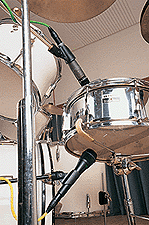 An extra mic below the snare can help provide more tonal options, but it's usually necessary to switch it out of phase with the other snare mic.If the overall snare drum sound is okay, but you want a little more 'zizz' from the snare wires, you could place the mic under the snare — or even use mics above and below. If the latter, remember that the bottom mic must be switched to the opposite polarity of the top mic, because its diaphragm will be moving in the opposite direction to the one on the batter head mic when the drum is struck. Once recorded, a little boost around 250Hz can improve the fullness of the sound, but don't take it too far or you'll end up with it sounding muddy.
Since the hi-hat is in the area, I have rarely found it necessary to mike it up separately — there is almost always enough hi-hat in the overheads and/or snare drum mic. However, should you feel the need for greater control and definition, another condenser mic can be placed about 10-15cm over the outside edge of the hi-hat, looking down on the side furthest away from the snare.
 In those rare cases where you need more definition on the hi-hat, a good strategy is to mic from above on the opposite side to the snare.Since the mic is seeing the hi-hat perpendicular to the plane of the cymbals it will be immune from the air chuff emitted when the hi-hats close. A little lift at the extreme high-frequency end (10kHz or so) can enhance the sizzle and sparkle if required.
Adding Tom-Tom Mics
In our purist, jazz-based kit, the toms very rarely need separate miking, because the main balance is obtained from the overheads. However, in more rock-oriented music everything is close-miked, as much for effect as anything — but this is a situation of diminishing returns. The more mics you have open, the more spill. The more spill, the less control, and the harder it is to balance the kit.
Some degree of control can be reinstated by using gates to remove the spill when there is no wanted sound entering each mic. However, gates inherently chop off the opening transient of the wanted sound, changing the character of the sound, so the result starts to become more artificial and processed — hence the sometimes rather odd drum sounds we have become accustomed to today.
 If you're multi-miking the drum kit, then the overhead mics effectively act as spot mics for the cymbals. In this case, you can afford to mike fairly close to the cymbals, although it's best if you choose a direction and location to minimise spill from other instruments.This multi-miking approach is, nevertheless, sometimes the best solution for a particular musical style, or if the entire band is playing in the same space (or on stage). In this situation the more distant overhead mic placement simply won't work, because of excessive spill, so we have to close-mike everything and balance the kit at the console. We have already talked about mic placement for the kick drum, snare and hi-hat, and these ideas still apply. The overhead mics can be brought a lot closer now, as, instead of trying to find a position where they capture the entire kit, they simply have to pick up the cymbals. How close you can go depends on the number and arrangement of the cymbals, how they are mounted (since this governs how far they will swing), and the kind of sound you are after, but somewhere between 20cm and 100cm is the typical range. Aim the mics towards the outer edges of the cymbals. Be careful with any EQ — too much can leave the cymbals sounding like harsh sheets of tin — and watch that headroom!
The tom-toms are best miked up like the snare drum, with dynamic mics positioned just over the rim looking at the centre of the head. The rear null of the mic should be angled up to reject as much cymbal as possible — again, hypercardioid patterns often work better in this role, since they don't have to be angled quite so steeply, although watch out for that rear tail picking up something you don't want.
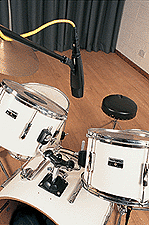 A single cardioid mic can be used to cover two closely mounted tom-toms, if necessary, but a wide polar pattern is preferable here.With small toms mounted close together, you may get away with a single mic positioned between the two drums and pointing straight down the middle. However, this really only works well if you are using a mic with a very wide cardioid pattern, as both drums are well off axis of the one mic. A better approach is to use a mic with a figure-of-eight pattern, since this can be arranged to see both toms while also providing the maximum rejection of the cymbals above. However, this means either a ribbon mic (not really a good idea on a rock drum session) or a condenser mic. I have used a Sennheiser MKH30 in this role before, quite successfully, but it is a very expensive solution to a fairly trivial problem.
On kits where the bottom tom heads are removed, there is also the option of installing mics inside the toms, approaching the head from the inside. This technique provides much more isolation, both from neighbouring toms and the cymbals, and keeps the mics out of the drummer's way, but typically the sound is more resonant and has less of the stick attack than a more conventional external position. If possible, fade out any mics on drums which won't be used during the recording of a particular song, to minimise the spill, but, if in doubt, leave the mic up. There's nothing worse than everything in sharp, defined, close-up sound and then an occasional distant tom hit!
 You can mic a tom-tom in much the same way as you would a snare.One serious problem when you start multi-miking a drum kit is that of the forest of mic stands. The more metalwork you place in close proximity to the kit, the greater the risk that something will come in contact with something else as the kit starts to wander around the floor, as they almost always do. Then you will start to get percussive noises reaching the mics through the stands, rather than through their diaphragms, which is not good. Fortunately, the invention of the clip-on drum mic has really revolutionised the whole drum-miking scene. The traditional forest of mic stands can be completely dispensed with, since the clip-on mics stay exactly where you put them on the side of each drum. Even better, they can be positioned far more accurately than most other types of mic because they are so much smaller. Personally, I've only used the Sennheiser clip-on drum mic — the E604 — but I've heard good things about the slightly cheaper Beyerdynamic Opus 62 too, and I recommend investigating further if drum kits figure frequently in your recording life. They also provide the benefit that they are obviously drum and percussion mics (although they are very effective on brass instruments too), so there is less chance of your favourite vocal mics being trashed!
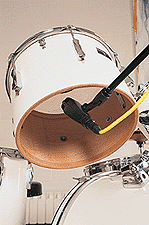 Where the tom-tom only has one head, you can try miking inside the drum for greater separation and less attack.Once all the mics are in place, it's time to check the relative phasing again. The kick drum, being the loudest drum with the lowest fundamental frequency, is the reference and will tend to spill into all the other mics to some degree. With the drummer working around everything on the kit and just the kick drum faded up, fade up each other mic in turn and flip the polarity switch on its channel until you find the position that gives the fullest sound.
Be careful if you are using top and bottom snare mics — I usually set the polarity of the bottom mic to give the best sound with the kick, and then set the top mic to the opposite position without checking further. It's more important that these two mics are opposite polarity than that they are both phased correctly with the kick, and since the bottom mic is closer, that seems the more logical reference. Don't bother checking the cymbal spot mics — after applying a hefty dose of low cut to reduce drum spill there won't be much kick left in them anyway.
Recording & Mixing
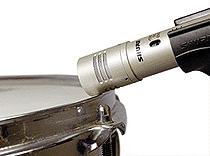 Keep an eye on your mic setup during recording, because you can get very unpredictable results if any mics or stands come into contact with the drum hardware.With all your mics placed, plugged, phased and working properly, listen to each carefully for spill, rattles, buzzes, or anything else that shouldn't be there. You need to do this quickly, though, for two reasons: first, the drummer will get tired, and, second, the rest of the band will be leaning over your desk trying to tweak the EQs and push the buttons by now! You need to get them back in the studio and start rehearsing for a take.
Panning the mics for stereo is, once again, personal taste. Traditionally the kick drum is placed in the centre — a hangover from vinyl record days. However, there are other advantages to keeping the kick drum in the centre, such as sharing the load on both channels of the power amp, and being able to put more and better-balanced LF energy into the listening room. Likewise, in surround, many engineers are placing the kick in all five channels.
With a minimalist miking scheme, the overheads will define the stereo image — either as a coincident or spaced pair depending on how they have been rigged. Most engineers pan these fully left and right, but I prefer less width to create more space for other instruments and to make a more realistic sound stage.
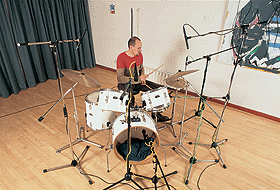 A complete drum kit setup — the signal from the more distant mic in the background could be mixed in to make the sound more ambient.If you have added a spot mic on the snare, it should be panned to the same position as the snare heard on the overheads, otherwise you will have a blurred and confused image. The easiest way to adjust the snare pan is to listen to the stereo overheads, focus on where the snare is in the image, and then fade up the spot mic. If the spot is panned to the centre initially, as it is faded up the image of the snare will pull back to the centre as the spot overwhelms the overheads. Pull the snare back down, pan the channel in the appropriate direction and fade up the snare again. This time the image of the snare will not pull as far, or may pull in the opposite direction, so adjust the pan a little more in the appropriate direction and try again. Repeat the process until fading up the snare just makes the snare louder, without pulling the image. It sounds long-winded, but will only take two or three goes with practice.
If you have gone down the close-miking path, there should be enough separation between mics to allow you to pan anything pretty much anywhere. The toms are usually arranged to span the entire stereo image, with the kick in the centre, the snare and hi-hat panned either centrally or slightly right, and the cymbals scattered as appropriate to fill in the image. In surround, some engineers have chosen to put various drums literally all around the listener (which I personally find rather disconcerting), but the choice is entirely yours.
Depending on the drummer's playing style and the type of music, you may want to apply a little compression the snare and/or kick drum to provide a more even and thicker sound. Pay careful attention to the attack and release settings, since too fast an attack will damage the initial transients, and too long a release will negate the compression anyway. Start with a medium attack and short release, and adjust the threshold and ratio settings to achieve the desired degree of squash — bearing in mind that more compression means louder spill.
Now, with everything up and running, the session can proceed. There's just one last thing to mention — a drum kit rarely remains in the state you left it for long! When the opportunity arises throughout the session, perhaps during a rehearsal for another take, audition your drum mics again to see if anything has changed. Fittings can work loose, the drum tuning can change with temperature and humidity in the studio, and if the kit creeps across the floor it may come into physical contact with the mic stands, causing unwanted microphony. If you have heavy mics on the overhead stands, the boom arms may even droop slightly. Keep a constant eye and ear on these things and the session should go smoothly.
Effects & Processing
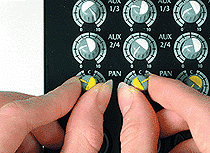 Although many engineers pan their overhead microphones hard left and right, a narrower setting can often create a more realistic sound stage.If the drums are set up in an ambient room, some distant room mics might provide all the reverb and ambience you require. Placing a pair of mics on the floor about eight or ten feet up and spaced slightly wider than the kit often works well. More usually, though, you will be using a digital reverb. The choice of programs will depend entirely on the style of the music — you may want a general ambience program over the entire kit, or perhaps ambience on the kick and a longer reverb (even a gated reverb) on the snare. Just remember that, although the drums are percussive, any reverb they generate is more continuous and so will fill the gaps in their sound. This will tend to muddy the mix, so less is preferable to more. If in doubt, take the reverb returns back another 5dB.
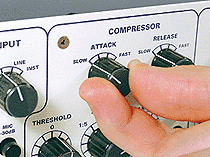 Beware of setting too fast an attack time when compressing drums, as this can damage essential attack transients.Something which is probably not done as much these days as it was in the height of the disco era is to add synthesised tones to the kick. Essentially, the kick drum signal is used to trigger a gate to allow through a 40Hz triangle-wave tone. The attack and decay parameters are adjusted to complement the real kick drum and the tone adds a lot of weight and solidity, while the real kick provides the transient attack.
Talking of gates, in my experience they are best avoided if at all possible, and should never be recorded to tape. If the drummer is not very consistent, it will be all but impossible to set a reliable gate threshold, resulting in false triggers or missed drum hits. Analogue gates also have a finite attack time which can cause the initial transient of the drum to be lost. Likewise, setting the release and hold times has a dramatic effect on the sound: too long a release and the spill will become obvious, too short and the resonance of the drum will be cut short prematurely, although a little reverb can mask the latter quite effectively. Also, don't automatically assume that maximum gate attenuation is the best option — you may well find you get better results with a more modest amount of gain reduction. A range setting of 12dB is still 12dB less spill, and the initial transients will survive far better. In digital mixing desks the gates are often provided with a look-ahead facility. This enables the gate to open fractionally in advance of the wanted sound so that the initial transients are preserved intact, which is far better.