

The price war in the budget condenser mic market gets even more fierce with the launch of this range of large‑diaphragm models.
With so many high‑quality, low‑cost capacitor microphones now on the market, many of which originate from the same factory in China, it begs the question why the factory don't simply sell their mics under their own name rather than making them for third parties. According to SCV London, who distribute the Superlux range of microphones in the UK, this is exactly what they are now doing, which means one less price markup between the manufacturer and the end user.
Build Quality & Specifications
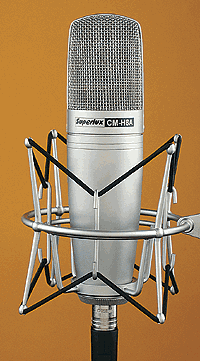 Superlux CMH8A.The range of mics reviewed here are the CMH8 series, comprising A, B, C and D models. My guess is that the CMH8A will draw the biggest crowds simply because of its cost/performance ratio. This is a fixed‑cardioid large‑diaphragm (one inch) model with an evaporated‑gold diaphragm only three microns thick. The onboard electronics comprise a transformer‑balanced FET preamp and a low‑cut slide switch on the circuit board, although there are no switches accessible from outside the mic. A swivel standmount comes with the mic as standard, though there's also a sensibly priced shockmount available as an optional extra, and the mic itself comes in a rigid, foam‑lined plastic case.
The frequency response of the mic shows a gentle drop‑off below 80Hz, though with the low‑cut switch active the roll‑off starts above 200Hz to compensate for the proximity effect when using the mic up close. Other than a very gentle peak at around 3kHz and a mild boost at 15kHz, the response is flat up to 15 or 16kHz and is still only 3dB down at 20kHz. Sensitivity is 20mV/Pa, which is pretty typical for this type of mic, and the equivalent noise is a healthy 16dBA with a maximum SPL handling of 132dB. The mic requires standard 48V phantom powering.
This product is rather nicely engineered both inside and out, with moulded plastic circuit board supports used to cut down on metalwork costs without compromising performance. The body itself has a rather attractive bulbous shape and conductive springs keep this in electrical contact with the grounded parts of the PCB. A dual mesh basket structure protects and screens the capsule, while the aluminium mic body has an attractive satin silver finish with the printed model number denoting the live side.
The slightly more expensive CMH8C model features a dual‑diaphragm capsule and is cosmetically similar to the CMH8A. It also has quite a similar frequency response, but can be switched for cardioid, omni or figure‑of‑eight responses and has on‑body switching for the low‑cut filter and a 10dB pad. Between these two models comes the fixed cardioid CMH8B, which is essentially a CMH8A with external pad and roll‑off switches. All three solid‑state models are optionally available as boxed matched pairs suitable for stereo recording — the model numbers are SKMH8A, SKMH8B and SKMH8C respectively.
 Again visually very similar to the previous models in the range, and with the same general frequency‑response characteristics, the CMH8D features switchable cardioid or omnidirectional patterns (like the CMH8B), but has the added benefits of a tube preamp. A second three‑position switch selects between low‑cut, flat and ‑10dB pad. A single military Nuvistor‑type tube is hard‑wired to the circuit board inside the mic body and, as with the previous models, the preamp has a transformer output stage. Nuvistors are very tough, have a long life and run on lower voltages than conventional valves.
A seven‑pin XLR cable connects the mic to the included power supply, which in turn provides a conventional balanced three‑pin XLR output for you to send to the input of your mixer or voice channel. An aluminium camera case houses the mic, cables and PSU as well as a swivel standmount, a cradle shockmount and a foam wind shield. The electrical spec is extremely close to that of the CMH8B and I'm pretty sure the same capsule is used in both models.
About The Manufacturer
The Superlux CMH8 mics are only a few of the products manufactured by Tenlux Electronics, based in Taiwan. The company was founded in 1987 initially to supply microphone components for large electronics companies such as Sony, Kenwood and Sharp. In 1993 Tenlux began producing its own microphones, and now has a range including more than 20 different models. It also continues to manufacture microphone products for many companies including Sony, Sharp, Electrovoice and Behringer.
Performance Test
In my tests, the CMH8A turned out to be a nicely neutral vocal mic, similar in sensitivity and overall tonal characteristics to my reference Rode NT1, though with perhaps marginally less 'weight' at chest frequencies. The high end is less splashy than some of the transformerless models I've tested in the past and, because the presence colorations are quite subtle, the mic should suit a wide range of voice types, making it ideal as a project studio all‑rounder. It's also quite at home recording acoustic instruments and would work adequately well as a drum overhead, especially in a matched pair. Noise was never a problem during testing, and even though having a low cut switch accessible only from inside the mic may seem like a limitation, most mixers and mic preamps have low‑cut filtering so you may never need to access this.
 As expected, the CMH8C switchable‑pattern model sounded similar in cardioid mode, though the presence characteristics weren't exactly the same because of the dual‑diaphragm capsule. In omni mode, the pickup pattern was nicely even, though possibly less transparent and natural sounding than some of the high‑end, small‑diaphragm models available. Used in figure‑of‑eight mode, the mic delivered more or less the same punch and clarity as in cardioid mode. As with all properly designed figure‑of‑eight mics, it was almost totally 'deaf' to sounds coming in from 90 degrees off‑axis. For example, if you were to set it up to record an acoustic guitar with the side of the mic pointing towards the player's mouth, it would reject the majority of breath noises, headphone spill and even vocals (other than reflected sound). Of course, you need to be aware of exactly where the back of the mic is pointing as it's just as sensitive as the front! Similarly, a second figure‑of‑eight mic can be set up to capture vocals while rejecting most of the guitar, making it possible to record simultaneous guitar and vocal parts with a respectable degree of separation. To my mind, this is as good a reason as any for buying a boxed pair of these mics.
Finally I checked out the CMH8D valve mic, which, although less overtly coloured than many of the valve mics I've used, does seem to open out the high end without adding harshness or splashiness. There's also a subjective increase in low‑end warmth, but my impression is that the high end is the most noticeably enhanced part of the spectrum, lending the sound more 'airiness' than the other models in the range. Unfortunately, this model only has the cardioid and omni options, so the benefits of figure‑of‑eight recording are denied to the owner, but when you take the low cost into account there are really no grounds for complaint, especially as you get an effective shockmount thrown in.
Four Tops?
Having so many inexpensive mics on the market is a mixed blessing in that it detracts from the perceived value of truly professional mics that are probably built to more stringent standards and which possess subtleties of tone that these cheaper mics can't match. On the other hand, the subjective performance offered by these mics comes dangerously close to that of some high‑end models, and the clear advantage is that while my early recordings were limited by the fact that I had to use cheap, dynamic, live performance mics for everything, today's musician can experience capacitor‑mic quality for less than I paid for some of those dynamic stage mics.
Judging the Superlux mics against other Far East budget capacitor models is no easy task. Even though most of them sound slightly different to each other (which can be due to something as simple as basket design), the general quality tends to be much the same, which is not surprising when you consider that pretty much all the capsules, and often the electronics too, are made in the same factory. Transformer models in general sound less splashy (some people would say 'warmer' while others might say 'less transparent') than transformerless models as their high end roll‑off tends to start at a lower frequency, but, other than that, they all offer incredible performance given their UK price.
In addition to sounding good, these Superlux models have the advantage of very low cost, pleasing cosmetic design and generally good build quality, coupled with the fact that the range offers a number of options to suit different needs. They may not be anything radically new, other than even better value, but that's probably enough to guarantee them a successful future.
Second Opinion
I tried three of the mics from the Superlux range. The CMH8A, which is the base model with a cardioid polar pattern, was tested first on vocals. I thought it had a clean, natural, airy sound, and I felt it was capturing my voice quite faithfully. I slightly preferred it on vocals to my AKG C3000, finding the Superlux smoother and silkier next to the rather woolly 'chestiness' of the C3000. The C3000 sounded 'bigger', fatter and more forward, but at the expense of a clarity and naturalness that the Superlux was notable for. On guitar it was a different story; I like the C3000 for miking acoustic guitar, and it came out best. Where the C3000 gave a lively sound with a lot of body, the Superlux sounded more mellow, but also somehow more muffled. The C3000's success on acoustic guitar (for me, anyway!) may be at least partly due to a pronounced peak at around 7‑8kHz in its frequency‑response plot — which can be a good place for boosting 'sparkle' if you're EQ'ing acoustic guitar.
Considering that I paid £300 for my C3000 a few years ago, and it was then pretty much the main affordable large‑diaphragm condenser, the price of this Superlux mic is impressive. It's not a 'character' mic, in my opinion, but it produces good, professional‑sounding results that no‑one would be ashamed of. It also has a look and finish that wouldn't disgrace a microphone of several times the price, and would make a good starter vocal mic that could continue to be useful even as your collection expanded.
I also evaluated the CMH8C switchable polar pattern model. Subjectively, its sound in the cardioid position was very similar to that of the CMH8A, while switching to omni produced the thinner, more ambient (and arguably more natural) sound of an omnidirectional response. Until quite recently, this would probably have been the cheapest multi‑pattern mic on the market; however, it's a testament to the pace of change in the world of quality mics that it already has serious competition from other manufacturers!
I tested the CMH8D valve mic alongside my Rode NTK (also a valve mic), and thought it came out very well from the comparison. The CMH8D sounds as warm and exciting as you'd hope a valve model would, with a slightly throaty and very much 'in‑your‑face' character. My Rode is smoother and less 'pumped' sounding, with a slightly more sophisticated quality, to my ears, but I really did like the Superlux for its more aggressive edge. If I ever sang a proper rock song, I feel the Superlux would be just the ticket. I wouldn't trade in my Rode for it, but I would like the Superlux too! Debbie Poyser
Pros
- Eminently affordable.
- Nicely engineered and styled.
- Good sound quality.
Cons
- None at these prices.
Summary
An attractive range of affordable capacitor mics which are able to deliver good vocal sound quality and which can double up for recording acoustic instruments.