

The AG Stomp physically models a miked‑up acoustic guitar sound using the DI signal from an acoustic guitar piezo pickup, and also offers a variety of useful effects processors.
Yamaha's AG Stomp is a digital floor‑standing processor designed for use with acoustic guitars fitted with piezo pickup systems, its aim being to process the pickup sound so that it sounds more 'miked up'. Applications include both live performance and recording, plus there's a useful headphone output for rehearsal purposes.
 There's actually rather more to the AG Stomp than mic modelling, as it also includes a chorus/delay section, limiting and onboard reverb, plus a five‑band feedback reduction system and comprehensive tone controls. Eight mic models are available, arranged as four mic types used both close up and at a greater distance, the latter settings including some nicely simulated room reflections that are quite independent of the reverb section. The whole unit is built into the same metal case as the previous DG Stomp (electric guitar preamp) pedal and is powered via an included AC adaptor.
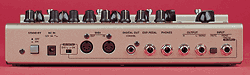
Like the DG Stomp, the AG Stomp is programmable and comes with 30 factory presets arranged as 10 banks of three sounds, as well as 30 more user memory locations. The outputs are stereo on balanced jacks, though short adaptor cables are included for anyone wanting to connect to a system with XLR inputs. An expression pedal input (stereo jack) allows a conventional expression pedal to be used to control volume or other parameters (such as reverb level) and there's an S/PDIF digital output operating at a set sample rate of 44.1kHz.
Both the input and output converters are 20‑bit, and MIDI In and Out sockets are fitted for patch dumping or remote parameter control. A small mute button is fitted next to the input jack, which enables the user to mute the signal whenever they're plugging or unplugging the instrument, avoiding unpleasant thuds and crackles.
All the controls are on the top of the unit, along with four footswitches, the first three of which may be used for patch and bank access or to switch the limiter, chorus/delay or reverb on or off. The fourth switch is used to access the feedback reduction's automatic mode, the patch bank or the onboard tuner. If feedback occurs, this switch can be pressed and one of the five filters in the filter bank will automatically lock on to the feedback frequency and then set itself to full cut (‑20dB). This affects the sound of the guitar quite noticeably, so a gentler cut setting might be advisable. A good way to go about achieving this is to force the unit into feedback during the soundcheck, thus identifying the problem frequencies. You can then reduce the amount of cut for the best compromise between tonal change and feedback reduction.
Directly above the footswitches is a row of seven knobs, the first of which selects between close and distant versions of condenser, dynamic, and tube mics, plus two further mic models optimised for nylon‑string guitars. This switch is also used in Utility mode to set footswitch options, MIDI functions and so on. Next along is the Blend control which mixes the direct and modelled sounds, though this can also be used in conjunction with the unit's Shift button to adjust the stereo width of the modelled signal.
That leaves the Bass, Middle, Treble and Presence knobs, which normally function as regular tone controls. However, when Shift is pressed they adjust the EQ centre frequencies. Because the knobs may not be pointing in the direction of the currently recalled parameter, a pair of up/down LEDs are provided to the left of the patch number LED readout window so that the physical position of the knobs can be matched with their stored values when editing. Edited patches may then be stored to any of the user memory locations via the Store button, located to the right of the window along with the Utility and Manual buttons. In Manual mode, the unit responds to the actual control positions rather than to the stored values of the last recalled preset, making it ideal for setting up sounds from scratch.
The remaining knobs deal with the effects section and comprise a limiter Level control, Frequency and Depth controls for the five feedback notch filters (selected via the five buttons above if you want to set them manually), Speed/Time, Depth/Feedback and Level knobs for the chorus and delay effects, and a simple Level control for the reverb. Buttons are used to select between the chorus and delay modes and to choose from hall, room and plate reverb settings. The Shift button and the main Output control are located at the top right‑hand corner of the panel.
The Sound
Most people who have tried DI'ing acoustic guitars fitted with pickup systems complain about the scratchy tonality and, though the AG Stomp mic models don't cure this entirely, they certainly make things a lot better. Adding a touch of limiter improves matters further, so, while the result isn't quite as natural as a well‑miked instrument, the mic models all produce convincing approximations of the tonality of the mics they purport to emulate. Moreover, the mic models don't seem to detract from the general brightness of the sound, but instead add a noticeable degree of mic‑like coloration, characteristic of recording an acoustic guitar in a real space. When the more distant of the two miking options is selected, the impression of room reflections is rather more authentic than I'd expected, a somewhat like a well‑designed ambience algorithm.
 It's also useful to be able to simulate a stereo mic array, even though the guitar pickup is only a mono source, as it adds worthwhile width and depth to the sound. As stated, the limiter is very effective in removing the worst of the rough spikiness that afflicts the typical DI'd acoustic guitar sound, and, in most cases, the best results are obtained by combining the mic modelling with limiting. Further flexibility is offered by the fact that the balance of untreated and modelled sounds can be varied.
In the studio, that's pretty much all you need, but for live use the feedback‑reduction system is a real bonus and the delay, chorus and reverb effects enable live players to recreate most of the commonly used acoustic guitar production treatments heard on records.
The feedback‑reduction filters don't seem nearly as unobtrusive as the ones used in something like the Sabine dedicated system, but then, as I recall, their system costs rather more than the entire AG Stomp anyway. Any side effects are, however, far less damaging than feedback in a live performance situation, and feedback should not be an issue in the studio anyway. Depending on how you set up the unit in the Utility mode, feedback‑reduction settings are either stored along with patches or applied globally, but either way the settings must be saved if you're wanting to use them next time you switch on the machine.
Verdict
The Yamaha AG Stomp is a very clever piece of technology, and although I don't think it quite achieves its goal of emulating a true miked‑up sound, it's certainly a big improvement over the raw DI'd sound. Its live applications are obvious, but the AG Stomp could also prove valuable in studio situations where spill from headphones (click tracks bleed notoriously) or from other musicians playing at the same time precludes the use of microphones.
In combination with the limiter and the EQ, the mic modelling makes it easy to approximate pretty much any standard acoustic guitar sound, while the room simulation used for the distant mic models works exceptionally well in creating a convincing impression of space without reverb. Given the impossibility of what Yamaha's AG Stomp is trying to achieve, I think the designers have done a pretty impressive job!
Pros
- Plausible modelling of different microphone types and positions.
- Onboard effects and anti-feedback filter bank.
Cons
- Because the end result depends on the output from the guitar's pickup system, the mic emulation can only ever be approximate.
Summary
Although of most use to the live performer, the Yamaha AG Stomp could save the day in the studio on those occasions where mics can't be used.
information
Yamaha-Kemble Brochure Line +44 (0)1908 369269.