

Production music's shoddy image means that many composers and producers ignore it, despite its commercial potential. Extreme Music are a London-based company who are trying to change the perception of library music.
"We get calls and demos from composers all the time, and the first question we ask is 'What do you do?'," says Russell Emanuel. "Quite often they'll say 'I'm great — I can do anything.' Well, that's an instant turn-off. We prefer composers to be creating the music that they know inside out and have an absolute passion for, because it's only then that we truly get the best results."
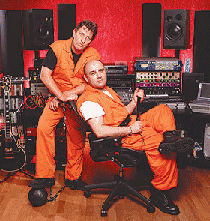 For a long time, library music has had a serious image problem. It's been seen as second-rate in every respect: produced by composers who haven't made it as commercial artists, for clients without the budget to license commercial releases. Now, however, things are changing, and companies like Extreme Music are leading the way. Russell and co-owner Dolph Taylor are trying to elevate production music — as it's now called — to the point where it's no longer a sub-standard alternative to 'real' music. Their approach is intended to be different in every respect, from the presentation and distribution of their music to their relationships with the composers who produce it.
Borrowing Rights
"The thing about library music, or production music, is that it's certainly never been the most exciting area of the music industry," admits Russell. "I first came across it years ago when I worked in the post room of Bruton Music, while I was trying to get my band away with a friend, Warren Bennett, who's now a successful library music composer. Bruton was one of the first production music libraries, and it was all on vinyl back then, and with a few exceptions tended to be full of people knocking out soundalikes of current hits. They'd change the chord structure round a bit and that would be it."
"It was a bit like those old Top Of The Pops albums that used to exist, before K-Tel came along and actually re-released the original recordings," says Dolph.
"Because it seemed to solve all the complicated licensing issues and permissions, it's an area of the industry that grew up very fast, and that was my first experience of it," continues Russell. "While we were working packing records in the post room, Warren's dad, who got us the job, had his own studio and he was writing in his spare time when he wasn't on tour. Brian produced an album with us for Bruton which was soundalikes of Ultravox and The Police and bands of that time, which was a great experience, but looking back it was completely dreadful! Years later, when I hooked up with Dolph in 1986, I was still getting cheques from that. We were doing other things at the time, Dolph was playing drums in Stiff Little Fingers and I was managing artists, but the cheques continued to drop through the door and I thought 'There's something in this, we should keep this going.' So we set up our own MIDI suite and started composing when we weren't on tour, or managing other people.

"We wrote for some music libraries that we were able to get into at the time, eventually writing for a small company called Match Music which we ended up running in the UK. It was a fantastic lesson for us in 'This is how we don't want to do it;' traditional old-school emulations which were not very sexy at all. What we wanted to do was use our commercial record experience and create a music library that had the same high production values as any major label, not only in the music but also in the presentation and marketing."
"There was a very good case for making it a lot cooler," agrees Dolph. "We were forever knocking our heads against old-school attitudes and being told that 'This is what the marketplace likes.' But we were seeing a new generation of editors coming into the industry and going to clubs like The End and Home, hearing all these thumping records, and they wanted to know why production music didn't sound like that. So we decided that the best thing to do was to approach commercial artists, some of whom we knew, some of whom we found, and some who were up and coming, and say 'Right. Make some library music.' Everyone was going 'Oooh, I don't know about that,' because those guys had always thought that library music was a second-division way of making music."
"It was a chicken-and-egg situation," explains Russell, "because we needed to create a library that felt cool enough for them, but we needed to get someone to actually produce something for us to get the ball rolling! Fortunately, we're in a position now where all that work's done, we've done the 'heavy lifting' and now composers usually approach us. Sometimes they have material already done that they haven't used, but most of the time we'll commission new material. We're always looking for new composers. Although a lot of them are well known, we also look for specialised or emerging talent as well. Historically, what libraries tended to do was gather a stable of composers, and they would just keep revisiting them, so one guy might have been producing drum & bass, but he might also have been doing a rock album, and then some jazz at the same time. So essentially, that's why the editors were wondering why their production music didn't sound great, because in order for it to be the real deal you should only create the sound that you live and breathe."
"Even now, four and a half years in, we don't think of ourselves as having a 'stable'," says Dolph. "There are people who have stayed around since Day One, but there are others that have come through. For instance Bushwacka [of Layo & Bushwacka fame] came through when we were doing a tech-house album because he is, pretty much, the inventor of tech-house. He's only ever appeared on that particular album, as that was the project that interested him."
The most high-profile example of Extreme's work with big-name artists is their collaboration with Hans Zimmer and Jay Rifkin's Media Ventures group. Hans and his team of film music composers, including Klaus Badelt, Patrick Cassidy, Harry Gregson-Williams, Gavin Greenaway, Steve Jablonsky, James S Levine, Henning Lohner, John Powell and Geoff Zannelli, have contributed to a series called Director's Cuts, which offers authentic Hollywood epic blockbuster film scores to library clients. Director's Cuts makes impressive use of Media Ventures' expertise with real and sampled orchestras: "Media Ventures bring a lot of eletronica into the orchestral sound anyway, so some of it is done using their massive sample library, and some is done with real strings or maybe a solo instrumentalist," explains Dolph.
|
Authentic Touches
So how do Russell and Dolph decide what to commission? "With contemporary library music, it follows the modern trend," says Dolph. "I'm always very keen to know what's going to be happening in Ibiza next year, not this year, so I'll talk to a lot of DJs, a lot of underground artists who are coming up with new ideas. So we do a lot of that, but we also produce in evergreen areas that we know people are always going to want. For instance, people are always going to need authentic ethnic music, so we're producing a comprehensive world music series which is a major project for us.
"You do see fashions come around. There's a lot of people asking for '80s stuff at the moment, stuff like Erasure and Depeche Mode, because most of the people that are asking for that are now in positions of power in the edit suites, but that's the music they listened to when they were at school and it means a lot to them. It comes around very quickly. Decades go by in a year nowadays."
Creating a library with an authentic feel is easier in some genres than others. "Punk rock was one of the hardest ones, simply because people play too well nowadays," insists Dolph. "The punk attitude wasn't about playing instruments, it was about expressing yourself. You've got to find someone who's really angry and has an axe to grind. From our own background we know a lot of those guys, but I couldn't go to Glen Matlock or Jake Burns and say 'Write me a punk song,' because they play too well now and they're just not as angry as they were!"
"Everyone thinks they can do it, but they can't," agrees Russell. "One of the other problems now is finding a studio that's shit enough to put them in! We try to use the right mics and gear that was being used at the time and, where we can, studios that have still got those values. Dolph's having to go round spitting in the microphones and putting old strings on dodgy old copy guitars. And the bass player's got to have bought his first guitar two weeks ago, drunk seven cans of Special Brew for breakfast, and he's only allowed to use the E string!"
"And with the punk stuff, there's no hard disk recording, you've got to go to tape," says Dolph, "and definitely no click tracks. For our Psychedelia disc, which is a retro project based around the late '60s, early '70s period, we cut from tape to vinyl at Abbey Road, brought it back in, and then started editing it from there. We did the same thing for our Motown CD, to make them sound as though they come from the period that they purportedly are from."
|
Making A Start
So, what advice would Russell and Dolph give to Sound On Sound readers who aspire to get their music placed with Extreme? "Well, there's no magic secret," says Dolph. "They just have to submit something they've composed. Often it's a case of whether we have a project on that their piece may fit. Sometimes we'll build an entire project around a track that's been sent in. I listen to everything and provided the details have been supplied I return everything that we're not interested in."
"You can compose on a Stylophone and the back of a fag packet as long as it's original and sounds cool," says Russell. "Just like all A&R people, we're looking for originality, passion and the finished article delivered, hassle-free, on a plate!"
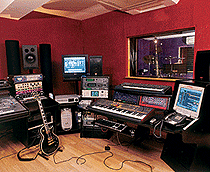 The control room in Extreme's London studio, which is used for mastering and some recording projects.
They are adamant that there are no hard-and-fast rules to be observed in writing library music, and that production values need to be as high as for a commercial release. "Good composers have high standards that they will not fall below regardless of how it's released," insists Russell. "Each project is different. Action tracks are all-singing and dancing with all the bells and knobs on, ambient material tends to veer more towards non-melodic and sound design. There are certain formulas or parameters within genres but it's pretty flexible."
So should composers master their material before sending it in? "No thank you," says Russell. "We want to hear how good your track is, not how loud it is! We master each disc on a project-by-project basis."
|
The Fight For Ears
As in any area of the music business, the great battle is getting your music heard by the client. "It is incredible to see," says Russell. "In the UK, editors have to sign up to the MCPS to use library music, and the next thing that happens is that the poor unsuspecting user is buried under an unmanageable, unsolicited stampede of library music discs, because MCPS distribute their details to the hundred or so library companies, and the race to get your catalogue in there first is on. Libraries have got into a bad habit of sending out full catalogues the minute someone signs up, but the first thing that potential users are going to think is 'I haven't got time' — some of these libraries contain thousands of discs — or they'll be down Cash Converters getting 50 quid for the lot! Before we send anything to a client we'll contact them, then find out what they use and what they need."
"We bring in all the elements that we learned from the commercial field of how to try and get a record away, to try and get a production music album away, and treat our catalogue in exactly the same way," adds Dolph. "People can be receiving 20 or 30 CDs a week nowadays from the various companies, of varying quality. They don't have time to sit there listening to all that stuff."
"A lot of the time, they'll cut to a commercial track to get the pace and inspiration, and then they'll come to us and say 'Have you got something in this vein?'" says Russell. "Alternatively, the other way it works is that they'll sometimes use our stuff to temp and then score it later. The up side of that is that usually, if they temp something in, there's a good chance some of it will stick, so we do encourage that. It makes it nice and easy for them. I'm always really pleased when we get uses that library music hasn't been considered for in the past, like film trailers and even within the films as well. In Ocean's Eleven, for example, they might be scoring the movie and using commercial hits, but when it gets to the club scene they're not going to pay someone to score that when they can pick up authentic-sounding material here."
"A major hit will sell a film, but not every piece of the film requires a major hit behind it," says Dolph, "and beforehand they might have gone to someone like Hans or William Orbit who was scoring the movie and said 'We want a club track in this scene,' but they'll charge them a fortune for that."
"They don't have to deal with Michael Jackson's lawyers or complicated negotiations with labels and possibly multiple publishers," says Dolph. "With us it's a simple headache-free one-stop clearance and it's sorted."
"With library music the composer waives all moral rights," concludes Russell. "It sounds scary but if you want to get into library music, the glory and the glamour goes away. You have to forget all about the credits, and you have to realise that your music is going to be edited, talked over and generally mucked about with. But that's the whole reason they use it, because it's off the shelf. Those are the compromises you make."
Copyright & Monitoring
"Although it's been a bit of a nightmare, we've now digitised the entire library for the third time, as we have now watermarked it," says Russell. "It's early days. The question at the moment is, is it watermarking or is it fingerprinting? Whichever it is, it's going to be amazing when someone gets it right. We're using Verance at the moment when we watermark, but we're also looking at reports from some of the emerging fingerprinting technologies. They are robust enough that you can throw a mic in front of a transistor radio and it'll pick it up in three seconds, even with a bunch of sound effects and noise all over it. The reason this is so important is so that we can more effectively track usage, and hopefully create more revenue by picking up more accurate performance details. It's incredible when you see the detection reports.
"I think we've only got around 12 watermarked albums in the marketplace, and we're getting approximately 5,000 to 7,000 detections a week in North America alone! The difficulty for us is that a network might make a show that gets sent out through the networks and spiders out through other deals, and there is a danger that you might accuse someone of not paying for something, but when you track it all the way back it was actually cleared."
"Some are illegal, some are just mistakes," adds Dolph.