

Glen Ballard was already a first-call songwriter and producer in LA — and that was before a young, unknown singer called Alanis Morissette walked into his studio...
 Glen Ballard with his Euphonix CS3000 console.Photo: Mr BonzaiMany home recordists were first introduced to the name of Glen Ballard by the media frenzy surrounding Alanis Morissette's Jagged Little Pill. It would have been enough that he had co-written and produced one of the biggest-selling debut albums ever, but the fact that he did much of the recording and engineering himself, in an ADAT-based home studio, has made him something of a legend amongst home studio owners — living proof that anyone can reach the stars by climbing their studio rack.
However, let's scratch a little at the surface of every studio pundit's second-favourite myth (you know, after the "if the Beatles could do Sgt Pepper's on a four-track, then anyone can" one...). Some of those swept along with the 'debut album' hype ended up with the impression that Glen Ballard had been some kind of raw undiscovered talent, but the truth is that he had been writing and recording songs before Alanis was even a twinkle in Mr. Morissette's eye. With a solo album under his belt before graduating from the University of Mississippi in 1975, by 1978 Ballard had managed to earn himself a staff songwriting position at MCA Music Publishing and soon caught the ear of Quincy Jones, who took him on as a songwriter and producer at Qwest Records in 1985. Not long afterwards, Ballard went independent and had already written and produced for a bewildering array of hits before 'Ironic' arrived, including Jack Wagner's 'All I Need', Michael Jackson's 'Man In The Mirror', Wilson Phillips' 'Hold On', and Curtis Stigers' 'I Wonder Why'.
|
Writing The Hits
And, of course, since Jagged Little Pill hoovered up all those Grammies, he has been rushed off his feet catering for the music industry's A-list, including Aerosmith, Christina Aguilera, Anastacia, No Doubt, Shakira, Dave Matthews, the Backstreet Boys and many others. As the number of co-writing credits in his star-spangled discography suggests, Ballard is obviously a great advocate of collaborative songwriting: "If you have the advantage of knowing the voice that you're writing for," he remarks, "that makes all the difference in terms of being able to custom-build the song. If you know the sound of the voice, the range, and the kind of stylistic approach that singer has — as well as knowing overall what that artist represents — it takes a lot of the guesswork out of the writing."
 The control room in Glen Ballard's studio.Photo: Mr BonzaiLike many songwriters, Ballard embraces what technology can offer during the songwriting process: "When I was starting off as a staff songwriter in 1978, I had an office with no windows and a piano which they'd pulled off the back lot somewhere, and my goal was to go in there every day and write a song every day. When it became possible to construct a bass part, a keyboard part and a drum part in a sequencer, it was so much more useful to me. I still do write at the piano occasionally, depending on what kind of song I'm doing, but it leaves to the imagination a lot of what the song can be, and it's a little bit limiting. It's much more inspiring working in the studio, and there are a lot of people out there who couldn't just sit down and write at a piano now.
"I usually start by dialling up a beat, a guitar riff or keyboard idea, or a melodic line or title — just something to get the thing going. More often than not, songwriting is about creating something out of thin air, and the heaviest lifting is creating something out of nothing, so I'm always trying to put the song on its feet as quickly as possible. Once you get something where you had nothing before, if you like it then it's going to lead you. If that idea is sufficiently exciting to my collaborator and me, then we respect where that's going to lead us. A lot is done in that early stage, deciding what the song's going to be."
I mentioned that many songwriters keep a notebook in which they continually jot down lyrics and musical ideas, to ease the beginning of the songwriting process, but Glen rarely keeps ideas 'on ice' like this. "I use my ideas right away!" he laughs. "They go right into a song, hopefully. There are a few things that I have that have never become songs which one day will, but it's usually pretty much spontaneous combustion. I do so much work, I don't really have time to gestate for years! Some people do craft songs over long periods of time, and it can work that way, but I'm much more into doing it right then. I go through ideas really quickly, but if everybody's happy with the first one then, fine, that's the one you chase. If what we're working on doesn't have something special about it, though, then we keep digging until we get to the starting place that everybody's excited about. The hardest songs to write are the ones that don't start that way, and the easiest songs are my best songs — they may be complicated musically, but they just write themselves after a point. If something's not feeling good right there, then I try to move the process on quickly in any way I can — trying another hook line, a new melody, whatever. Once something steps up, then I like to make a commitment to it, to really do it, as opposed to postponing it. I really believe that great things can happen if you get to that point and you push a little hard. By the end of the day's work, I love to have some sense of the song, even if the lyric isn't finished or there are things missing. I try to get a beginning, middle and end at least by then.
"If I have any basic overview of songwriting, it's that the choruses are the general idea and the verses provide the detail and specificity. But I'm not that orthodox about it — it's not like a Shakespearean sonnet which always has 14 lines of Iambic pentameter. You know, you've got three or four minutes to make your point, so you've just got to try to make sure that everything is interesting and thematic more than anything. I like to establish themes and then do variations on those. I try to make every section of the song have at least some thematic element. If you have a strong theme which you can establish, once you've heard it a couple of times it's nice to twist it a little bit. The themes act as signposts which make the song stay with the listener, but they're more than just a cut and paste of the same things.
"I also try to use interesting chords whenever I can get away with it, and I think that the harmonic landscape heavily influences the melodic content. There's less harmonic information in some forms of writing now, like hip-hop, than there used to be, but I'm always still trying to have chords, because it adds a richness and texture that I'm not willing to give up. I try to make things sound completely natural, but I hope that if people look at what I've done carefully they see that I've done something that's a little bit different from just a 1-4-5 progression. If it has to be a 1-4-5 progression, then fine, but I like to be able to slip in some music! I'm not afraid of major seventh chords and minor ninths, because there isn't enough of that going on.
"If I modulate, I try to make it as seamless as possible — I certainly don't want to be just cranking up the modulation on the third chorus in a sort of overly dramatic fashion. If a modulation is too obvious then it gets schmaltzy. My favourite modulation is in a song I wrote for Michael Jackson called 'Man In The Mirror', which is pretty unorthodox. As opposed to jumping up a whole step, we did a half-step modulation after a tacet and it worked. I won't try that again, I don't think, but it certainly worked in that case."
Guitar Sounds
I was intrigued to see that Ballard has a splitter box in his rack to feed both a Boss GP100 and a Tech 21 Sansamp from the same electric guitar. "And there's another direct line to the amp," adds Glen. "That way, I'm not affecting what happens to the amp. I have a Matchless amp which has a great overdriven tone, so I like to get the clean amp signal and then be able to add to it with some effects. I'll often mix the different sounds, but I'll usually print them separately. I might also print some delays on guitar, and if I can keep them separate on another track or two then I usually do. Although I'm always trying out different guitar boxes, I like the GP100 — I use it all the time. I use that as opposed to a bunch of pedals, and it's got six or seven sounds that I've modified that I really like."
Glen confirmed that this same process was used on Jagged Little Pill. "Although most of it was just the Matchless and a modified 1979 Fender Strat which I use maybe 90 percent of the time. I bought the Strat new in 1979, so it's got a lot of miles on it! Of all the Strats, a lot of people don't like the '79, especially on stage, because it's a really heavy guitar, and it doesn't have a traditional Strat sound, especially with what I've done to it! It now has two humbucking pickups in it, I've changed the tuning pegs and the nut, it's got a whole new setup for the tremolo bar, and it's been refretted. I've also got a five-position pickup switch so that I can go between the pickups, and the only original pickup is the middle one. It almost has a Gibson Les Paul meets Stratocaster sound — an unusual hybrid."
Arrangement Techniques
"Once I have a sense that there's a melody, a topic sentence, or an idea worthy of a song, then I'm just arranging and creating forms as I go. I don't believe in demos really, I'm just trying to make something that will really stand up on its own, right out of the box, so I'll work with the sounds from the word go — it's always fun to get an interesting sound that can be part of the DNA of what you're doing. Sometimes you try to go back and replace sounds which are really fundamental to a song, and you find that something magical has gone. Everything I'm doing could be part of the record, and is integral to it.
"The bass and drum parts, to me, are usually the foundation of the record. I'm really meticulous about the kick and the bass working together, because it's important to get that right pretty early on. Once you get the bass and drums sorted out, you've got the thing really grounded. It's something I learnt from Quincy Jones — if you listen to the Michael Jackson records that he did, the bottom end is always tremendously delicious, and a great anchor for the whole track. It's a part that I always try to get right, although I still work fast: Does this work? How about this? Or that?
"Then it's a question of how we go from there. I've got 20 or 30 guitars which I use on a regular basis, loads of synths which I'm always updating, a trillion loops — all of these are my toolbox, but I never go to one particular thing. You can just close your eyes and reach in there, and I usually get inspired by that."
One instrument Ballard seems particularly fond of, however, is the Hammond organ: "There's something about it's organic quality, if you'll pardon the pun, that I like. It's such an expressive instrument, and I'm lucky enough to have two of the best organ players in the world, Bill Payne and Belmont Tench, playing on records I do if I want the real deal. However, they often ask me to keep what I've done on there too — the Korg Trinity has a lot of great organ sounds, and it has a Leslie simulator which is remarkable."
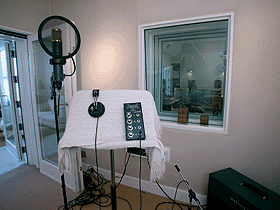 The interior of Glen's vocal booth, with an AKG C12VR tube mic ("I've got an AKG C12 from the '50s, which I used for Alanis, and I've also got some of the gold reissue ones, which are remarkable and best for female vocals. While the original C12 I have can't be touched in terms of sound when it's in peak condition, it's very delicate — I'm constantly getting it worked on — and the reissues are quite comparable.") and headphone distribution amp. Photo: Mr BonzaiI had also heard that he liked to layer up different pads for a rich background texture. "Only when it's appropriate," he says. "That soup that you're cooking sometimes wants to be thicker and sometimes it doesn't. Pads can work in subtle ways, where they're not featured, but you really miss the atmosphere if you take them away. When you get to that point, you've got away from the primary colours and you're into some of the shades. As Quincy Jones used to say when we'd get into that overdub stage: 'We're painting now.' Sometimes I do it with guitars, heavily effected or using E-bow to get a sustained sound. Fine-tuning those kinds of textures, that's the greatest fun!"
Because Glen is so intimately involved in the writing and arranging process, he's happy to hand many of the mixing tasks over to another engineer. However, he likes to nail down the arrangement as much as possible first: "During mixing, I don't usually have my hands on the board — I may make a few fader moves, but I'm not EQ'ing anything. I may say I'd like more high end on that, but I've done enough of that to know that it's not my strong suit, and that it's just too much to do alongside what I normally do. I recorded the first Alanis Morissette record myself, and by the end of three weeks I was mentally exhausted because I was recording her vocals, doing the tracks and recording everything by myself.
"However, I do try to present a mixer with a pretty airtight arrangement. I don't like to give somebody 64 tracks and leave them to deal with it. By the time a track is ready to mix it's pretty much there. I even print certain delays and special effects, because you can spend hours and hours trying to get one little detail like that, and it's really a waste of time during the mixing process. My goal is always to give something to a mixer where he can push up the faders and it's reasonably close to the architecture that I want in terms of the arrangement. If you give them that to start with, it frees them up to really focus on detailing the sounds and making everything sound great. I try not to add to their burden the idea that they've got to arrange the song as well."
So what does he look for in the finished mix? "I like to have dynamics in a mix from section to section. If I have any kind of characteristic trait, it's that I create severe dynamics — from something acoustic and sweet to something rockin' hard. I try to put that into the tracks before they're mixed, but sometimes you can take it even further in the mix stage. I like for a song to go someplace in the time that we have, and for it to have a lot of different textures to it."
A Selection Of Glen Ballard's Recording & Mixing Gear
 This rack houses the interfaces for Glen's substantial Pro Tools HD rig, along with the processing hardware and patchbays for his Euphonix console and a Glyph hard drive caddy.Photo: Mr BonzaiRECORDING:
- Macintosh-based Pro Tools 192 system.
"I like to stay at 24-bit/192kHz. It's going to get dropped down to 16-bit CD, but what can you do? I rarely use analogue any more. I have an analogue machine, but it's almost not worth the trouble."
- Euphonix CS3000M recording console.
"I like the fact that the signal path is so short, because the analogue components are in a tower and the desk is just a digital controller. You have these tiny, very compact signal paths, which I think is why it's so transparent — it has low noise and a really great frequency response. I also love how quickly you can reset that board from one song to another and from one project to another. You put up a snapshot and the whole board's reconfigured. It has a lot of inputs, so that I can have all of my synths available, and I like the way it sounds — it's very transparent. It's also very, very reliable. On the first Alanis Morissette album we recalled seven mixes in one day and tweaked them, and then the next day we recalled five. They all came back exactly. The only variable is your outboard gear, and if you take good notes then it's going to be the mix. I don't even think about it any more, it's just so easy and so convenient."
PROCESSING:
- Demeter VTMP2a valve mic preamp.
- Empirical Labs Distressor compressor.
- Teletronix LA2A compressor.
"The Distressor is great for vocals, and we generally use that. The LA2A is a little gentler and warmer than the Distressor, but you can't get as much range of effect out of it as you can from the Distressor, which is deep. For vocals it's usually one or the other of those two. The LA2A we use for acoustic guitar. Mysteriously, whatever acoustic guitar you've got, it'll sound better if you give it a little bit of that. I usually go through the Demeter to the LA2A. I have about a dozen different acoustic guitars, though, so I have to match the mic to the guitar and to the person who's playing it."
- GML Model 8200 parametric equaliser.
- Avalon VT737SP valve channel.
- Manley Variable Mu compressor.
- Dbx 160X compressor.
- Dbx 166A compressor.
- Dbx 263X compressor.
 Glen's Matchless guitar amp sits atop his main gear rack. Top to bottom, from left: Rackrider power conditioner, Korg DTR1 tuner, Roland GP100, Marshall JMP1 and Tech 21 Sansamp guitar preamps, guitar splitter, Yamaha SPX990 and 2x Alesis Quadraverb reverbs, TC Electronic Fireworx effects, Lexicon PCM41 delay, Dolby digital audio encoder and decoder, CB synchroniser; TC Electronic Finalizer 96k mastering processor, Tascam CD-RW5000 CD writer, 2x Panasonic DAT recorders, Roland SRV2000 and Lexicon PCM60 reverbs; 2x Demeter VTMP 2a and Avalon mic preamps, GML and Pultec EQs, SSL and Dbx 160X compressors; Manley Variable Mu, Empirical Labs Distressor, Teletronix LA2A, Dbx 166A and 263X compressors.Photo: Mr Bonzai"I think the 160X is the best compressor for drums that I've found. You just give it a little bit on the kick and snare while you're recording and it brings them into focus. I don't think you can find anything better for kick and snare — they're amazing! You can really slam them too! I love the fact that they have a really quick recovery, and you can exaggerate it if you need to. I love the 166A on any kind of stereo application, like on the Ensoniq piano I was talking about [see Sound Modules To The Stars box]. I love those things — every now and then when we see them available on Ebay we just buy them."
EFFECTS:
- Lexicon PCM41.
- Lexicon PCM60.
- Yamaha SPX990.
"This is very useful and easy to use. I can easily program it to change the size of the room on a reverb, or set up delays really quickly. I'm always interested in stuff where I don't have to read the manual to learn how to use it — I just don't have time."
- Alesis Quadraverbs.
"There's a couple of things in here which I really like. It's not a Lexicon 480L, but I hate to throw stuff out if I have to go find it again on eBay five years later."
- TC Electronic Fireworx.
- TC Electronic Finalizer.
"The Finalizer's fun, because it can pump up the level and get that kind of hyped radio sound. But I don't often use it a lot."
- TC Electronic System 6000.
"I've just got the System 6000, and I love it. I was looking at getting a Lexicon 480L, and my engineer Scott Campbell suggested trying the TC out for a week. And it's really comparable, if not better. It's hard to compare, because reverb depends on the signal that you're treating. With a pure vocal, the best test, it really holds up, and it certainly sounds like an expensive 'courtesy reverb'. With reverbs, most of what I do is change pre-delays depending on the tempo of the song. I'm always interested in hearing the vocalist's words, unless for some reason they don't want you to hear the words, so I like to have the dry signal a little bit clear of the effect, just for the articulation. If it's a really slow song, say a ballad, then the pre-delay will probably be longer."
- Solid State Logic compressor.
"I don't have an SSL desk, but I've got an SSL compressor, because it's so good. It's the magic button. Boom — it sounds like it's on the radio now! However, I try to be judicious with it. The mastering engineer is probably going to have to compress the mix again a bit, and then radio will compress the snot out of it, so if you already had it super-compressed then you start getting big holes in the record at that point. It's tough, because the radio stations are going to process it so much. Obviously, I want it to pop, but it's possible to drive past the money if you go too far with it. It's fun to crush a mix on the SSL so that it sounds like it's on the radio, but you have to come back to reality for your final version."
Demo Doctor
As well as being a phenomenally successful songwriter, Glen Ballard also heads his own Java Records label, which means he hears an awful lot of demos from the legions of home-studio hopefuls. "I have an A&R staff who are constantly listening, but I also get stuff through attorneys, managers, and other producers, and occasionally I get something unsolicited that's interesting, although admittedly not that often. I also have friends in all the publishing companies, and they're a great source of talent — they're looking for songs and songwriters, and you find amazingly talented people in that world. I met Alanis Morissette that way, for example."
I asked Glen what makes a great demo. "The song is still the most important thing on any demo," he insists. "If the song isn't there, then everything else is just window dressing. But if you have a good song, then you have to really try hard to mess it up. If there's a song in there, I'm not bothered if it's a bad demo. Good songs are harder to find than just about anything I know. Also, if someone has a great voice with a really distinctive sound, then even if it's in the service of a really bad song then hopefully I can help make the material better. A great voice can't be discounted.
"I like people to be original and not afraid to do something that's not what's on the radio right now. A great example of that in a new, very young artist is Norah Jones. She's made a record as if she had never heard anything on the radio for the last 20 years. It's timeless, and so connected with not worrying about being radio-friendly. I love anybody who's willing to be that creative without having to be like what's on the radio right now. By the time you do something derivative, something else will be in fashion and you'll probably have missed the moment.
"Being wildly creative in your own environment is the greatest gift of music technology. Your imagination is your only limit, and how far you want to go. I like people to be taking chances. That's where the next big thing will be, and it won't be what you expect. I want to encourage people to be as original as they can be, and not to be afraid to break a few rules as long as they're still communicating."
So how can SOS readers improve the appeal of their songwriting? "The main thing is to write a lot! I don't believe in writing one song every two months, poring over every detail of it. You have to learn to find the primary colours in it first, seeing if they work together. And you've got to be hard on yourself. Don't expect that everybody's going to understand it just because you do. I'm constantly listening to what people are listening to and what is connecting with people, and on some level comparing it to what I'm doing. All through my career, I've heard people criticising what's on the radio — I do it too. Some stuff I think is absolute rubbish, but once I get past my own emotional bias and really listen to the song, a hit song is a hit only because people feel it and like it. On some level, it's worthy of analysis as to why it's working. Sometimes it's a gimmick, sometimes it's clever, sometimes it's just so repetitive, and yet it's working. I try at least to listen to everything that's out there, and find out why such an irritating song works! Over time, you'll develop some instincts so that you can tell whether your writing works as well as what's on the radio. Get feedback from people, and ask people to really be honest.
"You've also got to make sure that your idea is being expressed as well as possible. If someone has to explain to me what a song is or what a line means, and it's not interesting in its own right, then I'm always challenging people to be clear. I don't mean simplistic or simple, because you can still be colourful and use imagery and tell the truth. A successful song is only successful when the listener really gets it. I try to keep the listener in mind while still doing what I want to do. I'm not Draconian about it, because if that's the sort of relationship that I have with somebody then it's not going to work. It works for some people, but not for me. I can usually be persuasive, but if I'm not then that's fine. There's something to be said for honesty when writing with somebody. You've got to be able to take a chance and look stupid, to be able to say 'I don't think that works' so that the best idea can win — not my idea, not your idea, just whatever works."
And, of course, Glen Ballard has found that winning idea again and again, as he will doubtless continue to do in the future. While this is good news to all fans of his Midas touch, there can be no doubt that this man's success is the product of years of hard graft, working alongside the biggest names in the music business, so maybe it's time for us humble home studio owners to bid a fond farewell to those dreams of becoming an instant super-producer. As the saying goes, there's no such thing as an overnight success.
In Love With Linn
 Glen's main sequencer is the Linn 9000, custom-modified by Bruce Forat with an extra display, which is used to trigger percussion sounds from the Akai MPC2000 (behind). On top of the Linn sits an Access Virus synth.Photo: Mr BonzaiGlen Ballard: "I've gone through a lot of the software-based sequencers, and I just don't think that they groove the same way as my Linn 9000. There may be a reason for that, and a lot of people tell me that it's to do with the way the MIDI information's processed, but I don't really know that much about it. I like the way the Linn feels, more than anything, especially the Linn hi-hat, which has eight positions of openness, and I have yet to find this in any other box or sequencer. I just like the groove on it — it swings beautifully. But it's also really consistent, just really solid. It does just one thing, and does it very well. In terms of hearing back the beat that I've put in there, it's very solid. If I have to print several things, it's always consistent. I've found that sometimes with software sequencers it's not quite as consistent, and I'm not sure why. It's got better, though. I can remember in the early days we would have a terrible time when we wanted to go back and reprint a bunch of elements. Some of it would be a little on either side of what should have been the downbeat, and that was always disquieting to be. I wanted it to be the same every time.
"There's a guy here in LA, called Bruce Forat, who was one of the original Linn designers. He's been continuing to write software for the 9000 for 15 years, just to keep it working. He's probably had his hands on every Linn 9000 that is still operating, and people send them to him from all over the world. I think I've got 10 of them now, because they're a little fussy and I don't want to make music without them. I do most of my programming on the Linn rather than the Akai, although I use a lot of the sounds in the Akai. For things that are really groove-oriented, I prefer the Linn 9000. I can use it in my sleep, and it's a big tactile thing for me. I just like playing those pads; that's how I play drums. The extra display is a Bruce Forat addition, so you don't go blind looking at the original display — it's saved my eyesight!
"I don't use any of the sounds on the Linn 9000, so I trigger the Akai MPC2000 out of the Linn, because I don't think it grooves as well as the Linn. I really don't need the MPC now, but I've got a good library of sounds for it, so it's convenient. I've also got two Akai S3000XLs which get a lot of use, and I have a fairly extensive library of sounds for these. However, we just got a PC with Gigastudio yesterday..."
Sound Modules To The Stars
Glen Ballard: "I probably use every one of my sound modules almost every day, for whatever reason. They all have a certain personality, and there'll be a dozen sounds that I've modified in all of them that I can go to if I have an idea. For example, if I want a backwards string patch I know I've got one in the 2080 that's wonderful, but they all do something interesting, so none of them are out of service."
- Waldorf Pulse.
 Much-used sound modules include the Studio Electronics Midimoog, Waldorf Pulse, Alesis DM5, Roland P330, Emu Planet Phatt and Korg Wavestation SR.Photo: Mr Bonzai"I love this instrument. It's really fun and there is an infinite variety of sounds you can get from it. I experiment a lot with the sounds on it, because there's a lot of ways you can get at the sound. It's really tactile and intuitive, and I can actually program it without having to go through 300 pages just to turn off the reverb. With some modules you can't turn effects off, or they're built in, but you really have to get into the operating system to find out."
- Studio Electronics Midimoog.
"I use this as my standard bass — the three oscillators give a really fat sound — and I probably use that on 60 percent of my records."
- Alesis DM5.
- Roland P330.
- Roland JV2080.
- Emu Planet Phatt.
- Korg Trinity Rack & Wavestation SR.
 Glen's most frequently used sound sources include Akai S3000 samplers and the Ensoniq MR-Rack piano module.Photo: Mr Bonzai"There are about five or six sounds in the Wavestation that are remarkable. There's one, basically a sine wave, which I've modified until it sounds like a cross between an organ and a Chamberlin — it's very smooth, it doesn't take up a lot of room, and it's very expressive. So I just can't get rid of it! I'd have retired it a long time ago, but there are just a few sounds which I can't get anywhere else."
- Access Virus Rack
"The Virus is nice for filtered stuff and single-line special effects. One of the reasons I like digital modules like this is simply in terms of space — I don't have to have a bunch of keyboards lying around like I used to. But I do like those sounds. I was listening to the Blade Runner soundtrack the other day, and a lot of that was done on the Prophet 5, and it has some of the most stunning sounds ever, still! We haven't got better than that. Different, but not better."
- Ensoniq MR-Rack (x2).
"These have a couple of really excellent piano sounds in them, which I've modified a bit. I put them through two Dbx 160X compressors linked together, or a Dbx 166A, and it just sounds pretty amazing. The compression really makes a huge difference if you give it a pretty good squeeze. It's as close as I've been able to get in terms of samples. It's always really hard to capture a piano, for a lot of different reasons. As a piano player, I'm the first to admit that they take up a lot of room in a track. You have so many overtones and such a range of sound that it soaks up the mid-range. On some level, I prefer sampled piano, because I can control it a little bit more. A real piano is a wonderful instrument, and I record piano here all the time, but it's just not as good as a sound module if there's not enough room in the track. Clearly, if it's a song based around a piano, then you want to use a real piano, but for accent stuff you can fool a lot of piano players with 'Mr. Rack'. It's all sleight of hand, so you should use whatever you need to use."