

Two surprisingly affordable units from a premium name in high-end valve processing.
Summit Audio is based in California, USA, and has been involved with professional audio equipment for over twenty years. The company was founded as a brokerage for high-end audio equipment where locating good working examples was proving increasingly difficult. Eventually, Mike Papp, the owner of Summit Audio, decided to manufacture his own products with classic valve circuitry to provide the characteristically warm sound that his customers were seeking, but using modern components for reliability. The results have been well received and the products have acquired a good reputation. In more recent years, Papp has been working with Mr Rupert Neve to develop a series of solid-state products, combining analogue signal paths with digital remote control and user memories. However, it is one of the latest valve products that is the subject of this review.
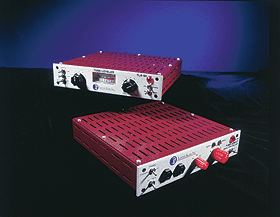 Two surprisingly affordable units from a premium name in high-end valve processing.Photo: Mike CameronThe TD100 instrument preamp is a single-channel active DI box and instrument preamp, using hybrid circuitry. It is a reasonably compact, sturdy, and extremely solid mains-powered unit, 1U high and half-rack width, and there is just a handful of controls and connectors. A single unbalanced, quarter-inch instrument Input socket is provided on the front panel, with an adjacent loop-through Direct Output which would normally be used to feed a stage amp. The input signal is buffered with an ECC83 (12AX7) double triode, operating in a Class-A mode, and a rotary knob allows the input loading to be adjusted between 10kΩ and 2MΩ. A second, larger rotary switch sets the input gain from zero to 24dB in 4dB steps — a green LED illuminates when signal is present and a yellow one indicates the amount of tube drive. The more the Drive LED is illuminated, the more nonlinear the circuitry becomes, so it's easy to dial in the degree of valve sound you require — although don't expect valve overdrive effects here, because this is, above all, a very clean preamp.
|

The only other front-panel controls are three toggle switches. The two on the left select Ground Lift and Polarity, while the one on the right turns the power on and off. The rear of the unit carries an IEC mains inlet with integral fuse holder (fixed 220V supply) and three output connectors. These are driven by solid-state circuitry, providing a nominal mic-level signal on an XLR and line level on a TRS socket (both outputs are balanced). The provision of both line and mic outputs is a real boon. On stage, the mic output would probably be selected to feed through the multicore back to the front-of-house mixer. In a recording studio, the line level output might be preferred to avoid adding any unnecessary noise from the desk preamps, or for patching directly into a multitrack recorder.
A headphone output on a second TRS socket is very useful for private practice sessions and extends the versatility of this machine greatly. However, I think a separate volume control would be an advantage because, if a lot of gain is used to produce the desired 'tube warmth', the headphone level can become deafening!
Using The TD100
 TD100 front panel.The TD100 requires a few minutes to warm up before it sounds its best, but once at normal operating temperature it worked like a dream. Everything operated exactly as expected, with a useful degree of warmth and body being added to the signal — yet without an overwhelming 'tube' character. The amplifier circuitry retains excellent detail and clarity, although this can be altered slightly with the loading control, of which more in a moment. With a healthy input signal the unit is certainly quiet enough to be used as a recording preamp, although I did detect a very faint residual mains hum which increased with the gain setting — implying it was getting into the circuitry at the front end. In practice I doubt this will trouble anyone. As I have already intimated, there is more than enough level from the headphone output to keep even the most ardent rocker happy!
I didn't come across a situation where the earth lift switch was required, but it is useful to have it there. I'm not so sure about the polarity reversal switch, but I'm sure someone will find they prefer their instrument with the reversed setting! It may also prove useful if combining a mic on a cab with the DI output, especially if the desk being used has no polarity reversal switches on its mic inputs.
 TD100 rear panel.The input loading control has a subtle effect at the best of times. With keyboards and other electronic sources connected with short cables I was hard pushed to spot any difference at all — in the end I decided that the high end sounded a little crisper with the control turned fully clockwise, but it really was negligible. With electric guitars and basses, and with the piezo bugs fitted to most acoustics, this control had a more audible effect, although it became impossible to say which setting was correct. The sound was never wrong, as such, but the character changed slightly and it came down to a case of what sounded most appropriate for the material being played. In practice, though, after some initial experimentation I tended to leave it at the highest value, as there always seemed more important things to worry about!
I was impressed with the TD100. It really is a bombproof and sturdy piece of kit which inspires confidence. The provision of direct, line- and mic-level outputs is great, and makes the TD100 extremely flexible, as does the inclusion of the headphone output. The hybrid circuitry combines a welcome tube warmth with solid-state reliability, and any musician who finds themselves working with large PAs on stage one day, and in the studio the next, will find the TD100 a very useful tool. There are cheaper DIs in the UK, but none that sound as good as this, or provide such flexibility.
Quality Construction
Internally, the construction of both these units is superb, and the steel cases are extremely robust — these are not products which will break easily! Looking inside the TD100, for example, the circuitry employs conventional components throughout, mounted on a high-quality PCB. A very high-quality Burr Brown op amp lurks near the input circuitry, along with a Groove Tubes ECC83. The latter is mounted horizontally from a daughter board, with a 'spider socket' to prevent heat damaging the PCB tracks. The circuit board immediately below the valve has also been drilled to enable convection cooling. Summit Audio claims a useful life of about 10000 hours for the valve, and gaining access to replace it simply requires the removal of the thick steel lid, held on with seven screws. The output circuitry appears to consist of a number of discrete transistors and another op amp with an LM339 to drive the headphone output. A chunky transformer has a 6V heater winding, centre-tapped at ±24V for the solid-state circuitry and with a 185V anode HT supply winding.
TLA50 Tube Leveler
 TLA50 rear panel.This is another 1U high, half-rack unit built like the proverbial outhouse, in a substantial steel case. The rear panel carries all the interfacing. A combi jack/XLR socket accepts the line-level input signal, with +4dBu sensitivity on the balanced XLR terminals and -10dBV on theunbalanced TS socket. A normal TRS socket is provided for linking with a second unit for stereo applications, and another provides an unbalanced insert send/return to the side-chain. An EQ unit inserted here enables frequency-conscious compression, such as de-essing. The output is provided on both an XLR at +4dBu (balanced) and a TRS socket at -10dBV (unbalanced). An IEC socket with integral fuse holder accepts a 220V mains supply.
 TLA50 front panel.The front panel is simplicity itself, with a near symmetrical control layout. On the left-hand side are three toggle switches. The top two determine the compressor's attack and release time constants with slow, medium and fast options. Summit Audio don't provide any details of the corresponding values, and to be honest it doesn't matter. You just flick the switches until you find the correct setting — its all about using your ears! The bottom switch selects the signal shown on the edge-reading moving-coil VU meter: output level or gain reduction. Strangely, zero gain reduction was indicated at +1VU on the meter (most compressors are calibrated to show no gain reduction as a 0VU reading).
|
To the right are two further toggle switches plus a power light. The lower switch turns the unit on and off, whereas the other bypasses the processing and primes the unit for linked stereo operation. Either side of the meter are large black rotary controls — the left one sets the input level and the right one determines the amount of gain reduction. What could be simpler? Indeed, it is this simplicity that gives rise to the name of 'leveler' rather than compressor, since the threshold and ratio controls are effectively combined under the 'gain reduction' knob.
Using The TLA50
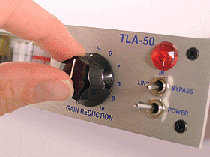 The Gain Reduction knob simultaneously controls both threshold and ratio.As might be expected, just running a signal through the TLA50 without any gain reduction brings sonic benefits. The valve circuitry adds a characteristic warmth on its own which can be very handy, and very small amounts of gain reduction seem to alter the clarity and brightness in a subtle way without introducing obvious dynamic control. With individual instruments, the unit was a joy to use. Once patched into the appropriate instrument channel, it was just a case of matching the input gain with the bypass level, and then dialling in the required amount of compression. The Attack and Release switches then optimised the response and recovery characteristics.
I found the TLA50 to work extremely well with most sources, especially bass guitars and vocals. In fact on both of these sources it proved able to exercise a lot of dynamic control without sounding heavy-handed. However, it didn't seem to have sufficient speed to handle percussive instruments — especially if recording to a digital medium — and didn't seem as effective with complex mixes. This is really a tool for polishing individual sources, and so I doubt anyone will make use of the stereo linking facility. Likewise, I tried the side-chain insert with an external EQ and was able to effect some useful de-essing, but I'm not convinced this is a very practical thing to do for most users.
Overall, I found the TLA50 to be a very effective and simple-to-use compressor, ideally suited to maintaining dynamic control of most musical sources. It adds a useful degree of tube character in the process and proved very good at 'warming' sources, especially when working with digital recorders. The downside is that it is a relatively expensive product in the UK compared with the likes of the Dbx 376 voice channel or the stereo Mindprint T-Comp, for example — both offering compression with thermionic signal paths. However, it is built very well, and would make the perfect rack partner for the TD100 — especially for a bassist.
| |
|
 TD100 £499; TLA50 £699. Prices include VAT.