

Engineer Richard Chappell has been at Peter Gabriel's Real World Studios for over 15 years -- and he's spent seven of them working on Gabriel's latest solo album.
Peter Gabriel fans have had to wait 10 years for a solo album proper to follow 1992's Us. Last year, their man finally obliged with a new collection of songs, Up, joking that "Old men take a little longer to get 'up'," and adding, "Starting is always easy... finishing is harder." Gabriel also noted that "Speed is not my strength: diversions are," and it should be pointed out that he has worked on several other projects in the meantime, most notably Ovo (2000), the music from his Millennium Dome show, and Long Walk Home (2002), his score for the film Rabbit-proof Fence. Nevertheless, 10 years is a long time by anyone's standards.
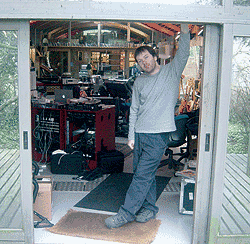 Engineer Richard Chappell in the Writing Room at Real World Studios.Up's CD booklet contains some hints of the gargantuan amount of work that went into its making, with 10 engineers and assistant engineers credited, and half a dozen recording locations across the world mentioned. The average amount of musicians credited per track is about 12 (counting bands and orchestras as one), with people doing things like 'groove treatment', 'tape scratching', 'loop manipulation,' 'Spectre programming', 'Supercollider programming', and so on. Apart from Gabriel himself, however, only one other person was there during entire period of the album's making: engineer Richard Chappell, "on whose shoulders," according to Gabriel, "this record has been built."
Chappell has worked at Real World, Gabriel's prestigious and pioneering recording complex near Bath, since joining as a 17-year-old teaboy in 1987. He's followed the usual route from teaboy to tape-op, assistant engineer and engineer, being taught by the legendary David Bottrill, who was Gabriel's regular engineer until he left in 1993 at the beginning of Gabriel's Secret World tour. Chappell took over, working as Gabriel's live assistant, helping prepare studio material for live performance, and engineering the studio overdubs that were added to Secret World Live (1993). Apart from a few diversions, as assistant engineer on New Order's Technique (1989) and engineer on the same band's Republic (1993), Chappell has worked full-time for Gabriel since he joined Real World. (In addition, Gabriel has another engineer working for him, Richard Evans, who was mainly involved in the making of Ovo and Long Walk Home)
Mountain Music
 Gabriel inside his Writing Room.I talked to Richard Chappell in the Writing Room, also nicknamed the garden shed, which is a glass and wooden building sheltered by trees and located a few hundred yards from the main Real World studio complex. "Peter made the decision for this album to get out of the production room in the main studio building and make the Writing Room his base," Chappell explained, adding that it offers privacy and the freedom to have the equipment set up as he pleases. "Whenever he walks in, his mic and his keyboards are always live so he can just sit down and play and work."
The Up album began life in the spring of 1995, when Chappell and Gabriel set off to a place called Meribel in the French Alps, where they rented a local chalet. "We achieved a lot there because there were no distractions," Chappell enthused. "We did a lot of writing, and a lot of snowboarding. It's a dream way of working, up in the mountains every day. It was very inspiring and made Peter very happy. We generally worked at night time, which was tiring, because we'd be exhausted from jumping around and running around the mountain by day."
Other than guitarist David Rhodes, who "came in at the beginning to jam along and play," only Chappell and Gabriel were present during this initial period. They worked for two months in Meribel, returned to Bath, took part in a Real World recording week, kept working in the garden shed, and in October went to Senegal for a further three months of writing. Apparently Gabriel managed to come up with more than 70 ideas during the Senegal phase. Afterwards it was back to Bath again, and in the Spring of 1996 they went once more to Meribel for writing and snowboarding. ("Peter's a fun boss, really.")
 The equipment Gabriel and Chappell were using during these sessions was brought over from Real World and included a Mackie 48-channel mixer, a 32-track Pro Tools system, a few ADATs ("for if something didn't work properly with the hard disk"), and three Macintosh 8100 computers, one with Pro Tools and Logic, one for backups and one for writing lyrics and going on the Internet.
"Peter had brought most of his normal writing setup to these places," Chappell explained. "This includes an Akai MPC3000 or MPC60 -- he likes to have a modular drum machine. His main sampler and keyboard controller has been the Kurzweil for the last 10 years, initially the 2000, then the 2500, and now the 2600. It can do a lot, and he can make interesting sounds very easily with it. He also has a Clavia Nord Lead, and lot of Korg stuff, like the Wavestation, 01/W, and more recently the Triton. He likes basic Korg sounds to play with and treat, more than he likes Roland-based stuff, even though he likes Roland pianos sometimes. He also uses an Emulator IV and the Waveframe, although the latter less and less recently.
"His setup is quite simple really, and it's more about the treatments in the moment. He'll work with a good piano sound, and then treat it with effects like Eventide or Delta Lab delays, or distortion or other pedals. He has a lot of guitar pedals to play with. We use Pro Tools plug-ins, but in general it's more a matter of putting stuff through speakers or a pedal. But it could be anything. It's not that calculated. It's whatever works."
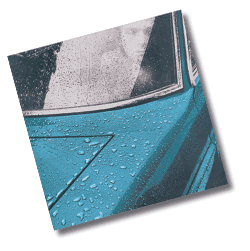 The eponymous first album's cover.During the Summer of 1997 the duo made another trip, this time to the Amazon, where they recorded on a friend's boat. "It was a small trip of perhaps two weeks or so," Chappell explained. "It was a private boat with a full recording studio on it, but I can't talk about it, other than to say that we worked on Logic there as well. It's just a crazy thing that we do now and then. It was a strange and bizarre trip in which we were travelling down the river working on music and looking out of the windows seeing the rainforest go by."
Back In The Real World
In the Writing Room, further writing, recording, overdubbing, and editing was undertaken with the help of a digital Sony R3 Oxford recording console which was installed in the Summer of 1997. "When we moved to the Writing Room we just had a Mackie setup here and a whole bunch of gear and a big mess of cables," recalled Chappell. "After the second Meribel trip we bought the console and installed a proper studio here, with Neil Grant Boxer 3 speakers, and currently Mackie HR824 nearfields. We have two Sony Oxfords now, one here and one in the workroom in the main studio. It has 120 faders, which is just about enough for what we do!"
After the different writing periods Gabriel had, with his 'sprawling' way of working, come up with about 130 song ideas and sketches. A selection of these would find their way on Ovo, Long Walk Home and Up, after going through many different permutations, variations and approaches, with people being invited in to try different treatments and musicians asked to overdub all manner of parts. The joke has been made that Up is the first recording that needed its own archaeology department to organise, store and retrieve all these bits of information. It was therefore not surprising to hear Chappell state that hard disk recording as well as the digital Sony desk were essential to the project. With hard disk recording Chappell was able to name and organise unfinished ideas and parts, while the combination with the Sony made it possible to switch instantly from one song idea to another, offering Gabriel unparalleled creative freedom and spontaneity.
 "Looking back, I don't think we would have been able to do it with more traditional studio gear," Chappell remarked. "With Peter's way of working there's simply no other way of doing it. It does get quite crazy, because he doesn't like to throw many things away, so you build up a huge archive of tracks and tracks and tracks. I had various assistants on the project and one of their main jobs was to listen to things and make notes of what's happening and highlight the different bits. These highlights then ended up on DAT tapes so we could go back and listen to them. Then they got transferred to iTunes, the Macintosh's MP3 player, and so Peter always had a point of reference."
Nevertheless, with Ovo and Up being Gabriel's first largely self-produced recordings, one wonders whether he and Richard Chappell didn't at times feel overwhelmed and find it hard to remain objective. It appears that the versatility of digital technology again proved essential. "We didn't get overwhelmed because the music we were working on was always changing. The canvas in front of us was always changing... it was always fun, and always interesting, and I really like the music. And Peter is very amicable and fun to be with. So it was refreshing more than overwhelming. I never got worried about it."
|
The Truth About Analogue
Gabriel and Chappell were, however, worried about another aspect of digital technology: sonic integrity. In 1995, when work on Up began, hard disk recording was in many ways still in its infancy, and many were fearful of losing data and concerned that 16-bit audio coming from a hard drive sounded inferior to tape. Chappell said "I tend to agree that the 16-bit/44.1k resolution is too low, but at the time we decided to work with what we had. We A/B'ed things and then it was like 'That's it, let's get on with it. Don't be distracted by that.'
 Richard Chappell with Sony Oxford console in Peter's Writing Room."We A/B'ed a lot of A-D converters. We had used Apogees for the final stereo transfer to DAT of Us. Since then we did more A/B tests and got a bunch of Prism converters to record any fundamentally important things, like vocals. We immediately heard the difference between the Prisms and the Pro Tools A-D converters. One of the reasons for going for the Sony Oxford desk was the quality of its A-D converters. In the end we simply used the Sony converters. Our only problem now is to figure out where we're going next, because the Sony doesn't support more than 48kHz, and I've listened to 96k and it sounds better. But then, the Sony sounds better than a lot of 96k desks that are around at the moment.
"When we began the project there was no 24-bit recording. We did eventually transfer everything to 24-bit/48k and kept it at that. Sometimes we couldn't get enough tracks out of Pro Tools for multi-channel sessions with drums or musicians, so they were initially recorded to the Sony 3348HR [48-channel digital multitrack] or the Studer A820 [24-channel analogue]. We used the latter mostly for treatments. We often work in analogue for treatments and used the Studer as a processor, kind of like an off-line plug-in. We take things out of Pro Tools, put them on the Studer, mess with varispeed, up an octave, down an octave, reverse things and so on. There's a real quality that you get from analogue that's beautiful and nice. It's not an arty way of talking about it, it's the truth.
"We also do treatments in the Sony console. I'll have a reverb available like his standard Quantec, a set of delays and quite a few plug-ins, whatever is needed. But as a rule I print any treatment or effect, so when you get something that's really happening, it is recorded, rather than having to go back and having to set up again. The same with a plug-in that's working."
|
|
Original Audio
The Writing Room boasts a 32-channel Neve 33-series desk, but its 33797 modules are "basically used as mic amps," according to Chappell, and it also features a wide range of other preamps and microphones. For Gabriel's voice, Chappell often used a Sony C800 valve mic in combination with a Shure SM58, run through external mic amps like the Amek or Neve. "It depends on the time or the song, there are lots of different ways really. I may sometimes use the digital compressor/limiter on the Sony when recording his vocal, but a lot of times I'll take it off and just ride the level with a fader."
Gabriel's love of guitar stomp pedals and analogue sonic treatments are other examples of old-tech -- as is, arguably, his most recent talent, playing the guitar. "Yes, Peter plays guitar now!" stressed Chappell, "and yes there are particular ways in which he works, sometimes with sampling, sometimes with manipulation. He doesn't play it normally, let's say. But he has fun doing it, and he likes to record a lot of it, and then he likes to go back and find out what happened."
'More Than This' is one of the tracks that came out of Gabriel's unorthodox guitar experiments (see box), as is 'No Way Out', on which he is credited as playing Telecaster. On these and other tracks Gabriel also receives some colourful credits such as Wonky Nord, Mutator, Oxford Backwards Samples, Firefly Keys and so on. Some, like MPC Groove or Sample Keys, are self-explanatory, but others demand an explanation. Chappell elaborated: "Peter likes to credit things in a particular way if it has been useful to the song. The Mutator is a filter box, and the Jam Man a small Lexicon delay box. You record into it and loop it and it layers and delays. It distorts really nicely and it's great fun for making instant loops that you can play with. Firefly Keys is simply Peter's way of describing a sound on that track. I think it may have been a patch from Gigasampler, a PC-based sampler that's great for instant sounds. If you want a string section or something, it's there immediately. It loads very quickly. Since the time we did Passion we also have a sample library for the Akai S3200, but we don't really use the Akai that much any more."
|
|
|
Chappell's credits on Up extend beyond general engineering to individual mentions for programming on all tracks and 'treated loop' on 'The Barry Williams Show' and 'loop manipulation' on 'My Head Sounds Like That'. Most of his programming centres on rhythms, reflecting his origins as a drummer. "It's basic stuff really," Chappell explained, "because you're engineering you're adding sounds, you're programming stuff, you're moving things around. It's normal in engineering now. This is why my credit for programming on 'The Drop' [a piano/vocal solo for Gabriel] pissed me off. I just recorded it and manipulated some stuff around. That's all. With regards to the other stuff, now and again we get people in to program, but most of the time I'm left to my own devices, and then I just program. I generally take audio samples and move them around or touch them up.
|
"We normally have a rule that we only use audio that originated from us, so no sample CDs. We have a lot of drum sessions that we go back to and get parts from, and then it's a matter of trying to get it to sound different. Sometimes I may get some MPC happening, but most of the time I like to cut up audio in Logic. On Ovo we had a programmer called BT [aka Brian Transeau, interviewed in SOS December 2001], who did some programming on the tracks 'Make Tomorrow' and 'The Tower That Ate People'. I was quite inspired by him. He does everything in audio, and since working with him I've copied that. So we do all the loops in Logic, stretch it a bit, cut it up, play with it, see what happens."
|
Mixing Up
 American engineer, producer and mixer Tchad Blake mixed the album.Another juxtaposition of the hi-tech and the old-tech came in with the American engineer, producer and mixer Tchad Blake, who mixed the album. Blake is particularly known for his work with 'dummy' binaural heads (in his case the Neumann KU100), and his strong preference for compression and what he calls 'mechanical effects', sticking microphones in rubber tubes, tin cans, or cardboard boxes rather than using digital reverbs (see SOS December 1997). Blake decamped from Los Angeles to the Cotswolds in recent years and now mixes and records frequently for Gabriel's Real World label, often using his binaural head. Blake himself was reluctant to talk about his work on Up, but Chappell was prepared to lift the veil a little. "I think Peter invited Tchad because he was producing himself and wanted to have a fresh pair of ears towards the end of the project to keep things under control. Tchad is very strong-willed and having someone like him around is a good discipline. We tried out a few songs with him, and Peter liked the results, so we kept going. Tchad is a genius with what he can do sonically. We also have a history with him here at Real World, so that's what we went for."
There was, however, one complication, and it fell to Richard Chappell to sort it out. Blake didn't want to mix on the Sony, nor did he want to mix straight from hard disk. So he set up in the large recording room in Real
World, where there's a G-series SSL, and Chappell transferred all the disparate bits and pieces that made up the ingredients for each track onto a Sony 3348HR and Studer A820.
"Tchad wanted to work off tape and completely in analogue -- although in the end he did mix from hard disk. Tchad likes to work in the big room because he has a lot of equipment and wants to spread it around. He likes the Sony Oxford desk, but he often inserts a lot of analogue gear everywhere in the signal path. You can do this with the Oxford, but you get sample delays. You can adjust these, but it was just too much hassle for Tchad to deal with. He's very instant and likes to quickly buss things in and out and get on with it. He could also use his binaural head techniques more easily in the big room.
The strings on 'Signal To Noise', for instance, were recorded quite dry, so he decided to spin them through a room and bring them back in via the binaural head.
|
"With Tchad mixing in a separate room it meant that Peter and I could keep working. Peter would be in here recording things with me for the same song that Tchad was mixing, and we'd walk towards the main building to add these things to the mix. Tchad would either agree or disagree, and they'd have to figure out between them what was going to be used."
Tchad Blake's mixing process and Gabriel's enthusiasm for last-minute overdubs meant that the various ingredients of many songs ended up in even more different places than before, making Chappell's job of compiling the material still harder. When I talked to him, he was in the middle of collecting the recorded ingredients of the song 'Growing Up' into one file, so it could be sent off to the American pop mixer Tom Lord-Alge for a single mix: "Even with all our notes it's still a pain in the neck to turn everything into one document. I'm looking through different versions and trying to turn it into one version. A lot of songs were worked on over such a long period of time, and things were added in SADiE, in Pro Tools, in Logic, in the cut. It simply takes a while to figure out what happened."
Chappell is also preparing material for producer Stephen Hague, who is working on a revamped version of Ovo, with Gabriel singing all the songs, which is to be released later this year in the US as a genuine Gabriel solo record. A remix album, which will see people like Tricky and Trent Reznor having a go at various tracks from Up, is also expected in the shops towards the end of the year. On top of all this, after the European and second American legs of the Growing Up tour in the spring and summer, Chappell and Gabriel intend to complete the follow-up to Up, tentatively titled I/O and based on material from the same sessions as Up. It is scheduled to be out some time in 2004. It seems like an extraordinary avalanche of releases from the master of non-record-proliferation: "Sometimes you wait ages for a bus, and none come, and then suddenly four come along," is Gabriel's explanation. With a possible six albums out in the period 2000-04 he may risk having a congestion charge slapped onto him...