

Some engineers earn a reputation for classic recording techniques and live bands, while others help to create the cutting-edge sounds of modern rap and R&B. From Foreigner and the Rolling Stones to Timbaland and Missy Elliot, Jimmy Douglass has done both.
 Photo: Eleonora Alberto"Half of the engineers today aren't engineers at all," asserts Jimmy Douglass. "They're either Pro Tools operators, or they're vibe kings! They sit there and they keep the vibe flowing. That is what 90 percent of the job is today. The sound has taken a back seat to this whole process of hanging, chilling, and screwing around until the vibe is right to do your thing."
It was all so very different when Douglass started out during the mid-'70s. However, he and his career have evolved considerably since then. From Aretha Franklin, the Average White Band, Bette Midler, Bryan Ferry, Dr. John, Foreigner, Hall & Oates, Roberta Flack, Roxy Music, Slave and The Rolling Stones, to Aaliyah, Bubba Sparxx, Cassandra Wilson, Ginuwine, Jay-Z, Jodeci, Missy Elliott, Magoo, Snoop Dogg and Timbaland, he's come a long way, learning new techniques and adapting to widely contrasting approaches while flipping between R&B, rock, rap and hip-hop. What's more, he's never lost his knack of stamping recordings with his own unique feel.
Into The Atlantic
Jimmy Douglass actually commenced his studio career while still attending high school, securing a part-time evening job as a tape duplicator/editor at the Atlantic Records facility in New York City. There he was able to observe legendary figures such as Tom Dowd, Jerry Wexler and Arif Mardin apply their skills to some now-historic recordings — not a bad education for a novice — while teaching himself how to work the custom-made 16-channel console during the studio's downtime. What's more, when Douglass asked Wexler if he could use the facility to demo a band that he'd discovered, he was given the green light. "Great!" enthused the kid. "Who's going to engineer the session for me?"
 "You want it, you do it," was the blunt reply, so engineer the session he did, as well as that of another band he brought in. Although the Atlantic brass didn't think much of the artists or their material, they were more than a little impressed with the sound that Jimmy Douglass managed to obtain. Assigned the task of pushing the faders on a project with Loudon Wainwright III, he thereafter found himself on the roster of Atlantic's in-house engineers.
"In that era there was a mystery and a magic to the studio," Douglass says. "That isn't the case anymore. Anybody and his brother can put together his own recording setup, whereas back then the musicians had to rely on the techniques and the ears of the specialists. In my case, I initially didn't know about microphones and what the different ones did, but Atlantic had a collection of some of the greatest mics ever, and so when I was in a session I'd put one of them up without knowing where it was supposed to be positioned. My ears would just tell me 'I like that,' so I'd place it here or place it there based on where I thought I'd seen it being used, and then move it to where I felt comfortable with it. It was a total case of trial and error, and I guess I had an instinct for that kind of thing."
From tape duplicating to engineering without any formal training as an assistant — this early career path ensured that, right from the start, Jimmy Douglass took an unorthodox approach. After all, how could he conform to the rules when he hadn't been provided with any? If a noted vocal mic sounded good on a snare drum, then that was fine with him.
"In the real old days, they'd use a single Neumann U47 over the drum kit to get the best snare sound," Douglass says. "Well, I found out, just by trial and error, that when you put a 47 over a snare, man, that snare sounds fat as hell. So, there I was in this studio for a couple of years, putting a 47 across the snare, and when I went to another studio and wanted to do the same thing the guy running the place said, 'Are you f**king crazy? I'm not putting my 47 there just so the drummer can bash it!' I looked at him like 'What's the problem?' I didn't know about such things. When I learned how expensive the mic was, I had to find another way to record the snare, but the truth is, to this day, the 47 still has that sound to it. Nothing else sounds like that. Still, I'm not willing to risk a $10,000 microphone being hit by a stick."
If Douglass did experience any kind of formal training, it came in the form of watching Tom Dowd take care of a mix. Late at night, the two of them would be the only people still in the studio, and Douglass would use the time well by silently observing. "Tom never said anything to me," Douglass recalls. "He used to talk to the board, the wires and the gear, and I'd be sitting there night after night after night, watching how he did certain things, and I'd think, 'OK, tomorrow when I come in I'm gonna try that.' He never made me his assistant, but before long I was serving him without either of us realising that this had happened. Watching him so much I just knew what his next move was going to be."
When I ask Jimmy Douglass if, during his early years as an engineer, he was ever clueless in the middle of a session, he says no. "It was an era of musicianship," he remarks, "and so basically all you had to do was just get a decent sound while people were playing. They were playing some incredible shit back then, whereas now nobody plays, so it's a totally different situation. I was blessed to work with all of these great musicians, and so how bad could it be? I was sitting behind the board and all I had to do was capture their performance.
"When I worked with Billy Cobham, I think I expanded my whole horizon, suddenly switching from R&B and funk to this whole different genre of recording. Ken Scott became my model, because he did Billy Cobham's first album, and I remember listening to that record and going, 'Holy shit, I've never heard anything quite like this!' The detail with the drums was especially noticeable. So, for me, Ken became the guy to beat, and when I got to work on Billy Cobham's third album [A Funky Thide Of Sings] in 1974, my whole miking technique changed. Billy wanted all of the drums covered, so whereas before I'd use this real basic setup, suddenly I was using, like, 21 different mics, and that changed my whole perspective on recording."
Jimmy Douglass's Studio
Jimmy Douglass's facility was assembled in 1998 and caters specifically to his own projects. Following is a list of the main gear:
- Akai MPC3000 percussion sampler.
- Alesis Andromeda analogue synth.
- Digidesign Pro Tools Mix Plus system.
- Emu Proteus 2000 with Protozoa card, Vintage Keys, Virtuoso, Extreme Lead and Mo Phatt sound modules.
- Ensoniq ASR10 keyboard and rack module.
- Mackie 56-input console.
- MCI JH24 analogue multitrack.
- Roland JV2080, fully expanded (x2) and Roland XV3080 sound modules.
- Sequential Prophet 5 analogue synth
- Tascam DA88 multitrack recorder (x4).
- Yamaha SY99 controller keyboard.
- Yamaha AW4416 recording workstation.
- Various outboard including Focusrite mic preamps and EQs, Lang EQs and Dbx compressors.
 Jimmy Douglass's studio is based around a Pro Tools Mix Plus system and an MCI analogue 24-track recorder, with a Mackie analogue desk."At the point when I got the Mackie, it was the only affordable console that was decent," Douglass says. "The analogue 24-track MCI was chosen simply because I needed an analogue machine — when I'm tracking I always go to analogue. At the same time, the DA88s afford me more tracks in the digital format, while the Pro Tools speaks for itself; you can't live without it.
"Among my favourite bits of vintage gear are some Eventide flangers, while in terms of my overall outboard selection I have five racks set up in the studio that go with me wherever I go. These contain anything from Neve and SSL compressors to a bunch of different EQs.
"My studio is just like an interface to the world. You can bring whatever you've got to my place and I can just kick it up. In fact, a lot of my gear mirrors the Timbaland setup, because one of the things we must be able to do, especially if we're working in New York and something should go down on us or we're missing a piece, is to go to my studio and grab whatever it is to keep rolling. That was my thinking behind that. A lot of the pieces I have, I bought because he had them first and I wanted to learn how to work them. I'd buy them just to fiddle with them, and before long I turned around and I had a whole bunch of gear!"
Rock & Roll
In due course, Douglass became involved with a lot more rock & roll projects, including about a year's worth of overdubs on the Stones' Love You Live as well as half of their Some Girls album. He also produced Slave's first album, which went platinum, before his career really took off when he encountered a group that had recorded an album at Atlantic, and which, according to Jimmy, "sounded like shit after it had been mixed. They came to me to help them remix it." The band's name was Foreigner, and this was their first album. "From that moment on, everything changed for me," he says.
"Having worked with the Stones, and co-engineered a Narada Michael Walden album with Dennis McKay, I'd learned about this English sensitivity; about how they treated everything differently from what I was used to in America. For one thing, they treated bottom end totally differently. In the US, what with all of the black funk records, it was always high: 100 cycles and above, real heavy and in your face. With the English guys, on the other hand, they'd put the bottom down in the lower 60-cycle area, where it was kind of woofy but it wasn't in your way. I mean, there was bottom, but it was a different type of bottom; one that gave a broader spectrum. Dennis McKay did stuff that was all backwards to me. He'd mic a piano and cut the bottom out of the low-end strings while putting bottom on the top. At first I thought 'That's crazy!' but it actually created a different spectrum and gave depth to the piano.
"Beforehand, I'd worked with a group called Television. Andy Johns was engineering and [Marquee Moon] was the only album I ever assisted on. No one could understand the sound of the speakers in Studio B at Atlantic — it was a really weird room — and Andy walked in there and started doing stuff, and I was thinking 'This sounds horrible! This f**king guy is overrated!' However, when he'd take the stuff into another room and play it, it was right on. The result was that I learned to hear like him and how to make the room sound so that when you came out of there, the shit was kicking. I learned so much working with that guy. It was a great experience.
"Given this English indoctrination, when I got together with Foreigner it was like a match made in heaven. My American sensibility — that raw, funk bass thing — combined with the English sensibility of Mick Jones, and together we came up with something really different."
At the same time, during a mid-'70s era when disco reigned, Jimmy Douglass took an unconventional approach by introducing a rock edge to the funkiness of Slave, a drum-and-bass-oriented outfit for whom he produced a number of platinum albums. "I treated their funk like rock, miking the drums like a live rock & roll drum kit," he says. "People were doing these tight mikings, but I'd do the opposite, and I think that's part of the reason why their sound was really happening. It was so different on the funk scene. They were playing this heavy-duty funk stuff and it sounded really open."
The Rebirth Of Cool
Despite his flexible attitude and willingness to always try something different, when rap and hip-hop became huge in the late '80s and early '90s Douglass was like a man with his future behind him. "The people buying records were different, the new artists were different, and the whole scene consisted of a different sound, a different vibe," he explains. "When you're in a position of certainty and you're known for doing certain things, you don't really know what's going on when a new regime takes over. I had no value to the new crew. As the music changed, the acts I was working with couldn't sell any records and I couldn't make any money, and so I quickly found myself doing the one thing I never wanted to do: jingle and post-production work. I did this just to keep going, and I even built a little studio in my house."
What Douglass soon learned was that, unlike his previous professional experiences, jingle work was done quickly and with relatively little attention to detail — if there was a minor aberration, it was often deemed unnecessary to fix it. Unaccustomed to this modus operandi, he initially found it difficult to readjust, yet what he didn't realise was how well this would serve him a little farther down the line.
"I was bringing kids off the street with no money into my home studio and asking them 'OK, show me why making this sample, pulling this off a record and doing this rap is really cool,'" Douglass recalls. "I'd let them lead me and I'd say 'Tell me what you want me to do.' They'd go 'Do this! Pick this one here!' I'd say 'Why?' and they'd say 'Because it fits!' Out of my record collection they'd pick the samples for me. They would do these raps and tell me what they wanted, and even though I'd listen I'd think 'Oh my God, that sounds horrible!' The sounds would be horrible — all distorted — but they'd go 'That's great!' and as a result I was basically retuning my ears to what they thought was really cool.
"After that, I stumbled on a couple of lucky situations where young artists wanted a real engineer who could obtain the new sounds. I ended up in this production house in The Village, NYC. These guys were from Chicago and we'd crank out songs and tracks and sounds. They'd have two beat-makers and three or four artists, and we'd just make records all night long, every day, over and over. I found them a real studio with a real board and a real tape machine, and they were like 'Well, since you've found it, why don't you be the man?' The year I spent doing that with those guys taught me a bunch of things; it taught me the new method recording in the studio, the hours you spend, the time you waste, and all the other stuff. It was a relearning process. The old adage 'Never write songs in the studio' was gone — now, that's how things were done.
"Records aren't made the way they used to be. Before, they used to be very expensive, and so you wouldn't waste studio time messing around until the vibe was right. Now you do — it's part of the process! In the old days you had to be a lot more creative with less gear, whereas now I have a lot of stuff but I don't use much of it. It's not really called for. The art of technology has gotten so amazingly good that I don't have to work as hard. It used to be that you had to create effects from nothing, but now there are a million boxes that'll produce 50 amazing effects at the push of a button. In fact, the hardest thing now is knowing when to use what — that's what makes the difference between the man and the boy.
"That doesn't mean I do less — I don't know how to do less — but the demands made on me have decreased, because I pretty much know what's going to happen and I have everything set up. Unlike a session where people are coming and going and you don't know what's going to happen, you don't know the lie of the land, I basically do know the lie of the land, because once you've used all of these machines you pretty much know where it's going. That makes life a lot easier for me, and it makes it even easier for me to be the overviewer while they're struggling with the little stuff.
"I've recently been working on Justin Timberlake's new project with Timbaland. When Timbaland leaves, I sit with the artist and do the vocals with him, like I've always done, but he doesn't know me. At one point he turned to me and said, 'Wow, you're really good, man!' and I laughed inside, because he has no idea about where I've been. I'm more than an engineer, and he doesn't usually get to work with people like me. I'm not trying to be egotistical, but I've spent a lot of years producing a lot of records and being in control, so of course I can help him, direct him and make his vocals sound great. That's what I do."
Timber
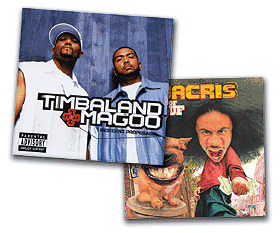 Jimmy Douglass first met Timbaland while engineering Jodeci's 1995 album The Show, The After Party, The Hotel alongside producer DeVante in Rochester, where a multi-studio complex served as a self-contained production house. A variety of projects featured assorted producers and artists, including Timbaland, Missy Elliott, Ginuwine, Tweet, Darryl Pearson, Playa/Static and Stevie J.
"We were all up there for two years together, and none of those people were really known at that time," says Douglass. "However, Timbaland and I really hit it off. His style married with my savvy just seemed to work. You see, the jingle work taught me about working fast, about not labouring on stuff like we did in the old days, about moving on an idea as soon as you get it. The details don't really matter, because the quickness of the vibe is more important, and when we were cranking that stuff out we must have done about 200 songs in a single year. The only way to do that was to sometimes close our eyes and go 'Imperfections? So what? So what if I've got a distorted vocal here? It's fine. It's part of the vibe, it's part of the feeling.'
"One of the songs that was actually done up there was 'Pony'. We did the track, did the vocals that night, and it was done. Then again, that record is a rough mix — there was a difference of ideas and career departures with DeVante, and when we all left we couldn't get hold of the masters because he wasn't happy to give us what belonged to us. 'Pony' was written by Timbaland and Static, and it was sung by Ginuwine, none of whom had a contract with him, but that was the deal, and what I had was a two-track DAT of the song. That recording is what I went to Sony with, and based on that recording they signed Ginuwine and Timbaland.
"One time, Timbaland and I were working on this record 'Same Ol' G' with Ginuwine, and while we were printing the string part we were listening to CDs. We turned the board off, it was just printing on auto-pilot, and as we listened to some other demo Tim walked behind the keyboard and layed across it so that the strings made a real weird sound. Well, we didn't know about this until we turned the board back on and went to mix. I heard this sound and said 'That's really messed up,' and then I said 'You know what, leave it. Nobody's gonna hear it, nobody's gonna care.' And sure enough, it's on the record."
Coming Soon...
 Jimmy Douglass (right) with Cheri (left) and Michelle of N/A, and their manager Olivier Ametchie.
Among Douglass's current projects is a batch of recordings with N/A, a two-piece outfit that he describes as "a former girlie girlie band; typical girls singing typical girl songs. Then, somewhere along the line, while they were working out of my studio, they decided that they didn't want to be a girlie band anymore. Instead, we'd focus on their writing talents, which are incredible." This decision coincided with the departure of a couple of female singers who'd been recruited to supplement the lineup, leaving the original pair — Cheri and Michelle — to once again comprise N/A, along with a newly added scratcher/DJ. "If you combine all of these elements you have Cyndi Lauper, Pink and the B52s," Douglass says. "It's kind of angry, wild, sexy, edgy dance rock." Enough said. At the time of writing, he is trying to secure N/A a deal, while also looking ahead to create his own label and develop the publishing that he's started to cultivate with regard to songwriting.
"It's been an amazing ride," Jimmy Douglass concludes. "To be there with the Stones and all of these high-level people, to then be in the position by the late '80s where I wasn't even invited to work in a studio, to now being right where it's happening once again — it's crazy."
Thanks to Olivier Ametchie for his help setting up this interview.