

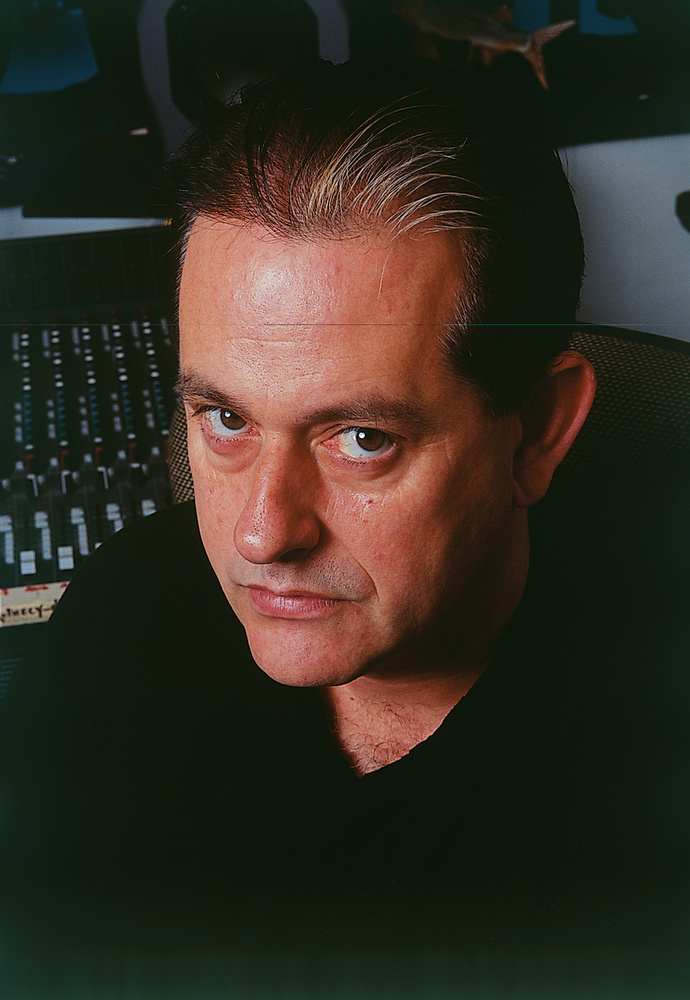
From his early days as a pioneer of British synth-pop, Martyn Ware has forged a career on the cutting edge of electronic music. And he is still innovating today — in 3D.
Martyn Ware is perhaps best known as one third of Heaven 17, although his career as an artist, producer and songwriter stretches back over 20 years. One of the founding members of seminal electronic band The Human League, he later enjoyed success as a member of electronic collective the BEF, having a hit with a cover version of the Motown classic 'Ball Of Confusion', before the BEF mutated into Heaven 17. The new outfit hit the big time almost immediately with their debut album Penthouse And Pavement, and with The Luxury Gap delivered one of the timeless albums of the '80s. Heaven 17's hits include 'Temptation', 'Come Live With Me' and '(We Don't Need This) Fascist Groove Thang'.
Recently, Ware worked on a project initiated by the National Centre For Popular Music, which is located in his home town of Sheffield. The idea was for a local artist to compose a piece of music to demonstrate the state-of-the art Ambisonics 3D surround sound system at the NCFPM. Enlisting the help of an old friend, Erasure's Vince Clarke, Ware has created a collection of musical pieces which push the boundaries of sound and production into the 21st century. Most notably, they were unique in being mixed to be heard in full 3D Ambisonic surround sound, in order to create a distinctive, futuristic listening experience. The same pieces of music have since been assembled to form an album called, with more than a little irony, Pretentious. Although the full 3D experience obviously could not be recreated on a conventional stereo CD, binaural processing was used to preserve at least some of the same feel.
"It all seemed simple at first," says Ware. "It became clear early on that it was going to take a lot more work than anticipated, because no-one had really thought about how to make popular music work in 3D. They wanted me to do the test piece, I wanted to do it in a classical form with different sections and moods to suggest the different aspects of the auditorium and I wanted to do it all electronically. After that, it was on six times a day at the Centre and we got a lot of requests to put it out as a record. So we did an album's worth of music in about a month."
Erasure: Rewind
The idea of bringing Vince Clarke on board stemmed from a mutual admiration which stretched back to early in both men's careers. "I had worked with Vince on the Erasure album I Say, I Say, I Say and we became great friends. We'd never met before but it was while making that album he told me the first single he ever bought was 'Being Boiled', which was the first record I had ever made. He made it clear he thought it was unlikely Depeche Mode would ever have existed without the example of The Human League. So there was a mutual respect from the word go, and I decided that if I wanted to do something very electronic, I didn't want to just use the standard presets you get on every instrument.
"Vince has the most amazing collection of instruments, with sounds on them he never gets a chance to use. He jumped at the idea, especially as he was taking a year's sabbatical from Erasure at the time. He decided he wanted to do interesting things during that period of time and it was a giggle for us. The whole experience was an absolute pleasure."
 Martyn Ware's home studio.
With both Clarke and Ware preferring to work from their own well-appointed studios, the immediate task was to find a way of working which allowed flexibility during the writing and recording stages of Pretentious. Ware describes how the working relationship developed: "Vince has a very well-trodden path using his BBC Micro computer and the UMI sequencer, which is an ancient piece of software, now being updated specifically for him. He's probably the only person in the world still using it. It's just a process of entering numbers. You'd give him an idea of where to start from and leave him alone for a couple of hours, and he'd have sketched an idea without any particular structure which we'd knock into shape. Then I'd use samplers to edit and move around sections of these ideas. Vince is using an Otari RADAR at his place, which did cause a few technical problems because transferring from the RADAR to Logic should have been easy, but it wasn't. I needed to get it onto Logic because that's the format I use and I wanted to have access to the vast number of plug-ins at my disposal."
Added Dimensions
With the unique brief to create music that worked in a fully three-dimensional environment Ware had to alter his own methodology, which meant helping to develop an almost completely new technology: "We would get about 80 percent of things done at Vince's studio and then do a pre-mix in my studio before going into the National Centre For Popular Music's off-line production facility in Brixton."
 It was here that Ware produced all of his 3D surround mixes for Pretentious, using a custom system comprising a Lake Huron DSP processor (made by Australian DSP and psychoacoustic wizards Lake Technology) and a 3D graphical user interface, Animix, supplied by an Irish R&D and design company, Cuan. This allowed Ware to place up to 16 tracks from Logic Audio in a virtual space, and make his sounds appear to move in any direction or rotate in any plane with the aid of a 3D joystick. The Lake Huron processor would then convert the commands from Animix into perceptual reality, storing the completed surround mix in a 4-channel matrix, the so-called 'B' format. Huron could then decode this for playback on a variety of multi-speaker surround systems, including the NCFPM's Ambisonics system, or binaurally encode it (see the '3D From Stereo' box later on). At least, that was the theory...
"The amazing thing was that it all worked for long enough to complete the album, because all the software, apart from Logic, was in development and kept crashing a lot.
"In an ideal world, before I actually started recording all this, I wanted to have the 3D part of it as an integral part of the recording process — to be able to do a rough mix and be able to put it into three dimensions — but there just wasn't the time to do that. I even asked if they could make it into a Logic plug-in, because then the whole thing could have been integrated into one box, but the timescale was just against us.
"Three months before I took this job on I attended a seminar at Strongroom studios in London, where I do a lot of my mixing, which was about Dolby 5.1 surround; they have just installed the new 5.1 monitors in all their studios. They had an engineer over from America who had used the system to explain the differences of mixing for surround sound and mixing for normal stereo. What it boils down to is very simply that because each individual instrument is separate you don't have to compromise so much in the actual sounds, because you're not trying to cram a lot of sounds into a narrow bandwidth of perception. You don't have to tailor sounds using EQ and compression so much. This gives you a tremendous amount of creative freedom — for instance, on the first song on the album it allowed us to have extremely loud and soft sounds running simultaneously, without the old worries of mistracking, aliasing, and general problems to do with mixing. You can keep elements metres apart in perceptual terms — it's much easier and quicker.
"This is like a piece of hi-tech equipment in the hands of a caveman though, because I don't begin to understand why or how it does this," laughs Ware. "If you go onto the Internet there are some very dry and dusty papers on the subject, but I got bored after one paragraph. Mixing on this system is an absolute pleasure to be honest with you — for someone who spends their life sitting in front of NS10s or whatever it was just a delight. To mix with four subwoofers and 16 equally paired speakers in two rooms of eight meant being surrounded by sound, and then being able to manipulate it in three dimensions is almost messianic. I was doing mixes which would normally take me eight or nine hours, in about two hours. Even though the techniques involved were more complex, the clarity and definition and the separation of everything was so staggeringly beautiful there wasn't much you had to do to it. Instead of having to turn a part down you could actually place it further away, whereas perceiving distance in a stereo field is a very difficult thing to do."
With so many new possibilities open to him, Ware had to resist the temptation to over-indulge when assembling the final mixes: "The test piece, 'Music For Multiple Dimensions' got all of that out of our system early on. It became clear that you can only amaze people so much without actually making them sick through the movement of the sound. Ground rules began to emerge: the movement of the sound had to fit the mood of the piece, and the intention of the original sound. If you had a loop running through a rotating 3D environment, and you wanted to have a kind of rollercoaster effect then that makes sense, because you want to draw the listener's attention to that particular sound, but if you're trying to mix something and blend all the parts together it makes more sense to have them all moving in the same direction even if they're at different velocities, or have them static — there's no rule which says everything has to move, anyway. With this system you can actually have a part sound as if it's sitting on a shelf 30 metres away; it's a lot to wrap your mind around because it's not simple surround sound.
"I believe this album engages the autonomic part of our brains which isn't normally engaged when listening to a record — it presses a kind of subliminal reality button. The reason we encoded the album in binaural was so that people could get a taste of what it might be like, but if there had been the demand to do it in 5.1 then we would have done that as well."
While surround technology is still beyond most home recordists, Ware believes it is only a matter of time before everyone is working with this technology or a variation of it. "Surround sound is finally taking off thanks to DVD and Digital TV, so obviously it will become a lot more common in the future — it's not a fad. It's becoming more and more common to have 5.1-equipped systems in America, so it's a situation we'll have in place in this country, probably within the next five years.
"3D surround sound could work brilliantly in a club environment. It would be relatively simple to import a similar setup to the one in Sheffield into a nightclub and actually mix things for that particular system. I think the dance fraternity will be the first people to embrace this technology. I'm excited to do more of this kind of music: the only disappointment with the setup in Sheffield is that in Ambisonics you have a sweet spot where you get the full 3D feeling. Unfortunately, against my advice, they set up the seats around the walls facing inwards, rather than in the centre facing outwards, which meant nobody is sitting near the sweet spot."
3D From Stereo — How's It Done?
Human beings are well equipped when it comes to our ability to 'localise' sounds, thanks largely to the brain's ability to compare the different signals coming from each of our ears. If a sound occurs off to your left, it will reach your left ear faster than your right; and what is received at your right ear will also be subtly filtered because your head is in the way. For this reason, making a stereo recording with a pair of mics arranged inside a model of a human head can result in realistic-sounding 3D recordings, provided they are listened to with the sound sources in a similar position to the mics, that is via headphones.
These days, the effects of so-called 'dummy-head' recordings can be modelled in software and imposed on a recording 'after the event'. This is where the likes of Lake Technology's Aniscape binaural decoder comes in, which Ware used to convert his multi-channel surround mixes into binaural stereo for Pretentious.
For more information on binaural techniques, see Hugh Robjohns' article on stereo miking in SOS March 1997 and Paul White's article on 3D mixing tricks in SOS November 1994. Matt Bell
Beyond Pretension
With Pretentious completed, Martyn Ware has been hard at work on his next round of projects. These include a return to working with Heaven 17 and the release of a new single, a re-working of the Human League classic 'Being Boiled'.
"Heaven 17 is the core of what I do," insists Ware. "I took a couple of years out when I had a family, because putting in 60 hours in the studio a week isn't conducive to having children. We've got a live album out now, which was actually recorded a couple of years ago when we were touring with Erasure. We've been writing a new album for the last two years, and because we want it to sound as contemporary as possible we keep getting distracted by all the touring we've been doing. Hopefully the new album will be finished by April.
"The reworking of 'Being Boiled' was Glenn Gregory's idea, because he's always liked the track and he sings it really well. It goes down a storm live — I'd forgotten of all the tracks I've done how timeless that one is. The new version sounds not dissimilar to The Chemical Brothers and Parliament/Funkadelic, which was the original intention. We have reworked all our songs, basically, because some songs adapt to new treatments. We are selling ourselves to a new audience who maybe haven't heard us before."
Although Ware clearly enjoyed the possibilities afforded him by the developments in 3D sound, he's unconvinced that all technological progress leads to better music-making. And he should know: "Heaven 17 have probably wasted more money on equipment than any band on earth! It's getting to the point where you switch on a machine, press a key, and you get something which is better than what you could buy on a white label. I'm not saying it shouldn't be done, but there is a danger that in doing that, you use up all the colours of your palette.
"The equipment you have governs the music you make. But the limitations you have are as important as the freedoms."
The Pretentious album is available on Mute Records.
Delayed Digital
Vince Clarke is famed for surrounding himself with analogue equipment, but this project gave him the chance to get back to using some digital technology, as Martyn Ware explains: "He does use a Roland JP8000 for pads and stuff, but he doesn't generally like digital stuff. He did say to me at one point, 'It's ridiculous. I have to stop buying stuff and start using the things I have now!' The other funny thing is that Vince is now using an Akai S1000 which he bought 10 years ago and has only just started using! He's got back into using samplers and things like that again.
"Vince is a very lateral-thinking near-genius in many ways, but he's also quite conservative in other ways. It takes him a while to get used to new ideas, but then when he does he really embraces them. He's only had the Otari RADAR system for about three months, and he engineers everything himself so he still isn't quite sure of all the possibilities available to him. Technology now means nothing is set in stone, you can change everything at any point and that means you have to rediscover and redefine the ways you make records.
"As a producer I'm a bit battle-scarred by all the productions I've been through in many genres, whereas Vince only does what he does and that is something unique. I'm a bit of a jack of all trades and Vince is very much the master of his."
Soft & Hard Ware
 Martyn's Roland System 100.
Martyn Ware has an eclectic writing and recording setup in his home studio which, in combination with Vince Clarke's enormous purpose-built studio crammed full of electronic instruments, offered enormous creative possibilities. "I have the Macintosh running Logic Audio," explains Ware, "with a couple of Digidesign 882 interfaces — 16 in, 16 out. 32 tracks is enough for me.
"I hardly ever use any outboard gear now. I've got an old Yamaha REV7 which I like and an Alesis Quadraverb, but everything else is a plug-in. I'm a big fan of Line 6's Amp Farm, and all the plug-ins which simulate the analogue world, funnily enough. This has given synthetic sounds a new lease of life. A synth can sound like something which has been miked up through a cabinet, for example. You can use so many multiple effects on the same sounds, and mutate sound sources so much, that I can't imagine ever going back to the way things were before. The snobbery about plug-ins is that so many dance records just use them for ear candy and don't really explore the possibilities, but they are the most sophisticated and creative thing to happen to modern music since the first synthesizers appeared. You can try things on Amp Farm which took hours to do with a mic and a cabinet.
 Some of Martyn's keyboards.
"I've loads of synths around, plus a Rhodes and a Quasimidi unit which is great. The Roland JP8000 is one of my main workhorses at the moment. The Roland S50 is still the best-sounding sampler in my opinion, even though it hasn't much memory and it's slow — it just sounds great. Vince has given me a couple of synths, actually. He has people searching the world looking for stuff for him, and he gave me one of the original Roland System 100s — I couldn't believe it, I was so touched — and also the very first synth I ever owned, a Korg 700. He had two of those and he said, 'Oh, you can have one' — that's the kind of guy he is.
"Vince has this amazing studio which is circular. It has walkways with all the synths arranged around the walls, connected by CV and Gate patchbays. Almost every keyboard he has in the studio he has a duplicate of in the basement in case they break down. That's also where he keeps synths which have fallen out of favour or he hasn't got room for. It's like a National Gallery for synths — you can only show about 50 percent of the stuff at any one time.
"Vince knows what each synth is capable of doing and that's his real talent — while we might go racing for the nearest preset perhaps because we're lazy, he would know the System 700 is best for electronic percussion, so he would use that and his custom made eight-channel, 16-step analogue sequencer to create a rhythm, and then find the best synth to do the bass on."