


Although he started his working life as a producer, Tom Lord-Alge chose to narrow his field of work and now ranks alongside Bob Clearmountain and his brother, Chris Lord-Alge, as one of the best mix engineers in the world. Paul Tingen discovers what makes a TLA mix tick...
Back in the early days of multitrack recording, mixing was seen as a largely technical process of blending the ingredients that had gone into the making of a record. But the creative options possible at the mix increased with the number of available effects, processors and recording tracks, and so mixing became more important and time-consuming. Nevertheless, for a long time it was still the recording engineer who would perform the mix, and the mixing process was still hardly centre-stage.
All this changed in the early '80s, when the legendary American engineer Bob Clearmountain pioneered the notion of the mix engineer as a secret creative weapon. For the first time, the person responsible for mixing was an outsider who could bring fresh input to a project, raise it to a new level, or salvage it if it wasn't happening. Since then we have seen the rise of all manner of mix engineers, including the remixer, who imposes his own vision on a record as opposed to bringing out what's on the tape.
Brotherly Love
In the United States there are three specialist mix engineers who are widely respected and accepted as the leaders in their field. Clearmountain is one of them, and the other two are brothers. The elder of the two, Chris Lord-Alge, is at the very top of his profession, with mixing credits ranging from Hole to Rod Stewart, from James Brown to Green Day, and from Little Richard to Savage Garden. During one week in 1998, records on which Chris had worked reached number one in three different American charts! His younger brother, 37-year old Tom Lord-Alge, is also successful, having worked with Sarah McLachlan (featured in SOS March 2000), Marilyn Manson, Oasis, U2, The Rolling Stones, Peter Gabriel, and even Hanson. Although the brothers' credits cover a wide spread of different music styles, they are perhaps best known for mixing energetic rock bands, and favour a hard-hitting, aggressive sound, with upfront electric guitars and drums, and a very hard and tight bottom end.
Tom and Chris are not the first generation of Lord-Alges to build a career in music. Their mother, Vivian, is a jazz singer and pianist, while their father sold jukeboxes for a living, and had a huge collection of 45s, plus a very sharp ear for what made a hit single. When they were young, Chris and Tom played around with the recording equipment owned by their mother, and eventually she found Chris a job as assistant engineer at H&L Studios in New Jersey, where the family was based. Chris moved on to become a staff engineer at Unique Recording in New York City, and in early 1984, Tom joined him there after a spell in live sound. At Unique, he became assistant to his older brother, who developed a habit of throwing him in at the deep end. No doubt this is why Tom coped so well when Chris handed him his first top-level job, engineering Steve Winwood's 1986 album Back In The High Life. Tom earned a Grammy award for best engineer, and repeated this achievement with Winwood's 1988 follow-up, Roll With It. Tom still acknowledges the debt he owes his brother today: "From a technical perspective, Chris taught me everything. Many of the tricks I still use, I got from him."
Tom Lord-Alge remained at Unique Recording as a staff engineer until 1988. During the '80s Unique was a pioneer of MIDI- and computer-based production techniques, and so the two brothers became experts in this field very early on, producing a number of hit dance mixes. After 1988 Tom Lord-Alge went freelance, like his brother working much of his time at The Hit Factory in New York. He went on to producing, but he soon changed course. "Steve Winwood and myself co-produced Roll With It in 1988, which had a number one hit, 'Higher Love'. This set me on the production path. But I quickly found that I just couldn't compete with the great producers out there at the time. These guys were so much better than me, but there weren't many guys who were good at mixing, so I changed my focus.
"In the period when I was producing, I was always mixing, doing single mixes as weekend projects. After a while, I found that it was really where my heart lies. I like to listen to what's on a tape, and be able to change it. When you're overdubbing, you can't really be twiddling the knobs all the time — and also my attention span is way too short for overdubbing. Mixing is akin to doing live sound in speed and immediacy, and that's an aspect that I like."
Unsurprisingly, Tom's decision to focus on mixing alone was also affected by the success of another ex-recording engineer in exactly that field. "Bob Clearmountain was definitely a big influence on Chris and myself. That's what we were striving for, to have a reputation like Bob, where you're known as a mix engineer and people seek you out for that, so that you will come with a fresh and objective input and finish a project off."
However, the younger Lord-Alge brother's mixing career took a while to get off the ground. For a few years after 1990, when he decided to focus exclusively on mixing, business was slow. Then he got a call from Talking Heads' Jerry Harrison with the request to mix an album for a band called Live. This became Throwing Copper (1994, and seven million sales to date), and it was "a turning point" in Tom Lord-Alge's career. The other record that made his name was the Crash Test Dummies' God Shuffled His Feet (1993), which spawned the hit 'Mmm Mmm Mmm Mmm'. After this it was fast forward, with commercial high points being the Hanson album Middle Of Nowhere, and five songs on the Rolling Stones' latest, Bridges To Babylon. From Manson to Hanson, it's a wide spectrum of music, most of it mixed at South Beach Studios in Miami, a commercial studio that is almost Tom's permanent residence. He comments: "I just love music, and don't distinguish between categories. I loved mixing Hanson's album, and really enjoyed the songs. I'm equally proud of the Marilyn Manson album."
Methodology
So what makes Tom Lord-Alge such a successful mix engineer? As already mentioned, the sound of his work closely resembles that of his brother, and so it comes as no surprise that their working methods are similar. Neither is afraid to use extreme compression in their mixes, and to this end, both possess vast collections of compressors (Tom has around 40, his brother even more). The brothers also share a love of Sony 3348 digital multitracks, SSL desks, and Yamaha NS10 monitors (as Tom says, "the Yamahas are so unflattering that if I can make my mixes sound good on them, they will sound good everywhere!"). Finally, both Chris and Tom prefer to mix a song a day if possible. Tom explains how he approaches a mix.
"At the beginning of a project I like to sit with the band and talk with them, and just get to know each other and shoot ideas. Sometimes the record company or the producer is also there, and my job is to digest all the different things they may be saying and come up with something that makes everyone happy. Then I like to be left alone with the tape, because I feel that the music speaks for itself. When I'm nearing completion of a song, usually in the afternoon or early evening, I'll call the band or artist or producer in, and I have no problems if they don't like a mix and want to make changes — I want to know!
"I bring objectivity, and part of that is being able to say, 'this part isn't working', and then being able to make it work. I'm not partial when it comes to what's on the tape. I listen to the whole song and view it as a big picture, rather than as a bunch of parts. I try to get everything to work in the service of the song, and sometimes that's a process of subtraction. I also have no problem with moving stuff around if it makes the song better. I will sometimes suggest overdubs, but generally speaking I use what's on tape. I'm really concerned with the artist's integrity and vision and don't want to put my own stamp on it.
"The first thing I do when I start a mix is transfer all the material to a high-definition, 24-bit Sony 3348 digital 48-track. I've been using the 3348 for seven or eight years now and it's a great production tool. Transferring all the material to it means I won't risk damaging or wearing out the original multitrack. I also never run anything live, from a sequencer. I don't want to have to worry about synchronisation or issues of sound level. So everything goes on the 3348, and the great thing about it is that it is easy to do a lot of internal bouncing with it. To start with I bounce everything to the tracks where I like them under my faders. Say the drums are on tracks 1 to 10. I like to have my drums on tracks 6 to 14. My favourite layout is to have the kick on channel 9, the snare on 10, the tom toms on 11 and 12, and the overheads on 13 and 14. The drum room mics will be on 7 and 8, the hi-hat on 6. The bass guitar will always be on 15 and 16. Channels 17-24 contain the main instruments, guitars, keyboards, or whatever they are. The lead vocal will be on 25 and any additional vocals go after that. Any music that's left over will go on 33 and upwards. If there's any percussion, like tambourines or things like that, it will go to channels 5 and down."
 Tom Lord Alge at his SSL mixing console.
This may seem arbitary, but as Tom explains, there is a good reason. "I want the instruments that are most important to be in easy reach, near the centre of the console. The faders for channels 17-24 are close to my left and 25-32 are close to my right. Tambourines can live on channel 1. I don't want to have to move over there all the time; I don't need that much exercise! Of course, by centring the most important instruments on the desk I can also remain in the ideal listening position between the monitors for most of the time.
"So I start by transferring all the tracks to the 3348 exactly as they are on the 24-track or Pro Tools, or whatever. Then I look at the track sheet and write out a new 48-track version showing where I want things to live. I program the machine and it moves everything to where I want it. I don't care about the fact that this means making a digital copy. All these people who spend their time comparing analogue with digital, or worrying about making digital copies, they have too much time on their hands. They're not living in the real world. Sometimes I move things around five or six times in one song. And you know what? I have never noticed the difference. I'd rather focus on the song. If the song is terrible it doesn't matter how you've recorded it, or how many digital copies you've made."
Having transferred everything to the 3348, and reassigned the tracks to his satisfaction, Tom goes to work. "I put all the faders up, and listen to the whole song once or twice; usually only once. By the end of the song I have a clear picture of where I'd like it to go. Then I begin working. The possibilities are endless, so it can help to put up records that you like, compare them whilst you're working and try to copy the sound. I've done that.
"I begin with the rhythm section, and then gradually bring in all the instruments. I start with the rhythm section, because I always want it to be very prominent. I come to the vocal last, and I'm not sure I agree with people who say that they leave a hole for the vocal in the backing track. I want the vocal and the instrumental track to be strong, and I don't want there to be any holes. Once I'm familiar enough with the vocal to know where it's singing and what its range is, I generally shut it off for a good portion of the mixing process. When I then bring the vocals back in, I may sometimes go back and tone down some aspects of the instrumentation. The vocal is the most important thing, it's the personality of the song. It's what listeners are going for, so it's important to make it commanding. But I certainly don't want the accompaniment to take a back seat. I don't think that the vocals should be so loud that it drowns out the music, as I've heard on some tracks, like for example in Oasis's 'Wonderwall'."
"Compress It To Jesus!"
Of course, it's not just relative level that's important; Tom Lord-Alge also stresses the importance of panning and EQ to ensure that instruments don't clutter one another and muddy the mix. But it's the subject of compression that really gets him going. "I often compress things really hard and I wish the meters would go round in a circle, because I'd love to see how much compression I'm really using. Each one of my 40 compressors has a different sound, and I generally use them as an effect."
Set Tom going on the subject of compressors and he's hard to stop. He continues for some time, outlining his favourites and preferred uses for them: "One of my favourites is the Neve 2254; I have six of those. I find that they work really well on strings and background vocals. I also have six of the old Neve 2264s. They're great for drums and vocals. I have some old Calrec limiters that I use on vocals and guitars, when I want an unusual sound. And the Inward Connections VacRac tube limiter is just a great all-round compressor. I have eight channels of VacRac. You can't control the attack and release time on it, but the settings are very musical; 200mS release time and 80 or 100mS attack time. If I need more control I'll use the Empirical Labs Distressor.
"Chris loves the Urei 1176, but I find that it is used too much by everybody. I also have old Altec limiters, which sound good on bass. Then there's the Focusrite Red 3. I always put finished stereo mixes through the Focusrite. It pulls the mix together a bit. I set it for 1-2dB compression, really light; I call that 'kissing the Focusrite.'
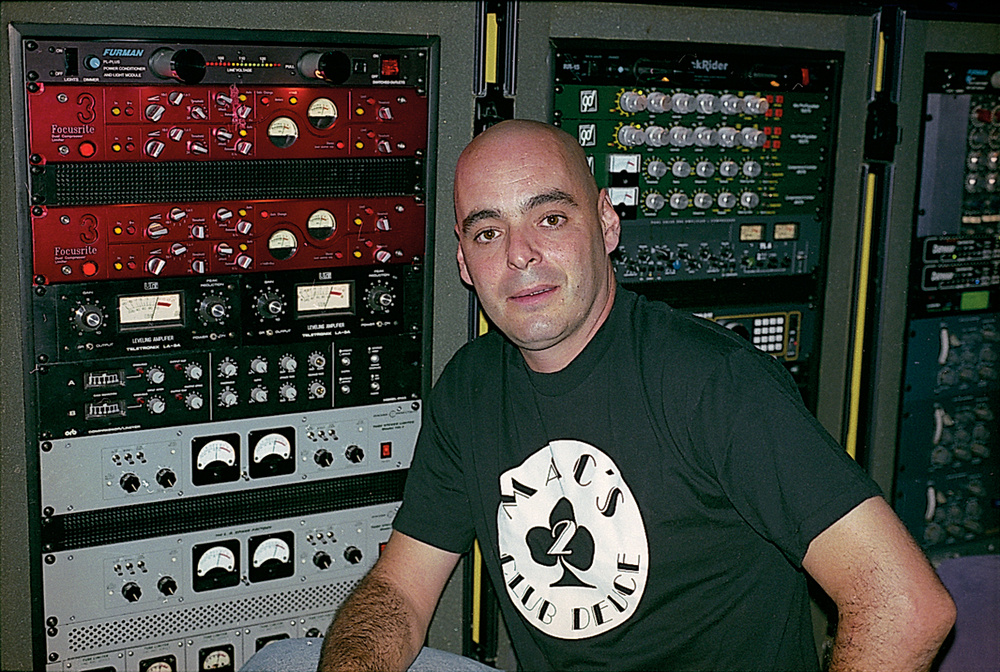 Tom Lord-Alge with part of his outboard rack.
"The main thing about compressors is to forget what they tell you and just turn the knobs until it sounds good to you. Don't look at the meter; throw out the book. For me, bass, drums and vocals are really important, and I like to make them sound pronounced and aggressive. I try all sorts of things; there's no rule against using 20 or 30dB of compression. I may even put compressors in series. To make a vocal command attention I'll put it through an Teletronix LA3A and maybe pummel it with 20dB of compression, so the meter is pinned down. If the beginnings of the words then have too much attack, I'll put the vocals through an SSL compressor with a really fast attack, to take off or smooth out the extra attack that the LA3A adds.
"Guitars I EQ before they go into the compressor. I prefer the way that sounds to compressing before EQ. The Distressors work really well on guitars, though you have to fiddle around with them a bit. The Dbx 160 is also very good for guitars. If I hear an acoustic guitar that's a little 'spikey', I put a compressor on it with a very fast attack time, to lose some of that pick spike. I find that the Neve 2264X is really great for bass guitars. I run them at a 1.5:1 ratio and pummel it with 12dB compression, EQ-ing into it. If that's not to my liking, I'll put an 1176 on it.
"When it comes to drums, normally I start with a 2264X on the snare. With drums the attack time settings are of course very important, and the Neves don't have variable attack; but I just like the way they sound. If for some reason the Neve doesn't work out, I'm not afraid to try out my arsenal of compressors. I'll try a Distressor, Dbx 160X or patch in my Summit. If I want to mess with the transient of the drum sound, the Distressor is good; I can either smack the sound hard to sharpen the transient, or set it differently to smooth out the transient a bit.
"Live strings are usually recorded on eight tracks, plus two channels of room. What I do is mix those down to two busses, patch them across to the 2254 and pummel them. It makes the strings sound very rock and roll. Of course there are all sorts of other tricks that can help create distinctive sounds. I have the TC Electronic Fireworx multi-effects, and I often use a preset called 'Little Speaker'. It makes whatever you put through it sound terrible, and that can create a cool effect on drums, vocals or guitars. It's really like a low- and high-pass filter cranked up all the way, just letting the mid-range through. I may do that on the SSL as well; use the high- and low-pass filter, crank the mid-range up all the way and compress it to Jesus, make it sound like the radio, or whatever."
Is there any limit to Tom's love for compression? It seems not: "I often find that I want to uncompress things that are on the tape, when they are over-compressed or compressed in a non-musical way. But I fix that by compressing even more, and then creating new dynamics by using the faders. Automation comes in handy for that."
Lest anyone get the idea that there is only one set of tools in Tom's sonic armoury, he is quick to add to this last comment. "Of course, compression is not the magic bullet; how much I use depends on the source material. For example, Sarah McLachlan's vocals are recorded really well with very tasteful compression, so I just use a little VacRac on her vocals. But even so, I think I was asked to do her softer music because I put a little bit of edge in it. So I did all the singles for her last album, Surfacing, to make them sound more aggressive."
It's clear that although Tom favours certain approaches to mixing, he's always willing to keep an open mind, and try something else if the music he's working on demands it. Indeed, he always lets the musician in him be the final arbiter, rather than the engineer. Clearly, he thinks we should too. "I'd recommend the readers of your magazine to experiment with stuff they wouldn't normally try, but think in a musical way, and forget about being too technical about it. Use your ears and your imagination."
Digital & Analogue
Tom Lord-Alge uses a mixture of digital and analogue recording formats, favouring the 24-bit digital Sony 3348 for multitrack work, but preferring to lay final mixes to half-inch analogue tape. "When I first used the 24-bit 3348, I immediately noticed that the top end didn't sound as choked. I love it when people bring in stuff on 24-bit Pro Tools and we go digitally into the 24-bit 3348, because it sounds awesome. On the other hand, I'm mixing an album for Third Eye Blind at the moment, and in one song I took the drums from the 24-bit 3348, transferred it to analogue 24-track, and then bounced it back to digital again, just to get a little bit of that analogue tape compression to round off some of the edges. It's for a similar reason that I like to mix to half-inch analogue, because of the way analogue colours the mix. It just gives a little bump in the bottom end and adds that little bit of tape compression.
"I have looked at using Pro Tools and other hard disk systems, but there are two reasons why I don't go for them. First, Pro Tools is a really cool system, but every time I've used it, it has slowed me down. I'm just not used to working with those kinds of systems. For someone who has worked most of his life with tape recorders and analogue mixing desks, it's hard to get used to the computer layout. I'm really used to working with real controls, being able to glance down and instantly see where everything is. It's a much harder transition for a cat like me than for someone who is used to working with computers. Moreover, I think that there are still many issues with regards to hard disk recording systems that are unresolved, such as the stability and longevity of digital data, and compatibility between systems, even between upgrades of the same system.
"A guy came in the other day with his whole album on four CDs for Pro Tools. Luckily I had the same version of Pro Tools here and I could transfer it to 3348 and get on with it. But what if some of the material had been recorded two years ago? And hard disk storage media are unstable. I simply don't trust these hard disk systems. If your album is on 48-track digital you can go virtually anywhere in the world and have it mixed, and if you go back to that tape in three years, you can expect that your tape will play back instantly without any problems. I don't see tape, whether digital or analogue, going the way of the dodo just yet. There are still thousands of analogue multitracks in the world, and they will be used for many years to come."
Samples? No Thanks
"I chucked out all my sample DATs and CDs a few years ago, because I never want to use them again; I don't even want to be tempted to use them. I'd rather use a live drum set. I prefer spending time to make live drums sound good — they will always sound better than samples.
Unless a sampled sound is what you're looking for — but even then I prefer to sample what's on tape and loop that. On the Marilyn Manson album Mechanical Animals I did work with drum samples, because we liked the feel of that, but it was always samples I'd taken from the tape, pulling out a few kick or snare hits from the performance that sounded good."
South Beach Studios: Selected Gear
RECORDING
- AKG 414 mic (x2).
- AKG D12 mic.
- Alesis ADAT digital multitrack (x4).
- Alesis Midiverb reverb.
- Amek Medici EQ.
- AMS RMX16 digital reverb.
- Aphex Type III Aural Exciter.
- Bel Flanger.
- B&K 4011 mic (x2).
- Cyclosonic Auto Panner.
- Dbx 120x Boom Box.
- Dbx 160 compressor (x2).
- Dbx 163 compressor (x2).
- Drawmer DS201 gate (x3).
- EMT 240T stereo plate & remote.
- EMT 250 reverb.
- Ensoniq DP4 multi-effects.
- Eventide H3000SE harmonizer (x2).
- Focusrite ISA110 EQ (x4).
- Genelec 1034A monitors.
- GML 8200 EQ.
- Kepex gate (x4).
- Lexicon 224 reverb.
- Lexicon 224XL reverb.
- Lexicon 480L reverb (with remote).
- Lexicon PCM70 reverb.
- Mitsubishi X880 32-track digital multitrack (with Apogee filters).
- Neumann KM84 mic (x2).
- Neumann M49 mic.
- Neumann U47 FET mic (x2).
- Neumann U67 mic.
- Neumann U87 mic (x2).
- Neve 33609 compressor/limiter.
- Neve Prism EQ.
- Orban Parametric EQ (x2).
- Panasonic SV3700 DAT.
- Pultec EQP1 EQ.
- RCA DX77 mic (x2).
- Roland Dimension D Chorus.
- Sennheiser MD421 mic (x3).
- Shure SM57 dynamic mic (x2).
- Shure SM81 condenser mic (x2).
- Sony 2700 DAT.
- Sony 7030 DAT.
- Sony DRE2000 reverb.
- SSL 4064 G+ desk (with Ultimation).
- SSL G384 compressor/limiter.
- Studer 820 analogue 2-track (with Dolby SR).
- Studer A820 analogue 24-track (with Dolby SR).
- Tannoy 6.5 monitors.
- Tascam 112 MkII & MkIII cassette recorders.
- TC Electronics 2290 delay.
- Teletronix LA2A compressor/limiter (x2).
- Urei 1176 compressor (x2).
- Yamaha NS10 monitors (x2).
- Yamaha REV5 reverb (x2).
- Yamaha REV7 reverb.
- Yamaha SPX90 MkII multi-effects (x2).
- Yamaha SPX900 multi-effects (x2).
- Yamaha SPX1000 multi-effects (x2).
COMPUTERS & SOFTWARE
- Apple Mac Quadra 950.
- Apple Mac IIci.
- Atari 1040 ST.
- Digidesign Pro Tools.
- MOTU Digital Performer.
- MOTU Performer.
- Opcode Studio Vision Pro.
- Opcode Vision.
- Steinberg Cubase.
KEYBOARDS & MODULES
- Casio CZ101 synth.
- Korg M1R rack.
- Korg Wavestation AD synth.
- Oberheim Xpander synth.
- Roland JD800 synth.
- Roland Juno 106 synth.
- Roland D70 synth.
- Roland D550 rack.
- Yamaha DX7 synth.
- Yamaha KX88 master keyboard.
- Yamaha SY99 synth.
- Yamaha TG77 rack.
DRUM MACHINES
- Akai MPC60 MkII sequencer/sampling drum machine.
- Emu SP1200.
- Linn 9000.
- LinnDrum.
- Roland TR808.
- Roland TR909.
SAMPLERS
- Akai S1000.
- Emu Emulator II.
- Emu EIII.
- Emu Emax.
MISCELLANEOUS
- Apogee AD500 A-D converter.
- Opcode Studio 5 (x2) MIDI Interface.