

One-time SOS writer Mark Cunningham hadn't produced an album for almost 10 years — until a soulful ex-prisoner inspired him to get back behind the desk...
In 1997, Steve McLean began a two-year stretch behind the walls of Norgerhaven Prison in Veenhuizen, Holland. With plenty of time on his hands, he used it to develop his songwriting, and discovered an emotive singing voice that he never knew he possessed. Fortunately, the wardens were encouraging and frequently made a tape machine available to him on which he and fellow inmates Angelo Croes and 'Chico' Julien recorded a series of crude song demos, amusingly titled With Pride From The Slammer. Returning to England and leaving a troublesome life behind him, he channelled his energies into maximising the potential of the material he had accumulated behind bars.
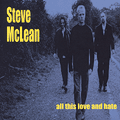 A move to Southend-on-Sea resulted in a new circle of friends, one of whom was session drummer Michael Bettell. With help from some guitarist friends, Steve and Michael booked a few days at Studio Adelaide, near Brentwood in Essex, a 16-track analogue studio owned and managed by engineer Grant Matthews. The handful of tracks laid down at these sessions lacked, it's fair to say, a degree of 'musician focus' and suffered from that intangible disease often referred to as 'local band syndrome'. Nevertheless, there was enough substance on tape for Michael to interest his long-time friend and musical ally, yours truly, in taking the role of producer.
 Steve McLean recording his vocal on 'Always'.My decision to take the production reins wasn't immediate. Frankly, I wasn't that impressed with the demos I heard; I could tell there were some good songs, but they were buried within lame arrangements, and Steve's vocals seemed a bit hackneyed. The real reason I got involved was down to my wife, Paula. She kept playing this bloody tape... in the kitchen, the lounge, the bedroom. It was on constantly, and although it was plain to me that Steve had great potential, all I could hear were the bits that annoyed me. I just held my hands up and said, "Right, OK. I'm going to get this bloody Steve into the studio and do it properly!"
Out Of The Wilderness
The Steve McLean project has effectively brought me out of 'production retirement' after a professional absence of nearly 10 years during which although I never really stopped recording, I only did it privately as a creative or emotional outlet, with no career agenda. For budgetary reasons, and also because I've long enjoyed a healthy creative/technical rapport with Grant Matthews for more than 10 years, there was to be no change in the choice of studio when recording began in August 2000. Founded by Grant in 1986, and named after his late grandmother who left him £2,000 which helped towards buying the initial equipment, Studio Adelaide is currently in its third location, occupying a converted barn 10 minutes' drive from Brentwood.
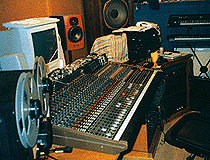 The control room at Studio Adelaide, showing the Studiomaster desk, Fostex reel-to-reel and Tannoy monitors.In terms of facilities and equipment, it's not unlike a middle-ground private project studio. Grant's desk is a Studiomaster T24, and his multitrack is a Fostex E16 which we synchronise with an Atari running Cubase, mixing down to a Tascam DA30 Mk II DAT machine. The keyboards we used were simply those which are resident at Adelaide — a Fender Rhodes, Roland Juno 6, Roland JX1 and Korg O5R/W — along with a Korg M1 which Steve brought in. Of course, this spec couldn't begin to compete with the sophistication of top London studios, but it is surprising what can be achieved when one pays great attention to detail.
I've never really taken an active technician's role on sessions. I'm more of an 'ideas' producer, while Grant can wrestle with the patchbay and deliver the goods. The limitations of working with 16 tracks present a real challenge, because ultimately you're going to get into bouncing tracks together, and you have to plan each new recording at the start and make decisions that can't easily be altered later. It's a healthy discipline to get into. Asked why he has not felt the urge to switch from analogue to digital, Grant says "There's no particular reason, I just love working with analogue and I've never seen any reason to change. There are plenty of small digital studios around with similar specs to mine, so people have a choice, but I'm constantly booked. That has to say something about analogue."
Special Effects
When Steve was released from jail, his main aim in life was to form a band and make something of his newly discovered talent. Knowing this, it was felt that we should make some audio reference to this at the start of the album. With the help of some old BBC sound-effects discs, and my friends at Orbital Sound, we obliquely recreated the scene of Steve's arrest at Schipol Airport by creating an audioverité collage whereby the sound of a jet airliner appears to crash into the massive slam of a prison cell door.
 Steve McLean (seated), producer Mark Cunningham (at piano) and drummer Michael Bettell working out the arrangement for a song from All This Love And Hate.Photo: Mark CunninghamEver since I gave myself the bizarre task of re‑recording The Beatles' Sergeant Pepper album back in 1987 (see SOS July 1997), I've made a point of injecting a little weirdness into otherwise straightforward productions. The more obvious approaches have included using reversed sounds (particularly those of exotic percussion) and effects, or placing reverberant/reflective surfaces in front of drums or amps to achieve a trashy quality.
Taking some inspiration from Pink Floyd, we used spoken-word material quite a lot in the production. On a song called 'Heaven', we gathered a bunch of friends around a microphone and recorded their responses to the question, "What is your definition of Heaven?" "One big party" was my favourite, young Georgia's "eating all the sweets up" was the cutest, but the chilling repeated line "living in a world without fear" provided us with a perfect ending. And on 'Liberate' we approximated a megaphone effect for my little evangelist-like part on the bridge.
Another interesting aspect of 'Liberate' is the illusion of a massive crowd rally which appears during the last few bars. Shamelessly influenced by Pink Floyd's 'Waiting For The Worms' (from The Wall), the technique of layering track upon track of my own close miked whispers to create a crowd effect was detailed to me during a conversation with Floyd engineer Nick Griffiths. "For the crowd chant in 'Liberate', we used a combination of multitracking and sampling," explains Grant. "There were four vacant tracks in one part of the song, so I fed the drum track to Mark in the studio and he whispered 'liberate' four times, one after the other to the first free track, then the second track, then the third and fourth. Then I put all 16 'liberates' into the Akai S3000XL and we repeated the process again and again until we had the equivalent of 64 people. I recorded this back to one track, adding some delay from the Eventide H3000D/SE to thicken the composite crowd."
We did, in fact, bring in a real crowd for the chorus vocals on the climax of Steve's anthem, 'Sister Blue'. A bunch of friends and family to be precise, as Grant recalls: "On 'Sister Blue' we needed to record 12 singers at the same time, which our headphone capacity couldn't handle. So I fed a rough mono mix to the studio through a pair of out-of-phase speakers, placed about 10 feet behind a Neumann U47, and recorded the choir singing along. It's not the textbook technique, but it worked, and after the crowd had added two harmony lines the result was pretty huge."
For most tracks, I fed my Fernandes bass (or Music Man five-string fretless) directly into the desk via a Sansamp GT2 preamp box for extra body except on three tracks, 'All She Wants', 'Heaven' and 'Liberate', where I double-tracked the bass lines and played one of the tracks either a through Vox wah-wah or a tremelo or auto-wah setting from the Eventide H3000D/SE and recorded to tape. 'Liberate' is notable for having seven layers of bass guitar, for reasons I have conveniently forgotten.
'Inside' was always going to be the moodiest and longest track, and from the start it was largely informed by an authentic sample of crashing ocean waves prepared by our friend Lizard, and a quadruple-tracked 12-string acoustic arpeggio that Grant looped continuously. Overdubbed on to this foundation were a two-note delayed bass pulse, reversed sitar inserts (sampled from my 1987 Sergeant Pepper re-recording!), Gilmour-esque guitar lines by Graeme Campbell, reverb-heavy string and piano phrases, and a four-bar drum loop by Michael which comes in for some dubby echo treatment as the track progresses. Unlike most of the other lead vocal tracks, which were complete takes, this was a composite mix of several vocal takes from different sessions, whenever the mood was right.
Grant Matthews: The Engineer's Perspective
On Steve McLean's album the drum tracks for every song were recorded fairly late, after most of the instrumentation and guide vocals had been laid down to a click. Grant Matthews explains the pros and cons of that approach: "Leaving the drum parts until later in a song's development does have its advantages, because the drummer has more time to become accustomed to the feel and direction of the song. He might be able to deliver a little snare flick or something that he just wouldn't have thought of when the tune first started going to tape. On the other hand, the bass line that has always sounded so good might suddenly not work anymore because of this great new kick pattern... bugger!
"The drums were generally close-miked with Shure SM57s for the snare and toms, and a Sennheiser 441 for the kick. I also used cheap, cheerful and very reliable Tandy PZMs for stereo overheads. We did experiment a little with things like putting various resonant metallic objects between a pair of mics and the kit, to see if we could create a different kind of sound. It was interesting — a dark but brittle effect which, with help from a Dbx compressor, made it on to 'Don't Take Our Smiles Away'."
 Producer Mark Cunningham adds an extra touch on electric mandolin.One of the central instruments on the album is the acoustic guitar, and I was very happy with the sound Grant achieved on this instrument. "There's no big scientific method!" he laughs. "For all the tracks I used a Neumann U47, about six to nine inches away from the instrument, and experimented at various times with the positioning. Sometimes it was appropriate to put the mic nearer the neck, sometimes nearer the bridge. Of course, a lot of the resulting sound is down to the multitracking of the acoustic parts, playing six and 12-string guitars and using different chord shapes and positions for each track. It's a very lush sound, and very warm after they're all bounced together in stereo."
At the mixing stage, Grant set up an initial balance before anyone else got their hands on the faders. "I start with the drums," he explains. "First I put up the stereo overhead tracks and listen to what's going on, because it's amazing how much detail the PZMs give you! Then I slowly bring up the snare, sometimes gated and compressed, until it sits nicely in the image, then I introduce the kick and toms. Once I'm happy I start balancing the guitars against the kit. I don't like to put the bass in until I've got plenty of mid stuff happening. When the instruments are all working well, I'll bring in the lead vocal, then any backing vocals. As soon as I feel the mix is almost there I like to compare levels and EQs with CDs of a similar style and adjust things accordingly. I have a BBE Sonic Maximiser 322 inserted across the master faders of the desk, and just switching that on usually does the trick of enhancing certain frequencies."
Prior to taking the production masters to Orbital for the final editing and crossfading, Grant conducted pre-mastering at Adelaide to ensure that the general 'condition' of each track was of the highest possible quality. He explains what this step involved: "I've been offering a mastering service since November 2000 using Sound Forge and the Steinberg Mastering Edition software running on PC. You can analyse the frequency curve of a similar style of recorded music and impose its shape on to your mix, which is a fantastic time-saver! We used this process on the album coupled with multi-band compression."
Special Guests
Of the handful of special guest musicians appearing on the album, Carol Kaye's presence is particularly noteworthy. Carol is, of course, a legend in the session world, having played bass on many '60s classics by the Beach Boys, Phil Spector, Elvis, Zappa, The Doors, The Monkees, and so forth. It was an absolute thrill when she agreed to play on three tracks.
 Mark Cunningham (left) and Dave Pearlman at Rotund Rascal Recording in America.At the end of last January's NAMM show in Anaheim, Michael Bettell and I stayed with Carol for a few days, during which time we booked a session with engineer Dave Pearlman at his Rotund Rascal Recording 24-track analogue studio in North Hollywood. The plan was to take a DAT containing a click track on one stereo channel and a composite rough mix of the songs on the right, copy the audio on to Dave's 3M 79 two-inch tape machine, get Carol to play the bass parts, and then copy them back on to DAT for 'flying in' to the master back home. It didn't go quite as smoothly as we'd have liked. Maybe it was the jet lag or something, but I had left the DAT back at Carol's (about 90 minutes away!) and all I had was a cassette. Mmmm!
Well, the musical aspects of the session went fine, although Carol had to laugh at my amateurish attempts at writing out the charts for her. Carol played her new Fender Precision Lite bass on the tracks while we took a composite balance of DI and mic (AKG C12) signals through the Quad Eight Ventura console. At Carol's insistence, very little compression was used — a tickling from a Urei 1176 — but we did apply an ADL 1000 tube limiter to keep things in check.
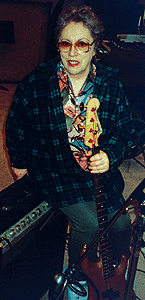 Carol Kaye with her newly rediscovered Versatone amplifier.The big surprise of the day came when Dave Pearlman emerged from his goodie cupboard with a virtually mint condition Versatone bass combo amp bearing the stencilled moniker 'Carol Kaye No.1', an item he'd bought several years ago. It was this very amp that Carol used on late '60s Beach Boys and film/TV soundtrack sessions (among them Butch Cassidy, MASH and Mission Impossible), and for Carol it was like being reunited with an old friend after about 30 years apart.
The hard work ensued back home in England as we tried valiantly to synchronise Carol's distinctive, pick-heavy bass parts with the master. The subtle differences in tape speeds caused us a nightmare. Carol would email me to ask how it was going, and I replied confidently, all the while chewing my nails. On 'Bad Girl', we could have gone the Pro Tools route, as we did for 'Always', but instead Grant sampled small sections of the bass tracks into the Akai S3000XL and laid them down linearly on to the 16-track master. It took a lot of time and patience, but we finally laughed in the face of adversity. Ha!
Nightfly
Steve's big commercial ballad, 'Always', a message penned to his mother whilst he languished in jail, was screaming out to be recorded but the ever-popular Adelaide wasn't available. Instead, we booked some time at Nightfly Studios in Southend, a rehearsal/recording complex run by Phil Aldridge of the Illegal Eagles and Tribute To The Carpenters fame.
Moving away from the analogue format, 'Always' was committed to 16 tracks of ADAT, and initially recorded wholly as an 'unplugged' acoustic track with Phil and me sharing the Fender Rhodes parts, until Michael's drums and strings by Debbie Harry lookalike Maddie Maxwell were added a few months later while Steve was honeymooning in Thailand. He was both shocked and surprised to hear the additions upon return, but as I told him at the time, Gus Dudgeon often used to add bits to Elton John's records after the singer had left a session, and the first time he'd hear them was when the album came out!
 Gordon Giltrap with the Dan Armstrong custom 'baby' guitar used to record his contributions to the album.Thinking that it would be a cool thing to stick some kind of a musical interval on the end of 'Always' (which we called 'Linkpiece'), I called guitar maestro Gordon Giltrap to see if he had any ideas for a cameo part. His tune 'A Dublin Day' was always a favourite of mine, and so I asked him to record his three distinct guitar phrases as separate tracks on a DAT, enabling me to sample the best bits of each and loop them. Using his custom-built Dan Armstrong 'baby' six-string acoustic, Gordon laid the tracks down on to his Vestax hard disk recorder, and sent stereo mixes. Michael's drums, my electric guitar parts and keyboards were overlaid on 16-track at Adelaide, with Carol's bass 'nudged in' along the way — hence the first pairing on record of these guitar and bass icons! Maybe I have a future career as a matchmaker?
Human Nature
It's interesting to note that of all the artists I've worked with over the years, my most profound education has been gained through working with the one who is the least experienced — namely Steve. Throughout this project, I've been constantly reminded that Steve's general knowledge of music is virtually non-existent, and it has therefore been difficult to use reference points to illustrate ideas that I've had for sounds or treatments. One would assume that as the producer, I would be assigned the right to have the final say but it hasn't been that cut and dried. Ultimately, Steve, as the artist and songwriter, has in some ways retained the power of veto — a luxury which many producers would not condone. All I can do at the end of the day is make strong suggestions regarding the direction of any track, hoping that by the time we've mixed the thing, he's happy. Or more importantly, the result faithfully represents his craft and is a saleable commodity. Otherwise, my involvement is unnecessary. Negatives aside, it is also incredibly refreshing to approach a production like a blank canvas, with no preconceived ideas about style.
Editing At Orbital
Although pre-mastering and some editing of tracks had been conducted by Grant Matthews at Studio Adelaide, the final editing, crossfading and track sequencing was carried out in Pro Tools by Sebastian Frost at Orbital Sound in Brixton, to achieve the 'concept album' feel that I'd been looking to cultivate. Monitoring via a pair of Genelec speakers, the equipment used for these purposes included a 24-bit Pro Tools system running on a Mac G4, TC Tools and Lexicon Lexiverb plug-ins.
Reviewing the method he used for the crossfading, Seb Frost comments: "I used a wide variety of fade envelopes, using both the crossfade facility and mixing between different pairs of tracks. The timing of the fades and the start and end points of each track are the most crucial aspects of this task."
An alternate version of 'Always', which is lined up as a potential single, features the bass line recorded by Carol Kaye in Hollywood which posed a problem for all until Frost saved the day. "Adding the bass line [from a DAT] that was recorded in America, to a track that had already been laid down in England, was the only real challenge. The bass line was at a slightly different and variable tempo to the rest of the track, and took a fair bit of time using time compression plug-ins, and much editing of the bass notes to make it all fit together."
The album starts and ends with customised sound effects from the Orbital library — the eerie cell door slam on the intro, and the unlocking of a door and subsequent birdsong, indicating freedom, on the fade of 'Comin' Back [Reprise]'. "The sound effects library at Orbital contains nearly 20,000 different items that are all listed in a computer database, and that makes searching for effects very quick," says Frost. "However, some of the best effects are created by using Pro Tools to combine and edit multiple library effects. Very rarely do we use library effects by themselves, and nearly always some customisation takes place either with Pro Tools, or the studio's Akai S6000 sampler."
Puttin' Out The Discs
Being a bit too long in the tooth to weather the mood swings of fashion-led A&R types, presenting a handful of reasonable demos to an established record label in the vain hope of a five-album deal was never going to be part of our masterplan. Although it was high-risk from a financial point of view, we decided to fund the recording of the whole album ourselves, and set up our own company, Bigbash Music Productions, to market the end product. This we are doing primarily through our web site at www.bigbashmusic.co.uk where clips of all the tracks can be accessed, and the CD purchased on-line.
Our ultimate aim is to cultivate a homegrown success which we can license to a major label at a later stage for worldwide mainstream release, on better personal terms than could have been expected if we'd have gone cap in hand at the start. That's the theory, at least! With the album now complete and 'out there', Steve is now in the throes of assembling a live band for a tour, which we hope will boast production values rarely connected with what is effectively a start-up act.
Mark Cunningham is the author of Good Vibrations: A History Of Record Production (Sanctuary Music Library), a one-time regular contributor to SOS, and the founding editor of live event technology magazine Total Production.