

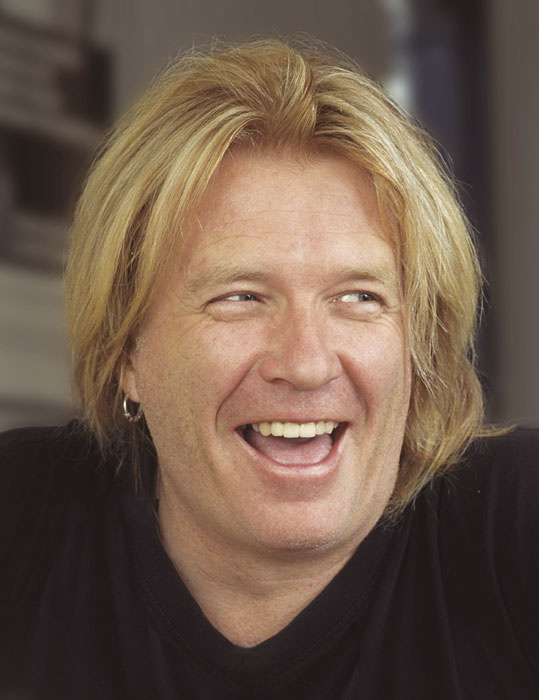
 Photo: Niclas Swanlund
Bob Rock has been responsible for some of the biggest rock and metal albums of the last 20 years, including nearly all of Metallica's output since 1991. Last year's St. Anger saw band and producer reinventing the genre with a savage, thrash-oriented sound that has divided fans and critics.
"There's an underground movement in music right now that has even spread to hip-hop," says Bob Rock. "Not only have they been able to use the grungiest, dirtiest sounds and turn them into great pop songs, but there's the emergence of bands that are using lo-fi and have been doing so for some time, such as the White Stripes and the Strokes. For me this is refreshing. Metal has always been about rules — about how the kick drum and the guitar and everything should sound — and I like the fact that St. Anger doesn't sound like a traditional metal album whatsoever. This has really pissed some people off. The word hate has come up a lot, but I love it. I love the fact that it was thrown in the face of radio and in the face of metal. It's time for a switch, guys. Everybody's been way too comfortable and it's getting stale."
What Rock is referring to is Metallica's first album of new material in more than five years, released last June in the wake of much upheaval, including a lengthy stint in rehab for singer/songwriter/rhythm guitarist James Hetfield, the departure of longtime bass player Jason Newsted, and a high-profile head-to-head with Napster over Internet file sharing. St. Anger 's sound is loud, aggressive, raw and uncompromising; its tone is menacing and confrontational; its songs are intricate, unmelodic and less than catchy; its lyrics are intensely personal, often painful; and there isn't a ballad or instrumental solo in sight. Consequently, while the record serves as a brutally cathartic exercise in laying bare Hetfield's inner demons, the reaction it has provoked from fans and critics alike has been sharply divided — they either love it or despise it, with very little opinion in between.
"Radio's been really tough on the record," Rock confirms. "Radio stations don't like snare drums that sound like a tin can. They want it to sound like Creed, they want it to sound like Nickelback. They want it nice and smooth, Auto-Tune d and fixed up. I've been doing that for years, and sure, it's great, there's an art to it, there's a craft. But then, sometimes you've just got to make raw power."
Jason Disappears
Bob Rock has been the helmsman of all things Metallica since the band's eponymous, multi-platinum 1991 long player (aka the Black Album), while also producing and/or engineering a vast catalogue of records by the likes of Bryan Adams, Aerosmith, Bon Jovi, the Cult and Mötley Crüe. Nevertheless, this time around he was recruited by the celebrated San Francisco outfit to supply a little extra, standing in on bass guitar as well as providing his expertise from behind the board.
 Photo: Niclas Swanlund"Jason wasn't around when we worked on a song called 'I Disappear' for the Mission Impossible 2 soundtrack in 2000," Rock explains, "and so I played bass while running through the number with James and [drummer] Lars [Ulrich]. We kind of redid the feel, and at the start of this project I was basically told 'You know what, with all the things going on right now, we don't really want to audition guys. What you did on Mission Impossible was really cool, so why don't we kick things off like that?' That's what I did.
"I'm a pretty basic bass player — I'm more of a guitarist — but it just worked out, and I guess that's because I didn't have a whole lot attached to being the Metallica bass player. Then again, not being a bass player, I didn't really care what I did over and above serving the song. Given my own production ideas, I knew what the bass should be doing, and so it really was very traditional playing, looking to play off the drum kit rather than follow the guitar riffs [of Kirk Hammett], as is standard with a lot of metal bands. Lars and I tried to come up with rhythms, and that's what I concentrated on."
In turn, this temporary assignment changed the dynamic of Bob Rock as co-producer, playing as part of a live unit on the studio floor instead of being ensconced in the control room. "There was a definite difference overall," he agrees. "You know, we always merge our ideas, but this time there was the bass playing, the engineering, the production, and also helping them finish the writing. There were a few more roles, and that did change the perspective. Still, the luxury that we had was time — we were in the studio for three or four months, took a seven-month break when James wanted to go deal with some personal things, and then reunited for a schedule that saw us working from 11 in the morning to about four in the afternoon everyday. That meant at night Lars and I could go through and edit what we'd recorded, so there really was a lot of time to be able to get good perspective on everything."
Within A Deserted Barracks
For Metallica, time off the road is time to be spent at home with family and friends in San Francisco, and this is why the decision was taken to record St. Anger there. Nevertheless, as the band's studio wasn't quite ready when the project was about to get under way in May 2002, a recently purchased SSL 4000 console was installed within a deserted barracks at the US Army's Presidio base in the City by the Bay. This was then complemented by equipment that was transplanted from Bob Rock's own Plantation Studios facility on the Hawaiian island of Maui: a Studer A800 24-track tape machine that was actually never used, along with UREI 813 monitors, Studer amps, Pro Tools HD rigs, vintage mics, and assorted effects.
"In a lot of cases, bands that come to Plantation basically use all of my gear," Rock explains, "but that isn't the case with Metallica, where each of the guys has a truckload of his own equipment. It therefore made sense for me to go to them. We went to the top floor of the army building, where two huge rooms were connected to one another, and we stuck the console in one room and all of my gear in the other, and then we ran cables down to some of the other floors where we used separate rooms for guitars and everything else. The rooms had painted walls and were very bright, and we had to give them a little bit of acoustic treatment, but overall the whole thing was very makeshift, very guerilla-style, and it was kind of interesting, providing the start to how the album ended up: very raw, very garagey."
The setup was largely the same when sessions resumed at Metallica's own facility after the aforementioned seven-month break, and so was the underlying desire to avoid conforming to the aesthetic and acoustic ideals of what a good studio should be. Here was a basic square box, adapted to meet the recording requirements.
"I really like that approach, because I think you get character," Rock states. "You know, whenever I've worked in these acoustically tuned rooms, they're OK, but usually they're just blah. On the other hand, some of the older places in New York, London and elsewhere often consisted of rooms that weren't built as studios — Abbey Road and a few other big places were exceptions — and they often had the greatest sound."
Too Raw For The Final Cut
Although three months of jamming at the Presidio produced worthy results that will probably surface at some point in the future, none of this material actually made its way onto the St. Anger album. In short, even by Metallica's current standards, it sounded too raw for the final cut, and so about 35 songs were then tracked at the band's own facility and, just before Christmas 2002, it was time to take stock of all the work. James Hetfield, Lars Ulrich, Kirk Hammett and Bob Rock each had their own ideas as to what the album should be, but there was a consensus of opinion that four of the numbers definitely fitted the bill: 'St. Anger', 'Dirty Window', 'Sweet Amber' and 'The Unnamed Feeling'. Management concurred.
Photos: Niclas Swanlund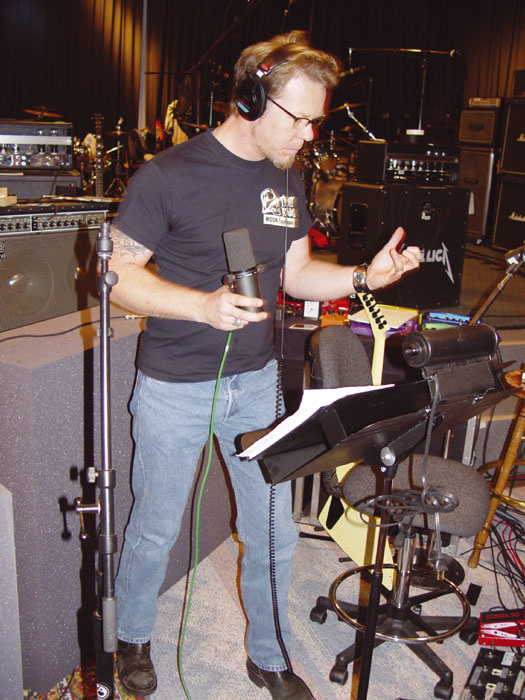 James Hetfield prepares to lay down a vocal.Photo: Niclas Swanlund James Hetfield prepares to lay down a vocal.Photo: Niclas Swanlund |
"At that point we came up with the notion of adding to those four tracks and, after we'd get back after Christmas, take some of the best ideas from the Presidio and use that head space to record the rest of the album," Rock recalls. "'Frantic', 'Invisible Kid', 'Some Kind Of Monster' and 'All Within My Hands' were from the Presidio, and that's how we set about finishing the record."
Collaboration was the order of the day. Traditionally, Metallica's songwriting modus operandi has been to compose the music and add lyrics later on, and whereas some numbers have resulted from concerted piecemeal efforts to make everything fit, the best material has usually been borne out of momentary inspiration. Accordingly, the decision was taken at the very start of the St. Anger project to aim for the latter approach.
"At the Presidio we talked about things," Bob Rock recalls, "and I said, 'Well, look, whatever we do, let's write the lyrics right away, get the ideas down, and from there we can tweak them. Over time you can come up with something else, but at least we'll have something and you won't be staring at a blank page.' So, we went for that, and when James couldn't come up with something in the first 15 minutes, that developed into everybody coming up with ideas and from there he would be the master editor. It was very stream-of-consciousness, and that held true for most of the tracks. For instance, 'Unnamed Feeling' was a song that James brought in, but then it went through the same process, and the whole album was like that.
"All of the songs were jammed. There'd be a main idea or a sound that we'd come up with, and from there we would all go out and play, leading to the stems of different ideas and different feels. We'd do that over the course of a couple of days, and in the evenings Lars and I would assemble everything into a song structure. Then James would come in and throw down some melodies, we'd all contribute lyrics, and then he'd kinda put it all together."
Up-tempo And Really Complicated
The album's title track was a prime example of this approach. It began with a riff played by Kirk Hammett that didn't even end up on the finished recording, but nevertheless served as the stem of two songs — 'St. Anger' and 'Sweet Amber' — following a jam session that lasted around eight hours.
 Metallica get busy in the control room: drummer Lars Ulrich (centre right) looks thoughtful while singer James Hetfield (centre left) works on a St. Anger lyric. Bob Rock attends to the desk while Kirk Hammett looks on.Photo: Niclas Swanlund"We'd take that riff and try it at different tempos and with different feels," Rock explains. "We'd break up the riff, extend the riff, do all of these different things and record every single one. Out of that, we'd get anywhere from 30 to a hundred different sections of feel, and then it was a case of just going back through all of that. With 'St. Anger' I distinctly remember the point when I turned to James and joked, 'What we need is one of those half-tone riffs that's up-tempo and really complicated.' He said, 'How's this?' and he played the riff. All of our jaws dropped and we were like, 'Where did that come from?' I mean, he just came up with it on the spot. Then we had these other feels, like the near-reggae feel of the verse, and we just put them all together.
"What's interesting in terms of the songwriting is that these songs aren't about sitting down with the acoustic guitar. They're almost like soundbites and sound chunks, and the people who don't pick up on that are the ones who really hate this album, not only sonically but also because of the songs' length and the way that they are. However, it's really a new approach to songwriting. In fact, the whole album was about throwing paint at the canvas. It was total cut-and-paste in the tradition of [William S] Burroughs."
At the same time, Rock asserts that the record's aggressive balls-to-the-walls sound and in-your-face attitude was what the band members felt most comfortable with, reflecting a natural progression from the creative searching and experimentation that commenced during the 1996 sessions that gave rise to both the Load and Reload albums.
"It really was a case of what feels good now," he remarks. "It defines where the band is right now: 'We want to make a garagey, broken-up, scarey kind of record,' and that's what we did. Certainly, there's some truth to the theory that James was using the songs to expel his anger and try to cope with recovery, although to be honest I'm not sure if the record was preconceived like that. After all, the band was going through recovery, James was going through recovery, and they were just trying to be a band again. They were trying to get to know each other and kinda go through this whole process, and while they were doing that they were making music. So, it was bound to come out in the music and come out in the lyrics."
The Recording Setup
After trying out a number of different basses, Bob Rock settled on playing one of the original Spector guitars through an Ampeg SVT Classic as well through a 100 Watt Marshall, miked with a Neumann U87 and AKG D25, while using wah-wah pedals and Sans Amps for distortion. Shure SM57s, Sennheiser MD421s and Neumann KMS105 live vocal mics were used on the guitar rigs of both James Hetfield and Kirk Hammett. Hetfield's setup combined Mesa/Boogie, Diesel, Wizard and Marshall amps; Hammett's included Mesa/Boogie, Marshall, Vox, H&H and Park.
Lars Ulrich, meanwhile, had a couple of different drum setups. "When we were first at the studio he had a pretty normal kit," says Bob Rock. "Then, on the stage, I had his drum tech Fleming [Larsen] set up an old heavy metal kit: double kicks with all the toms. It sat there and Lars stared at it for months. But then one day, when James went home, he started playing it and I miked it up quickly with about four microphones, because that's all I had left; these Beatles mics, AKG D19Cs, which I'd just bought on E-bay. I also had an old AKG D30 which I put in front of the kick drum — there was no padding in the kick — and basically I used the overheads à la Beatles; the D19s and a couple on the toms. That was the drum setup you hear on the album.
"The majority of the drum kit came through the D30, which was placed about a foot from the kick. In fact, you could hear as much snare as kick drum in that mic. That's why the sound is so raw. It's all compression, and it just ended up that way. It just sounded so metal, it just sounded so old-school but not old-school. You see, what's great about it is that with Pro Tools HD you can use an old microphone and the character stays. You don't have to EQ it to crap and you don't have to EQ it after you get it back from tape. You put a little compression, you put it in the right place and it just sounds good."
Basically About Truth
Indeed, although St. Anger 's straighforward, no-nonsense feel is something of a throwback to Metallica's earlier albums, its sharp contemporary sound definitely is not, and it is this combination which makes for an interesting overall effect.
"This kind of approach is not necessarily very popular right now," Rock concedes, "but it's basically about truth. I think I can safely say that I know how to make stuff that doesn't sound good sound really good, because I've been shining shit for 25 years. I don't have to prove that to anybody, and so the band members and I sat there and went, 'This is what Metallica sounds like when everybody's in the room.' I mean, we can make the guitars sound unbelievably huge, we can hype the drums — the Black Album stands out in terms of 'How far do you want to go? How big do you want to get?' We could have done that, but once you do it you go, 'Well, there's got to be another way to express ourselves.' So, it really was a case of 'What is the most truthful and sincere thing to do at this point?'
 The new-look Metallica (from left): Kirk Hammett, Lars Ulrich, new bass player Rob Trujillo, and James Hetfield. Photo: Niclas Swanlund"You know, so much has been said about Metallica, and so much crap has been read into what they do, that we felt the most honest thing would be to have two guitar players, a bass player and a drummer play off the floor to produce exactly how they sound with those instruments, putting on vocals that aren't sweetened by tons of harmonies and doubling and tripling and Pro Tools fixes, and without fixing all the drums so that every drumbeat is perfectly in time. We just said 'Let's do it raw.'"
And raw it was, culled from the live jam sessions without resorting to very much overdubbing, save for when a desired section boasted a really bad note or when a change was required to make the transition from one section to another. Still, despite Bob Rock's earlier statement about opting for the inspirational songwriting approach rather than the piecemeal method, he also points out that every song's recording turned out to be a huge challenge, with 'Some Kind Of Monster' and 'All Within My Hands' cited as particularly noteworthy examples.
"Both of them were started at the Presidio, where there was a definite vibe and those songs sounded so cool, so to then redo them and try to recapture that sound at the new studio was really tough," he says. "We had told ourselves that we weren't going to do that, and in the end we almost had to think of them in a new way, but that was hard to do. When the Presidio stuff comes out, everybody will get an idea as to the changes that were made. That'll provide the full picture."
According to Rock, any difficulties encountered weren't to do with the band's playing, which he says usually accounts for about three-quarters of the time spent on recording an album. Instead, about 75 percent of the time afforded St. Anger was spent on the editing and assembling.
"When James and Kirk went home, Lars and I spent every evening doing that for about 14 or 15 months," he says. "This was due to the integrity of what we'd talked about doing and also to locate all the right parts. What's interesting about Lars is that he is not a guitar player, so he doesn't really relate to the pitch. He only goes by what he hears, and he'd therefore stick together things that I don't think James or Kirk or I would, because musically they don't match or whatever. Yet, by putting them together, something would emerge. It was very interesting. After all, when you have eight hours of jamming and you're trying to find some cool things, it takes time."
No Going Back
St. Anger represented Bob Rock's first ever all-digital project, even though analogue was used for mastering. "The digital just sounded good," he explains. "It was so raw and in-your-face, and the guys really loved it. Kirk didn't want to go back to analogue and soften the guitars. If you stood in front of his amp, that sound was coming through an NS10, and if you go into your car and listen, it still sounds the same. It sounds like you're right in front of his speaker cabinet. Good or bad, that's what you're hearing, and he loved that, so we wanted to retain it."
The mix, which took place at Metallica's studio, afforded Rock about three hours per track. "It was a challenge," he confirms. "I'd challenged them, so they challenged me. As there was great energy when I did the rough mixes, they basically said, 'Why do we have to sit there for days and nitpick? Why can't we just do it in three hours?' So, that's what we did, and it was very difficult for me. It wasn't difficult doing it, but it was difficult to let go. However, once I got into it, I realised that there is something to this; doing it here, now and having a feel of immediacy. I'm old enough so that the first records I worked on, like the Loverboy album [1980], I mixed by hand. I didn't have automation on an old Neve, and working on St. Anger had the same feel, which can be good."
The stereo mix — like the surround version for the bonus DVD which sees Hetfield, Hammett, Ulrich and new bassist Robert Trujillo thrashing their way through each of the songs on the studio floor — made use of a Prism Dream ADA8, acquired after much A/B testing of all the available converters on the market.
"To our ears, the Prism had the least coloration," says Rock. "It didn't change anything, and we bought it for Metallica's studio because we knew they'd probably end up doing the 5.1. That was recorded in a different room while we were actually doing the stereo mix. We took a day off and did the first half of the album — they'd play the songs and we'd mix them, all in one day. And then, after they'd learned the other half of the album, we recorded and mixed that about two weeks later... It was difficult. It was very, very difficult."