


With 16 mic preamps and a built-in mixer, the M16 certainly delivers on quantity. Can it deliver on quality too?
TF Pro is headed up by engineer Ted Fletcher, who is probably best known for starting up the Joe Meek brand. Ownership of that trademark and all intellectual properly associated with it has since been acquired by a US company, which is why Ted launched the TF Pro brand, with a new range of products. The 4U rackmounting TF Pro M16 is a conceptually straightforward unit offering 16 independent channels of microphone/line preamplifiers, for use with DAW systems or other recording setups that need more analogue inputs, but it also has a mix buss enabling it to be used as a 16:2 summing mixer with gain and pan controls on each channel. There are no built-in converters, so DAW users will need to team the M16 with a suitable multi-channel A-D converter. This particular design offers a wide audio bandwith (extending from 8Hz to 80kHz), which makes it suitable for use with 24-bit/96kHz (or above) converters. Power comes from a supplied external stabilised PSU, which has internal switching for 230 or 110 Volt operation. This PSU has a reassuringly chunky cable, whose connector is locked in placed using a threaded locking ring. By way of price and performance, the TF Pro M16 sits above what you'd expect from a typical mid-priced console's preamps, but below the more esoteric stand-alone preamps.
The microphone inputs are conventionally presented as rear-panel XLR connectors optimised for 200Ω microphones, and with enough gain to accommodate both capacitor and dynamic models. The maximum gain from input to output is 70dB via the mic input, or 50dB via the line input. These preamps use 'current mode' circuitry, which I know Ted is particularly keen on, combined with input transformers. He claims that cable length problems are effectively eliminated, cable interference is significantly reduced and that inputs are more tolerant of mic impedance variations. A side-benefit of this 'current' design is that if you unplug the mic the output goes quiet, rather than picking up the usual open-circuit interference.
Cosmetically, the front panel is clearly set out, with a nice, deep-blue finish. All the knobs are machined from aluminium and are shaped for ease of use. All the necessary switching is done using small red buttons, each of which has a coloured status LED. A rotary input-gain control is used to adjust either the mic or line gain, and phantom power is individually switchable for each input. Both the line (balanced TRS jack) and mic inputs go via the balanced transformer, and so are galvanically isolated (fully floating). Unbalanced inputs can also be handled with no level changes. It is worth noting that that although transformers have certain technical advantages in audio applications, they do tend to be susceptible to picking up interference from magnetic fields, so it makes sense to mount the unit away from other devices that have large power transformers in them.
A horizontal five-LED level meter shows the peak audio level at the channel's direct output. The top LED is a peak-warning indicator, coming on at +12dBu, which leaves approximately a further 10dB of headroom. Each channel also includes a phase reverse switch, with a yellow LED indicator, and a 75Hz high-pass filter with a 12dB/octave slope. This is particularly necessary, as the lower frequency limit of the M16 is around 8Hz.
In addition to direct outputs, the channels also include insert points, to add flexibility when the unit is used as a mixer. In this mode, the channel direct outs are used as insert sends and the Insert jacks as returns. An advantage of this system over the usual TRS insert jack is that balanced equipment can be connected without losing the benefits of balancing. The insert socket sensitivity is around -8dBu for 0dB at the main mixer outputs, with the channel fader at 'zero' so as to allow a practical amount of headroom. Note that there are no master mix level controls or metering, though the maximum mixer output level of 26dBu means that clipping is unlikely. Each direct channel output has a maximum output level of +21dBu. A grounding point is available on the rear panel for when a separate chassis ground is required.
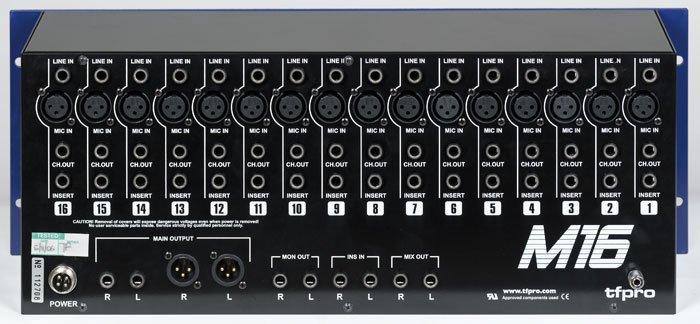 The rear panel is clearly laid out, and offers inserts on each channel, as well as the line and mic inputs and the outputs.
Each channel also features a post-fader Solo button that engages a solo relay to route the selected channel direct to the mixer monitor output, while muting the monitor feeds from the other channels. The Solo output is mono and an active Solo is indicated by a large red LED to the right of the panel, as well as the individual channel's yellow solo LED. On the review model, the yellow solo LEDs still glowed very dimly when they were supposed to be off, but this didn't present any operational difficulty. As expected, the direct outs and main mixer out are not affected when the Solo button is operated. A separate Cut button with a red status LED disconnects the channel from the mixer but, again, does not mute the direct channel output.
The rotary Pan control below the function switches pans the audio signal between the left and right mixer channels and is calibrated to give a 4dB level drop in the centre position. As expected, the Pan control is only relevant to the mixer section, not to the direct outputs. Similarly, the rotary channel level control only affects the mix, not the direct output, which is taken pre-fader.
Ted's mixer design uses balanced mix busses and the mixer outputs are also balanced. Rear-panel separate send and return balanced jacks are provided to allow balanced equipment to be inserted into the main mix path, with the main mix outputs appearing on both balanced XLR connectors and quarter-inch TRS jacks. The monitor outputs are on quarter-inch TRS jack sockets and the signal is influenced by the Solo and Mute switches, so, unlike many mixer designs, the integrity of a balanced signal path can be maintained all the way from input to output.
Planet Earth
The M16's power supply is not connected to mains earth (although the mains transformer is double insulated and complies with EEC standards of safety), and neither is the internal audio ground connected to the chassis. According to the spec sheet, the 'screen' of all output terminations is bonded to the chassis and the 'screen' of line input, individual line output and channel mix input connect together, but are not connected to the chassis: they are left floating to avoid the possibility of ground loops. The screen of the microphone inputs is connected to audio ground in the normal way. In certain circumstances (for example, if interference is experienced), it may be an advantage to connect the ground terminal on the M16 chassis to a good mains ground point.
Appraisal
Tested on speech and vocals, the M16's preamps came across as very full-sounding and warm when compared with those built into my audio interface, though for some reason they seemed to slightly exaggerate any tendency to 'lispiness' in the voice being recorded, possibly because of their smooth-sounding high end. They're certainly quiet at typical recording levels and have bags of headroom to accommodate peaks.
In comparison to my Universal Audio Solo 110 preamp, the low end was subjectively similar but the Universal preamp had a little more crispness at the top end. Both devices use transformers, which probably accounts for the subjectively similar vocal warmth. Which of these sounds 'best' is a bit like asking the same question about microphones, as it really comes down to what suits the singer best. The TF Pro M16 should work well with most microphones, though very warm microphones might result in a slightly overblown low end, so naturally 'presencey' mics might be the best match for capturing a contemporary vocal sound that is both warm and glossy.
Having mixing facilities built in might well satisfy the current desire for mixing multiple DAW outputs in the analogue domain: here, the M16 could double as an analogue summing mixer during mixdown. It should also be possible to record via the direct microphone outputs while monitoring a multi-channel mix fed into the insert returns. Having no main mix metering or level control is a bit disconcerting, though, as you may want to record the mix back into a digital system that requires the level to be set at source. If, however, you treat the TF Pro M16 as a rack of mic amps and take the mixing facilities as a welcome bonus, there's not much to complain about. By way of value, given that you get 16 good-quality, transformer-coupled mic preamps plus basic mixing facilities for around what you'd pay for three or four channels of esoteric single- or dual-channel units, the cost seems not unreasonable.
Alternatives
I'm not aware of any 16-channel units that are equivalent to the M16. There are plenty of good 8-channel mic preamps on the market, such as those from Studio Projects, Focusrite and Presonus, and buying two of these would present an alternative, but that would sacrifice the M16's ability to mix 16 tracks down to stereo.
Pros
- Warm, smooth sound.
- Wide bandwidth.
- Built-in mixing facilities.
- Low noise with plenty of headroom.
Cons
- Mixer has no metering or level control.
Summary
The TF Pro M16 provides better preamps than you'll find on most affordable consoles, but at a cost below that of some of the more esoteric names. Its warm tonality may not suit mics that are already very warm and smooth, but other than that it seems very versatile.
information
M16 £2500 including VAT.
Unity Audio +44 (0)1440 785843.
+44 (0)1440 785845.