

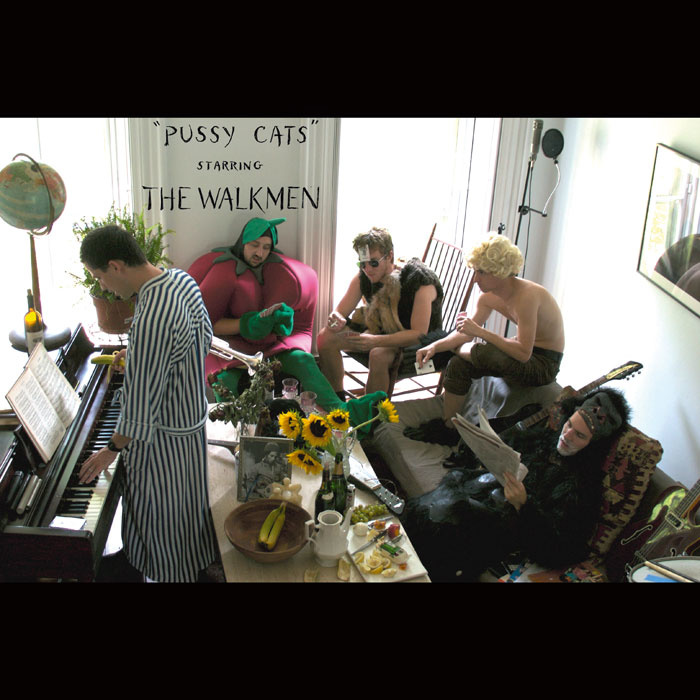
You've got four weeks left until your studio closes. How to make best use of that time? The Walkmen's answer was to recreate their favourite album, note for note, in all its drunken and shambolic glory.
1974 was the best of times and the worst of times for Harry Nilsson and John Lennon. The Brooklyn-born singer and the former Fab had become friends in the wake of the former's Pepperesque 1967 album Pandemonium Shadow Show, which earned him the nickname — given to him by Lennon and McCartney — of 'the Beatle across the water'. By '74 Nilsson was coasting on the success of hits like 'Everybody's Talkin' and 'Without You', and Lennon had temporarily split from Yoko Ono, moved to LA and embarked upon his famously drug and booze-driven 'lost weekend'.
Together that year the pair recorded the Pussy Cats album, produced by Lennon and featuring a dangerously wild-living supporting cast that included Ringo Starr and Keith Moon. It's a fascinating document of fine songwriting (Nilsson's 'Don't Forget Me' and 'Black Sails', Lennon's 'Mucho Mungo'), wild rock & roll covers ('Subterranean Homesick Blues', 'Rock Around The Clock') and utter studio chaos.
The Cats Are Back
Pussy Cats has always enjoyed heavy rotation on the tour bus of New York band the Walkmen, formed in 2000 out of the ashes of Jonathan Fire*Eater, a band who influenced the Strokes, among others. "It's one of our favourite records as a band," says bassist Walter Martin. "It's a humorous and loose record. It's the whole spirit of just screwing around." In early 2006, while mixing their third album A Hundred Miles Off and with a month left on the lease of their NY studio Marcata, the band hatched a plan to recreate Pussy Cats, track by track and virtually note for note.
The resulting album Pussy Cats Starring The Walkmen is a loving homage to the flawed original. "There was no grand artful concept behind it," Walter explains. "It was more we thought it would be really fun. It was like 'We have a month left in the studio, we might as well take advantage of that.' We suddenly just realised we should do it and we never really questioned it. It's sort of throwaway. It's a lot different from covering a great, great masterpiece album."
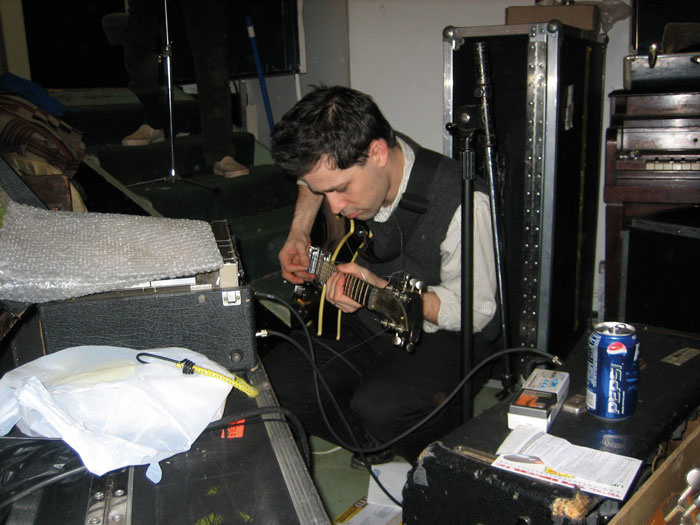 Walkmen guitarist Paul Maroon takes a solo in the band's now-defunct Marcata Studios. The original Pussy Cats had been recorded in March 1974 in Burbank Studios, California, fuelled by cocaine and Brandy Alexanders (a heady cocktail of milk, creme de cacao and brandy). So wasted was Nilsson that he actually ruptured a vocal cord and was spitting blood, a fact that he kept secret from Lennon in fear he would cancel the sessions. As a result the singer's formerly flute-like voice is reduced to a ravaged husk for most of the album.
Similarly, the Walkmen's frontman Hamilton Leithauser is in possession of a raw-throated vocal style that perfectly suited the songs on Pussy Cats. While clearly not taking things to the extremes that Nilsson had, Leithauser made sure that his voice was in a suitably ragged state before stepping into the vocal booth.
"He has a really strong voice and he can really yell," says Walter. "For some reason, so far, he hasn't damaged his voice. Most of the singing on Pussy Cats, he did it normally. Then we went on tour for three days and it really screwed up his voice, it was really raspy. So we did a couple of songs and realised it sounded great, so he just re-sang the whole thing."
Walkmen engineer Kevin McMahon agrees. "He had really good vocals recorded, but he came in and recut all the vocals when he was almost unable to speak. It's literally like his vocal cords sound like they're tearing. Especially on [opener and Jimmy Cliff cover] 'Many Rivers To Cross', when he sounds so laryngitic. That's got such a great sound."
Marcata Manufacturing
Based in a former car factory in Harlem, the now defunct Marcata Studios had been built by the Walkmen in 2000 as a symbol of their commitment to their new band. "I still live up here," Walter points out, "because it's one of the only affordable neighbourhoods around. We looked at a bunch of places, but it was a really great unusual space. It wasn't that expensive so we got it."
 Prior to the recording of Pussy Cats and the Walkmen's 'official' third album, A Hundred Miles Off, Walter Martin (left) swapped band roles with original bass player Pete Bauer (right).Even though they'd had no experience of studio building, three of the band — Martin, drummer Matt Barrick and guitarist Paul Maroon — set about constructing the rooms through trial and error. "There was some form to it already," says Walter, "because there was a small room and a 10-foot step down into the larger room. We had to put in the windows between the rooms and put in a lot of soundproofing between the rooms. We used drywall and Homasote [made from recycled paper], this soundproofing stuff that they sell in a hardware store. We were there for maybe three, four months. It was a lot of hard work."
Borrowing money from friends and family, the Walkmen amassed a $50,000 budget to buy equipment for Marcata, their intention being to keep the gear as analogue as possible. "Our friend Greg Talenfeld, who'd done some recording for our old band, he sat down with us and told us the least expensive way to get a good analogue recording studio going — which mics we should get, what outboard gear and what tape machine and board. So we took his loose advice and just shopped around."
Initial purchases included a 1979 MCI 400-series desk and an Otari MTR90 24-track two-inch machine.
"When we opened the place, our only experience had been recording on cassette four-track," Walter explains. "So none of us really knew what we were doing at all. We still don't know. We'd have people come into the studio to record and engineers would ask us, like, how many busses there were. To this day, none of us know what a buss is. There was a lot of panicking."
Let's Not Go Crazy
The bassist says that their decision to work with tape was partly for sonic reasons, but partly to remove some of the variables from the recording process. "It allows us to focus on making sure we're prepared with the songs. Some of the reason we record to tape is the sound, but most of it really is the process. With digital there's always the temptation to go crazy with all the options you can draw on."
 The band's notorious Aeolian piano, which later became something of an eBay star.Other key bits of equipment included a pair of Urei 1176 compressors, an EMT plate reverb and an AKG BX10 spring reverb. "You could put that on something," Kevin says of the latter, "and people might perceive that it's on something else. The whole song sounds like it's being affected by it." Elsewhere there was much use of a Roland Space Echo for authentic slapback delay. "It's a big favourite. It's like smoke, the way it creeps around and gets in between everything."
Amp-wise, the Walkmen use an Ampeg Gemini guitar amp for bass, blended with the DI sound, and a selection of vintage Fender amps for the guitars. In the run-up to the recording of A Hundred Miles Off, Martin and Pete Bauer actually made a permanent swap of instruments, from keyboards to bass and vice versa. "I'd been playing the keyboard since I was in high school," says Walter, "and I was really, really, deeply bored of it. I'd completely run out of ideas on playing it. Pete seemed very excited to try it, so we just thought it would be fun to swap."
As a result, Martin has a collection of old keyboards ("A couple of Vox Continentals, a couple of Farfisas — a Fast 3 and Fast 5 — and a Wurlitzer electric piano"), that he now never plays, leaving them to Bauer. Another big part of the sound of Pussy Cats Starring The Walkmen is the studio's Aeolian, the latest in a rather long line of beat-up pianos. "We keep on buying five-octave pianos because they're actually small enough to take on tour. Three people can carry them, but they're so heavy to treat carefully and they get beat up."
More Space, Less Gear
Engineer Kevin McMahon's first impression of the completed Marcata was how unusual the facility was compared to most New York studios. "They had this real gear, but they didn't have a lot of it, and they had this massive space in a city where there were tons of decked-out, great studios crammed into little generic spaces with no real live room and an SSL and miles of outboard gear. Theirs was like a really stripped-down Sun Studio."
Before the sessions commenced, McMahon supplemented the Walkmen's equipment with some of his own. "I love old vintage microphones and I've been lucky to get my hands on a few. I have two Telefunken U47s — I usually just keep one of them running, the other one is there in case the tube dies. Then two RCA 74 Junior ribbon mics. The Walkmen had an AKG endorsement, so we had a bunch of 451s and those were inexplicably amazing. They're good mics and everybody knows about them, but sometimes they would totally win out over the U47s. They also had one of the reissue C60s, but it was almost too new. They would do a lot with dropping mics inside pianos and stuff like that.
"We had this Altec five-channel tube mixer that I had done a modification on so it's like a phase/distortion machine. That would be used for weird channels or the odd room mic that you'd maybe want to fuck up a little bit. I had a rack of Altec 438C compressors. But the mission was that it be heavily analogue, with lots of emphasis on just trying to get the band to play well."
Tricky Moments
Some elements of Pussy Cats were easier for the Walkmen to recreate than others. One problem came with the woozy, drunk-sounding strings, typical of early '70s Lennon records, that float over 'Many Rivers To Cross'. "That was hard," bassist Walter Martin concedes. "We had three string players — violin, viola and cello — and they overdubbed it. Then we tried to compress it as much as we could so it didn't sound like a string section, it sounded more like a Mellotron or something." Elsewhere, the tremolo keyboard that precedes 'Mucho Mungo' was recreated using a Farfisa Fast 3 through a Fender amp ("That's one of the reasons we wanted to do the album, 'cause we all loved that song"), but the lavish orchestration of ballad 'Black Sails' initially stumped the Walkmen.
"That was the hardest one, because we didn't know how to do it," Walter admits. "We figured doing it all with the strings would be really hard. I had the idea for all five of us to play an organ and get our friend Rockwell to sing it. But then we couldn't arrange it for five organs, so we did it with two organs and a guitar and a piano. Ham has a really good ear for picking out how things go, so he picked out the arrangements. It's much more complicated on their version. We took the essential changes and simplified it."
Meanwhile, the band had to use another studio to record the simple piano-and-vocal track 'Don't Forget Me'. "We did it at Marcata and it wasn't that good," Walter says, "because the piano we were using was so out of tune. It's fine on most songs but on that one it didn't really work. So we were on tour and we were in Nashville and we had a day off so we booked time in this studio in this guy's house and we just did it in eight hours. At Marcata we use a C12 a lot on the piano, but I'm not sure what we used in Nashville."
The Romantic Years
In preparing to engineer the sessions, McMahon says he didn't have to get himself into a '70s sonic mindset, since he's already a huge fan of the productions from that era. "I sort of romanticise recordings from that time period," he explains, "and we all collectively have a lot of gear from that time period. I went at it in my head like I wanted to try to emulate a certain sonic character. It was pretty conceptual. They tend not to really communicate that technically about stuff. I wouldn't have expected them to be, like 'Oh we really have to match up this sound.' I didn't really perceive beyond certain things like using a plate reverb or slapback. But I think we were all going after a certain thing." Paul Maroon behind the drum kit at Marcata. Note the original Pussy Cats LP on the music stand to the right.
 The original Pussy Cats LP cover.
Surprisingly, given the level of detail that the Walkmen's version shares with the Nilsson/Lennon version, McMahon and the band didn't constantly scrutinise the original album during the sessions for the remake. "They had the original album there as more of a reference point for A/B'ing their performances," says the engineer. "They're not very verbose about stuff. They're really detailed in preparation — watching them, you know they really know what they're going after. But it happens super-fast and it's not conversed about in ways I'm used to hearing people talk in the studio. They had the record going and were listening to it. But sonically I knew the time period and so I just listened to it once or twice."
"The night before we started," says Walter, "I went through the album and learned my parts. Most of the songs, we just did them and then we'd listen back to the original to make sure there weren't any essential things that we'd left out. With, like [the cover of The Drifters'], 'Save The Last Dance For Me', it just sounded weird and we had to go back to theirs and figure out things that they were doing and it made it sound a lot better. They were just doing it a lot slower than we had imagined."
Generally the Walkmen would gather together in the live room and try to get down takes for drums, bass, guitar and a guide vocal, paying no attention to bleed. "It was pretty much a whirlwind," Kevin notes. "We did it in 10 days. There were remix sessions on one or two songs that dragged it on, but the bulk of it was done really super-fast."
The original tracking was done to the MTR90 and then transferred onto a basic Pro Tools rig — LE 5.1 running on a 400MHz Apple Mac G4 ("Prime vintage digital audio," Kevin jokes) — for overdubbing. "We finished all the bigger overdubs and mixed out of Pro Tools through a little Neve 12-channel broadcast console running the reverbs and stuff like that. We were still using Pro Tools like a tape machine. The Neve is what I typically use for preamps for the first 12 tracks, then I'd go over to the MCI. It has a great sound combined with the spring reverb and the plate reverb. I would pipe things back out into the room and use it as a natural reverb chamber. We had really long cement hallways, so there was a lot of natural reverb at that location."
Sober Chaos
Recalling the chaos of the original sometimes proved difficult, particularly since the Walkmen's sessions were abstinent in comparison to Lennon, Nilsson et al 's rollicking recordings. "We're actually sort of prudes in that way," says Walter. "We can't really drink when we're working because we wake up the next day and everything we've done is terrible."
 Kevin McMahon engineered the Walkmen's Marcata sessions.Initially, their recreations of 'Subterranean Homesick Blues' and 'Rock Around The Clock' thus sounded a bit stiff. "With 'Subterranean Homesick Blues'," says Walter, "we decided to put the shaker and maracas and tambourines on it, and suddenly it just really sounded like a lot of fun. In the same way, 'Rock Around The Clock' sounded a little bit boring, and so we put a ton of percussion on it and kazoos and slide whistles and a table saw." The fade-out of 'Subterranean Homesick Blues' appears to feature the rantings of a madman, who turns out to be the maintenance man from the studio building. "He really wanted to be on the record, so we let him yell on it. He's just jerking around. There's so much bad language on it, but we faded out before it got really dirty."
One other key track, Nilsson and Lennon's rambunctious take on classic rock & roller 'Loop De Loop', saw the Walkmen invite 50 friends up to Harlem for a Pussy Cats party to record the massed backing vocals on the chorus. "We all got completely drunk at that," Walter says, "so that was in keeping with the spirit of it."
Kevin adds "It was a thematic party where Brandy Alexanders were made in excess of what people should ever drink. I had the room miked up, they got everybody absolutely plastered and we piped the song through."
The End Of Marcata
The mixing of Pussy Cats Starring The Walkmen was carried out at the same breakneck pace as its recording. "We were mixing a song in somewhere between a half hour and three hours. By the time you get to the mix, you have your thing together. It really was more to do with the bleed in the room and the way that made the drum sound come together, which probably would've taken 10 times as long to do if you'd tried to mix it that way."
By the mixing stage, McMahon comments, the original album was rarely played, so ingrained were the songs and productions in the minds of the band and producer. "There were maybe two or three songs that when we ended up listening to the originals, everybody conceded that it was almost retardedly exact."
If there was any pressure on the final process, it was the fact that the gear was being stripped down around the band and sold off as they were laying down mixes. Walter laughs and says. "We had to tell people to come at, like, four o'clock to take our compressors 'cause we were finishing a mix."
"We knew that Marcata was going to close," states Kevin, "but it took forever before it came to fruition and those were the real shocking moments, like 'Oh my God, we better get this mix right.'"
Album duly completed, the band shipped off the remaining gear to upstate New York where McMahon built Marcata MkII in a barn, adding some of the last bits of equipment remaining from the original Bearsville Studios in Woodstock.
And what does Walter think the legendarily piss-taking Harry Nilsson — who died of heart failure aged 52 in 1994 — might have made of the Walkmen's elaborate remake of Pussy Cats? "I dunno," he laughs. "I wonder. He probably would've thought it was pretty stupid."