

Will this young gun fire the imagination like the Telefunkens of old?
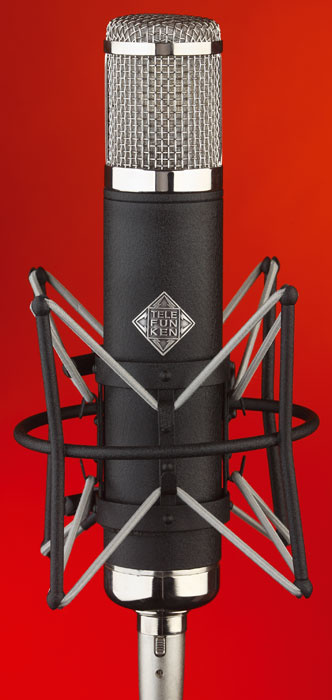 Photo: Mike CameronThe Telefunken name that we associate with rare and valuable microphones and preamplifiers dates back to well before World War 1. Telefunken were set up in Berlin as a collaboration between Siemens & Halske and the General Electricity Company and by 1939 the parent company had a staff of over 23,000 workers. In 1941 AEG bought Siemens & Halske, and in 1967 Telefunken were merged with AEG and the company renamed AEG-Telefunken. AEG were bought by Daimler in 1985, and the Telefunken name dropped from the name, though Daimler-Chrysler still use it as a brand within Europe.
Connecticut-based Telefunken USA were incorporated in 2001, after acquiring the rights to the Telefunken name, though founder Toni Fishman had been working on his ideas for a couple of years before that. He apparently started out by looking at the possibility of providing replacement parts for some very rare and valuable vintage mics, including some Telefunken models, but ended up wondering if his company could just build the whole thing from scratch to replicate the original — and clearly he could!
Initially, it was the Telefunken Ela M251 model that took Toni's attention. The original was developed during the 1950s in collaboration with Vienna-based AKG, as a competitor to the Neumann U47, and it used the famous AKG CK12 capsule. This capsule, the 6072 tube and the model T14 transformer were the same key parts as used in the AKG C12, so the models are inevitably similar in some respects, and the Ela M251 actually replaced the C12. Before Telefunken USA could attempt to replicate an Ela M251, they had to reverse-engineer and document the original, because there was no blueprint available. As you might expect, building an exact replica of the original capsule was the greatest challenge, as this particular model has a somewhat complicated design and sells at a premium price.
Outside In
Exact replicas of microphones that are impossibly rare and hugely valuable don't come cheap! For the rest of us, Telefunken USA have developed the RFT AK47 tube mic, which draws on the design ethos of microphones like the U47 but uses newly designed circuitry, based around more readily available parts, including a purpose-built AMI/TAB Funkenwerke B47 audio transformer, wound for them in the US. The one-inch-diameter dual capsule is sourced 'overseas' (which probably means the Far East), and uses a pair of six-micron sputtered gold-on-Mylar diaphragms. The tube is a NOS (New Old Stock) EF732 miniature wire-ended device (also used in some Soundelux microphones) that is soldered directly to the circuit board.
The AK47 has a wonderfully retro look, with black crackle paint on the body and bright plating to the basket and surrounding metalwork. The output transformer is a substantial-looking piece of engineering, and the main circuitry is built from good-quality components hand-soldered to a single-sided, glass-fibre PCB. A small metal U-clamp secures the miniature tube, and the body shell is held in place by means of a bright-plated locking ring at the mic's base.
A seven-pin XLR cable connects the microphone to the power supply, which is a simple steel box with a three-pin balanced XLR output connector, a nine-position pattern switch (omni, through various widths of cardioid, to figure-of-eight) and a switched IEC mains inlet. The PSU has grey, hammer-finish paint and both mic and PSU bear the distinctive Telefunken logo. Overall, the AK47 measures 46 x 240mm and weighs a substantial 30.5 ounces.
This rather impressive-looking side-address microphone comes in a wooden box with a shockmount, a remote power supply and a Gotham GAC7 cable. A five-year limited warranty comes with the mic, which is aimed at serious project studios, smaller pro studios and the broadcast market.
Like most large-diaphragm studio mics, the AK's frequency response isn't ruler-flat, and as well as a very slight presence peak there's a noticeable mid-range dip at around 300 to 400Hz. At the low end the response rolls off gently below 200Hz, presumably to counter proximity effect in cardioid mode, and at the high end the roll-off starts at 15-16kHz. A frequency response of 20Hz to 20kHz is quoted, but from the included frequency-response graph made for this specific microphone, I'd say the two extremes are around 10dB down relative to the output of the mic between 200Hz and 10kHz. Not that this matters a jot, of course, because what makes mics of this type so attractive is the way they sound, rather than how they look on paper.
One paper specification that does matter is noise, and this mic manages a 76dB S/N ratio and a sensitivity of 14mV/Pa. At 125dB, the maximum SPL is a little lower than for most studio mics, but that's still adequate for all but the loudest sources, and I'd expect this model to be used mainly for vocals or acoustic instruments, rather than kick drums!
Studio Test
I used the AK47 on a long vocal session and it performed faultlessly, capturing a well-balanced sound that managed to be both solid at the low end and smooth at the top. The tube 'character' isn't overdone, and the investment in a decent audio output transformer seems to have paid off, as the high-end detail remains intact without getting gritty. While tube mics tend to be slightly more noisy than their solid-state counterparts, noise isn't an issue in typical studio applications and, used with a standard pop screen, the mic had no tendency to over-react to plosive 'B' and 'P' sounds. I also tried this mic on acoustic guitar, where it put in a good performance (though I wouldn't buy one specifically for that application).
As with all large-diaphragm mics, the AK47 isn't going to perform as accurately as a small-diaphragm model in omni mode, but provided the sound being recorded is positioned in front of it, it delivers. I used it mainly in cardioid mode but, even then, having a choice of cardioid widths was very useful.
Whether this mic is worth the asking price is a more subjective question. I've tried less costly tube mics that sound every bit as smooth, but I think you have to work with a mic for a long time to discover its true strengths. Also, you often find that cheaper mics sound great on one voice and quite disappointing on another. The Telefunken name has kudos, and although this model isn't one of their high-end vintage recreations it certainly looks the part. More importantly, it delivers a very credible sound.
Conclusion
Though not exactly bargain basement, the AK47 isn't overpriced for a multi-pattern tube mic, and you get a decent shockmount, so although there are cheaper options this model has its attractions — especially when you consider how smoothly it captures vocals. I certainly enjoyed using the AK47 and very quickly took it for granted, which I'd suggest is the sign of a good microphone: if you have to keep thinking about a mic during a session to coax a good sound out of it, arguably it isn't such a top performer. With the AK47 I got a great sound both really close to the singer and 12-14 inches away. In fact, it seemed that wherever I pointed it I got a positive result, and I needed little or no EQ to arrive at the sound I wanted... which is, of course, what we're all looking for.
Alternatives
The market for large-diaphragm condensers for vocals is very crowded and there are plenty of alternatives available, such as the Rode Classic MkII and NTK2, the SE Electronics Gemini and M-Audio's Sputnik. As always, there's never a guarantee that a mic, however good, will suit a particular vocalist and if you're working predominantly with one vocalist it's a good idea to audition a wide range of mics to find the one that works best.
Pros
- Classy, vintage look.
- Good sound quality that is slightly flattering without being over-coloured.
- Multiple patterns.
- Sensibly priced.
Cons
- No obvious cons.
Summary
This is a very nice multi-pattern vocal mic, with vintage styling and a high-quality audio transformer that gives a definite boost to the mic's performance.
information
£999 including VAT.
Unity Audio +44 (0)1440 785843.