

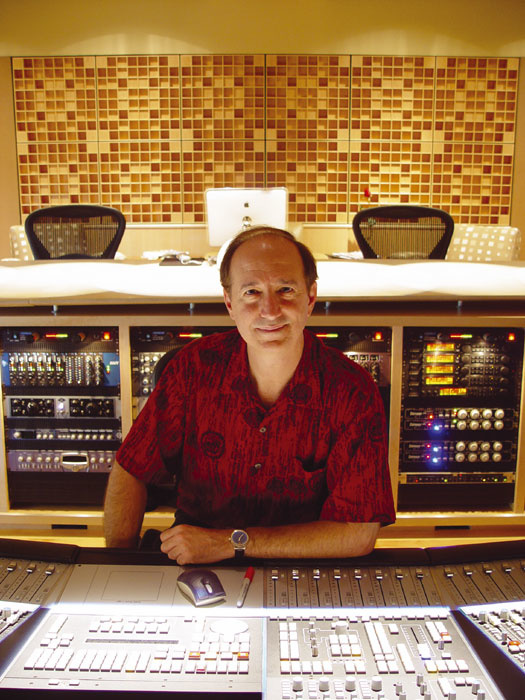
 Bob Bullock in Nashville's Paragon Studios.
For his third album with Shania Twain, reclusive production legend Mutt Lange introduced an ambitious concept: different mixes and instrumentation for different markets. And as engineer Bob Bullock found, even the 'country' version left Nashville and its conventions pretty far behind...
Shania Twain's life as a country recording artist has been eclipsed by her reinvention as a global superstar, an evolution that has garnered the Canadian native an unprecedented three diamond-level RIAA certifications, for 10 million-plus sales of each of her three albums. Twain's records are crafted by the same hand that gave the world Def Leppard's Pyromania, AC/DC's Highway To Hell and Back In Black, and Brian Adams's 'Everything I Do (I Do It For You)': that of the reclusive Robert John 'Mutt' Lange, Twain's husband and producer.
 On previous records, Twain and Lange took with them enough elements of country music to enable her to allow the country music establishment to maintain the impression that she's still one of their own. Twain's latest, Up!, however, dispenses with compromise and comes in three distinct flavours: the so-called 'red' disc, containing the pop/rock versions of the album's 19 tracks; the 'green' disc, with softened versions laden with acoustic guitars, fiddles and pedal steel; and the world music version, with which Twain aims to conquer south-east Asia, the subcontinent and other terra incognita.
After having done much of her first LP The Woman In Me in Nashville, and most of the follow-up Come On Over in Lange's sumptuous then-home studio in northern New York State, Lange and Twain took Up! on a long ride around the world, including stops in Ireland, Italy, India, Switzerland and — for the country versions, of course — the Bahamas. You can take the girl out of Nashville...
From Nashville To Nassau
Bob Bullock has engineered enough country records in his career that he probably knows how to get sawdust out of speaker cones and get it into the sound of the pedal steel guitar. What he was about to learn, as he sat down at the 48-input Neve V3 desk in Compass Point Studios in the Caribbean, was how to do the same thing with sand.
Bullock has a solid history of engineering hits for country artists, including superstars Reba McEntire and George Strait, for whom he is currently working on a new album. He had worked for Lange before, first in the early 1990s on a female artist whose career never gained any apparent traction, and later on Twain's second album. When he got the call for Up!, the mission was for him to bring Nashville to Nassau, and he did, accompanied by the cream of Nashville's A-team musicians: Paul Franklin on steel guitar, Brent Mason on electric guitar, John Willis on acoustic guitar, and Jonathan Yudkin on fiddle, mandolin and banjo. Programmed bass and drums and Twain's vocals had already been tracked, by Lange, in a variety of studios, including Windmill Lane in Dublin and Next Recording Studios in Milan. They resided on a Digidesign Pro Tools HD3 system whose Session files had followed Lange and Twain literally around the world, shepherded by Lange's technical wizard Kevin Churko.
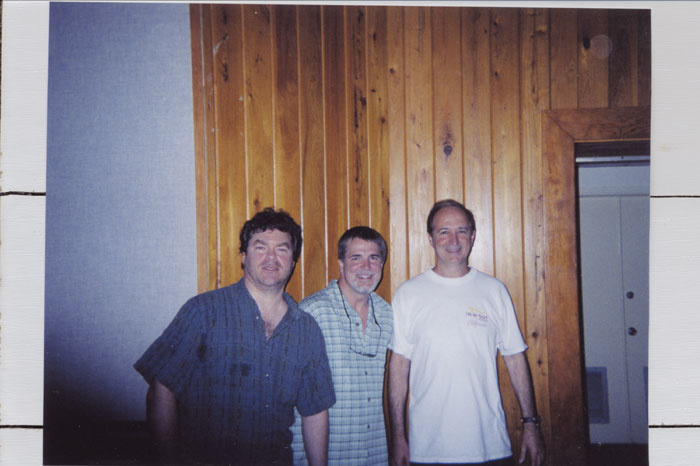 Bob Bullock (right) in Compass Point Studios, Nassau, with guitarist John Willis (left) and pedal-steeler Paul Franklin (centre)."They were the same songs that would be the 'red' version of the album," says Bullock. "The plan was to set up the sessions just as we would for a typical recording session in a typical studio in Nashville, with the players all in the same room and with good sight lines and communications between them. The only difference was, the bass and drums were already recorded, programmed by Mutt on previous sessions. The idea here was to reduce the track to their basics — all the overdubs for the pop 'red' version has already been done and were part of the Pro Tools files — and record new overdubs over the basic tracks to make the acoustic or 'country' version of the album. There were 128 tracks and every time I brought up another [pre-recorded] track, it was like listening to a new song. I never heard the international version of the record, but I can only imagine. Looking back, I guess you could say what we were doing, replacing the pop overdubs with more organic, acoustical ones, was remixing the record as we recorded it. It was kind of startling at first, but we got into a groove and it became totally normal within a few days."
Bullock set the musicians up in Compass Point's spacious (38 x 30 x 14 feet) Studio A — the same one in which Lange had recorded AC/DC's Back In Black LP — using a combination of microphone techniques and baffles to achieve substantial but not complete isolation between instruments. "A little leakage was fine," says Bullock. "I didn't use a collective room microphone to record the group. The way we did it was, the band would listen to a track and then play it down with the pre-recorded bass, drum and vocals, learning the song and coming up with their parts. Then we'd record each instrument one at a time. We recorded everything — the ensemble playing and the individual overdub passes — and after each song we'd comp them down to a single performance. It was much like the way you record vocals, doing several passes and then comping together a single track. That's why I didn't use a room mic: in case we used a combination of individual overdub tracks and parts of the group tracks, the room ambience wouldn't match up. But one thing it did do — and this was important throughout the sessions — was keep the energy generated by the ensemble playing available during the overdubs."
The acoustic guitar and the Fender guitar amps, though, did have their own sort of mini-ambient microphones; Bullock set a Sennheiser 414 back away from the electric guitar amp to capture the air around it.
Fiddle & Mandolins
The actual played parts were remarkably similar between the red and green records; only the instrumentation changed. For instance, Lange chose a combination of mandolin and fiddle as surrogates for the string section recorded in Milan. A couple of parts were ultimately used on both records, such as the guitar solo on 'She's Not Just A Pretty Face', and the green record would ultimately influence another round of overdubs on the red record, when Lange had guitarist Michael Thompson add some parts based on what took place in the Bahamas.
 Jonathan Yudkin laying down a fiddle part at Compass Point.It's an understatement to say that Lange is noted for his reluctance to discuss how he works — to discuss anything, for that matter. But Bullock recalls moments that provide remarkable insight. For instance, Lange asked guitarist John Willis to play the banjo. "Since John's primary instrument is the guitar, he's going to approach the banjo as he would a guitar, playing it with a pick and using it percussively as a replacement for straight eights on a guitar," he remembers. "It really gives you a very different result than if you had asked a banjo player to do it. Things like that are part of what make working with Mutt so unique and enjoyable. I mean, it's different enough that you're making a country record in the Caribbean. Then you're switching instruments around. It definitely keeps you focused."
It even inspired Bullock to record the banjo differently than he would have in Nashville. Rather than approach it straight on as he usually did, Bullock chose a pair of AKG C451 microphones configured in an X-Y pattern. "It was more the way I'd record an acoustic guitar," he explains. "I went for a stereo recording to give the banjo, which has a pretty percussive attack, more width in the track. It gives you more of the tone without diminishing the instrument's percussiveness."
Bullock did record some of the banjo parts more conventionally, using a Neumann TLM170 aimed straight at the head skin of the instrument, and other times using an Audio-Technica AT4050; several microphone selections were set up in 'stations' around the recording room so players could simply move to new setups to vary the sound. (Bullock pays Lange another sort of compliment: "Certain instruments tend to fall in and out of favour on country records, like steel and fiddle," he says. "After Up! came out, you noticed a definite increase in the amount of banjo on country records.")
The electric guitar passed through various Fender amps, each miked with a combination of a Shure 57 close in and a Sennheiser 414 back a foot or two into the room. Those microphones were run through the console's onboard preamps; most of the rest of the microphones went through Bullock's choice of various Avalon preamps. Fiddle and mandolin were recorded using an Beyer 834 set in a cardioid pattern, through an Avalon 737SP mic pre, as the main setup. A second microphone was the Royer SF1, used to trigger effects in Yudkin's rack.
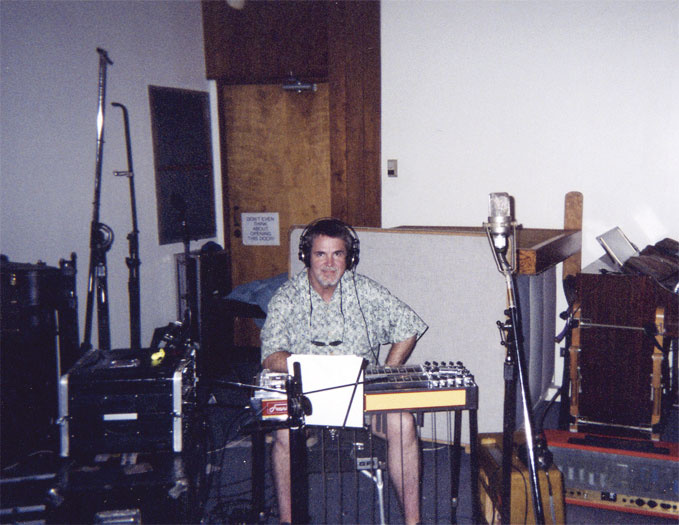 Paul Franklin's pedal steel, along with mandolin and fiddle, provided the country trimmings for the 'green' version of the Up! album. "We already had a kind of sonic blueprint for the green record in the form of the red disc," says Bullock. "And I also liked having the chance to hear everyone playing together as they ran the songs down in the beginning. So I had the luxury of being able to go out and change microphones around, literally swapping them out even as everyone was playing. It really gives a good sense of how all of the instruments are going to sound mixed together. That's where the sounds started; later I would work with them individually. It's a great way to get sounds because you know everything is going to mesh later on."
Another Lange trick, used extensively on Come On Over, was to take a single instrument and make it much larger. "There was a lot of fiddle on that record, and he and Shania agreed that the fiddle part was great but it didn't sound big enough," Bullock says. "The solution was that he hired three more fiddle players who then played the exact same part in unison. I never saw that before in Nashville. You will occasionally see a pair of fiddles, usually playing harmony parts. But never four fiddles playing the exact same part simultaneously." Bullock says this tactic has very different results from simply doubling or tripling a part by the same player. "The sound is there, the part is there, and it's big-sounding. But it takes up no more space than it's supposed to in the track. That's one of the reasons why Mutt's records never sound cluttered, even though there's a lot going on in them."
Mutt Lange, Mandolin Man
You would have to listen to a Bill Monroe record to find more mandolin than is found on Up! Mutt Lange seems positively enthralled with the diminutive eight-stringed box, often using it in unison with the fiddle tracks, such as when he employs that combination to replace the traditional string section on the Mexicali-like motif on the bridge to the hit single 'I'm Gonna Getcha Good'. (The pedal steel, whose portamento often makes it the intuitive choice to replace string parts, is here used to stand in for an ARP-like synth part that plays the song's main riff.) However, one never hears the mandolin played with any of its own picking conventions — there is not a balalaika-like trill to be heard.
Eric Silver played fiddle and mandolin on Shania Twain's first live tour, when she was supporting her first Mercury Nashville album, produced by label head Harold Shedd. It was a strictly country affair, riding a Silver Eagle tour bus from city to city, opening for larger artists. He remembers the experience fondly, as much for its ongoing practical jokes as for the music. The next time Silver worked with Twain, it was on her sophomore album, Come On Over.
 Eric Silver.Silver, who has produced tracks for country artists Michelle Wright and Neal McCoy, is sophisticated in the studio — he's a veteran of hundreds of master sessions, and has his own home studio equipped with a Sony DMX R100 digital console, IZ Technologies RADAR system and KRK E7 monitors. He is also, however, very much a product of the Nashville studio system, which holds that if you can't nail a part in a couple of takes, it's time to move on. Furthermore, Nashville players expect to improvise most of the parts they play on sessions. All that goes out the window when you and your mandolin cross Mutt Lange's studio threshold.
"I was doing a mandolin part for one song," Silver recalls. "It's a particularly interesting example of working with him because it's not an instrument he's mastered. He tried to explain to me a part he had in mind, kind of a real Latin line, aggressive rolling strum. I knew from talking to other musicians that that you know he's hearing something in his mind — you keep going at it over and over until you can play what he's thinking. It's like you're waiting for that magic moment when you can play what he's thinking."
Lange often regards as eminently musical the errant thuds or 'plinks' that session players call 'clams'. "He's looking for idiosyncracies in the instrument," Silver suggests. "I often mute the strings when I'm playing, but when I was doing it he said it distracted him. So I took some tissue paper and wrapped it around the strings that I would have muted, until I was literally playing one string. But it was the one string playing the one thing he wanted it to."
Bob Bullock concurs with this scenario. "Mutt has a very exact and specific template in his head about what he wants to hear," he says. "Not just the notes played but also the sound of the instrument. It might be hard for a musician to hear it initially, but it's there. When he was working on the mandolin, for example, it wasn't just the notes and the sounds but the textures and the brightness. There's a lot of nuances in there.
"The real gist of the interaction between Mutt and musicians is him communicating that template to them. It's actually something to watch. Like osmosis. It takes time, usually, but he's incredibly patient and he's never judgmental. And he does respect what musicians bring to the table. He also gives me a lot of leeway in helping create the sound. He really does lead a team effort. It's as though he's navigating a ship and we're the crew."
During the long days of intense recording, Silver says there were moments when Lange would open up a bit about how he makes records. Interestingly, considering the bands he has worked with like AC/DC and Def Leppard, Silver says Lange told him that he felt that working with session musicians was a 'challenge'. He seems at his most comfortable when programming basic tracks himself. This might be reflected in his methodology of working with musicians one at a time for lengthy, intensive bouts of playing. Silver, who has studied martial arts for decades, nonetheless found himself amazed at Lange's own zen-like mien in the studio. "I'm very used to the Nashville way of making records," he says. "An overdub for a song might take an hour at the most. The first day I worked with him, it took seven hours to get two relatively short parts on two songs. I was actually getting a bit nervous, wondering if I was taking too long to give him what he was looking for. I remember his assistant telling me not to worry — 'We don't normally work this fast,' he told me."
Silver walked away from the experience a bit changed. "He told me it's the only way he knows how to make records, and you get the sense that it's work for him, too," he says. "He's not taking all that time for its own sake or because he necessarily likes to.
"But it taught me a lesson," he concludes. "When you're doing sessions, especially in Nashville, there's an urgency to be a genius very quickly, every time. With Mutt, there's no sense that time is money. Whatever it takes to play what's in his head, then that's what it takes. And when you hear his records, you realise it's worth every minute."
Processing
 From the start, Shania Twain's Up! was conceived in three different versions, which saw the same basic tracks augmented by different instrumental flavours to suit different markets.
Bullock says Lange's attention to detail is meticulous but not obsessive. "It's not like you're in the studio with Phil Spector," he says, drily. If Lange has achieved anything, it's an ability to offer perfection without compromising enthusiasm. Where some epic-style producers seem intent on pursuing a cinematic scale, Lange's work with Twain evokes a different type of film work: the classic Warner Bros cartoons of the 1940s and '50s, when Friz Freleng and Carl Stalling worked highly musical in-jokes into the arrangements. The mix mutes on 'Up!' and the sound effects kicking off 'Ka-Ching' come across as playful rather than simply calculated. In fact, considering Lange's historic penchant for big sounds and heavy gating, the effects processing on Up! is subtle and rarely done for its own sake.
"There are some printed effects, especially on the pedal steel and fiddle, which I also took a feed from a contact microphone for that we added some delay and chorusing to," Bullock says. "Once we established the sound Mutt was looking for, it made sense to lock it in. We used what was in the musicians' racks a lot for that. I added some outboard digital delay to Brent Mason's guitars and some compression through an 1176 and an LA2A on the fiddle and mandolin, but a lot of the sound was also just standard-issue stompboxes. There wasn't a lot of gating of effects on this record, but there was clean-up editing on effects and in between parts in Pro Tools after each session. There's a lot of instrumentation but there's also a lot of space, some which was definitely added in during editing. But we tried to do most of the effects using hardware on the front end as opposed to plug-ins later in Pro Tools. The point was to make this a very organic-sounding recording. It was truly an 'old school' type of record, very live."
On The Beach
If the sessions for Up! were intensive, the ambience of the Bahamas compensated considerably. In fact, Bullock suggests that the choice of recording location was as premeditated as any other aspect of the production. "We all had huts on the beach, and it was a very creative environment, very detached from the rest of the world," he recalls of the place. Characteristically Caribbean, it also had occasional power outages, with only the computers running on UPS backups. "So we'd just sit on the beach until the power came back on. It wasn't an opportunity to stress. It was a chance to be social with each other. We would often come back into the studio recharged, like we just had a little mini-vacation."
 Compass Point Studios in Nassau: a change from Nashville.
In fact, the whole venture was a welcome change from what Bullock concedes can be a bit of a routine in Nashville. Shania Twain and Mutt Lange have done much to change how country is defined, and how it defines itself. In 1995, the pair's first collaboration The Woman In Me was largely recorded in Nashville. Country records already were experiencing big snare drums by the time Lange and Twain began working there, and the LP's hits, 'Whose Bed Have Your Boots Been Under' and 'Any Man Of Mine', were perhaps more country than what much of Nashville was spouting at the time. It was almost as though Lange was learning the rules before he could allow himself the luxury to break them.
Bullock says the two ways of working — Nashville's production-line approach and the more leisurely and worldly pop method — are not necessarily incompatible, particularly since Twain is now a world-class diva. "There's nothing wrong with the Nashville way," he says. "But when you can get out and away from it and make a record in such a different environment, you're able to bring something back with you that takes the old way of doing it and transforms it, because getting away has transformed you. It's a great way to make records."