


Allen & Heath, these days primarily a mixer manufacturer, have made many different kinds of gear in their time, but none is more obscure than 1985's Inpulse One. We unearth the facts about one of music technology's most forgotten rhythm computers.
The early 1980s was in many ways the dawning of a new age for music technology, as digital control systems and sound-generation technology started to become affordable for use in mass-market recording technology. It was also a new dawn of sorts for the well-regarded British company Allen & Heath. Famous for high-quality studio consoles, they started the decade having acquired tape-recorder manufacturer Brenell, and were keen to follow this up with success in new markets. The new company, named AHB during this period in recognition of the Brenell acquisition, planned three new products — the Syncon M24 console and 24-track recorder, the Inpulse One drum synth and computer, and an aborted project to produce a sampling keyboard based on the same technology as the Inpulse One.
Allen & Heath's current MD Glenn Rogers recalls, "The vision was to produce high-quality solutions for the recording community... Allen & Heath can't lay claim to the conception of the products, only the design and final development. The idea was introduced by an external designer who worked on a retainer plus royalty. The development took two years."
The original design team was formed at Livingston Studios, London in 1983, and consisted of sound engineer Simon Jones, electronics engineer and 'father' of the Inpulse One Alan Robinson, percussionist (and former drummer for The Kinks) Robert Henrit, and at Allen & Heath, Glenn Rogers and freelance industrial designer Martin Appleby. Some of the samples for the Inpulse One were provided by a mysterious 'Barry', whose letters to AHB detailing his work I have found, but haven't been able to trace.
Form Following Function
To understand why the Inpulse One was special, even by the time it was released, you have to know something about the technology on offer from other manufacturers at the time, and how someone working with it would want to improve it.
When AHB first planned the Inpulse One, the competition came mostly from the USA in the form of the Oberheim DMX, the Linndrum, and the Sequential Drumtraks. Simpler analogue devices from Roland and Korg also offered less programming flexibility and cruder sounds.

 The Inpulse's multi-segment LED is common on gear from the mid-'80s, but this one provides much more feedback than typical displays of the time. As you can see in the inset picture, it wasn't just for text feedback, but also displayed the positions of beats in your patterns as you programmed.AHB targeted the US-dominated high-end market square on. From day one, the system offered excellent connectivity with the technology you'd expect to find in a studio of the era. The Inpulse One accepted and could output a timebase signal which could be set to a range of pulses per beat from 1 to 96. This reduced the need for converters and the additional cables and power supplies that went with them, at a time when when Korg and Roland had both settled on different sync timebases. Some high-end rivals from the US offered SMPTE, but usually as an option, and as part of a wider package that offered sequencer and sampling functions. Needless to say, the Inpulse offered an excellent implementation as standard, with its large LED giving frame information and quick access to features via the front-panel buttons. The Inpulse One could also output MIDI Time Code — an undocumented feature that took another couple of years to be widely adopted.
It wasn't just the feature-list that was impressive at the time. The power-supply technology was derived from that used in A&H's consoles, offering a clean, noise-free solution that was (and is to this day) also highly robust. The physical construction is vastly superior to anything available either at the time of conception or release, being built into a flightcase over 20 inches wide. The heavy (20kg) construction was also designed to provide a solid framework for the eight velocity-sensitive pads, which can be played with sticks or hands. The Inpulse's robust build would make it a fine candidate for live use, were it not for the rarity of the machine!
Most high-end drum machines of the day could have their sounds altered by replacing the EPROMs. Some, like the Oberheim DMX, offered their own samplers and EPROM burners to write the eight and 16K chips. However, most of these required the user to open the case and remove the chips with a puller, thus running the risk of bending the pins. The Inpulse One offered the user another way — tape interfacing. In addition to the sounds supplied in ROM, AHB made a sample library available on data tapes, which could be loaded into the Inpulse's RAM.
The developers had an even more complex job getting the samples into the machine — they originated as 16-bit recordings on an Apple IIe, and were then fed through a custom card into a sampling delay effects pedal, which was then interfaced to the Inpulse One (sadly, no-one involved can remember what it was)!
Despite all this effort, the manual claimed that the Inpulse One sported only 64K of RAM, which was barely enough to hold the 48K Crash Cymbal sample provided on the tape with the machine! The handbook may have been wrong though, as the 64K limit was dictated by the cash constraints of 1983 when design began. According to some of the designers, the Inpulse One was in fact intended to carry 256K from day one. Confusing the issue further, sample sizes on tape and internally were measured in blocks of 2K, so the free memory display would (in theory) have only shown 30! Glenn Rogers recalls that the engineers had some doubts about the memory capacity after the launch, and as some early machines were returned to have MIDI implemented later, it's entirely possible that additional RAM was added to early machines. It's worth noting that Emu's SP12 only offered 48K of RAM as standard, the Turbo upgrade expanding this to 192K.
Compared in price to its competitors, however, the Inpulse One was quite expensive. In 1985, just before the Emu Drumulator was withdrawn from sale, the Inpulse One was supposed to have been around £1995 — compared to $995 for the Drumulator and $2700 for the SP12, although the Drumulator required optional upgrades to be remotely similar in specification.
Buying An Inpulse One
Exact statistics on the sales of the Inpulse One are as hard to come by as many of the other details relating to it, but it is believed that less than 140 were made, which makes it hard to put a price on. I paid £250 for mine, and it's in excellent condition, but it lacked a manual or any of the sample tapes, so I only have the default EPROM soundset. The only other unit I've seen for sale was advertised a couple of years ago on a French web site for 1500 Euros — around £1000 — and it seems it also lacked the sample tapes.
 The Inpulse One is built into its AHB flightcase, which is very much a part of it! Attempting to remove it is not a good plan...Allen & Heath do have a copy of the manual and some marketing materials, but don't have that much information about it. Nor do they have any copies of the drum sample tapes. Mike Clarke, Technical Director at A&H, tells me that he gets an enquiry about an Inpulse One every couple of years or so, usually because the backup battery has failed. In really bad cases, the battery can leak and destroy the circuit boards inside, as is common with a lot of gear from this era.
If you can find one, check that all of the buttons work (there are 63 of them!), and also that all of the individual outputs work. You should also make sure that the velocity-sensitive pads respond to different pressures, but don't be alarmed if the response doesn't seem equal on all the pads, as there are trim pots located on the rear panel and these may be incorrectly adjusted.
The case is a proper flightcase — you can't remove the Inpulse One from the lower half — and so the lid is essential rather than optional packaging (see the picture above). There is enough space to store a couple of drumsticks and a manual in the case, but no pockets to facilitate this, so there may be marks on the casing.
The only hardware problem I have had is with the heatsink falling off. On the rear panel, to the right of the interfaces, are three screws holding the heatsink to the case, and if these become detached, the machine will overheat. It appears to shut down before any damage occurs, but replacing the heatsink involves removing the drum pad panel.
Don't be concerned if the RAM sounds aren't present when you switch it on — they're not supposed to be. If the unit isn't storing songs or patterns, however, the battery will have to be replaced, and this requires an engineer. Allen & Heath haven't kept any of the technical information, but Panic Music Services in Cambridgeshire will attempt to repair any fault and are an A&H authorised service centre, and original designer Alan Robinson still works with electronics and has been known to undertake more complex restoration efforts. There are few, if any, custom components in the machine, and in my own experience of it, it has never actually 'broken', unlike the Sequential Drumtraks I obtained, which suffered a failed CEM filter in the space of a week!
It's possible to test operation of the RAM by copying the samples from the EPROM locations, and you can then test the tape interface and the amount of memory installed. No modifications should be needed to replace the 64K memory with appropriate 256 x 1-bit ICs — my machine has M5M4256-150 DRAMs, which are still readily obtainable.
If you do find a complete system, with sample tapes and original manuals, keep it safe and make a backup of the sample tapes, as no-one I have spoken to seems to have copies of them. If I can source tapes from anybody, I'd like to make an archive available, so I'd be delighted to hear from any past — or, even better, present-day — users. I can be contacted via the SOS office.
Flop!
Despite all the lofty plans of the design team, the time between the conception of the Inpulse One and its delivery in 1985 coincided with the arrival of many more inexpensive products from the Far East, offering slightly lower quality and more restricted functionality, but also costing considerably less in most cases. By the time the system was released, Casio and Korg had lower-cost sample-based machines ready to appear, and the US manufacturers had released their next generation of drum computers. Even the Inpulse's tape interfacing seemed anachronistic, as other high-end machines now offered support for the MIDI Sample Dump Standard, or even disk drives. Perhaps unsurprisingly, the Inpulse One was discontinued after just six months following very disappointing sales, and the planned sampling unit and computer-controlled sequencer mentioned in the brochure were cancelled with it.
AHB suggested that the Inpulse One was too complex for the buyer of the time, who had yet to encounter the Atari, Cubase or sophisticated drum machines like the Linn 9000. I can't agree with this, however — compared to machines like the Drumulator, which sold in thousands, the Inpulse is incredibly straightforward to use.
More down-to-earth reasons may be to blame. Like so many British electronic products, the Inpulse One would appear to have been marketed before it was ready, then sold before it worked correctly. A 1986 Sound On Sound interview with Bill Nelson — one of the handful of recording artists I've been able to confirm as having used one — implies that even as a new machine, the Inpulse One was far from reliable. "I like it very much, but I don't think I'm being unfair when I say that it's been incredibly unreliable. I ordered a version of it before it was ever available in the shops. But the company had technical difficulties putting it into production, so it was quite a while before I received mine".
Other British Drum Computers
LARKING MOVEMENT DRUM COMPUTER I & II
Not so much a drum computer, as a computer that happened to have drums, the Larking Movement provided analogue and digital sounds in a bright orange computer vaguely reminiscent of a 1970s terminal, with a large green CRT display, typewriter keyboard, and controls for the analogue sounds. The Movement is very rare, and very little information is available about it, but it was definitely used by The Thompson Twins' Steve Goulding, The Eurythmics, Thomas Dolby, and Mick Karn (formerly of Japan) on his solo album Titles. First appeared in 1983.
SIMMONS
The Simmons Drum System is well known, especially for the 'peeow' sound the analogue toms produced. However, most of the systems used were sample-playback devices, with lo-fi samples burned to EPROM. In the late '80s, Simmons planned to launch a technical tour-de-force of a product, the SDX sample-based drum system, but tragically, it ended up killing the company. The SDX featured 16-voice polyphony, 2MB of RAM (expandable to 8MB), internal hard disk options, SCSI interfacing, a GUI with a trackball and integrated CRT screen, plus 16-bit sampling and analogue resonant filters. Nowadays, it sounds merely quite good, but in 1988 it was one of the best samplers around, and just happened to be a great drum machine, with zoned, velocity-sensitive pads. It was featured in SOS back in June of that year.
What's It Like?
There's much more to the Inpulse One story than its failure. Many contemporary drum machines, with their obtuse interfaces, defeat me — witness the uninformative face of a Drumulator or Drumtraks, and you'll see what I mean. Even the Oberheim DMX — one of the most 'user-friendly' drum machines of the era — lacks direct access to many of its functions. You even have to open its case and adjust a trim pot to alter the pitch of a drum! Compared to these, using the Inpulse is like moving from DOS to Mac OS.
Without giving a video demonstration of it, it's hard to pin down exactly what makes the difference to the user interface, but the LED panel is a good place to start. On the Sequential Drumtraks, although you can play in a sequence in real time, editing the velocity of each beat afterwards is tricky, you can't step through a sequence, and even if you could, there's no visual feedback as to where you are in that bar. You can't move a beat, either — you have to erase a duff one and re-play it. On the Inpulse One, moving a beat in a sequence is much easier thanks to the visual feedback afforded by the display.
General programming is also easier. Playing the drum pads allows the user to compose a beat almost as naturally as playing drums, although a kick-pedal would be an essential add-on for anyone wanting to make full use of it. You simply enter Program mode, and either play the loop as it records (at a maximum resolution of 32 steps per beat), or go into a useful 16-step sequencer. All 16 possible sounds are accessible and programmable, although the machine's polyphony is limited to eight notes and those eight channels aren't dynamically assigned.
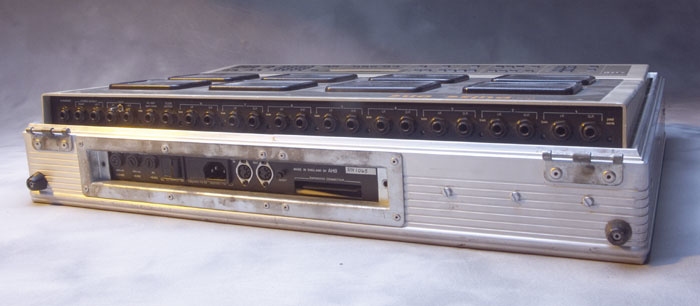 There's no shortage of individual outs on this drum machine, and this model even has MIDI (not all of them did).
On most drum machines, programming the synchronisation or accessing tuning functions is a multi-menu operation. Whilst the Inpulse One isn't perfect, the logical grouping of functions makes, for example, writing an SMPTE track very easy. Only the MIDI functions are obscure, probably as a result of MIDI being a later addition.
It isn't all roses — you need to plough through a detailed section of the manual to find out how to program key signatures other than 4/4, and it's much harder than the simple 'select a time signature' offered by Sequential's Drumtraks. However, using advanced programming techniques is much easier overall, so this limitation can be worked around to produce meticulously edited sequences.
Of course, all of these features aren't much use if you don't like the sound. Overall, the engineers appear to have focused on making the sound quality and signal path as clean as possible, whilst trying to get the 'cleanest' sounds they could. For fans of '80s production, that gives the Inpulse a curious edge. Once in a mix it can appear to be a fairly normal, if slightly processed, drumkit, albeit one played with that precise timing that marks out a machine, and yet without the painfully accurate sound of a modern sample-based system. The cymbals manage to retain a good proportion of the metallic ring that is so often lost in machines, although they cut off sharply. It's probably best suited to a rock band — working with the EPROM factory samples, it's not going to be the backing to a dance hit now (it's hard to imagine it happening 19 years ago either, to be honest), but it does sound like the drums on the The Cure's Pornography album, and people won't listen to your recording and go "oh, that's a Drummonster XYZ". In fact, they might not realise that it's a 1980s machine at all. Some of the credit for this is due to the design team's 'percussion consultant' Bob Henrit, whose rock bias no doubt contributed to the overall feel of the machine.
With other samples, it might be a very different story, of course. AHB listed over 10 cassettes for the machine, with sounds ranging from conventional acoustic drums to milk bottles, tin trays, and guitar power chords. The included factory cassette would make up for the lack of a cowbell, shakers and blocks in the EPROM sounds, although again, the lack of a dance emphasis shows in the omission of handclaps — they were on Tape 2... Tragically, I am unable to comment further, as the Inpulse One I managed to track down was missing all of its sample tapes (see the box on the previous page).
Inpulse One Users
- Bill Nelson, formerly of Be Bop Deluxe and various other bands, used one on the album Getting the Holy Ghost Across.
- Ed Vargo of Total Harmonic Distortion has owned one, but can't be contacted to confirm if it was used on any recordings.
- Bob Henrit of Argent and The Kinks provided the samples and input on how the Inpulse One should work, and may well have used one during the design process.
Back To The Future
Integrating the Inpulse One into a modern environment is actually quite easy. Sadly, it's only capable of outputting MIDI Time Code over MIDI, making integrating performances into your sequencer a little tricky. Controlling it via MIDI from something else is a different story, however, and quite rewarding. You can assign each pad to a range of notes (RAM and ROM sounds can have their own ranges, allowing all 16 sounds to be accessed), and each range will play different pitches, allowing you to program cascading tom-toms or tuned bass drums that would take intense programming on other machines, and wouldn't be possible at all on some cheaper contemporary systems. The human feel (or 'Scatter') option is crude by modern standards, but the high-resolution quantising results in versatile sequences with easily manipulated dynamics.
In addition to the expected stereo output, individual outputs are available for all channels, and each sound can have different volume and pan settings, allowing for great flexibility during recording. Backing up your patterns and songs is inevitably a chore, since the tape interface is your only option, but you can always just link it to your computer's audio in and record that way — that's how I store patches and data from my Inpulse One and my Akai AX73.
Fascinating Rhythm
The Inpulse One occupies an almost unique position in the world of electronic instruments — it's both rare and advanced, and yet it has escaped the legendary status of rare synthesizers like the Elka Synthex or ARP Chroma. It seems likely to remain a curiosity, rarer than the Linn LM1, almost unheard of and almost unheard. Although I've come close to selling mine out of frustration at the lack of available information surrounding it, there is a certain intangible quality that means that I would never part with it, and it's not just about the rarity or the sound. Like all the best instruments, it has a character all of its own. Seek one out... if you can.