

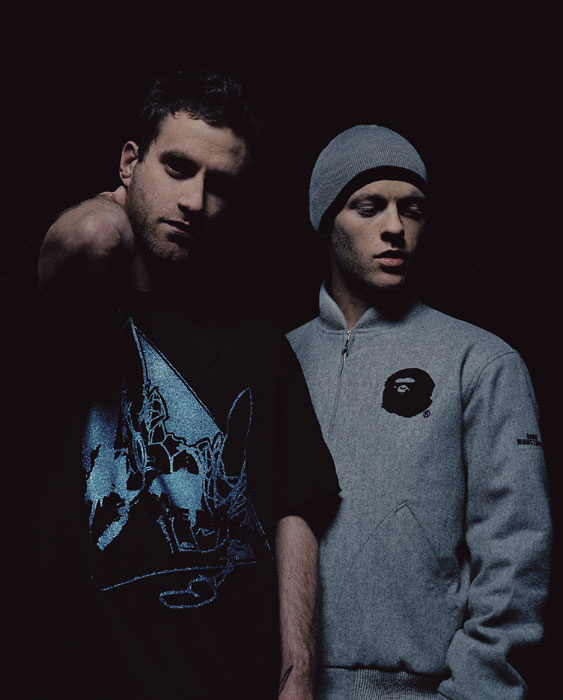
 Unkle's core line-up for Never, Never, Land consisted of James Lavelle (left) and Richard File.
With help from their galaxy of high-profile collaborators, Unkle have embarked on an ambitious attempt to reinvent dance music.
"One second you got it made, the next second you're down in the dumps. And it goes back and forth throughout your whole life." Thus declares a world-weary voice in the opening track of Unkle's Never, Never, Land, and the words seem an apt comment on the musical life of band members James Lavelle and Richard File. Unkle had enjoyed huge hype and commercial success with their 1998 debut album Psyence Fiction, which sold over 700,000 copies, and although the follow-up Never, Never, Land has sold respectably and received mostly positive reviews, Lavelle admits that its melancholy tone reflects a general disillusionment with the British music scene.
"I'm into new music," he says, "and into the idea of utilising new production techniques. It's great that there are a lot of new live bands around at the moment, but to me a lot of them sound derivative of things I've heard before. I grew up with artists like Massive Attack, who were into using new techniques, trying to do something that hadn't been done before. When I hear them, or people like Björk or Dr. Dre, I hear interesting records that sound new and have production values that I like. To me the ultimate mix is Radiohead, who are geniuses in a pop aesthetic and playing live instruments, and also embrace new technologies."
Lavelle began pushing the boundaries as a teenager, when he was part of Sheffield's 1980s electronic music scene, and founded the Mo'Wax label in the early 1990s, aiming to promote innovative electronic dance music. Signing acts like DJ Shadow, Air, Headz and Attica Blues, he quickly proved successful; and (now defunct) Mo'Wax, with its bias towards low-key, stripped-down soundscapes, is credited for being one of the main instigators of the trip-hop movement.
While displaying his Midas touch as a label boss, Lavelle retained his ambitions for more hands-on involvement with music, and together with childhood friend Tim Goldsworthy and Japanese producer Kudo he set up Unkle. (Goldsworthy and Lavelle were fans of 1960s TV shows, and the name was, indeed, a pun on the US spy series The Man From UNCLE.) Lavelle supplied the concepts and direction, while his two bandmates got their hands dirty using machines. Unkle's first release, the EP The Time Has Come (1995), was an unusual mixture of hip-hop, jazz, funk and ambient music. It received rave reviews and was considered the epitome of the Mo'Wax sound.
 Three years later, the Psyence Fiction album saw Goldsworthy and Kudo replaced by Mo'Wax's best-selling artist, DJ Shadow, who was responsible for the record's more abrasive sound. The album was a showcase for an array of notable guest artists, ranging from Thom Yorke, Richard Ashcroft and Badly Drawn Boy to Kool G Rap, Mark Hollis and Alice Temple.
Out Of The Shadows
Never, Never, Land marks another change in personnel, with DJ Shadow being replaced by the unknown Richard File. Once again there's a galaxy of well-known guest stars, including Brian Eno, Ian Brown, Jarvis Cocker, Massive Attack's 3D, Queens Of The Stone Age's Josh Homme, and Graham Gouldman, who, in true 10CC style, dubbed 140 tracks of backing vocals on 'In A State'. In every other respect the album appears to be a genuine team effort from a trio compromising of Lavelle, Fine, and producer/writer/instrumentalist Anthony Genn.
Richard File picks up the story of the making of Never, Never, Land, beginning with his own entrance. "In the early 1990s I was skateboarding a lot at the South Bank, hanging out until the last train home. I'd been doing some DJing, and met James in 1994, and through Mo'Wax I would do drum & bass sessions in clubs during the last hour... I was usually pretty drunk by that point. James and I were hanging out as friends and when he was coming towards the end of working on Psyence Fiction, in 1997, he asked me how I felt about singing on the album. It was too soon for me, but afterwards I picked up a guitar, learned a few chords, and also did a lot of programming beats for James when he was doing remixes.
"This carried on until three years ago, when James and I moved in a flat together for six months, and there we created Unkle Sounds, the DJ aspect of Unkle. We began experimenting with various rock records and other records that weren't right for a club context unless we f**ked with them, ie. re-edited them and remixed them. We also remixed a lot of the Psyence Fiction stuff in a more club, uptempo way. We were just using an Akai MPC2000XL, an Atari, and an Emu 6400, which were standing in a corner of the flat. James introduced me to the MPC, and I really got into it.
"We also developed a number of really basic ideas for songs. At that point I was into the acoustic guitar, and knew about six chords, but only used the few that worked for me, and moved a capo up and down the neck to play in different keys. The chords I used were mainly Am and Em, and sometimes Dm and C. I just love those chords and found infinite melodies through playing with them. At the end of that six-month period we were excited about the raw ideas we had, and then James signed to Island. At that point we were officially Unkle."
Unkle Sounds Tech Talk
Unkle Sounds is the moniker under which James Lavelle and Richard File tour the world as DJs, performing in places other DJs can only dream of. In addition, Lavelle has released several successful mix compilations, for instance Fabriclive 01 (2001), Global Underground: Barcelona (2002) and Global Underground: Romania (2004). Particularly on the last set, the tracks have been severely edited by Lavelle and File.
"We just did a tour of Asia and Australia," reveals File, "and James has a residency at [London club] Fabric. We may cut stuff up bar-by-bar and add percussion and sounds, which we can mute in and out when we're playing live. For instance, in 'Tomorrow Never Knows' by The Beatles, only the first two bars are instrumental, so we work a lot with those two bars, and loop them for quite a while with extra percussion. When you're in a club you can't go straight into songs, you need to give people a groove and take them into the songs slowly. We also take Zip disks of sounds with us, and all our effects, like reverb and so on, come through the KAOSS Pad."
A lot of the pre-editing is now done in File's Apple laptop with Digidesign's M Box and Pro Tools LE, "which is 24-track and as much as I need. After which we'll go into the Strongroom to spend two days finishing off there. We stick the mixes on CD-R, while many of our samples will be coming off the MPC2000."
The equipment that the duo use live consists of two Pioneer CJD1000 CD decks, two Technics 1200 turntables, the MPC2000XL, a Korg KAOSS Pad, and an Allen & Heath Zone 64 mixer. "They make really good mixing desks," says Lavelle. "It has great filters and stuff."
The high-pass filters on the desk are of particular importance, since the absence of them is the only gripe Richard File has with the MPC2000. "We do our best to clean samples up, so that the bottom end remains as spacious as possible. For example, with hi-hats that you've taken off a record player or CD you want to get rid of the lower frequencies. Because the MPC doesn't have a high-pass filter, you end up having to put everything through Pro Tools so you can EQ things to sound good. Doing it on the desk is also possible, but doesn't always work, because you don't always have the separation."
Dos-Shot
Island had approached Lavelle on the basis of the success of Psyence Fiction, and asked him to deliver a new Unkle album. "We created a studio from the advance we received from Island," remembers Lavelle. "We simply rented a space, and put Pro Tools in it and quite a lot of outboard gear. We had a lot more time on our hands with the making of Never, Never, Land than with Psyence Fiction, when Shadow and I were trying to fit into each other's schedules. It was very broken up. I didn't enjoy that process very much. I wanted to work in a partnership where everyone complements each other's roles. For me part of the process of enjoying a record is doing it with people you have a friendship and share similar ideas with. Richard is one of my best friends, and our relationship is born from a love of music and clubs and drugs. So the dynamics our of friendship were to me the ideal relationship for working in a studio."
 Although Unkle had their own studio HQ, many of the parts for Never, Never, Land were tracked by James, Richard and their many collaborators in other studios such as Strongroom, Sphere and 2kHz.File and Lavelle set up their studio in East London and called it Dos-Shot. File continued his work with his acoustic guitar and MPC2000 programming techniques, while Lavelle continued to contribute samples and conceptual ideas. The studio's Pro Tools rig was a then-top-of-the-range Mac-based TDM system, and in addition to the MPC2000 they retained an Emu 64000, and also had a Korg MS2000 and MS20. Meanwhile, says File, "mates would bring in loads of things. Pro Tools was the hub of everything, and we had every plug-in available going. On the Atari everything was in MIDI, which is great for beats and samples. But working with audio in Tools gave me so many options, I couldn't believe it."
With Lavelle and File coming from the hip-hop school of non-musicians who use technology to cut, paste, loop, edit and treat samples, they soon found that the project was missing one crucial element: someone who could actually play and arrange. Enter Anthony Genn, who, explains File, "has a traditional song-based background, and has played in Elastica and Pulp. He's brilliant melodically, and James involved him because he had great ideas and a repertoire of songs. When we went into the studio, I was still someone who had only sung in my bedroom. But Ant, within a week, completely opened me up and got me feeling good about my singing. During this first week we realised that we would work well together as a team.
"Creating the album was a case of me coming in with chord structures and melodies, like the bare bones, and Ant adding the meat and the skin. And together we took it to a larger point, with all of us adding stuff. Ant might add a spark that we could generate ideas from. This was with my stuff. With James's stuff, for instance with 'Eye For An Eye', he had the original samples ['Ball of Confusion' by the Undisputed Truth and 'Fairground Ghost' by James Asher], and the vocal line and a concept for the song. James would talk to Ant about where he wanted the song to go. Because he doesn't play or program, he would sing things, like a bass line. That's the way he gets his ideas out."
Hands Off
"It's difficult to explain the process," adds Lavelle. "Ant played and had more of a producer role. I'm the least hands-on, and have more of a conceptual role. I don't know if I could be more hands-on, because my mind is so erratic when I'm bringing in ideas. I need space to be able to take in what's happening. Rich is more technical in his application. We talk about ideas, and try things out. Things sort of happen and tracks come out of reacting to each other and out of these discussions and reacting to what's happening sonically. I might say that I'm really into a certain synth sound or a certain mood, and we work to find sounds and samples to replicate that. Then you build on that."
 The vintage EMI desk in 2kHz Studios was particularly favoured for its warmth.
With regards to the input of the various guest performers, Lavelle explains: "Things happen very organically. Most of them are friends, or a friend of a friend. The only person that wasn't was Brian Eno. He's a wonderful, amazing guy. The track he worked on ['I Need Something Strong'] was a very collaborative track. All he did was play a Korg KAOSS Pad, while Jarvis [Cocker] played a Moog synth, whose sound was put through Eno's pad. Eno would manipulate the sound, and we'd stick it into Pro Tools. Originally that track had lots of beats in it, but we took them all out, because we felt that there needed to be a place on the record that was a break for your ears."
Never, Never, Land is, according to Lavelle, "a lot richer in its production values" than its predecessor. "The first record was a lot rawer in the way it was made. Most of it was done at home on an MCP2000 and then mixed in a studio. But for Never, Never, Land we didn't only work in the studio we set up, we also recorded in quite a lot of other studios, like Strongroom, 2kHz, and Sphere Studios. We record things there to Pro Tools, and then brought the files to Dos-Shot to work on them. At 2kHz we recorded through this old 1969 valve T-model EMI desk. It looked like a submarine console. It sounds very warm and we liked recording live instrumentation on it."
Eyes Opened
For all Lavelle's non-hands-on non-musicianship, he is credited as playing Mellotron on 'What Are You To Me?'. "That was the first live recording session we had," explains Richard File. "Ant and James and I just had a writing week and I was really inspired and we had come up with 'What Are You To Me?' and 'In A State'. On 'What Are You To Me?' I was playing guitar, and we had a bassist and a drummer and a guitarist, and James was playing a Mellotron through a Space Echo, and manipulated the filter.
"'What Are You To Me?' was a real eye-opener because we'd never been involved in playing like this. Up to that point everything had been done in a computer, programming beats and bass lines and so on. Suddenly we were in a band environment, where we were actually playing a song and seeing how it goes and what's good and bad. We probably put down four or five takes and then we pretty much had the structure of the song. We suddenly realised that this was a much quicker way of getting an arrangement and a real vibe between people."
So why not record the entire album like this? "Because we didn't want that live sound," protests Lavelle. "We're not players in the traditional sense, we're not a band in the traditional sense. We got the structure of the song during that original take, but then we edited and chopped things. The unique sound from the sample culture is very difficult to replicate playing live. The way the beats are chopped and the music is edited is very inherent in the sample aesthetic. We wanted to retain that. That's where we're coming from. To us it was very interesting to fuse the live and technological approaches to making records."
 "The other eye-opener from that session," says File, "was that it was possible to take something that sounded quite live at the beginning and then edit and treat it to a point where it didn't sound live or programmed, but was the mid-point inbetween that we were all into. We added electronic drums to the live drums and synth bass to the bass, while we took a two-bar loop from the live bass and that became the bass line. In the end several tracks of the album were predominantly live tracks that were crunched into a more programmed style.
"With other tracks it was the other way round. For example, 'Panic Attack' came from a Joy Division beat ['She's Lost Control']. Listening to the Joy Division boxed set it sounded like a beat I'd never heard before. I just had to sample it. So this was a case of a tune starting from a beat. It was a 3/4 loop that I programmed to be in 4/4. I loved the sound of the beat, but the tempo and rhythm weren't quite right. Once I'd turned it into 4/4 it had the right feel. I began working with it in the MPC, but because it's a three-minute piece of music, I transferred it into Pro Tools, where I can cut and loop things more easily. You also don't have the beauty of cross-fading in MIDI. Generally, I'd cut beats up in Pro Tools until every part had the right length, and then dump it into the MPC, because it's easier to work with for me. The MPC interface allows me to play parts as if I'm playing drums, by hitting the pads. I then transfer it back into Pro Tools.
"The beats for tracks like 'Panic Attack' and 'Eye For An Eye' were programmed in the MPC, and then I'd throw in various one-bar loops and edits and arrange all that in Pro Tools. I'd sample a beat, like a bar of music, and then I'd cut it up in 16ths or whatever, so every hi-hat and every kick drum and snare are separate, and so I can rearrange them to fit in the song. Our samples were taken from records, rather than sample CDs. James has such an endless library, and it also instantly gives a rough edge to what you're doing. You get grit from taking things from records. I tend to sample beats every so slightly slower than I'm going to use them, so that when it comes to cutting them up, you don't have air gaps between the samples which you then have to stick together. It's remediable on the MPC, but it's a nightmare."
An Ear For Music
Clearly, a lot of skill goes into programming beats in this way. But is it really a substitute for traditional musicality? "My dad said to me 'Don't you wish now that you'd learned to play the guitar at school?'," says Richard File. "And I'm like 'Not really, because then I would have learned the rudiments of music, and maybe I would not have dared to make the mistakes that sound good but are theoretically mistakes.' If I'd known too much about music, just using Am and Em would have been too naive for me.
"I'm now at a point where I want to learn to play the guitar better. Also, we have come to a point where samples are less important because, first, you get screwed for publishing and second, when you sample notes from, say, a piano, if you try to detune them, they sound shit. But if you play a line, and think 'Hey, wouldn't it sound great an octave up?' then you just play it an octave up. This may sound really naive for someone who comes from a traditional background, but for someone who comes from the sample side of making music, it frees you up when you can change things by playing them differently, rather than detuning a sample and it sounding horrendous. Still, there's an element of sampling that we want to keep, because our roots are in hip-hop and drum & bass and dance music generally, and there's an inherent sound there that you want to be part of everything you do."