

Yellow Magic Orchestra pioneered the use of electronic instruments and sampling. Now Uwe Schmidt, aka Señor Coconut, has used the same techniques to render their greatest hits as Latin dances, with contributions from all three original YMO members.
The idea of reworking classic synthesizer tracks in the style of a Latin dance band may be inherently amusing, but Yellow Fever!, comprising 10 covers of Yellow Magic Orchestra songs, is anything but a joke. Far from being mere novelties, the songs are extremely well arranged and rhythmically complex, which is particularly impressive as they were constructed using little more than a laptop computer by just one man — Uwe Schmidt, creator of the Señor Coconut persona.
 Uwe Schmidt, aka Señor Coconut.
The Coconut Enigma
Over the past 20 years, Schmidt has made a habit of releasing off-the-wall records, mostly under pseudonyms such as Lassigue Bendthaus and Atom Heart. As far back as 1986 he helped set up the NG Medien label to manufacture and distribute 'audio tapes of diverse electronic music projects', later establishing his own aptly titled Rather Interesting label in an effort to promote new forms of electronic music. Despite maintaining a level of anonymity by the use of his numerous monikers, Uwe is a highly regarded producer and remixer, a reputation partially earned from his collaborations with high-profile international musicians such as the Yellow Magic Orchestra's own Haruomi Hosono, and experimental musician/producer Bill Laswell.
In recent years Schmidt has relocated to Chile, chiefly to experience a completely non-European musical culture and to nurture his interest in Latin rhythms, a process which eventually led to the creation of his alter ego Señor Coconut — an enigmatic South American bandleader specialising in Latin dance covers of Western electronic music!
 Uwe explains how the idea evolved. "I started getting interested in covers about 10 years ago, having previously produced a lot of electronic music that you would categorise as techno. I was becoming fed up with the development techno had taken, and felt that it had stagnated a little, so I wanted to expand my musical language and have something different going. To do this I took a historical approach to my music listening and didn't buy any new records for years. I just bought old stuff and soon realised that there was a history of cover versions, particularly in Latin music.
"The first Señor coconut album, El Gran Baile, was more about combining audio tracks and cutting and pasting samples together to create a Latin atmosphere — it wasn't about songs or melodies. In those days I used an Akai S3200 sampler, Akai MPC3000 sequencer and an Akai eight-track digital recorder for overdubbing. It was a very minimal setup. There was a time before that when I'd started accumulating a lot of analogue equipment but I wanted to reduce the setup, so I replaced it all with the sampler and basically cut my entire record collection into pieces, categorising everything into long loops, short loops and hits, and putting it all into folders. So for saxophone, for example, there were hits, lines, breaks, fills and categories like 'soft' and 'baritone'. I gathered everything I could without having a specific purpose for a sample. I was creating a database of sounds."
Krafty Work
The Señor Coconut record which really captured the imagination of the press and public was El Baile Aleman, an album consisting entirely of compositions written by the German electronic pioneers Kraftwerk, recorded as salsas, rumbas, merengues, cumbias, cha-cha-chas and baklans using samples of marimbas, trumpets, maracas and other typically Latin instruments.
"I started each song by spending a couple of days analysing the whole track — the core structure, melodies, stuff like that," remembers Uwe. "I'd spend so much time thinking about it that I'd have it recorded in my head and could imagine the modifications I wanted to make. At that stage the songs seem to automatically connect with sample grooves I have memorised from my database, so when I try out the line or loop I have in mind I usually find that I only have to modify it a little bit. Then it was a matter of constructing the songs by cutting and pasting samples taken from records rather than commercial sample libraries. For percussion, I certainly prefer the texture of records.
"I began building the rhythmical section before deciding which instrument should play what part during each song segment, always bearing in mind that there was going to be a coherent combo playing. I tried to imagine how a traditional arranger would handle the available resources and how they'd spread them throughout the song. Since I'm not a trained arranger this took me quite a while. The marimba rolls, for example, I programmed in quite a microscopic way, which took a lot of patience.
"I didn't have a total recall system back then, so I had to program the entire structure from top to bottom and had to mix the song down in one pass. I did use a Yamaha 02R digital mixer, but that had very limited recall, so it was very difficult and I needed a lot of concentration and focus. It usually took me a month to do a song."
Fever Symptoms
By the time work started on Yellow Fever! the Akai hardware had been replaced by a 1.33GHz Apple 12-inch G4 Powerbook and a Digidesign Digi 002 Rack Firewire interface, running Pro Tools LE. The new setup, with its total recall and more sophisticated audio editing tools, made it possible for Uwe to entertain a more ambitious method of production. Having had a number of years to reflect on the relative successes and shortcomings of El Baile Aleman, he concluded that using just his library samples would not enable him to obtain the musical complexity and subtle textures he wanted.
 Uwe Schmidt's minimalist studio, based around an Apple Powerbook and a Microkorg keyboard. The mic is a Soundfield ST250."I was listening to big band records from the '50s and '60s, where the tightness of the playing and sound was amazing, and at an early stage in the project I knew I wanted that kind of texture and feeling. One option would have been to write the scores and then rehearse the whole album with a full band, but I decided that, for someone like me who doesn't have a band that is playing every night, it would be impossible to get that sound in a traditional way. You have to remember that those people played together for a long, long time and were doing the same set over and over, so it was not a big deal for them to go into the studio and record together. We're living in a different age, and there wasn't the budget for that anyway."
Uwe solution was to hire a trained arranger who could score the music, and then find some musicians to record the various parts one at a time, so he could later manipulate them from within Pro Tools. "Once I'd established that it was impossible to record the songs in the traditional way, my plan was to chop up the recordings, combine the parts with samples and build it all back together, and that's what I did. I quite literally spent two months manually cutting every note on this album and rebuilding the tracks! So although it was recorded with real instruments and musicians, in the end that was just the raw material."
Before any recording could begin, however, Uwe had to decide what Latin rhythms he was going to use, and then create guide templates. "When I'd selected my songs I imagined which Latin rhythm to use for each one and at which speed that should happen, bearing in mind that certain rhythms are connected to certain bpms. When that was figured out I generated some very basic guide rhythms which I either took from a sample library or programmed myself. I then synchronised the original Yellow Magic Orchestra song to the timeline by cutting and stretching it to fit.
"I sent the results to my friend Norbert Kraemer, who did the arrangements and produced the scores for the musicians following our discussions about which type of arrangement we wanted for each song, which instrument to use for each part or line, and so on."
German Latin
The instruments, including marimba, vibraphone, acoustic bass, saxophone, trombone, trumpet and vocals, were recorded over a 10-day period in a studio in Wellnoise Booth Studio, Cologne. All the mics were plugged directly into Uwe's Digi 002 interface and recorded straight to Pro Tools running on the 12-inch laptop. The musicians were each recorded one at a time, using a variety of microphones. A single AGK112 was selected for acoustic bass, while a pairing of Neumann KM84s was favoured for mallet, percussion, marimba and vibes. "For marimba and vibes I used the modern classical orchestra method of recording; placing the KM84s approximately 40 to 50 cm above the plates so that they captured the entire range of the instruments," recalls Uwe. "For some takes we also positioned a pair of the Studio Projects C3s under the marimba for a less percussive signal. We ended up with eight marimba signals which I mixed down to mono."
Although some of the trumpets and saxophone parts were also captured by the Studio Projects C3 microphones, a Sennheiser MD441 dynamic microphone proved ideal for the rest of the brass including, trumpets, saxes, trombone and bass trombone. All the 'horn section' instruments were close-miked to obtain a dry sound that would leave Uwe with effects options during the mix. "For some conga takes we also decided to record the reverb of a neighbouring room using one of the Studio Projects mics," adds Uwe, "but no other 'real' room reverb recording was used."
Bringing It All Back Home
Back at his 'Mira, Musica!' home studio in Santiago, Chile, Uwe set to work attending to the rhythms that would underpin each composition. Having begun his career as a drummer, before switching to programming, he was particularly concerned about getting this element exactly right. "My musical approach is always rhythmical, so I usually adapt everything to the rhythm. Since we recorded the parts one at a time there wasn't really a cohesive swing or groove to the rhythm section, so it was quite un-tight.
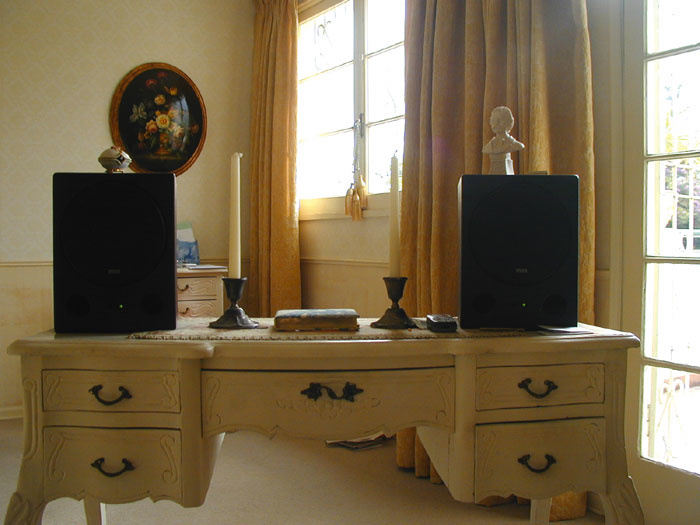 Everything is monitored through Uwe's Meyer Sound nearfields."I looked for eight or 16-bar guide grooves on Latin records and cut the sessions accordingly. It was a matter of looping the sample groove and then adjusting the audio by manually moving the notes so that everything was swinging in accordance with the loop. I also looked for bits and pieces in my library and combined them with the recording. I don't buy sample libraries, so they are all things I've collected over the last 15 years, some of which are fragments from the Akai S3000, although I occasionally use one of the standard Battery kits when I need a particular conga or shaker."
Not all the tracks easily lent themselves to interpretation in the Latin style. One of the most impressive songs on the album, 'Firecracker', was also one of the most problematic. "When the scores were written, I have to admit that I wasn't sure exactly what rhythm that should become," explains Uwe. "The melody didn't fit with any Latin style that I knew and there was a lack of time to think about it. When I listened back to the recording I figured it was too slow. The accent was a merengue but we'd recorded it at a cha-cha-cha speed. It didn't work at all and everything I tried sounded crappy, so I decided to make it faster, and that meant cutting it all, note by note. I never used time-stretch — every note was manually moved to its new position by dragging it along the timeline while the relevant section was looping. And I didn't use shortcuts like snap to grid to help me place notes; I just kept listening to it until I got it right.
"Aligning a note on the beat doesn't always work, because different instruments have different attack times. For example, if a baritone saxophone player has to play a long, deep note, which is difficult, it takes him longer to gather breath and hit the note, so he's always off-grid. You can't snap it to grid and get it sounding good, so you have to analyse how the instrument is played. I like to zoom in and study the Session on screen visually. You can see that the saxophone player is always late, but it sounds good, so I take a mental snapshot of the timing and that helps me offset each instrument when I start adjusting notes.
"I also decided to have it speed up as the song goes along, so it actually goes from something like 106 to 130 bpm! I managed to do that part quite well so it's not too obvious, which was quite hard on a digital processor!
"I worked on blocks of 16 or 20 bars at a time, and each one I mixed separately using very complex automation to change scenes and levels. There's was no traditional mix approach of having channels where you set the EQs and effects and press Start. For example, I usually bounce the effects, so there's no fixed send for them. I was mixing blocks and then joining them together, basically."
The Return Of The YMO
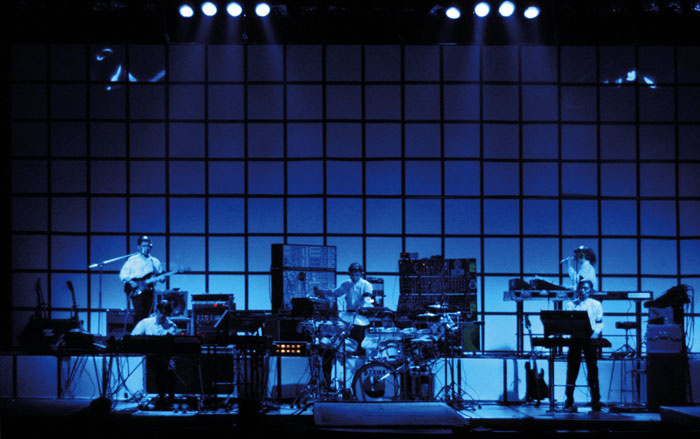 The Yellow Magic Orchestra in full flight. Not only is Yellow Fever! an album of Yellow Magic Orchestra songs, but it also features musical contributions from all three original members of the band itself. Having previously collaborated with YMO's Haruomi Hosono on two HAT albums, which were released on his own Rather Interesting label in Germany, and Hosono's Daisy World in Japan, Uwe decided to ask all three YMO founders if they would perform on Yellow Fever! "I've been in contact with Hosono for about 10 years, and with [Ryiuchi] Sakamoto for three, so the only person I didn't know was Takahashi," says Uwe.
"Once you know certain people who are involved in the Tokyo music scene it's not hard to get in touch, but I tried approaching them officially through their management, which wasn't easy because they are very famous people in Japan. I couldn't get any feedback, but we'd heard from some people who were working with them that they were interested in participating. During this time the album was progressing so there was becoming less space for them to participate.
"I asked each of them to play on the songs they'd written and provided a few choices. Sakamoto decided to play Rhodes on his song 'Yellow Magic', and that worked pretty well. We sent him a reduced six-channel production so he could find space and the mood. I asked Hosono to sing on 'The Madmen', and Takahashi to sing backing vocals on 'Limbo'. I left the mixing of those songs until last in the hope they'd be able to participate, and fortunately they sent the material with about 10 days to go. There wasn't much to do to the vocals aside from selecting the best takes, but I had to do some chopping of Sakamoto's Rhodes to fit it into the spaces within the arrangement, which was already very full."
Between each of the 10 YMO tracks on Yellow Fever! sits a curious musical interlude, typically featuring grainy sampled loops and guest vocalist contributions; as Uwe explains, this is also a nod to the original recordings. "I'd decided on the track order before recording, so I had a clear idea of how I wanted the songs to join together. There are, I think, two YMO records with interludes, so I was simply quoting that idea."
Breaking The Illusion
Although some sections of Yellow Fever! sound almost like a traditional band playing together, other parts are interrupted by deliberate sample triggering and looping effects, and even the odd electronic synth squeal. Uwe explains his rationale for using such devices within the compositions. "Each segment or section of a song called for a certain complexity. Very often the YMO achieved different moments in the song by switching sounds on the synthesizer, but that wasn't appropriate in my arrangements, so I had to either cut out certain sections where it was getting repetitive, or do a lot of trickery like go from an acoustic part into an electronic part, thin something out, or play with effects. Whatever I did depended on how difficult or easy it was to keep one's attention throughout the song. If I was listening to a whole song and felt that there was something missing I'd consider doing something like that.
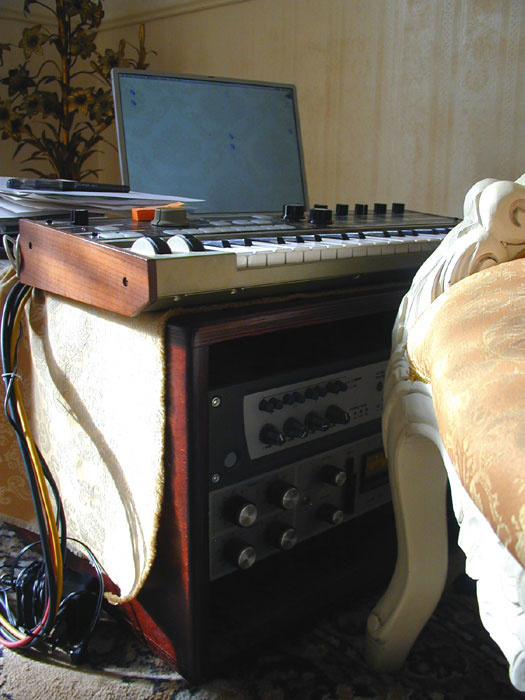 Apart from the Digi 002 Rack, the only outboard in Uwe's studio is a Urei 1178 compressor (bottom)."I also wanted a more eclectic sound than the last three Coconut albums. When I found it necessary for the flow of the part I would make the samples blend in, but in general that was not very important. I tried to adapt some of the new recordings to sound like the old samples using amp simulations, and vice versa. Sometimes a sample is obviously a sample, other times it's not. I wanted to play with that idea, so it's a bit like running through different historical moments of Latin music. The idea was not to stick with certain sounds but to emulate different sounds in different songs or sections of a song."
Part of Uwe's plan for giving Yellow Fever! an eclectic feel was to encourage vocal contributions from a variety of international artists, instead of using a single lead and fixed backing combo. "I asked other musicians to participate, and that gave me lots of little bits and pieces to deal with and incorporate. I emailed them little musical sketches, or sometimes only words, and they sent me their interpretation. Most of them stuck very closely to what I told them. They emailed it back to me and I combined it with what I had and what others had sent. One song features both Marina from Nouvelle Vague and Towa Tai, but they never heard each other's contribution. For me, one of the most interesting things was getting all the different parts and giving them coherency."
Mixing & Processing
Remarkably, the entire album was mixed on Uwe's laptop using a pair of Meyer Sound HM1 nearfields for monitoring, and a collection of Pro Tools plug-ins for processing. "I mostly used the Sony Oxford EQ and Dynamics for processing and the version of Amplitube that comes free with Pro Tools for effects," explains Uwe. "I didn't really use any delays other than for the odd little dub-style effect parts, but if there are any they will also be from Amplitube. Sometimes I used very cheap reverbs, like the D-Verb, which comes free with Pro Tools, and I used a lot of reverbs from Amplitube. Then there is also a bit of Waves Renaissance Reverb. I usually put two reverbs on each song; one small, close one and a distant one. I wanted the quieter instruments like the saxophone section to sound close and strong, and the loud instruments, like the trumpet and trombone, to be far away at the back of the room as if there was one mic standing there listening to them all. Having said that, I based the sound mainly on records from the '70s where some instruments were recorded together, some separately, then the reverbs were added afterwards to create a particular space. I didn't want to overdo the reverb so it's all relatively dry, and there are also a lot of unprocessed sounds in the mix.
"On the last three records, working from my sample libraries, it wasn't possible to give the same sound to a set of instruments, but having a well thought-out arrangement gave me a clear picture of how the band looked in terms of how many instruments there were and how they played, so it was much easier to imagine how each one should sound and where to place it in the virtual room.
"I mixed it down and did the pre-mastering on the same computer, but the final master was done in a separate studio in Germany. My pre-mastering is about fixing little bugs that are impossible to mend during the mix. Mixing a song may take a week or two so it's easily to get lost, and one's hearing adjusts to the sound of the song so you just don't know if it's too bright or dull. If you leave it for a week you realise what it is like, but going back to such a complex patchwork of a mix to fix it is impossible so I prefer to do it in the pre-mastering. By listening to all the tracks in a row I can hear the mistakes, so I balance all the songs using a touch of EQ and Waves' C4 multi-band compressor to make it a bit more even."
Recovering From The Fever
Uwe admits that making Yellow Fever! was much more difficult than El Baile Aleman, summing up the editing process as "very anal and obsessive"! As yet, no other Coconut projects have been planned and Uwe is enjoying a well-deserved rest. It does seem certain through that, having achieved such an impressive result with his newly perfected recording and editing process, there will be more to follow.