

 Photo: Richard Ecclestone
The idea of bringing folk music up to date is not a new one, but few people have taken it quite as far as Jim Moray. His material may be traditional, but his approach to music technology is as modern as it gets.
To some, he's breathed new life into a stale folk scene. To others, he's a vandal whose approach to our musical heritage will have Ewen MacColl spinning in his grave. Either way, there's no denying that Jim Moray's take on British folk music is a pretty radical one. His first album, Sweet England, saw him framing traditional ballads in an elaborate web of Marius de Vries-style orchestration, electronic percussion and heavy metal guitars. The follow-up, Jim Moray, replaces the florid orchestral arrangements with an equally startling indie-rock slant on things, and was released on May 1st this year.
"I don't think you get up in the morning and think 'I'm going to do something really innovative,'" insists Jim, when asked how he ended up taking this particular musical path. "You just do what comes naturally. I don't think what I'm doing is particularly revolutionary, it's just playing the songs in the way I want to play them. There's a lot of things that are present in traditional music that really get me going, but there's a lot of things that annoy me, and there's a lot of things that I miss from other music that I like, so it's trying to make a big pot of all the things that I like."
So why has his music upset so many in the folk scene? Partly, it's the scene itself ("Folk music thrives on being very nice, and everyone liking everyone else, but in a way that's not really true"), and partly it's his carefree attitude towards the songs. Jim Morays sees folk songs not as sacred relics, but as creative launching pads for his own musical and lyrical ideas; many of his tracks are not so much recordings of the traditional songs, but new songs that build on fragments of old ones. "A lot of this new album has been taking four lines from a traditional song and then writing another eight verses of my own. I use the original tunes quite a lot, but the original tunes are quite bendable, and also, a lot of them are related to each other. There are a lot of similar tunes that you can mix and match phrases from, and I do quite a lot of that. In a way, that's the most traditional thing you could possibly do. That's what traditional music is, it's not rigid or set in stone. The idea is to put your own spin on whatever's there. English folk music is my cultural heritage, it's like a gift that's been passed down, and it's as much my right to decide what I do with it as it is anyone else's to not like it, or to do their own thing."
Variety Show
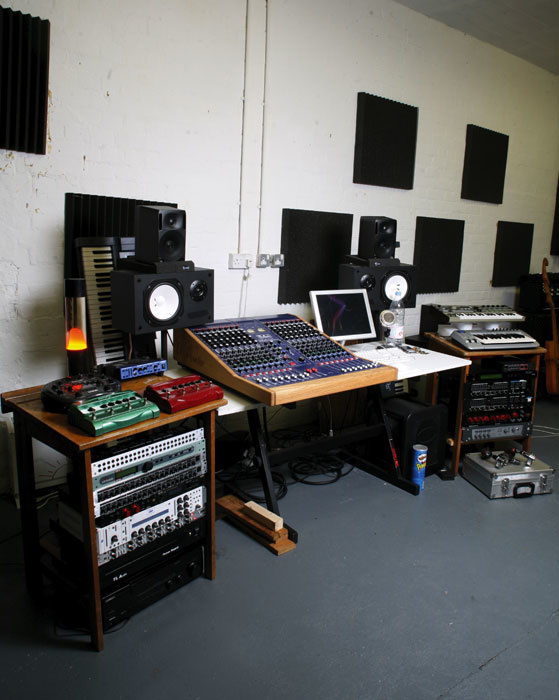
 Jim Moray's Bristol studio.Photo: Richard EcclestoneThe new album was written and recorded over the course of 18 months at Jim Moray's large Bristol studio, which is home to an impressive and sometimes oddball selection of instruments and recording gear. He plays most of the instruments on his albums himself, including drums, keyboards, guitars and basses, and he's very sensitive to the possibility of relying too heavily on any one thing. Most of the first album was written using Logic as a songwriting tool, and in many ways the rockier feel of the second is a reaction against this. "The first record was a lot more based around the backing, and the problem with that is that when you strip it down, the song disappears. If you try to play it on an acoustic guitar, the song evaporates.
"If you write on guitar in standard tuning all the time, you fall into familiar shapes and patterns, and you get stuck in a bit of a rut of playing your favourite chords. If you try writing on another instrument, it quite often opens everything out, and it's got a bit like that with the computer for me. I don't tend to write as matrix-based tracks, it's all as staves, so I go 'Right, I'll start with four-part strings,' and then you end up writing all the same notes. So I've done quite a lot of writing recently without an instrument at all, just trying to sing or hum, focusing on the melody and letting everything else come later."
 Some of Jim Moray's guitars, including a custom Atkin acoustic (right) and 'violin' bass (centre).Photo: Richard EcclestoneAs you might expect, there's rarely a clear distinction between writing and recording in Moray's studio. "A lot of the stuff on my albums is orchestral-based, or programming-based, or comes from a tiny little sound. On the first album there's a song called 'Two Sisters' that's all around a loop — it was the end of a guitar take; after the take had finished I accidentally hit a harmonic and muted it. I cut it out and then looped it and it took on a life of its own, and then when it was time to do other bits, the song was there and I was adding to it, just doing overdubs. I quite enjoy those afternoons when you're trying to make a sound, but you've no idea how, so you're playing a radiator with a contact mic on, or scraping a mug across the bristles of a brush.
"When I first started recording stuff on four-track, I had a Yamaha keyboard with an inbuilt sampler, which had really grainy-quality sampling. What I used to do was record myself singing and my playing as parts, and I still do that a lot with EXS24: sample things in and make my own patches, rather than just using generic ones. There's quite a few things on the album that are sounds I've recorded on Minidisc or Dictaphone, transferred into EXS24, looped and used as a sound bed — at the start of the song 'Nightvisiting', there's a sample of some children in a playground, and I've just fiddled with the pitch-bend. Generally, I often use instruments as sound generators, like the upright bass — if you bow it, you've got a pretty pure waveform to stick plug-in effects on. I quite like combining effects in a different order to make something new, like delays where you plug the return into a pitch-shifter and every time the delay comes around again it's gone up a tone."
Orchestral Manoeuvres
"I use a lot of the East West Symphonic Orchestra Gold Edition, for mocking up strings and brass — about a third of the stuff on the album is from that rather than real players. Sometimes it gives better results than real players: if you've got something that needs really precise repeatability, it's very good, but there's a bit of an art to programming those things."
 The 'stick' electric double bass, played through a hardware Auto-Tune unit, is often doubled with a Hofner violin bass.Photo: Richard EcclestoneThe real orchestral parts are one of the few areas where Moray hires in other people to play, but his method owes a lot to the sequencer-based approach to recording. "I tend to put the orchestral parts on quite early, because the way I do those parts is quite indecisive. Rather than doing the arrangement and getting it all right on paper, then overdubbing it in an orchestral session, what I tend to do is write out bits that I know I want to be in there, and I put them on separate pieces of paper as eight-bar sheets. I get the string players in and physically conduct them through all the bits, but they can't actually hear what they're doing, they're just playing all these little eight-bar bits. So I'm almost making my own sample kit for each song, that I can then cut out and put in a different order and mix and match sections. I kind of make my own phrase kit for each song, and then sort out the arrangement on the computer afterwards."
The method might sound haphazard, but, as with many of Jim Moray's unusual ideas, there are sound reasons for doing it this way. "It's a lot easier, and also you tend to get one really good performance of each bit. There's something your ear latches onto. If I, for example, have a rising movement in the first violins and the cello is holding a note, what I can do is take those violins and put a different note underneath them, and they're looping but the rest of the strings are moving. It gives this kind of symmetry. What I like about electronic music is the repeatability of it; there's something hypnotic about it, and I think that applies as well to really good orchestral playing, but I'm generally working with people who have never seen the music before.
"With production, the job is to get the best possible performance out of people without them knowing what you're doing. So with strings I tend to not come clean about what it is I'm trying to achieve. I just tell them what's right and try to give them pointers. I usually do four takes of a quartet, and sometimes extra cellos, and I usually do double-bass myself, here. I find that if the bass is out of tune or out of time, that's the thing that has ruined a lot of tracks for me. I don't know if you have ever made a demo and you can't work out what's wrong with it, everything's there but it just doesn't work? I've found that when I've gone back with a more critical ear, it's the bass end, so I tweak the timing and the tuning... I use a stick electric double-bass. I've got a rack Auto-Tune unit, because I'm not a double-bass player, but it's great for bowing. You can even distort it and compress it a lot and it sounds almost like a triangle-wave synth.
"A lot of tracks on my albums don't even get a bass guitar, but when they do it's this one," he says, indicating a copy of a Hofner violin bass. "It's a lot less boomy, you get a lot more plectrum attack and it doesn't get in the way so much. I usually have a sustained note on the double bass and I'm doing a rhythm underneath it on this."
Tuning In
 A Variax in disguise.Photo: Richard EcclestoneOne of the many interesting features of Jim Moray's music is his guitar playing, which combines the sort of sound palette you'd expect in modern rock music with chord patterns and tunings drawn from folk artists like Dick Gaughan. "This album has been a return to standard tuning, a bit, but I still used about 10 different tunings for different things," he says. "The folk style of guitar playing has always been about alternate tunings, so I grew up trying to emulate that, and because it was easier, I transferred over to electric guitar, still taking the tunings.
"I change strings a lot, because if you get the gauges of strings right for alternate tunings it just sounds a million times better. What you're trying to do is keep the string tension the same as it would be for a standard set, generally, because you lose sustain and you lose a lot of tone when you have a floppy string going 'bong'. I try to match the tension as much as I can so all the bends come off exactly the same, and when you hit a chord there's no one string that dies away before the others. Also, if you palm-mute parts, some notes will ring out and some won't if you've got them all at different tensions.
"You end up changing a lot of strings, and I do a lot of changing halfway through a song, as well, so for live I use this [Line 6] Variax. It's a home-made job: Variax guts inside a Japanese Telecaster with an early '80s Japanese Strat neck. The Line 6 guitars are all a Fender scale length, so you can actually take the neck off and bolt on whatever neck you want. I'm still tidying it up — these are just the tops off pickups, cut with tin-snips and glued on! I tend to leave it on one pickup sound, so it's got a Telecaster sound, but I change all the presets to be different tunings. Before this, as I can't take this many guitars to gigs, I used to use a Roland VG8 system, which had more latency. I did have one of the acoustic Variaxes, but I didn't get on with it very well, I think mainly because I've got some very nice hand-made acoustic guitars, and I wanted it to sound like those!"
Keeping Music Live
Although Jim Moray's studio space would probably be large enough to swallow the average home studio four or five times over, he's chosen to keep it as one large and very live-sounding room rather than build partitions, booths or a control room. "Here isn't actually the easiest place to mix," he admits. "I have, before, put up duvets hanging off mic stands and so on, which helps a lot, and I check things on headphones. I'm quite used to the room, because it's quite live, and the reason the foam is there is because it's just the right amount to make drums sound nice. I did a bit of recording orchestral stuff, sending it back out through PA cabs and re-recording it — this room just glues everything together in a nice way. A good rimshot on the snare drum makes this room sound really nice. The way it projects down the room is just perfect."
 "This is a Fender electric mandolin from 1966. I think they made them and gave them away as a set with Strats from 1966. I tune this to my own tuning. Instead of being in fifths, the bottom three strings are in fifths and the top is a fourth. It's quite good for overdubs, little twinkly things."Photo: Richard EcclestoneSome people would automatically expect to use a dead-sounding recording area for vocals, but Jim is happy to exploit the sound of his room. "I don't put up any trapping or anything, it's just a BLUE Kiwi mic in omni mode, so I get the whole room. I ride the levels fairly early on, and if you do that early, you can get the rest of the instruments to fit around the vocal. When there's loud bits, if you record in omni mode, the room really comes out at you. I'm quite a fan of that swamped-in-reverb sound — all the strings are like that — but for vocals, there's a UAD1 plug-in called Reflection Engine, which is almost a slapback thing, but more subtle than a delay. I also use tape delays, some from the Line 6 DL4 and some from plug-ins. I try to use delays on vocals, to keep them fairly up-front but with some detail on the edges. I don't usually double-track with my voice: my voice just doesn't seem to take to it. I double-track a lot of harmonies, though, to the extent of doing six or seven different harmonies with four or five takes of each.
"On this album I've gone really big on Soundfield miking. It was an eBay purchase which I'm still learning how to use; sometimes you almost don't need to do anything — you could just hold it in your hand and it would sound great — and sometimes it sounds abysmal. I've gone really big on Mid & Sides miking, so all the guitars were done like that, and all the drums. What I tend to do is use the same BLUE Kiwi or a TLM103, at head height about four or five feet in front of the kit, and then I've got a little Beyer ribbon mic. I got a hypercardioid ribbon and a figure-of-eight ribbon as a set, but for some reason it works a lot better with non-matching mics, so I use the ribbon as the figure-of-eight for the Sides, and then a mono mic which I move about to get the best sound, and that's my main Side mic. The mono mic goes through the Liquid Channel, using something quite distorted and sucky — one of the Universal Audio channels, or driving one of the Neve simulations really hard, so you get it not distorted, but quite excited and crushed. Then I roll a lot of the bass off the Sides, and they go quite high in the mix, because with M&S your width control is the Sides level. I have quite a lot of those in the mix, but they just tend to get the cymbals and the top end of the snare; that gives the width, and then you've got this massive, thick thing down the middle. Generally all I have in the mix is the Mid & Sides mics, the kick mic and a bit of top snare mic. I hit drums quite hard when I play, though, and sometimes it can get a bit overpowering if you use just the top mic — you get too much of that tubby thump and not enough 'crack' from the bottom, so I'll sometimes blend those.
 "I bought this Yamaha CP70 piano to use at gigs, but that was just a ridiculous idea. I've modified it quite a bit. It's got a piezo pickup under each string, and they're chained together and output to a jack and then to another preamp that I had made, but I need to get it built back into the case. It's characterful and it's on quite a few things on the album, but it can be temperamental."Photo: Richard Ecclestone
"Then I use an Electrovoice RE20 inside the kick, just off centre, and I've got the same mics I use for drums live; they're Electrovoice ND408s with swivelling heads. I have these rim-mounted. We did a tour with films, and I wanted the drums to be quite low-profile so that we didn't get a shadow on the screen. Instead of overheads we kind of had 'underheads', clipped on the cymbal stands facing up. You tend to get more cymbal than drum that way. It's nice and crisp."
Jim's other mic placements are also often unconventional. "I tend to use a Sennheiser E609 on [electric guitar] cabs, hard against the grille, or the EV ones again, or possibly an SM57. SM57s sound really nice, but I just tend to use other things — I don't know why. If you've just got a three-piece guitar band you can quite often stick an extra mic somewhere, say underneath the ride cymbal, to open up at a certain point, like a chorus or a middle eight or something, and then bring down again, and it makes the drums breathe a bit. I've got a couple of '57s that I tend to put in random places for things like that.
"Acoustic guitars I do either with the Soundfield or with the Mid & Sides arrangement. I tend to mic them the length of a string away from the mid-point — quite far off. When I went into the BBC for the first time, they miked my guitar in this particular way that sounded amazing, with a U87 about four feet away, pointing at the bridge, and another at right angles to it, looking down the neck at the nut. Those, panned 25 percent left and right, sounded really nice. The guitars on a song called 'Barbara Allen' were done like that, tracked up four times, with every other take panned the other way, so you've got two right-handed guitarists and two left-handed guitarists playing it, and it makes this big, solid, happy, thick, bright sound."
 Jim's TLA M4 tube mixer is used in conjunction with mixing and automation in Logic. "I use it for mixdown, but also quite a lot for sends. I like to print effects so that you can play them in real time — sending the signal out to loads of delays and turning knobs in real time — and quite often I do rides by sending out the signal, doing a ride of a vocal or whatever through the desk, and then printing it back into the computer. I like the idea of a mix being a performance, but I also like total recall, and that seems the best of both worlds."Photo: Richard Ecclestone
On Your Own
So far, Jim Moray's musical career has been a one-man show, at least as far as recording is concerned, but he's painfully aware of the limitations that brings. "To be honest, I think saying you produce yourself is a bit of a misnomer. I don't really think you can produce yourself. Production is buoying people up, setting the mood. It's making everyone feel at ease, so that it just comes out and you haven't had to do anything, but you can't really do that if you're the artist as well. I think 90 percent of what I do when I'm producing other people is talking to them, making them cups of tea, making them feel comfortable, and picking the right moment to say 'Do you want to do some vocals now?' That's when you get good stuff, and that's possibly the thing I'm a bit hesitant about on my own records. They don't always have the greatest performances, because no-one coaxes that out of me. I had some help with vocals on this one, from a guy called Grant Showbiz, but in general I engineer my own stuff and make the decisions. It's a lot easier that way, but I wish I had somebody to get the sound, so I could concentrate on singing.
"Next time, I'll hire a really good engineer for eight weeks and spend eight weeks making the record. This one's taken me 18 months because I've recorded, thrown away, recorded more bits, thrown them away, had a tantrum and erased the disk, and you never quite know when it's finished. The last record was mixed by Simon Emmerson and Mass in London, and I was there mixing it with them, but this time I spent so long and so much money making the album that when it was time to mix, I couldn't afford to get anyone else to do it. But I had the gear, and I thought 'Well, I guess I've got the time to teach myself to do this,' so this whole album's been a bit of a learning curve, engineering-wise. I think I'm quite pleased with the work I've done."