


Writing music for picture seems like the ideal career. You get to work in your studio for a living, you can earn good money, and there's so much potential work: action films, travel and nature documentaries, romantic comedies, cartoons, low-budget sci-fi, even breakfast cereal ads. But how do you break into this lucrative world?
I'm sure this isn't just true of those who write music to accompany moving images for a living, but I admit that if I'd known what I was getting myself into when I decided to try to make my career in this field, I'd have given up on the idea (and, in my case, gone straight back into IT consultancy). Over the years I've been writing music for picture, I've been asked many times how to break into this line of work, and always, my simple advice is 'don't do it!', simply because it would take far too long to convey the finer detail of just how awful — but also just how rewarding — such a career choice can be. Over the course of this series, I hope to be able to make some of these finer points clear, so that you can make your mind up for yourself whether it's for you. You'll find plenty of tips and tricks of the trade here, some straightforward, some technical and even some to do with your emotional attitude to this kind of work — in my experience, this is an important aspect of the job that is often overlooked. Of course, this series isn't designed to provide exhaustive advice on how to be successful in this field, nor is that even possible — there is no one path to achieve that, any more than there is in the music business. But after reading what I have to say, you might at least have better advice available to you than I ever did.
When I was asked to write this, friends joked that I'd be telling everyone how to do it, and thus do myself out of a job. Well, not really. You might think that anyone can do it — like driving a car. In response, I'd say that while lots of people drive cars, few of them earn as much money as Michael Schumacher from doing it, and it's similar with music-for-picture work. Just as the man in the Ferrari shirt got where he is today by being blessed with instinct, drive, ambition, confidence, self-belief, natural ability and a fair amount of luck — qualities that not everyone possesses — not everyone is destined to make it as a wealthy composer of instantly recognisable film themes.
Commitment is a word that sends many musicians running, but if you're not putting in your all in this job, you're not trying hard enough. You'll frequently be called upon to put your heart, soul and bank balance on the line simultaneously, and then expect to lay your sanity next to them. I would be doing you all a disservice if I didn't tell the truth, so that's what you'll get here. But then nothing in this industry is easy, or everyone would be doing it; there will always be a cost, be it personal or financial.
Who Am I To Tell You All This?
What gives me the right to tell you the best way to forge a career in music for picture? Well, as you won't be surprised to learn, that's been my chosen path for the last few years, and much of the information and many of the stories that you'll find in this article are based on personal experience, although some of them also come from colleagues and friends, many of whom are far better qualified than I. I might not be as high up the ladder as some of them, but I have been fortunate to make it further than many. I was very lucky in my first few years to bag two film scores before I'd done anything for TV. These breaks had little to do with skill, however, more youthful naïveté — and I made some huge mistakes and other errors of judgement that with hindsight could have been avoided.
Ill-health pushed me out for a couple of years, and circumstances demanded I find a sensible job. IT consultancy beckoned, and I joined the massed ranks. After another couple of years of enjoying the money, I realised I was hating every moment of it — Ionian and Aolian modes are one thing, TCP/IP and IPX/SPX are quite another. At around that time, though, I was lucky enough to meet a lady (now my wife) who was adamant that you should follow your dreams. She'd been on the corporate treadmill for years and was likewise heartily sick of it. With her support, I was able to once again turn my back on IT and return to what I really wanted to do. I might not have started working with Spielberg yet, but I've come further both professionally and creatively in the past three years than in the six that went before. From a battered showreel and outmoded equipment, I am now once again up at the cutting edge, and working with three production companies. The beneficial effects of emotional, as well as financial support should never be underestimated in this line of work!
Married To The Job
Firstly, it's almost impossible to pursue a career in TV while holding down a regular job. There simply aren't enough hours in the day, and if you do get the chance at a pitch or even a commission, you'll have to come up with the goods in a ridiculously short space of time. There will be no time to go to work; you'll have to drop everything and work instantly. Writing music for picture is not like being in a band — you don't gig at night and work by day, and moreover, you certainly won't have six or 12 months to deliver a finished album. It's sometimes more like 12 hours!
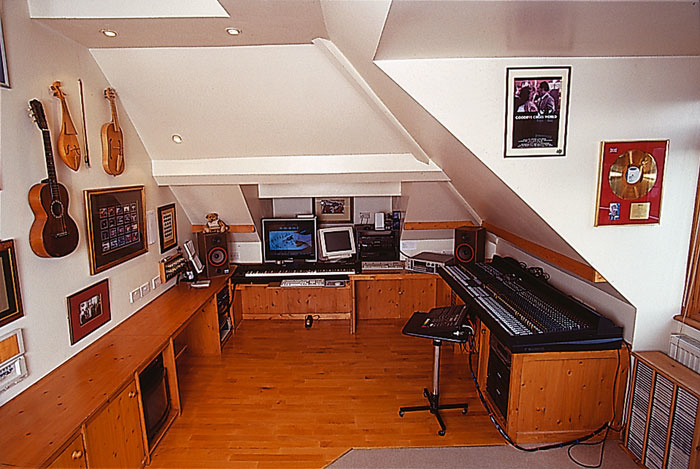 Of course, you'll need some gear to create all this music with, and there'll be more on what exactly you're likely to need later in this series. But not everybody's music-for-picture setup can be as sleek and lovely as that of well-established music-for-film composer Barrington Pheloung (above, as it looked in 1999)...If you think I'm exaggerating, here's a real-world example. I got wind of an upcoming TV series last year, and when it went into pre-production, I approached the directors and the producer and put myself forward for consideration. I was asked to submit a showreel, plus a couple of ideas for the series. Everything went silent for six months, the shooting date came and went, and I assumed I had been unsuccessful. Then out of the blue, I got a call telling me a draft was on the way, and asking if I could write several cues to pitch for it — by the following Monday.
I'm used to this kind of thing, but this one was a shock nevertheless — it was Friday, and eight days before my wife had given birth to our first child, so to put it mildly, my mind wasn't on the job and I was exhausted. However, this is the life I have chosen, so my wife was literally left holding the baby, and I shut myself in the studio for four days. In that time, I had a grand total of six hours' sleep, but on the following Monday, the pitch was on the director's desk as promised.
You might think that doesn't sound too bad — we've all stayed up through the night working on mixes we desperately wanted to finish, haven't we? However, bear in mind this was purely for the pitch — I hadn't signed any contracts, and there was no guarantee of getting the commission. And of course, no-one ever gets paid to pitch. My wife was off work caring for the baby, too. It's not exactly a life replete with financial security...
Here's another scenario, one all too familiar to me. You're beginning to make a name for yourself and the work is coming thick and fast. Ther next few months look good, because Commission A is in February, B is in March, and C is in April. But then Commission Z runs over from January, and you have to work like lightning to get A done on time. And then B is delayed, but C is brought forward. Come the end of March, you have two production teams breathing down your neck at the same time... and the money from Commission Z still hasn't come through — much less A, B, or C!
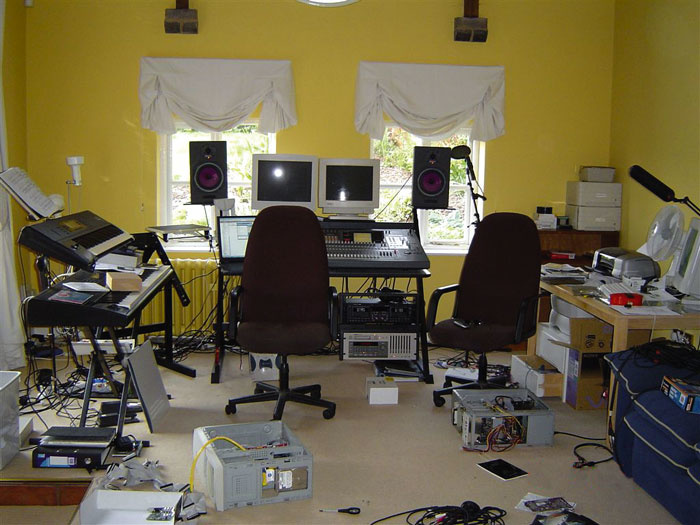 ... the author's rather less beautiful setup is more like the kind of thing you're likely to be working with as you try to get your career off the ground!With time pressures like these, you can see why hanging on to a day job is next to impossible. But what about the financial pressures? If you're like most of us, you need the money from your day job to survive. How do you pay the bills when no one is paying you? The days of understanding and supportive bankers are long gone, so don't expect understanding when you ask for help from them.
It's something of a catch-22 situation — you can't get the work without being prepared to commit the time most people devote to their nine-to-five, but without the salary from a regular job, you won't be able to support yourself and your dependents, if you have any, much less buy gear or support a studio. I'm afraid there's no easy answer to this one, and what suits one person won't work for another. What's more, it's hard to say "I'll try it out, and if I don't make it in six months, I'll go back to my old job." You'll be forever telling yourself that the big break is just around the corner. And even when you get work, it doesn't always lead onwards and upwards. I got lucky and scored my first film at the tender age of 20 — but then I didn't get the chance to do another for two years!
One possible middle way is to take one job — a part-time one — to fund the other. For example, if you're a trained musician, you could take a peripatetic teaching job. For those like me, with a background in IT, a sales job in a PC shop (even PC World!) or even better, a part-time post as an IT consultant could give you a little something to keep the roof over your head. And you may need to tighten your belt — give up smoking, and have fewer takeaways and nights out on the town. Whatever your vice, the money has to come from somewhere.
Gear Doesn't Grow On Trees
And of course, if you're reading this magazine, it's unlikely that you compose on a ukelele and an ocarina, with a stack of manuscript paper and a pencil. What about your studio gear? Do you have the right gear to compose film and TV music? You're probably going to have to update a few things, and of course that costs money too. For example, if you're called upon to create the soundtrack to a documentary about life on a remote Pacific atoll, you're unlikely to have the director's required indigenous instruments to hand (or the knowledge of how to play them). You're going to need sample libraries, and good ones at that — and they don't come cheap. And supposing someone sends you a draft of the documentary on VHS — are you going to be able to lock that to your sequencer? The chances are you'll need a synchroniser and all the cabling to go with it. This kind of expense soon adds up.
Working For Nowt
To add further to your financial woes, when you're trying to get a career in film and TV music off the ground, you'll often find people asking you to work for nothing. But before you turn such an offer down in disdain, stop and think. At this stage, getting something on the CV is more important than the potential reward. The chances are that if there's no budget for music or anything else, it's probably a student film or charity corporate video.
Ask yourself one simple question — what's in it for you? If no one is ever going to see it outside the Student Union, and you have nothing better to do, do it. After all, it's good practice. And if the film's going to a festival, and a big one at that, then you'd be mad to turn down the free publicity. On the other hand, if the film-makers have the funds to get it that far and they're touting shiny cameras, you might want to enquire why they expect you to work for love alone...
Whatever you decide, make sure you get something out of it, be it practice, exposure or expenses, if nothing else. Also, look at the number of film and TV directors who always work with the same composer. The simple reason is they're mates and work well together, and the best way to forge such a relationship is to get in there early. If the budding Spielberg goes places, the chances are that he could take you along with him.
Money Matters
When you hear of some of the fees commanded by top composers for music-for-picture work, it may sound like easy money, and conjure up fantastic ideas of what a lazy, well-paid life they have, but when you break it all down, you begin to realise that there are some philosophy students getting better wages at fast-food outlets. To prove what I say, here's a breakdown of a typical project, based mostly on experience and fees from real jobs.
Imagine you've been commissioned (a whole job in itself, and a part of the process we'll look at in more detail later in this series) to write the music for a TV series involving sailing, set on rivers and at sea. It comprises four episodes of 56 minutes each, with 28 minutes of music per episode, including the series theme and cutaways. That's 112 minutes of music in total. Your budget is £2500 per episode — but you only have four weeks to deliver the goods. This kind of timescale is entirely typical — in fact, if anything, it's rather more time than you might be given!
EPISODE ONE
With one week to get this part finished, and by limiting yourself to an hour's sleep a night, you work 161 out of a possible 168 hours, and you need to buy two sample libraries of suitably nautical musical instruments and sounds at £350 and £500 respectively.
EPISODE TWO
You're getting the hang of the job, but it's still hard going grabbing two hours' sleep a night. You work 154 hours this week, and you need to hire a session guitarist for 20 hours to play some parts in the series theme and incidental music. That sets you back £700.
EPISODE THREE
You're in full swing now, but schedules are pressing, so you work 154 hours this week.
EPISODE FOUR
Disaster — your computer blows a fuse, the PSU dies and takes your dual hard drive array with it. Somnambulism gets you through the week — you work 166 hours. Oh, and the director loved the guitar and wants more, even though you thought you were finished with the session guitarist. You hastily rejig your score, write new parts for guitar, and call your man back in. A new PSU costs you £60, replacing your two hard drives and controller sets you back £470, and the guitarist is a painful £1400.
FINAL ANALYSIS
Congratulations — you're done and dusted on time, and now there's a cheque for £10,000 on its way to you. But if you break down the time and money you've spent on the project, it doesn't look quite so rosy. You've earned 10 grand, but spent £530 on new equipment, £850 on necessary samples, and £2100 on a session guitarist. That leaves £6520. And if you divide that by the total number of hours you worked (635), you realise that you've earned just over a tenner an hour. Or, put another way, just over £58 per minute of music.
Doesn't look so great, now, does it? And that's before you've hired an arranger or psychiatrist to get you through it! That's also assuming a few hours' sleep a night, and sometimes you won't even get that.
But surely these figures aren't typical? Well, obviously, not every job is paid like this — rates vary with your experience and according to what the programme-makers think they can get away with. If you want a rule of thumb, the chances are that if the job is important, high-profile and will do wonders for your career whilst being a monumental undertaking, you'll be paid in play-dough and string. The mad world of the media being what it is, things can also work out the other way, whereby you land a job bodging together hackneyed rubbish that's only ever shown on Serengeti TV at 2 o'clock in the morning, and are showered with gold for it — but please, don't count on it!
Family Affairs
It's not just the financial aspect to this life that you may find unsettling. If you have family or other dependants, what about them? Opportunities for sleep are few and far between when you're struggling to get a commission finished on time, and when you come out the end of it, you'll have a mountain of chores and duties to fulfil before you can put your feet up. And if there are children to care for, how is your other half going to cope while you're locked away trying to work out why your sequencer's lost sync with the video for the third time that day? When you've finished, and all you want to do is stagger upstairs and collapse into bed, they'll be needing help, as they'll have done nothing but wash, cook, clean and child-mind (and possibly hold down a job of their own) since you disappeared into your studio.
Imagine another scenario. You've booked a holiday somewhere, and the night before, or the morning of departure, a possible job comes up. Do you take it or leave it? Logic would dictate you step on the plane, but if you turn the client down, they may never ask you again. Can you afford to take that risk? Fix in your mind your reasons for trying to make a career of this — is it for love of music, love of money, or is it just a job? Frankly if it's any of those three, I'd advise you to stop wasting your time. You'll be asked to write styles you hate, and the money is risible until you're four rungs up the ladder. And if it's an ordinary job you want, why are you still reading this article?
 If you're asked to write music to accompany documentaries about far-flung corners of the Earth at the beginning of your career, it goes without saying that you won't have the budget to record nose-flautists of the Kalahari in their natural habitat. Fortunately, that's what 'world' and 'ethnic' sample collections are made for! You may be seeing a lot of discs like the ones shown here...Whichever way you look at it, it's got to be worth it. Speaking personally, I could no longer conceive of doing anything else — but that doesn't mean there aren't days when I question what it's all for, and if it's really worth it!
Feedback Welcome?
Now, have you ever played back one of your own compositions and sat back thinking "my goodness, I'm a genius!" only to feel utterly deflated when someone picks holes in it? Out in the world of film and TV composition, it's a hundred times worse. You won't usually have the time to polish tracks as much as you'd like — it often feels as though there's always a courier waiting on the doorstep to take your finished masters to the dubbing stage. And worse still, you'll rarely, if ever, get any feedback. Granted, if you get the commission, then clearly you were up to the job. However, I can count on the fingers of one hand the times I've had feedback on a showreel — usually it's "yes, here's the job", or absolute silence.
If you're a sensitive type, this silence can be soul-destroying. You never know if it was something you did or didn't do, or because of other factors. These might include someone being better than you, the company liking your work but needing something in a slightly different style, which someone else was able to provide, or the director's cousin's sister's former roommate pitching at the same time as you! It might even be down to your CD not having turned up in the right place at the right time. Of all these possibilities, only one can be ruled out to everyone's satisfaction — Royal Mail Special Delivery was created for a purpose! The rest is up to you to overcome...
Support Issues
It's a life of ups and downs. Just imagine; you've canned your day job to make a go of music, stuck your neck on the line, got a pitch and then heard nothing. The company doesn't answer the phone, and the only calls are from the bank saying they won't extend your overdraft. It's got to hurt, and it does. Who's there to catch you when you fall? Emotional support is crucial, and you'll get nowhere without it. To mangle the famous phrase, behind every successful composer is a caring friend — and it doesn't matter if that person is your significant other, a parent, or just a mate. If you know someone who's trying to make it in the same game, they can be the best help of all — when you witter on about ego-crazed directors, equipment woes or composers' block, they'll understand better than anyone!
I'd love to say that it gets better with time. Well it does and it doesn't. If you're prone to worry, that trait is only going to get worse, and only care and support will keep you on your feet. On the other hand, if you're so laid back you're horizontal, then you don't have a hope of seeing it through — quit now, while you're ahead.
Still Up For It?
Thus far, I have hopefully scared and excited you in equal measure, and with a bit of luck, some of this will serve to keep your feet on the ground over the coming months. Still up for it? What part of "Don't do it!" didn't you understand? Still with me? Then read on next month...