

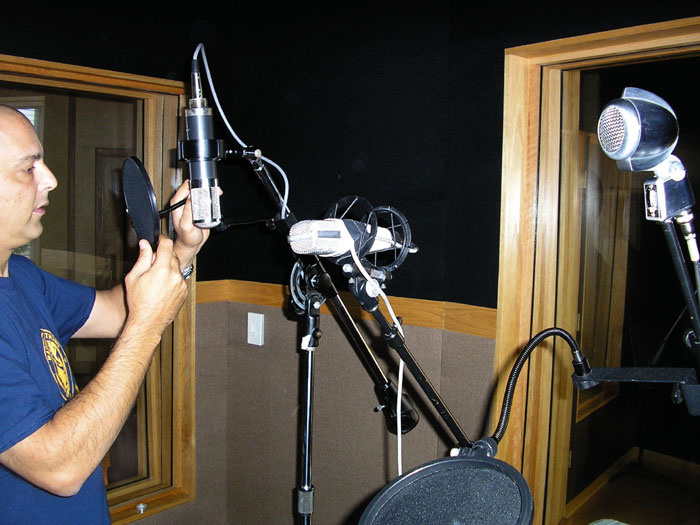
 Toby Wright puts the finishing touches to a mic array for vocal recording. Left to right: an original custom-made Soundelux U95, a Telefunken (not Sennheiser, though they are identical) 421, and a Shure crystal mic dating from around 1942.
He took an unusual and unhurried career path, but Toby Wright has helped to create some of the most influential hard rock records of the last 20 years, including Metallica's definitive ...And Justice For All, and is now one of America's most sought-after engineers and producers.
Patience is a virtue not in overabundant supply in the music businesses. But when it's allied to a large amount of native talent, as it is in Toby Wright, it can make the difference in forging a lasting career. It was patience that led Wright to start his career as a maintenance engineer, rather than seeking engineering gigs straight away, when he landed his first job at New York's Electric Ladyland Studios in 1979: "I figured I was going to be around for while, so I bided my time, learning and listening."
It's an unusual statement, and an unusual way of looking at the world when you're 18 years old, as Wright was, when he entered the professional audio programme at the Institute for Audio Research at New York University that year. But patience would pay dividends; within a few years he was assisting on sessions for artists including Kiss, Damn Yankees, Sammy Hagar, Heart, Michael MacDonald and Cheap Trick, with producers such as Ron Nevison and Mike Klink, and two decades later would be the producer and/or engineer for records for Alice In Chains, Machine Head, Metallica, Tantric, Third Eye Blind, the Wallflowers, Fishbone, Korn, Primus, Sevendust, Slayer and 3rd Strike. It would become a career worth waiting for.
While attending school, Wright and his roommate were sitting around one afternoon, plinking out songs on the guitar and drinking beer. "I remember saying to him 'This is retarded, we need jobs,'" Wright recalls. So they picked up the Manhattan phone directory, with Wright starting at 'A' in the listings for recording studios and his mate starting with 'Z', and each working towards the middle. They cold-called studios for two days. Wright got as far as the 'E's, landing a job as a runner at the famous Electric Ladyland for the grand sum of $5 a day. His friend took a bit longer to hit paydirt, working back all the way to the 'P's before getting a similar gig at Power Station.
The low pay was understandable: pro audio schools were still in their infancy then, and studio owners almost universally derided them as not preparing graduates for the real world of music recording. "They tended to focus a lot on electrical theory," Wright remembers. "But we did get to work on big Neve consoles and there were a lot more Class-A electronics floating around then. There were no computers, but the Neve was fitted with one of the earliest versions of the NECAM automation, which was before Flying Faders. That prepared me pretty well to work on the Neve 8078 in Studio A at Electric Lady."
Once A Maintenance Engineer...
Although he had been employed in major studios for the best part of a decade, it was not until he engineered Alice In Chains' Jar Of Flies that Toby Wright's career behind the desk really got going, and he secured management with the Lippman agency. "It was around this time that I really began to think of myself as a producer," he says. "I started letting go of maintenance."
Or at least he tried to. The music business has always been big on pigeonholing and categorising people and music, and engineers are not immune to that phenomenon. When most people have known you as a maintenance engineer, you are a maintenance engineer and always shall be in many minds. "It was a hindrance at first," Wright agrees. "People can be very closed-minded about things like that. But I went back to the philosophy that got me into engineering in the first place: if I can fix it, I can work it better; if I can work it better, maybe I can be more creative with it.
"Roy Thomas Baker once asked me, when I was an assistant, if I knew what an oboe sounds like. Then he asked if I knew what a tuba sounds like, and so on. Then he asked me to record an acoustic guitar, and he really liked what I came up with. What he was telling me was, if you can envision an instrument and its sound in your mind, then you can record it. Visualisation really does help in music recording. Think about it: how many people really know what an oboe sounds like? Music is a language that you learn to speak. Once you do, then it doesn't make a difference if you're recording Alice In Chains or a pop band or whatever. A lot of careers have been stunted by people categorising others for only being able to do certain types of music. But when you do that, you're not only limiting them but limiting yourself. Who knows what someone is capable of? That's why I always was eager to do music that I wasn't always associated with. Right now, I'm developing a hard rock act, a country artist and a techno band."
Moving To Maintenance
Early on Wright was little more than a runner — a gofer, in the studio parlance of the time. But he did get to see sessions chaired by engineers such as Neil Kernon, Hugh Padgham and Michael Frondelli. "I was realising I had a hunger for this stuff," he says.
A critical point for him was a friendship with Sal Grecco, then Electric Lady's maintenance engineer (now head of maintenance at Ocean Way Studios in Nashville). "He used to come into the room screaming about incompetent assistants not knowing what the hell they were doing, and I didn't want to get yelled about like that," Wright says with a laugh. "So I figured out that if I knew how to fix the equipment, I'd be better at operating it when the time came. So I joined Sal's maintenance team and wound up doing maintenance for the next 10 years."
In 1982 Wright moved to Los Angeles, driven out of New York by the city's notorious decline in the 1980s. He specifically recalls the moment he made his decision: "I was coming home at six am from a long, long session and as I'm walking along, a homeless person threw up on my shoes. And then she started laughing at me. That was the final straw."
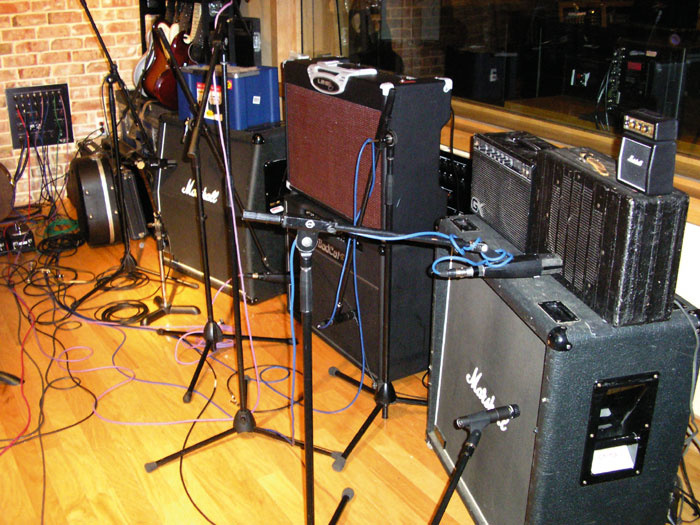 A typical Toby Wright guitar amp setup... In LA, Wright had maintenance gigs at Village Recorders and One On One Studios, but was still recording music only rarely. He worked on the construction of One On One, and when the other engineer on the project left suddenly, Wright became the sole engineer at the facility, doing maintenance as well as assisting and occasionally engineering sessions. Most of those were demos, to be sure. But it was a demo session for a now-forgotten band on Warner Bros Records Canada, Brighton Rock, that got him his first album engineering and production credit. "The manager heard the demos I'd done with them and asked me to produce the band on the spot," he says. "Even though I'd been at studios for hundreds of sessions, I had been doing maintenance and I didn't have a lot of experience actually doing music. But I figured that at least if anything broke I'd be able to fix it."
Brighton Rock's record was a non-starter, and Wright went back to assisting in addition to maintenance work, working closely with producers Ron Nevison and Mike Klink for a while. Klink was about to start production on Metallica's ...And Justice For All LP in 1987 and chose One On One to record it. However, Klink and drummer Lars Ulrich had serious disagreements about the album's recording and Klink left the project, with Metallica's original producer, Flemming Rasmussen, coming back to direct it. Wright was in the right place at the right time. ...And Justice For All would go on to become one of the sonic signature records of the 1980s, entering the Billboard Top Ten with virtually no radio or video support, despite almost every song being an extended opus of mixed time signatures and odd sounds, including the unlikely Top 40 single 'One'. Considering the recording approach, one can see why it's considered such a unique album.
"Lars wanted to do a record that required very, very heavy editing," Wright explains. "Flemming had always been a proponent of hitting the drums very, very, very hard. He said that that's where you get the sound out of them: sheer brute force and volume. The harder you hit it, the better it sounded. Now Lars is very well built and muscular, but at this level of velocity he couldn't play for more than a minute or so at a time. So we recorded in bits and pieces. None of the songs on that record were recorded all the way through in one pass. We ran a click track and [guitarist] James Hetfield played along to it, laying down a scratch track of rhythm guitar. Then Lars went out and played drums to that, stopping each time he got tired and then picking it up again after he rested up. All of those snippets of songs were later edited together by me. It was a pretty remarkable way to make a record, and I can see why perhaps Mike Klink wasn't nuts about it. But I was up for anything. To me, it was like fixing things. You have a bunch of parts and you put them all together and you make the thing work."
Wright was also up for flouting convention. Working with Ulrich, he spent days experimenting with drum-miking techniques and combinations to discover the elusive power Ulrich and Rasmussen were seeking. "In the end, it was all microphone placement and EQ," Wright comments. "I put a 412 and a D112 inside the 24-inch kick drum and ran them through a Technics DN360 31-band graphic equaliser. That was the whole signal chain. The EQ was pretty twisted — lots of bottom and top and no middle. Lars was pounding the drums; after one tom roll I'd have to go out and change the heads. I still have those drum heads, signed by everyone in the band."
Enter Alice
...And Justice For All was a big hit, but Wright went back to assisting, working with Nevison again on projects for Heart and Ted Nugent's Damn Yankees. But more than a decade in studios had also introduced him to some of LA's A&R contingent, and the rep for Alice In Chains decided to pair the band with Wright for two songs on the 1993 Arnold Schwartzenegger film Last Action Hero. Wright went on to engineer the next record release, Jar Of Flies, the first EP to ever debut at number one on the charts, and whose seven songs were cut in 10 days.
"They called from the road during Lollapalooza that they had lots of new songs and were ready to go back into the studio," Wright remembers. "We had 10 days booked at London Bridge Studios in Seattle. We got there and I asked [guitarist] Jerry [Cantrell] to play them for me. He looks at me and smiles and says 'That's funny — we don't have any songs. Do you mind if we just jam for the next 10 days?' I said sure — I didn't have anything else to do. I figured, I get to listen to a bunch of great musicians play around for a week. Incredibly, they began writing as they were playing. On the eleventh day, I began mastering what would become Jar Of Flies."
New Sounds From Old Techniques
The 1990s were explosive for Wright. He produced Korn's Follow The Leader with the band, having been promoted from engineer after initial producer Steve Thompson departed the project. "This was a very experimental project, sonically," Wright recalls. "They wanted very much to get sounds that hadn't already been used on records before. They thought I had the technology background, from fixing such a range of stuff, and was open-minded enough to let them get pretty far out there. We wanted to make sounds without using plug-ins on Pro Tools.
 Another way to get a novel guitar sound: the mic is taped to a barbeque grille and a miniature amp is rested on it."One sound in particular, on 'Freak On A Leash', was interesting and kind of illustrated what we were doing on that record. There's this whirring guitar sound, which is a guitar played through a Pignose amplifier placed in front of your garden-variety house fan. I put a Shure 57 and a Sennheiser 421 on the other side of the fan from the Pignose, some dynamic mics with pop filters on them to take the edge off the moving air from the fan. It took a while to get the right position for the mics, but it was similar to what you go through when miking a Leslie cabinet — you're looking for the spot where you get the most sound but the least amount of useless moving air. Oh, and the fan was set on low.
"That kind of set the tone for the rest of the record. We were constantly looking for ways to get new sounds without using processing, just using microphones and placement techniques. When I was at NYU, I took a course in acoustics. That has really helped me understand the nature of how sound moves around in a space, and has been a big part of how I approach microphone choice and placement."
Sevendust's second album, Home, was recorded by Wright at the residential studio Longview Farm, in Massachusetts. There, he had a lot of space to play around with. "There's about 50,000 square feet of space in the barn, the main recording area, which was built in the 1840s," Wright explains. "The building is old and wonderful and it acts like a huge violin in terms of how it reacts to sound and volume. When you play loud, the entire structure vibrates and resonates, and it becomes part of the music, and on Home we used a lot of it. If you listen closely to the guitar tracks, you can hear it. I had the band play for a while I went around the room looking for the frequencies at which the walls resonated most and where the vibrations were the most intense. The I took some PZM microphones and put them on the walls, covering them so they didn't pick up any direct reflections. Soloed, [those tracks] sound kind of gargly, but when you mix them into the sound, it adds this dimension that's incredible."
Stomp Guy
This is good point at which to ask Wright about how he approaches effects. A dedicated analogue tape fanatic — he always records basic tracks to a Studer A800 MkIII with 16-track heads running Quantegy tape — he likes to think ahead. "If I'm going to be mixing the record, I'm less inclined to print effects," he says. "Because I know I'll be able to restore the sound we had originally envisioned in the mix stage. If I'm not mixing, I'll print effects to another track and make notes to whoever is mixing that they're there and what they're for. But I love effects. I'm known as the guy who will stomp on the flanger pedal for you during a take."
Recording Jakob Dylan and the Wallflowers with producer T-Bone Burnett was an exercise in minimalist effects. "Everything was organic," Wright recalls. One Headlight was done at Jackson Browne's studio and Sunset Sound. "T-Bone said he wanted very classic sounds on this album," Wright says. "Classic drums and guitar sounds, using the kinds of microphones and placements I learned years ago at Electric Lady. When you hear a B3 sound on this record, it's a B3, not a B3 patch on a DX7. The sounds are all genuine, and that really helps push the music along. This is the kind of stuff I learned from guys like Ron Nevison and Eddie Kramer. The band was recorded ensemble, no overdubbing of basic track parts. And the musicians you use make a huge difference. We had Matt Chamberlain on drums for that record and he is a one-take drummer. If he plays it again, it might sound a bit different, but it'll be just as good as the previous take. A guy like that in the band puts a very good edge on the entire band and the entire record."
 More creative engineering from Wright: the guitar amp is directed at the piano's soundboard in order to record the resonance of the strings.Wright has a basic setup he likes for drums: a Shure 57 and AKG 451 taped together on a single stand on the top of the snare, with a Sennheiser 441 on the bottom snare head. There'll be a small condenser microphone, like a Neumann KM84, on the hi-hat, AKG C414s as stereo overheads, a combination of a Sennheiser 421 and an AKG D112 on the kick drum, and 421s on the toms.
But this is not written in stone, and he's willing to adapt at a moment's notice. "On Sevendust we used about six different drum placement setups," he says. "We'd move the kit into different rooms, too. The kitchen there gives this great small-combo jazz sound to the kit."
His basic recording methodology is also adaptable. While he's a dyed-in-the-wool analogue fanatic, Wright generally takes the basic tracks and moves them to one of the three Pro Tools systems he has for editing. He'll re-record many of the parts on Pro Tools, but will fly them back to tape before mixing. "If you do it all in Pro Tools, you'll get this unhumanly tight performance from the band," he cautions. "If you use Pro Tools at the front end of a session, you'll lose the warmth. But it's amazing for editing, and tape simply adds too much to the cost of a record these days. Sometimes I might go straight to [Pro Tools] HD, depending on the type of session, but I'll always go to tape before mixing in any case with the basic tracks, and then mix from both tape and Pro Tools locked together with a Lynx synchroniser."
Wright owns a Neve 8081 console and is partial to studios that have Class-A equipment like the Trident A-range modules, Pultec EQs and other vintage goodies he keeps in the six 24-space racks that travel with him. He likes to keep the old gear close at hand and is comfortable with it, just as a master mechanic is unperturbed driving a 1958 C-type Jaguar simply because he's also capable of fixing it. He mixes to Yamaha NS10M monitors — no tissue paper over the tweeters.
Wright has one other new project, and it's not a band. Mixlab is a software package he developed with a codewriter friend who spent months analysing where Wright puts elements in the surround soundfield, such as the 18-track video DVD he completely remixed from the original tracks for Alice In Chains. The resulting algorithms will, Wright asserts, do the surround panning placement automatically for a record. The user enters various bits of information into fields on the screen — this is a rhythm guitar here, drums on these tracks, here's a vocal, and so on — and after processing the entered information plus the audio data, the software will create a surround mix field using the console's panning structure. "It'll go through about 2.5 million possibilities from 24 tracks and figure out where everything makes the most sense," he explains. "You can also adjust the preset algorithms to have it create panning templates suited to your particular way of doing surround mixes. It speeds up the surround mix process, which I hope will encourage more people to do surround mixes. I used it to do the surround mixes on [Phish guitarist] Trey Anastasio's album. It took me 16 days to do the stereo mix at Electric Lady; it took me four days to do the surround mixes. That's fast."
Speed doesn't seem to be a primary characteristic of Toby Wright, though. After putting in nearly a decade in the solder-filled back rooms of studios, he knew his day would come and he didn't rush it. The accumulated wisdom of all that time waiting was worth the time it took to acquire. As he says, "When you think about it in the long run, what's the rush?"