

Classical interpretations of guitar music might not be new — but when the guitar music in question consists of 64 minutes of deafening feedback, it takes a lot of interpreting!
 Few records have alienated audiences like Lou Reed’s 1975 double album Metal Machine Music. Each side bore a single track lasting exactly 16 minutes and one second. There were no drums, no singing, and no songs. Instead, waves of shrieking guitar feedback created a brutal sonic assault which, thanks to the locked groove at the end of side four, was literally never–ending.
Deleted by RCA after two weeks on sale, the album attracted the highest number of returns of any record ever. Since then, it has been widely dismissed as a bad joke or a two–fingered salute to the record label, and the name Metal Machine Music has become synonymous with ‘unlistenable’. What’s more, unlike much ground–breaking music from the ’70s, it sounds every bit as jarring and difficult today as it did 30 years ago. Nevertheless, Metal Machine Music has always had a hard core of devoted admirers. These have included pioneers of electronic and industrial music, but also avant–garde classical musicians such as Ulrich Krieger and Reinhold Friedl of unorthodox chamber ensemble Zeitkratzer.
“It can’t be done. It’s impossible!” was Lou Reed’s reaction on hearing that Krieger had transcribed and arranged Metal Machine Music for piano, strings and saxophone. “He said that he could transcribe it and these guys could play it. Let ’em do five minutes and they would send it to me and I could see what he was talking about. So they did, and I was astonished by it.” So much so that Reed agreed to join the group on guitar for the occasion. And whatever your opinion of the original, it’s hard to deny that the Zeitkratzer performance, recently released on DVD with a 5.1 mix by Reed himself, is an extraordinary feat of musicianship. The idea that a small group of string and wind players could faithfully recreate every squeal, drone, pulse and howl of Metal Machine Music sounds absurd, but the results speak for themselves.
The Ultimate Guitar Album
With the benefit of hindsight, it seems clear that the original Metal Machine Music was intended neither as a joke nor a piece of record–company politics. As Lou Reed explains, the real motivation behind it was much simpler. “I did it for fun, and I did it for myself, because I wanted to hear lots of guitars and not have to worry about keeping the beat of a drum, or a lyric and a melody and what key you were in. I’m a guitar player. I like guitars, I like amps, I like tubes.”
And although it was hardly an obvious follow–up to the slick and sleazy Sally Can’t Dance, Metal Machine Music did not come out of nowhere. “There are Velvet Underground songs that have guitar solos that are the younger brothers and sisters of Metal Machine. A song called ‘All Tomorrow’s Parties’ has that kind of tuning in it. Another song called ‘I Heard Her Call My Name’ has that kind of feedback entrance. I was playing around with these things all over the place.
“Years before that, I had started out with an electric guitar with a lot of things built into it by a guy named Dan Armstrong, who was the guitar guy in New York at the time. He made the Plexiglass guitar, he made the Dan Armstrong guitar, the Dan Armstrong pickups. It’s still the best idea out there: the modular pickup. No–one’s ever done that since, and I don’t understand it. That’s where you just take the pickup out and put another one in. Now if you could explain to me why you can’t do that today... because they can’t make any money from it, probably. Because today, to change a pickup you have to go into a guitar tech. With the Dan Armstrong, you slipped it out and you put another one in, the way it should be. It’s very cool.”
Metal Machine Music thus has a claim to be the purest ‘guitar album’ ever made, since no other sound sources were involved at all. “What I did is I had a bunch of 4x12 amplifiers, and I would set them up with various repeat and tremolo units, and then I would tune all the strings to a certain note, and then I would figure out a good distance to have the guitar in proximity to the cabinet, and then it would start feeding back naturally. And then I would have another guitar doing the same thing from another 4x12. And then these harmonics would hit one another, causing a third one. And I would be playing another guitar over those, while I was recording it.
“I had a three–speed reel–to–reel. Sometimes while I was recording it I would overload the reverb, or sometimes I would change the speed of the tape. I didn’t make any loops. I don’t think it was a four–track recorder, I think it was stereo. I don’t think you could overdub onto that; I don’t actually remember, but it would have been pretty hard.”
The recording took place in Reed’s New York loft. “I was living in an industrial part of town, put it that way,” he says, when asked how his neighbours felt about the deafening racket emerging from his apartment. “You would have to do a lot more than that to get any attention.” And was the album’s brutality and harshness a reflection of those surroundings? Not consciously, but Reed admits that “You’re probably the product of your environment. It’s hard to imagine someone in Bath doing an album like that!”
Fools’ Metal Jacket
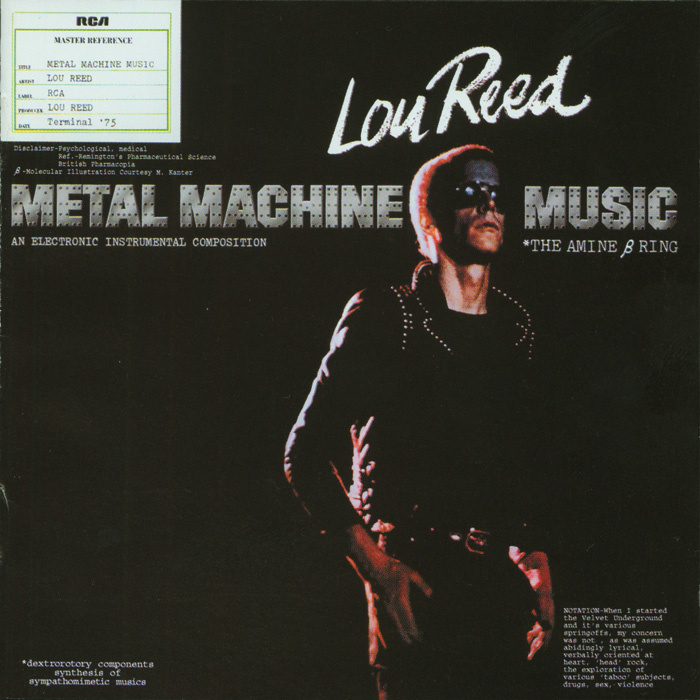 Ironically, the idea that Metal Machine Music was some sort of prank on Lou Reed’s behalf probably stems from the one element he didn’t create: the sleeve art. In a desperate attempt to make the album marketable, RCA used a live photo depicting the artist in leather–clad Rock & Roll Animal pose, deluding shoppers into thinking this was going to be of a piece with hit albums like Transformer. This certainly wasn’t Reed’s idea. “I didn’t want it to be confused as a rock record with songs on it,” he says. “I went to talk to [legendary label boss and A&R man] Clive Davis about what could I do with it, and he said ‘Why don’t you try putting it out on a classical label so it doesn’t get confused with your rock stuff? Make sure it says that there are no vocals, no songs.’” Reed had to content himself with nonsensical liner notes that mocked the pompous ’70s trend of listing the equipment used to make the album (‘Electro–Voice high filter microphones’, ‘Distortion 0.02 bass and treble ceilings’).
Despite its unfortunate billing as a rock album, Metal Machine Music would go on to win many admirers in avant–garde classical circles, particularly among fans of the so–called New Music pioneered by Pierre Boulez, John Cage and other post–war composers. “The same thing that interests me in rock, industrial music, No Wave and noise music, is what interests me in New Music: sound, soundscapes and structure, which are the large–scale format of rhythm,” explains Zeitkratzer’s Ulrich Krieger. “For me, these are the essentials of music — not harmony, not melody. So music is coming full circle today. Archaic ritual music consists mostly of these two parameters, sound and rhythm — and long durations — and so does a lot of contemporary music of any style, even dance music like techno.
“And I found all of this in Metal Machine Music: intricate, beautiful, complex and daring sound–colours like in New Music, the rough, sheer force of real rock music, and ritual, archaic, long–duration intensity. So Lou brought this together from the rock guitar side of things, and I wanted to emphasise the orchestral side of it and the human touch and group experience by having it performed live.”
Transcribing Sound
At the time, Krieger was saxophone player in the experimental classical ensemble Zeitkratzer (the name translates literally as ‘timescraper’). The group were already known for their cross–genre collaborations with pioneers such as Merzbow. The idea of transcribing and performing an existing work was new to them, but it was one they had strong opinions about.
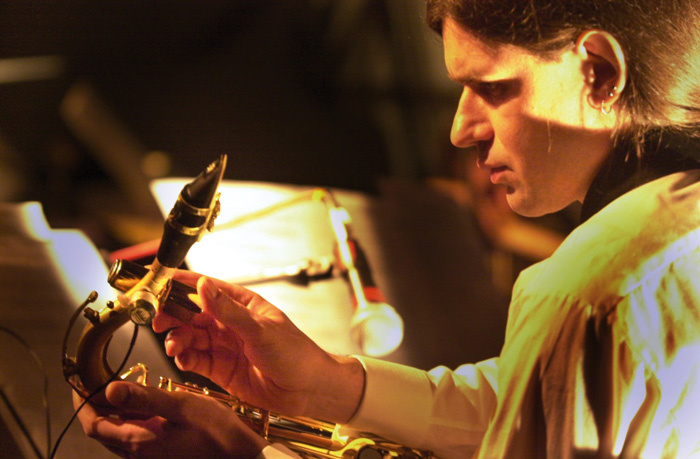 Zeitkratzer saxophone player Ulrich Krieger, who jointly transcribed Metal Machine Music.“The problem with orchestral or string–quartet arrangements of rock music, which seem to be popular today, is that the arrangers often don’t have a knowledge of rock music, nor do they actually love it,” explains Krieger. “They just transcribe the pitches and the rhythms, but they miss the whole point. They don’t transcribe the sounds of rock, which for me is the ultimate essential. If you turn on the radio in your car, how do you know that you’re listening to, let’s say, the Rolling Stones, when Jagger is not singing ? It is not the harmonies, it is not the melodies, it is not the rhythms, because these all are used by uncountable other bands as well. It is the sound and the way they play it and with it. So if you don’t transcribe this, you miss it. You fail.
“Another example is a CD of house and techno pieces performed by a British brass band. The idea is great, but it doesn’t work. The arranger himself says in the liner notes that he didn’t know this kind of music before, he’s purely classical. The transcriptions are accurate, in terms of pitch and rhythm, but he ignored the sound and he didn’t get the style, and especially not the philosophy behind the music. He couldn’t make the brass band sound like an old 808 and he couldn’t make them sound as ritual as the original. And actually I think that a brass band would be great for playing house tunes.
“You can hear the same problem when listening to projects like Metallica and orchestra. The orchestra never moves towards the sounds and style of playing of the group it is playing with, which is a problem of the arranger and the conductor. Another failure was the Warp Records project with chamber orchestra. Same problem: the arrangers were classical composers, not knowing, loving the music they arranged. And the players were not fluent in the style of Warp. In the concert they mixed Warp arrangements with New Music pieces. The New Music was performed fantastically, the Warp pieces sounded dull.”
Moving Clouds
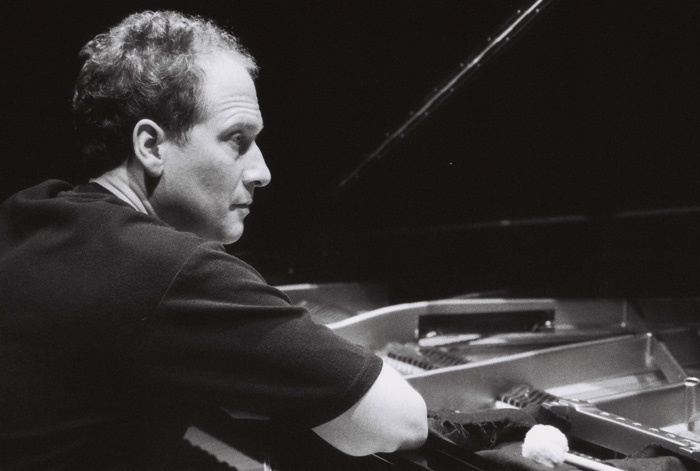 Reinhold Friedl at his prepared piano: "Almost nobody will realise which sounds are made by the piano."With this in mind, the transcription of Metal Machine Music created by Krieger and accordion player Luca Venitucci went far beyond simply notating pitch and rhythms. Equal thought was given to how their instruments could be used to capture the sounds of the source material. “Almost all musicians from Zeitkratzer are specialists in finding new sounds on their instruments,” explains pianist Reinhold Friedl. “I worked out a lot of methods to play ‘inside–piano’, that means to produce sounds on the strings of a grand piano. So, on the recording, you can hear the piano very well, but almost nobody will realise which sounds are made by the piano. There is, for example, a high screaming produced on the strings, but the very deep hums are also made by the piano, and a lot of metallic beating pulses. The passages played on the keys of the instruments are mostly prepared strings, so they sound like Chinese gongs in the background or like a detuned piano in some parts, but also like a mandolin in another parts.”
The use of amplification is also fundamental to Zeitkratzer’s work, but not because it allows them to use electronic processing or effects; indeed, that would seem to defeat the object. “The only treatment, if you like to call it that, was the amplification and the microphones, plus some standard tools you use for normal big hall or outdoor orchestra concerts, like a bit of compression,” insists Krieger. “The only compromise was that we used guitar distortion on the strings. But this was mainly because we only had four string players and we needed to fill up the sound.”
What amplification does offer Zeitkratzer’s musicians is the ability to work with mic placement to shape their tone and make quiet sources loud. “The strings are amplified with pickups and microphones,” explains Krieger. They play a lot ‘sul ponticello’ — at the bridge — in order to bring out more of the overtones, which are strongly emphasised by the pickups. So we get a very rich string sound with many overtones clashing at each other, much like the guitars leant against the amplifiers. But they use very refined sul ponticello, always changing the distance to the bridge, the pressure of the bow, speed of the bowing and so on, so the overtone clouds move and change and live.
“The wind instruments often play rather soft, but very close to the mic or even with the mic in the bell, so we get a very sine–tone–like quality, which sounds a lot like feedback.”
Map Making
The daunting process of writing down a score began with close listening, to assign elements of the original to the most apt instruments within the Zeitkratzer ensemble. “First I tried to identify which instrument can produce or ‘mimic’ which sounds of the original MMM,” explains Krieger, “thus generating a general map of the instrumentation, of who can do what and in which way. Strings can play continuous yet varying sound, and have the closest overtones to the guitar. Wind instruments can create sounds with a feedback quality. Accordion, piano and percussion can have a noise–like quality and fill in with other instruments.
“Then Luca Venitucci and I separately did a rough transcription of the piece — two pair of ears hear more than one. Then we compared what we heard and put it together. We did several rounds on several speaker systems, always getting more and more into details: main tonal field, details, durations, melodies and so on. We used several sound systems and pairs of headphones, because on each system you hear different aspects of MMM better or worse. After that I wrote out the score in proportional time notation with Luca’s assistance.
“Metal Machine Music is not atonal! It is actually modal. It is based on a fundamental pitch, a clear tonal centre. All the string instruments in my arrangement are tuned to the open fifth B–F# and play only these notes or the overtones thereof. This is the original tuning of the guitars in Lou’s original version, so it is very drone–like. There are also tonal melodies played around that drone, if one listens closely — they are just ‘hidden’ in the sonic eruption of MMM.”
 The Zeitkratzer performance of Metal Machine Music took place in Berlin in March 2002, but has only recently been released on DVD.
As you might expect, the process of recreating that sonic eruption required plenty of rehearsal. “The musicians needed to get acquainted with the material and also find their position in the overall structure of the piece,” explains Krieger. “In standard classical or even avant–garde music the long–time experience of the musicians lets one know if you have to be up–front, accompanying in the back, solo, or whatever. With MMM it was very different. Although all of this exists and is relevant to MMM, you need to define your role anew. Specifically, because it is a no–ego music. You might not be heard as a individual player with your part, but you still bring an important aspect to the piece, which adds up to the overall sound and experience. If you don’t play, it will be heard. If you play, the audience might not recognise you playing. This is a very new and a different experience for a musician.”
Fun, Fun, Fun
Zeitkratzer’s interpretation of Metal Machine Music premiered in Berlin in 2002, and it is that performance that is captured on Asphodel Records’ DVD, with Lou Reed on feedback guitar. “It’s real fun and even sport to play this piece on stage,” says Reinhold Friedl. “It’s not only for the ears, but also for the eyes of the audience. It’s interesting to see the physical work, and a lot of sweat, that the musicians have to do on stage.” Since then, the work has also been performed by Stockholm’s Great Learning Orchestra, under Ulrich Krieger’s guidance, and threatens to take on a life of its own.
In the meantime, the myths that surround the original album continue to build. Surf the Internet for long enough and you’ll discover that side four is side one backwards, or that it’s the greatest New Age album ever made; everyone has their own theory. “You know, I love the things that are said about it all over the place,” laughs Lou Reed. “I don’t want to disenchant anyone. In the end, none of it really matters. You either get fun out of it or you don’t.”
Lou Reed’s Guide To Guitar Feedback
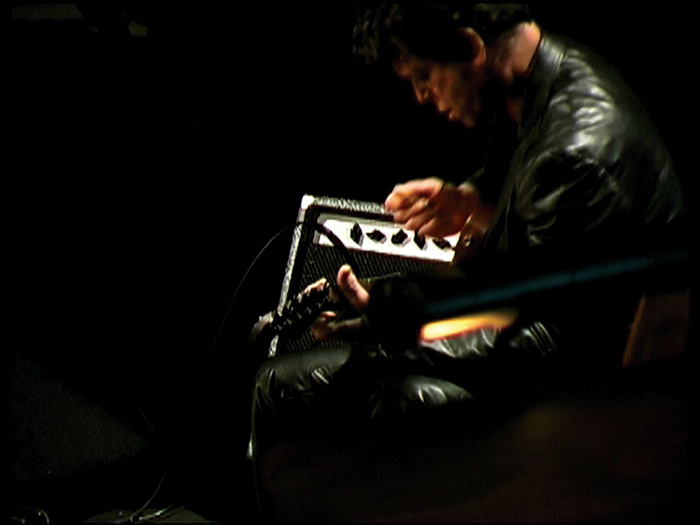 No guitarist has done more than Lou Reed to exploit the musical — and, arguably, unmusical — potential of feedback.No guitarist has done more than Lou Reed to exploit the musical — and, arguably, unmusical — potential of feedback, something that has been pivotal to his guitar playing since Velvet Underground days. “The real problem is not going deaf,” he says, when asked for his tips. “Anybody can get feedback, right? But getting controlled feedback is another story, and that gets a little bit involved, though it’s not nuclear physics. Heavier gauge strings are better. Wood, tubes are probably better. A cabinet that can carry bass — you need at least 1x12. But the way you set it up is essentially by distance.
“As you’re getting the feedback, you can control it, like if the sound was a bull coming at you, you bob and weave with it. What I like to do is get what I call the good harmonics. I’ve spent years trying to get the ones that are just pure noise out, and have the musical ones in. I personally like the bass notes, because you can sound like a cello section, and then if you do it right it’s kind of like Metal Machine, it can set off another harmonic that’ll bounce into it and they cause another one, but the real problem is you’re achieving it by volume. I’ve been having guys build things for me that let you get a loud sound soft, that’s the idea.”
The pedalboard Reed plays through in the DVD of the Zeitkratzer Metal Machine Music show features his latest weapons in the fight to achieve controlled feedback. “Those are some things built by an English genius named Pete Cornish, who builds custom gear for people who have requests. I’m playing through a thing he calls the Lou–tone, which gives a real wide sweep of various harmonics that I can go through using a pedal and cause to feed back, using another thing called the Death Pedal, which is a simulator of a speaker breaking up. And when I put the two together, you’re off and running. And usually that’s on top of some other distortion.”
Quad Versus 5.1
For the many who find the album baffling and unlistenable, the prospect of a wholly enveloping, immersive Metal Machine Music experience could be truly frightening. Yet that was exactly what Lou Reed and mastering engineer Bob Ludwig intended when they created a quad version of the album on its initial release. “It was the ultimate version,” laments Reed, in the light of the format’s commercial failure.
But couldn’t the quad version be rescusitated as a 5.1 mix? Not according to Lou Reed. “You can’t compare quad to 5.1, it’s hopeless. It’s like comparing stereo to mono. There’s no point to it. I personally am sorry that 5.1 exists. In this case, by a lot. Five point one is pretty much home theatre, sound effects in the rear speakers. It’s not especially musical, I don’t think. You couldn’t make a quad mix into a 5.1, and no–one has quad equipment. The only conceivable way of doing it would be to do an installation somewhere, so if someone wanted to hear it they would have to go there. If I had my way it would be binaural sound, but no–one’s done that.”
Despite his reservations about 5.1, Lou Reed mixed the Zeitkratzer performance in surround for the DVD release. “It’s a terrific 5.1,” he says, but admits “It’s as close as we could make it, but it’s not the quad. It can’t be.”