

When they began work on The Seldom Seen Kid, Elbow had no record label and no producer. Two years later, it's brought them mainstream success at last.
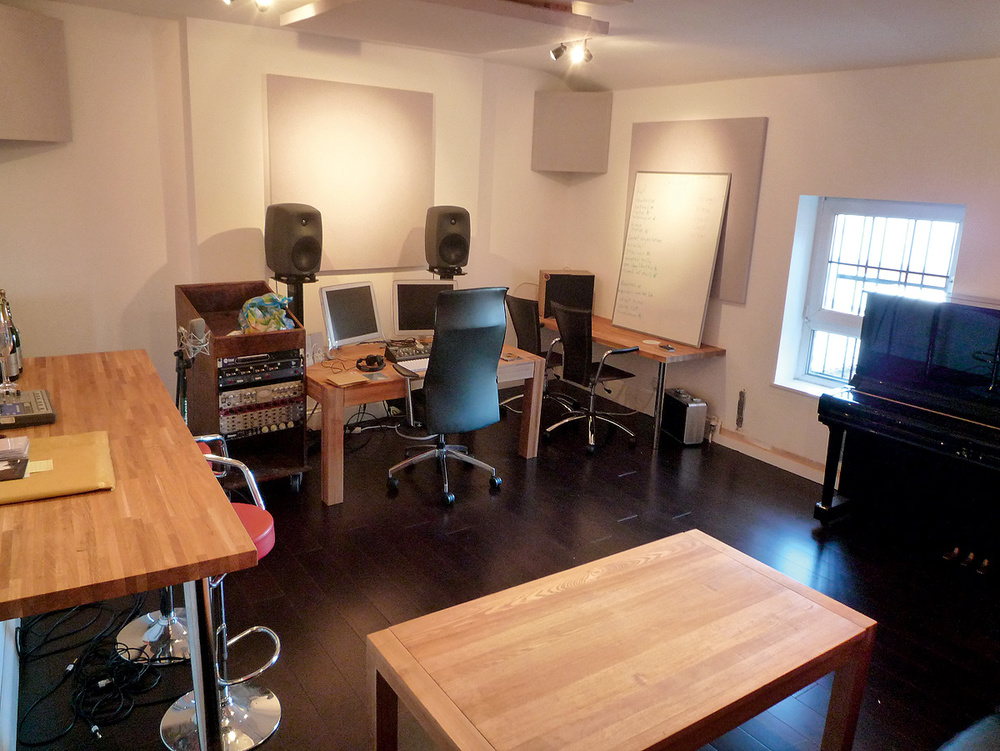 The nerve centre of Elbow's operations is this room at Blueprint Studios in Manchester. With no desk or control surface, recording and mixing happens entirely 'in the box'.Everyone loves Elbow, it seems. When the judges of the Mercury Music Prize chose The Seldom Seen Kid as the best album of the year, even rival contenders like Radiohead and Alex Turner applauded. Eighteen years and four albums into their career, the Mancunian quintet renowned as the nicest guys in rock are finally receiving the recognition — and the sales — they deserve.
The album took over two years to make, much of which was spent searching for a new record label after the band felt let down by V2's failure to promote its predecessor, Leaders Of The Free World. "We've had great reviews for all our albums," explains the band's keyboard player and producer, Craig Potter, "but we've never had the money behind us to advertise and promote them properly. That was what was very frustrating about the last album: we all loved it, still do, and we didn't feel it got the shot it deserved."
Going It Alone
 Blueprint from the outside: the 'big room' makes up the top half of the building, with the main studio that other clients use beneath it. Although the band have always been involved in the production of their records, The Seldom Seen Kid is the first they've made without any outside involvement, with Craig Potter handling engineering and mixing duties. "It was the intention to do Leaders Of The Free World ourselves, but we got a little bit stuck," he laughs. "It all got a bit much for us about three–quarters of the way through, so we got some people in, but this time it went smoothly, and at the end of it, we had a record that everyone was really happy with the sound of.
"It wasn't a big leap from the previous albums to me producing this one, because we'd all worked together, and we co–produced the other albums anyway. It was just that someone had to take that role, really. The advantage is that we've known each other for so long that if anyone has an idea, there's no time lost in having to explain what you mean, because we all use exactly the same language. We pretty much know what each other are thinking most of the time, so you can go straight from initial idea right on to tape, hard disk, whatever. There's not much to get in the way of that process, which is really beneficial."
Building Sounds
 Craig Potter, who produced The Seldom Seen Kid.The Elbow approach to making an album is a thoroughly modern one. Not only do they record and mix entirely 'in the box', without even a control surface to hand, but their songwriting process begins and ends in the studio. "We're very much the sort of band that writes in the studio. A lot of it is us sat in a studio building sounds. Although we do sit around with our instruments playing together, quite often we end up layering and building a song sat round the computer, just thinking 'OK, here's a song, what does it need? It needs this sound here. How should it sound?' And then someone might do an impression of it, and we'll go out and try and find it somehow. It's more that than 'I play keyboards, what do I do on this song?' It's what the song needs.
"We've got a lot of experience with it now. A lot of people don't know where to stop adding things, but quite often we'll get to a point with the song and we've realised that it's working well, but the song is potentially much better than what we've done with it, so we'll strip it back, take off the initial idea, maybe just keep the vocal. Always, at some point we take a step back and think 'Are we really making the most of what the lyrics mean here?' We always have to take a step back, and quite often change the vibe of the song if the lyrics are taking a different direction. If it was played on the piano we'd maybe take the piano off, keep the chords and just build it again. So it's not a case of just adding and adding, it's re–evaluating all the time. It's pretty democratic. It's a good job there's five of us, or else there'd be a lot more arguments!"
"We record as we go along, and a lot of the initial ideas get used right from the very beginning. On 'Grounds For Divorce', for instance, there's a bluesy–type loop that goes right through most of it. That was just the very initial idea in a little room, we just sat around, set up, got this bluesy riff going, and that was recorded on an Edirol field recorder. It's good to have different textures, and sometimes that's what creates the depth in a recording. If you record everything at the same time, it's all got a certain sound, whereas it's good to layer things up, and then you've got stuff up front, stuff that sounds like it's coming from a hundred metres away. It all helps, I think, to use some demo ideas, just as effects. You just tend to build on a Session in Pro Tools. The names change, they gradually evolve, and two years later you've got a finished mix in Pro Tools, all in the same Session."
Impressions Of Elephants
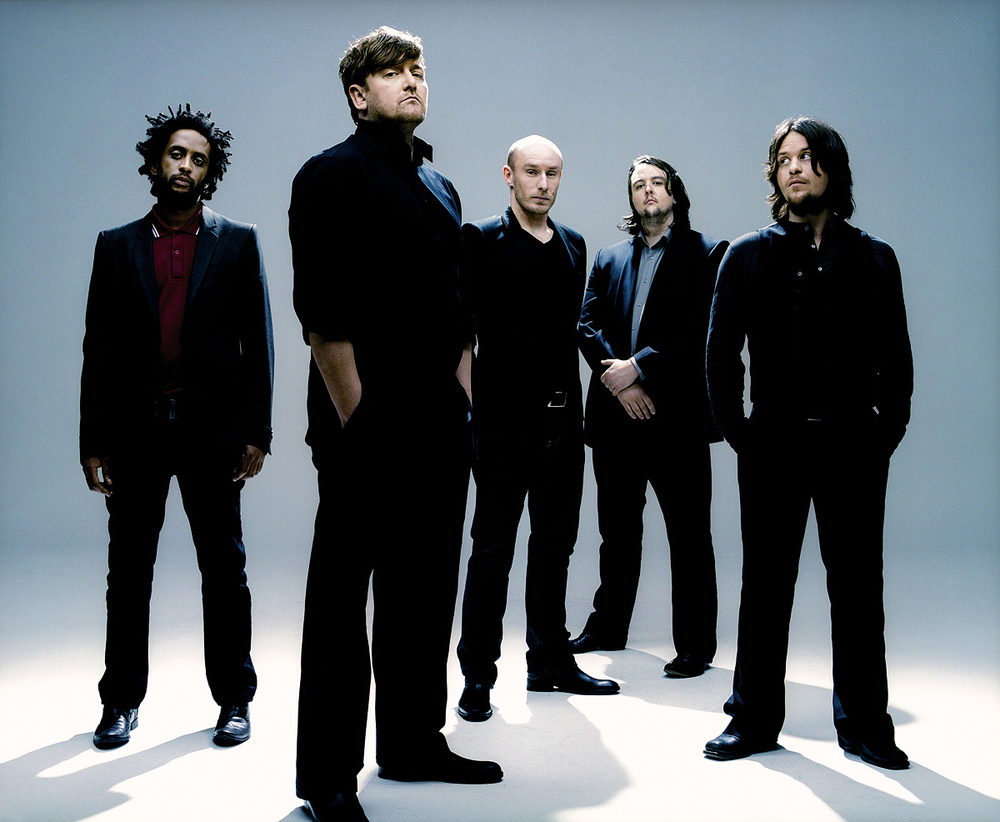 Elbow: from left, bassist Pete Turner, singer Guy Garvey, drummer Richard Jupp and brothers Craig and Mark Potter, who play keyboards and guitars respectively. "We're not necessarily satisfied with straight–up guitar sounds or keyboard sounds or bass sounds," says Craig, and offers examples that illustrate the band's unique creative process.
"We'll get a sound on the guitar but we'll think 'Well, it's sort of what we were thinking of, but there's no front to it, we need people to notice it a bit more when it comes in, but it shouldn't be that loud, so it needs more attack.' So we'll get the knock of a piano key or even just knocking on the guitar itself, I'll edit that up, and we'll play it back out through an amp. We get quite specific on the sounds we want, even on normal guitar sounds — there's a strummed acoustic in the middle eight of 'Mirrorball' that didn't have enough of the pick attack, so we muted all the strings and did exactly the same performance but with no tone, so it's just 'bdlip, bdlip', and put that on it. There was a lot of time spent on little details like that."
Likewise, the growling, portamento bass in 'Some Riot' was something that had to be crafted in the studio. "That was a harmonica sample in a Korg Triton. When we play 'Switching Off' live, which is off Cast Of Thousands, I use that with an organ sound to create this kind of wind–organ type effect, like the old wind organs that have got a fan in them. It's had all the attack taken off so it's a slow fade–in, and then I actually played that live in the big room, so it's very much a big, roomy sound. There were two Fender Twins 30 feet apart and two mics pretty much facing them, 20 foot back. I was playing it and I was using the pitch–bend on it, but every time it bent down I was pushing the volume up, so you only really get the gritty distortion when it's actually moving from note to note, rather than on the actual note itself.
"People say a lot that they can't tell what these sounds are, and I suppose that's because we think 'What does this song need?', someone will do an elephant impression or something, and we'll go and find what can do that. We might get the attack of a banjo and the tail of an organ percussion or something, and make a new sound, that's the sort of thing we like experimenting with. We just do it in Pro Tools."
Elbow Room
 The 'big room' at Blueprint Studios was a key resource for drum recording, re–amping and other aspects of the Elbow sound.Demo ideas excepted, The Seldom Seen Kid was recorded at Blueprint Studios in Manchester, where Elbow rent a room of their own as well as making full use of other spaces. Craig Potter sounds apologetic when he says: "There's no desk. Our studio looks pretty rubbish really, it's just a screen and a keyboard and a mouse and a pair of speakers. We've got some nice preamps, just to get some good signals going in, but everything else is in the box.
"We've got our main room, which is just like a little bedroom–sized room that we do a lot of stuff in, but we've got access to the stairwell outside and there's a big room above their main studio that we record in, it's the size of a five–a–side football pitch. We've had that since Leaders Of The Free World, but we couldn't actually use the big room as much this time, because the main studio at Blueprint was up and running, and the soundproofing wasn't good enough when they'd got people in, it's directly above their studio."
Mixing Up The Vocals
Front and centre in any Elbow song is Guy Garvey's distinctive voice. "Guy's got a great voice, and lyrics are so important in our music that it has to be the star of the song," says Craig. "That's where a lot of people make mistakes when they're mixing stuff. Guys who are just starting out don't have the confidence to push the vocals up front, and that's what makes it sound like a professional recording, in a lot of ways."
Some singers like to stick to a particular mic that works well for their voice, but Craig and Guy don't sound especially fussy. "We mix it up, it all depends. We've got a [Neumann] U87 we use quite a lot — it's not particularly bright, though, so we use [AKG] 414s and sometimes just a [Shure] 58 in the studio, maybe to get some specific effect.
"Effects–wise, we quite often use room effects, but very subtly, maybe distorting them. We don't do much doubling, but if we do, we quite often do Guy singing a line 20 feet away, off the mic, distort the fuck out of it, and then automate that under the vocal, so it can be a close vocal, but it can sound like it's getting more powerful — you can give it an extra nudge by automating this gruffer, roomier sound up now and again. There's a hell of a lot of automation going on with effects and things like that, just to make it all fit together."
Everyone Loves Recording Drums
 Given the Elbow approach to other instruments, it's no surprise that they spend a lot of time creating different drum sounds. "Everyone loves recording drums, don't they?" laughs Craig Potter. "We have lots of different drums, we move them from room to room, tune the drums differently for each song. I don't understand why bands don't do that more often. So many bands you just hear, they've obviously gone and recorded the drums all at once, in one day, in one room, with the same setup. I just don't get it. Songs need different sounds on them! We've got the stairwell outside our room and we've got the huge room, and then on 'An Audience With The Pope' that's very much a tight, compressed, more natural sound, but with a lot of attention to detail on how the drums are tuned.
"Sometimes it's just a case of chucking mics up in the usual positions and moving them around depending on how the drums sound, and if I know there's a very specific thing, we'll just use one mic. The drum sound on 'The Fix' was actually two drum performances, with pretty much just an overhead on each one, the same setup played twice and split left to right. It's the same pattern, but shifted slightly in time. Because it's a shuffly thing, you don't really notice, but it makes it sound quite wide. It's the first time we've done double–tracked drums, I think we're going to do a lot more of it.
"There's quite a lot of loops going on, while some tracks are a completely live drum performance. If we're going to loop something up, rather than try and quantise stuff, I'd rather have a loop that's slightly loose than a quantised whole performance, in a way. There's just something about anything that's bang-on that doesn't have the right vibe. We loop drums up, but only if it's right for the feel, and not necessarily because they're not in time — just because it's a different feel."
Many of the songs on The Seldom Seen Kid also feature strings, courtesy of the band's three regular players. "Stella and Jyoti play live with us, and Ian's played live with us as well, so it's violin, viola and cello, just layered and layered. The main string arrangements were written by Guy. He just went in with them and stood there and sang part after part, and we just recorded it and recorded it and built it up, changing the position of the room mic every now and again. We're pretty lucky to have a nice room to record in, to build it up, I think it sounds pretty good considering it was just three of them. There's some keyboard strings sounds going on — 'Mirrorball' is pretty much synthesized strings, but it's supposed to sound like that."
Flexible To The End
Working always with the album as a whole in mind, the total recallability of the band's Pro Tools HD rig was as important as any instrument. "The way we put an album together is that if it goes cold at all in the writing or recording process, then we move on to another song," says Craig Potter. "We jump around between songs all the time, and then eventually it all comes together.
"For writing an album and recording an album, sound–wise, to make the songs work next to each other, I don't think we could have done it any different way. Because even at the end of the recording process when it was all there and we were putting the album together, we decided to bring sounds in that would take an influence from a sound on the previous track — and at that stage you can still change it to make the album work as a whole. We mix within the box, it's just all there, and we don't have any outboard, and for me, that was a really essential tool to get the album working as one. Quite often we'll put the previous song in the Pro Tools Session, and every now and again while we're recording, we'll go 'Let's just listen to that song again all the way through, and see how it goes in,' and we'll hear 'Oh, it does need a bit of this and a bit of that,' or 'Let's base this sound on the backing vocals from the previous song.'"
The last stages of production were the ones that provided the biggest challenge for Craig Potter as producer and engineer. "For me, this time round, I'm most proud of the mixing side of things really, because that's the thing that I hadn't been confident about in the past. There's very specific technical things that you need to know when you're mixing, that I have just had to learn. I've been going on various web sites, reading up about it, and now I'm finally confident enough to do that, and I think I have the mixing skills to make a record."
He pauses, and then adds, smiling: "It's won the Mercury Music Prize, so I suppose that's been proven, hasn't it?"
Saturate & Re–amp
Two techniques that seem to be central to the Elbow sound are the use of saturation and distortion plug–ins, and re–recording things through speakers in real spaces. "I go a bit re–amping mad, sometimes," admits Craig Potter. "Even with reverbs and stuff. Altiverb's probably my favourite reverb plug–in, and even if it's close, I just need a little bit of room reaction from where the drums were recorded. Room sound's very important.
"Most of the re–amping is vocals back out through guitar amps, or reverbs back out, sometimes kick and snare. I'll put a room mic up and just mess around with it, really. On a couple of tunes I've put the snare next to the room mic with the snares loosened quite a lot, to get a bit of rattle going on — things like that. Ideally, you can do all that at the recording stage as well, but sometimes you miss it and you have to go back. We recorded a whole track in Big Hands [bar] in Manchester once. We thought 'This needs a bit of bar ambience,' so Guy took the finished mix, nipped down to Big Hands, and put it on the PA there in the background.
"I am a fan of saturation. The Waves SSL 4000–series stuff, I like the EQ on that, you can get distortion out of it that sounds like saturation. We have to use that subtly, but it works well on Guy [Garvey], not necessarily for air but for brightness. I like the McDSP AC1 and AC2 plug–ins and the DUY Tape's good, but they're all very subtle things, it depends where you put them in the chain. If you put them first, you can bring stuff out with EQ. I'm not scared of heavily compressing stuff, I do it quite a lot, but settings–wise, it's different all the time.
"We've got guitar pedals and Pods and stuff, but I tend to use the plug–ins in Pro Tools as an effects unit a lot of the time. So if you've got a keyboard part or a guitar part, you can effect it and then send it back out and record it. So that's really like a rack of pedals, I use that as my effect, but most of the time it has to be recorded [through an amp or speaker] again just to get it sitting in with the tune."
Re–amping and distortion are likewise more important to Craig Potter's own keyboard sounds than experimentation with synthesis or sampling. "I don't have many old analogue synths, I have a few, but I usually just use piano and bits of organ," he says. "I suppose I'm just a big fan of distortion, really. I distort everything! Piano distortion I love. We just chuck a 58 or a 57 in the piano and then we run that out, make sure there's plenty of doors in the way so it doesn't feed back, crank it up through an amp — I love that sort of thing. So it is basically piano that I play, bit of organ, some synths. We've got the Microkorg we used for the bass on 'Bones Of You' and we've got a Nord, little bits and bobs."
A Turn Up For The Books
As anyone who's been startled by the blaring trumpets on 'Starlings' will testify, The Seldom Seen Kid is a far more dynamic recording than most modern CDs, and it is perhaps the most high–profile release yet to bear the logo of the 'Turn Me Up!' campaign to restore dynamics to digital music. "I've become friends with Charles Dye, the engineer, mixer and producer in America who's behind the whole Turn Me Up! thing," explains Craig Potter. "It's a really difficult thing to try to fix, because how do you get people who are quite happy with the sound of MP3s, who have no idea about quality, to even consider something like too much compression in the mastering stage? The reason I've got involved in it is that hopefully, if other bands see that we've got it on our album they'll think 'What is that?' and then they'll read up about it."
Potter believes that the problem originates with artists rather than labels. "At the end of the day, it's the artist's decision in the mastering to do it or not, and even though a lot of artists are aware of it, they still want their albums to sound louder than others. Maybe it's because I'm more experienced or more confident about what I'm doing, but everyone is always paranoid about whether their music sounds as good as other people's, and if you've got the confidence enough to know that it does, you also know that you don't have to make it louder than everyone else's. Once you get that confidence, you'll think about not squashing the shit out of it in the mastering stage."