

Manipulating the frequency spectrum is one of the most important skills in recording and mixing. We explain the different types of EQ you can use in your mix and share some tips on how to get the best from them.
 It's always worth thinking about where you place EQ in relation to other processors. It makes sense to perform corrective EQ before any compression, so that the compressor isn't triggered by and doesn't boost any unwanted frequencies. This means that if your sequencer has a built–in channel EQ, you need to think whether it is more appropriate to use an insert — or possibly both, as shown here. Equalisation, more commonly abbreviated to 'EQ', is one of the key elements of the recording, mix or mastering engineer's toolkit, and you'll hear engineers talking at great length about the sound characteristics of specific makes and models of EQ — such is the importance of EQ to a modern recording. But simply knowing that engineer Bloggs uses a Pultec on his kick drums teaches you very little about how and why he uses it. In this article, then, we'll take you through the different types of EQ and explain their applications, as well as offering tips and tricks about which frequency ranges you might find most useful for common instruments.
What Is EQ?
 Using high– and low–pass filters (top), you can 'bracket' the frequency band you want to let through, cutting out unwanted frequencies on either side — a helpful way of making space for other elements in a mix. High and low shelf filters level out ('shelve'), so are a better option when you want to apply a gentle boost to the top or bottom end.The term 'equalisation' comes from the pioneering days of the telephone, when it described the process of correcting for — or 'equalising' — tonal changes caused by losses in the long telephone lines, but today the term is more generally used to cover all types of audio 'tone' controls. To put it very plainly, an equaliser is a frequency–selective filter that's able to cut or boost the level of specified parts of the audio spectrum. The simplest equaliser consists of just one capacitor and one resistor. With the resistor in series and the capacitor linking the output to ground, you get a high–cut (alternatively, 'top–cut' or 'low–pass': they all mean the same thing) filter that's just like the tone control you find on an electric guitar — that is to say, one that filters out the higher frequencies. Putting the capacitor in series and the resistor to ground gives you a low–cut (or 'high–pass') filter, that cuts out lower frequencies.
As long as no additional electrical load is applied to such circuits, the response is 6dB/octave (which means that the signal level drops by 6dB for every octave below the filter's 'turnover' frequency), or 'first order'. These simple, passive circuits cannot be used to boost frequencies, they can only cut them. To achieve an EQ boost, you have to combine the filters with active circuitry, which is what Peter Baxandall did when he developed his bass and treble equaliser, which was capable of cutting and boosting both low and high frequencies using two independent controls. Baxandall's basic circuit still forms the basis of many mixing console high and low equaliser sections and is mimicked in the form of presets on a good number of EQ plug–ins.
The Highs & Lows
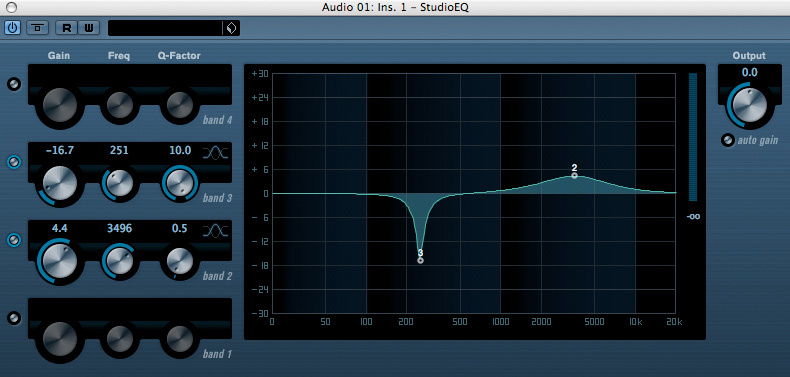 There aren't really any hard and fast rules for EQ — you do what sounds best — but a useful guideline is to use narrow notches for 'surgical' removal of unwanted frequencies, but gentle, broad boosts when looking to augment one aspect of a sound. You may be able to achieve more radical notches by combining more than one filter.Let's look more closely at the simple first–order low–cut filter. As I've just mentioned, the signal level drops by 6dB for every octave below the filter's turnover frequency, and this means that any components two octaves down from that frequency will be attenuated by 12dB, those three octaves down will be attenuated by 18dB, and so on. If you need a 'steeper' filter slope, you put two first–order filters in series, creating a second–order filter with a 12dB/octave response. Such filters are very useful for attenuating frequencies that are outside the area of wanted frequencies, and they form the basis of the low–cut filters found in microphones and mixers. However, although their response shape is useful for cutting, wiring them into a boost circuit can be problematic, because for every octave you go past the filter's cutoff point, the gain rises by 6dB (doubles in voltage), which makes it incredibly easy to run into clipping problems.
 Why are some analogue EQs, such as the Neve model emulated below, so revered? It's because they do more than cut and boost frequencies: phase shifting and distortion also colour the sound. Linear–phase digital EQ is much more precise, but doesn't always sound as pleasing. Some plug–ins, such as the ddmf LP10 shown left, offer variable phase for each filter, giving access to the best of both worlds.
A more practical option for boosting a frequency region is the 'shelving' equaliser. In these designs, instead of the gain continuing to change by 6dB per octave, the curve flattens out — or 'shelves' — so that you can adjust the gain of the desired high or low section of the audio spectrum by the same amount. For example, if you've a filter that's designed to affect only frequencies below 100Hz, once the filter flattens, out all the low frequencies will be cut or boosted by the same amount when you turn the EQ gain control. Again, the more filters you stack in series, the steeper the transition at the filter's operating frequency. (The screen shot at the bottom of this page shows a shelving equaliser plug–in.) Because the amount of gain levels out, this type of filter is less likely to cause clipping problems when boosting. Most equalisers will use high– and low–pass filters only for cutting the extremes of the audio spectrum, and shelving filters where both cut and boost are desired.
What's In The Middle?
While the filters described so far are useful for general high–cut, low–cut and boost purposes, you'll often find frequencies between these two extremes that need attention — such as when you need to reduce the boom of an acoustic guitar body, for example, or emphasise the crack of a snare drum — and this is where the 'band–pass', or 'peak' equaliser comes into its own. This is essentially a tuned filter that offers both cut and boost, and operates on a specific band of frequencies. The range of frequencies that are affected is determined by the bandwidth of the filter (measured at its –3dB points). These adjustable filters can usually be tuned over a wide frequency range, although the technical limitations of analogue circuitry mean that analogue band–pass EQs seldom cover the entire audio spectrum with a single filter. Digital equalisers, on the other hand, can have pretty much whatever range their designers decide they want to build into them.
The shape of the band-pass EQ curve is sometimes described as bell–like: the maximum cut or boost occurs at the centre of the bell and gets progressively less each side of it. The centre frequency of the filter divided by its bandwidth at the –3dB points gives the 'Q' of the filter, meaning that the higher the Q value, the narrower the filter response.
On smaller mixers (and some less sophisticated EQ units) with so–called 'swept–mid' controls, the bandwidth of the mid filter is preset — or may perhaps offer a couple of preset widths — but in a true 'parametric' equaliser the filter width is variable, which means that the user is able to apply a broad boost, or to focus in on very narrow sections of the audio spectrum — or, of course, anything in between these two extremes. Parametric equalisers offer control over filter frequency, cut or boost amount (usually up to about 15dB) and bandwidth (or 'Q'), so there are three controls per band. Most practical parametric equalisers have two or more bands that can be used at the same time to tackle problems in different parts of the audio spectrum.
Graphic EQ
 Graphic equalisers are based around a large number of fixed–frequency filters, either with fixed bandwidth or proportional Q responses, usually spaced by a half, a third, or a whole octave, depending on the number of bands. Each band is controlled using a vertical slider, which governs the cut or boost, with 'flat' being in the centre position — so clearly the name 'graphic equaliser' comes about because the faders show the general shape of the EQ curve. Individual filter bandwidths are arranged so that they overlap smoothly, while the highest and lowest frequency sliders are usually linked to shelving filters to provide more useful control over the high and low extremes. Although there's no reason not to use a graphic equaliser in the studio, most engineers prefer the parametric EQ because it gives them more precise control. Live sound engineers also often like to use graphic equalisers, because they're fast to set up and quite useful for tackling general room EQ problems.
Minimum Vs Linear Phase
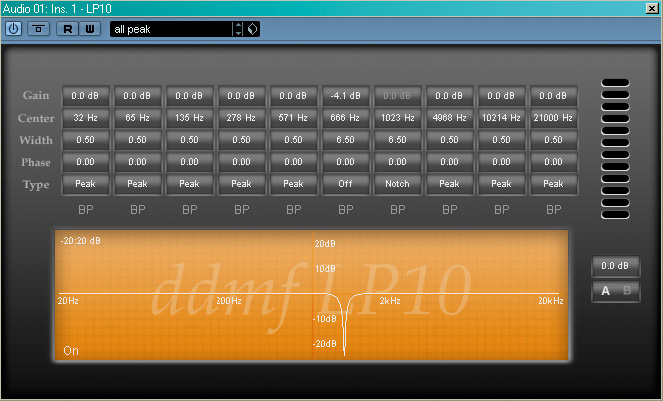 Analogue equalisers tend to colour the sound in a way that's more complicated than simple frequency bosts and cuts, because they introduce phase shifts, some of which will be more musically pleasing to the ear than others (one of the reasons that people admire some particular 'classic outboard'). Unsurprisingly, digital equalisers are often designed to emulate such characteristics, to the extent that both the frequency curves and attendant phase shifts are emulated as closely as possible. This type of EQ is a 'minimum–phase' design, but digital equalisers can also be created with 'linear–phase' characteristics, where no phase shift is introduced between low and high frequencies when cutting or boosting — and this sort of EQ is ideal for correcting spectral balance issues without changing the sound excessively.
It's probably true to say that the phase changes introduced by many classic equaliser designs make an important contribution to their sound, so it doesn't always make sense to choose the technically more precise linear–phase option. You should also bear in mind that linear–phase equalisers introduce quite a lot of delay, which means that they'll increase the latency of your DAW by a significant amount. I like to think of traditional minimu-phase EQ as 'art' and linear-phase EQ as 'science'. Put another way, analogue or minimu-phase EQs tend to be better for creative tonal shaping where you're looking for a musically pleasing sound, whereas linear–phase designs tend to be better for corrective, 'surgical' jobs, such as notch filtering.
Analogue EQs tend to sound different for a number of reasons, not least the shape of the EQ curves — which may depart from the theoretical curves we've discussed so far by intent, or perhaps by some accident of design. Then there's the quality of the circuitry, as equalisation places heavy demands on both the headroom and bandwidth of the active support circuitry. Some vintage equalisers may distort in a musically pleasant way, while a badly designed one can run out of headroom when large amounts of cut or boost are used, which can result in a harsh, unpleasant sound. Engineers creating digital models of classic analogue gear go to great lengths to emulate all the subtle distortions and quirks of the original, as it is often these that give it a unique sonic signature.
Some Practical Considerations
When using EQ, it's useful to understand something of the way our ears perceive the changes we make. In fact, you can try this for yourself by playing a mix through the equaliser and then listening to the subjective results of narrow EQ cuts and boosts at different parts of the frequency spectrum. What should be evident right away is that narrow EQ boosts sound much more obvious — and unnatural — than correspondingly deep EQ cuts. While EQ boost can be useful, it tends to sound most natural when the range of affected frequencies is fairly wide, and where the amount of boost used is quite modest. However, before you boost something you'd like to hear more of, try instead cutting those parts of the spectrum that you feel are overpowering it: sometimes the effect of cutting a lower-frequency sound can make the higher frequencies seem brighter, even though you haven't EQ'd them at all.
You can also sometimes make instruments sit better in a mix by using low– and high–pass filters to 'bracket' the sound, removing unnecessary low and/or high frequencies — in fact, if you ever read our Mix Rescue articles you'll know just how useful this can be for de–cluttering a mix. The classic example is the acoustic guitar in the rock mix, which can sound much better with a lot of low end shaved off, because this prevents it from conflicting with other sounds in the mix. The steeper the filter, the more assertive the bracketing — typically a filter–slope of between 12dB/octave and 24dB/octave will do the trick. You can also afford to be fairly heavy–handed in this respect with instruments such as electric guitar, which don't really have a 'natural' acoustic sound to get wrong. The same radical approach can often be used for synths, where confining pads sounds into a narrower region of the audio spectrum can avoid conflict with other instruments and thus really help to clean up a busy mix.
One pitfall you should avoid is EQing each sound in isolation to make it sound as big and shiny as possible. Although this might make instruments sound good alone, the subjective sound of each part will change once the other elements of the mix are brought into play — and if you've tried to tune up each sound on its own, the chances are that your mix will sound somewhat messy, as all the parts will probably be fighting to be at the front of the sound stage. In reality, some sounds, such as vocals, need to be treated to sound very upfront, while other sounds can play more of a supporting role, and really shouldn't sound so big and glossy. If you listen carefully to some well–crafted commercial records and try to pick out the various different elements of the mix, this should be very obvious.
When it comes to recordings of acoustic instruments and voices, you should always try to get the best sound you can at source, because many problems simply can't be fixed by EQ. What you may think of as a 'coloured' or 'boxy' tone that EQ should be able to fix may, in fact, be down to room reflections caused by insufficient damping in the recording area or by inappropriate mic placement — and where this is the case, you'll often find that EQing will make little or no improvement.
To find the parts of a sound that need equalising, the most common — and, indeed, the easiest — method is to use a parametric EQ with a Q setting of around 1, turn the boost right up, and then sweep the EQ across the frequency spectrum. Listen for those elements that benefit the sound and those that cause problems: the unpleasant elements should really jump out at you when you sweep through them, giving you an idea of which part of the spectrum to cut. You can then experiment with the depth and width of cut to get the best subjective result.
Some engineers may prefer to estimate the problem frequency before applying any such cut or boost, because this offers the advantage that they haven't had their judgement clouded by the sound of a harsh EQ boost, but getting this right is, of course, something that comes with experience and plenty of ear–training 'on the job'. Either way, remember what we said above: always make your final adjustments to a sound with the rest of the mix playing, because what sounds good in isolation doesn't always sound good in context.
The Equaliser
Finally, then, a knowledge of EQ is important to today's music production process, and it can be used either to correct problems or in a more creative manner, to shape sounds in a less natural — but musically satisfying — way. All these uses are valid, but whatever you do, don't fall into the trap of thinking that radical amounts of EQ will help you fix an imperfect sound at the mixing stage — because very often it won't!
Where To Cut & Boost For Common Instruments
The English language is a wonderful tool in that it usually offers many alternative ways of describing similar things. Alas, that can also make it rather imprecise and confusing — particularly when it comes down to describing sound! We might describe a sound as deep, warm, bright, shrill, crisp, forward, or perhaps shimmering. They're useful terms because we all know roughly what they mean, but they're not a lot of use when you're trying to narrow down which frequencies to cut or boost.
In the main article, we describe how you can sweep a narrow–ish parametric EQ boost to zoom in on any problem frequencies that you might want to 'notch out', and this approach can also be useful to train your ears, so that you get used to the different elements that make up the sound of different instruments. In time, you'll start to know intuitively which areas to cut and boost to get the sound you want. Until then, here's a mini reference guide. The list below isn't exhaustive, but it provides some useful starting points for commonly used instruments — and as you can see, the same term can mean different things for different instruments. One word of warning: as always, these are only guidelines, and you really have to listen and experiment if you want to get things working in the context of your track.
Kick Drum: Bottom or depth is usually found in the 60–80Hz region; slap at 2.5kHz.
Snare Drum: Weight, fatness or body at about 240Hz; bite at 2kHz; crispness at 4–8kHz.
Hi–hat: 'Gong' at 200Hz; shimmer at 7.5–12kHz.
Cymbals: 'Clunk' from 100–300Hz; ringing overtones at 1–6kHz; sizzle at 8–12kHz.
Rack Toms: Fullness around 240Hz; attack at 5kHz.
Floor Toms: Fullness around 80–120Hz; attack at 5kHz.
Congas: Resonance around 200–240Hz; slap at 5kHz.
Bass Guitar: Bottom at 60–80Hz; attack or 'pluck' at 700Hz to 1kHz; 'pop' at 2.5kHz.
Electric Guitar: Mains hum at 50Hz (UK) or 60Hz (US); fullness at 240Hz; bite at 2.5kHz
Acoustic Guitar: Bottom or weight at 80–100Hz; body around 240Hz; clarity from 2–2.5kHz.
Hammond/Electric Organ: Bottom from 80–120Hz; presence at 2.5kHz.
Acoustic Piano: Bottom from 80–120Hz; presence between 2.5 and 5kHz; attack around 10kHz; 'shrillness' at 5–7.5kHz.
Horns: Fullness at 120–240Hz; shrillness from 5–7kHz.
Brass: Warmth at 200–400Hz; 'honk' at 1–3.5kHz; 'rasp' at 6–8kHz; shrillness at 8–12kHz.
Solo Trumpet & Sax: Warmth at 200–400Hz; nasal tones at 1–3kHz.
Strings: Fullness at 200–300Hz; 'scratch' (bow and string noise) from 7.5–10kHz.
Vocals: Fullness around 120Hz; 'boom' around 200–240Hz; presence at 5kHz; sibilance from 7.5–10kHz. Matt Houghton
Five EQ Tips
1. You can't boost what isn't there, so get things right at source. Boosting the top end will only result in undesirable crackle and noise if there's little there to augment.
2. You should always EQ in the context of a mix because that's where things need to sound good — no–one else is going to be listening for the perfect hi–hat in isolation!
3. Too much bass or sub–bass will eat up your mix headroom, which makes high–pass filters your best friend.
4. Narrow notches and broad boosts usually work best: so if you hear can hear a nasty resonance, try a narrow cut with a linear–phase EQ; and if you're looking for tonal change, work with gentle, broad boosts and cuts using an analogue EQ (or analogue–modelling plug–in).
5. Different analogue–style EQs impart different characteristics, so try to experiment with different hardware or plug–in EQs to get the results you want. Matt Houghton