

Software samplers are revolutionising studio recording, but can they replace their hardware counterparts in live performance? Jazz keyboardist Django Bates is in the process of finding out...
Are hardware samplers dinosaurs, about to become extinct species at the hands of their software counterparts? Many studio‑based musicians are turning to programs such as Emagic's EXS24, Bitheadz' Unity DS1, Nemesys' Gigasampler and Steinberg's HALion, and the benefits for music recording are obvious. Whether it's close integration with sequencers, full‑screen graphic editing, effectively unlimited sample memory, or the ability to load samples in seconds from the computer's hard drive, soft samplers apparently promise more of everything.
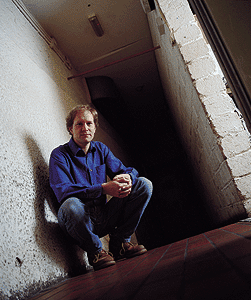
 Django Bates (front) and Human Chain members Josefine Cronholm (vocals), Iain Ballamy (sax), Martin France (percussion) and Michael Mondesir (bass).If there's one area in which you might expect hardware to remain pre‑eminent, however, it's on stage. After all, it's a fact of life that computers crash every now and again. If this happens in a recording session, you might lose five minutes of studio time, but if your laptop goes down in the middle of a show, those lost minutes could be very awkward indeed. Add to this the fragility of your average portable computer, potential issues with latency and the headaches involved in setting it up for live use, and you can understand why musicians might prefer to have a reassuring lump of rackmount hardware backing them up.
I was interested, therefore, to meet a top‑flight musician who's in the final stages of moving to a soft‑sampling setup for live use. Django Bates is one of Britain's foremost jazz keyboardists and composers, and has brought a rare freshness and innovation to the genre, partly through his use of electronic instruments. For many years, his principal sound sources have been a battered Korg electronic piano and an Ensoniq ASR10 sampler, along with a Yamaha TX802 FM rack synth and Clavia Nord Lead keyboard, but in August 2001 he began the process of migrating to a system based around an Apple G4 Powerbook running Emagic's Logic Audio and EXS24, along with Bitheadz' Unity DS1. When I met him in late November, rehearsing with his band the Human Chain, he and his technical consultant Tim Adnitt were, they said, "Ninety percent of the way there..."
Why Software?
Why leave behind a tried‑and‑tested setup for the uncharted territories of software sampling? According to Django and Tim, for the same reason why other people choose hardware samplers: reliability. The band tours extensively all over the world, and they have had innumerable problems transporting their rackmount gear. Django: "What started all this was, I suppose, jealousy of seeing a band that just had two laptops, and two people playing from them, although they were doing a very different thing to what I want to do. Jealousy, and also the cost of taking heavy equipment on planes. It's not only the cost, but they make it incredibly hard, by often breaking it on the way out and on the way back."
 "There's also the problem that a lot of this equipment is getting old, and if it breaks, trying to get someone to supply the same piece of equipment is getting increasingly difficult," adds Tim.
Django offers an example: "I had two Syquest hard drives to store samples from the Ensoniq. The first one died, so I started using the second, then that died, and I went back to see if the first one would work and it did — for a while. Then when that died, we tried loads of hire companies. They sent one that didn't work at all, and I just happened to stumble upon one that a friend, Ashley Slater of Freak Power, still had on a shelf somewhere. When that goes, we hope the new system is going to be ready!"
"It's good using a computer, because you can just burn an image of your OS and everything, set up and ready onto a CD," enthuses Tim. "I've never had any serious problems, but if you did, you could just reformat the disk, or hire a computer, and hopefully that will work. Although copy protection is a problem — Unity has to be manually installed because of the way their copy protection works."
The New Setup
The obvious basic requirement for the new computer‑based system was that Django should be able to do everything that he'd been able to do with his decade‑old ASR10. Despite the theoretically massive increase in power that modern software samplers offer, however, this has proved surprisingly difficult. The first stage was simply to transfer the raw sampled sounds from the ASR10 into the Mac.
 "When we came to sample the sounds from it into the computer, we took a lead from the digital output at the back, thinking that this would be much better, and nothing happened at all," laughs Tim. "We spent about four hours thinking 'There must be some kind of method by which you activate the S/PDIF output.' Anyway, we opened it up, and we couldn't quite see what was going on, and during this time Jeremy [Farnell, Django's manager] was phoning all these people he vaguely knew who had contacts at Ensoniq, and I was looking on the Internet. And simultaneously, we discovered that the digital board was an option, but they'd put the connector on the back regardless of whether you had the board or not!"
"And then we rang Ensoniq and said 'Can we get the digital board?'" continues Django. "They said 'It was never built.'"
"So that was a dead end, but we found that doing it analogue didn't have any side‑effects at all," says Tim.
At this point, though, they came up against a much more serious problem: even though their ASR10 belonged to a previous generation of instruments, none of the currently available software samplers could easily mimic its unique envelope shapes. Transfer the samples themselves was one thing, but getting them to respond to Django's playing in the way he was used to was quite another. "The samples are quite short, and we soon realised that many of the samples themselves were actually quite dull," explains Tim. "The real character of the sounds comes from the envelopes and all those kinds of aspects, which is why that's so important. I think that's something that could be improved in a lot of these software samplers, just to make the sounds more interesting. It's very easy to end up with something very lifeless and drab, and it's very easy to trigger a sound, but actually playing a sound seems to have fallen by the wayside. In some ways it's a compromise, because we just can't do what the Ensoniq can do in terms of envelopes."
Django Bates: Keyboard Player
Since coming to prominence in the 1980s as keyboard player with big band Loose Tubes, Django Bates has forged a reputation as one of the most individual jazz musicians and composers in the country. As well as playing solo piano gigs, he leads several bands: Human Chain, which is comprised of Django plus long‑term associates Iain Ballamy (sax), Martin France (percussion), and Michael Mondesir (bass), also form the core of his current big band Delightful Precipice and, with the addition of singer Josefine Cronholm, the vocal‑led Quiet Nights. He's also in serious demand as a composer and a collaborator.
Human Chain's music is a refreshing antidote to the seriousness of much modern jazz. A bewildering blend of styles incorporating everything from free jazz and bebop to pop, classical and ethnic influences, it achieves the rare feat of being entertaining and accessible, yet modern and experimental. Their up‑to‑date sound stems to an extent from Bates' choice of instrumentation: rather than use acoustic or electromechanical pianos, he leads the band from behind his Korg SG1D stage piano, which he uses both for its own sounds and to trigger layered samples (see main text). I asked him how he'd decided to take this path in a genre which is still predominantly the domain of more traditional instruments.
 It seems that his first experiments with electronic keyboards came about largely for pragmatic reasons: "In England, you often find that pianos are really crap in the kind of venues you have to play in when you're starting out. In fact, the first proper jazz gig I got was at the Waterside Theatre in Rotherhithe, and there was no piano there at all, so I thought 'I've got to get something.' I tried all the obvious things like Fender Rhodes and Wurlitzers, and got pissed off with them all for the same old reasons that people always do — the Fender Rhodes is great for a certain thing, but it's the whole 'Can I play this for a whole evening?' problem.
"The point when it started to feel that I could really play music was when I found just a basic electronic piano that worked as a base, and a Prophet V which provided the excitement that could be thrown in with it. It was from getting the Prophet V that I started enjoying playing keyboards, and not just thinking 'Well, this is something I have to do because there isn't a piano.' I gradually built up an interest."
Nevertheless, he admits to being slow to see the potential of sampling technology when it became affordable in the late '80s: "When I was in Loose Tubes, there was a bit of a buzz about that band. I got a call from Akai, and they said 'Come in, we just want to show you some keyboards.' I was really naïve or thick, or both, and I went in there, and this guy showed me things that looked like that [he points to his rackmounted ASR10], and I was so untechnological that I could only relate to something that looked like a keyboard. They were trying to lend me or give me one of the first S900s, and I walked out going 'Yeah, I'm not really interested, it's not my kind of thing.' It was so stupid!
"A couple of months later I was in Rod Argent's shop, and a guy was playing a keyboard, and all these weird sounds were coming out of it, sounds that had nothing to do with music — farmyard sounds and stuff like that. I just thought 'God, there's so many possibilities.' And then it started to get really exciting. I thought 'That's great, that's what I want!' and I ended up buying an Ensoniq Mirage."
Just A Few Buttons
Perhaps the biggest stumbling block in the migration process was thrown up by another Ensoniq feature which Django had always employed, and which proved infuriatingly difficult to emulate on a computer setup. The ASR10 features a row of eight large buttons on the front panel, which the user can assign to call up eight of his or her favourite programs at one touch. Pressing any of these buttons once simply changes patch, but 'double‑clicking' them effectively layers the new sound on top of whatever program(s) are already being used. In this way, it's possible to switch in and out up to eight individual programs on the same MIDI channel, at the touch of a button. Tim and Django decided that the best way to reproduce this in a computer system would be to use a Kenton Control Freak hardware MIDI fader box to fade individual programs up or down.
Getting this system working properly, however, has been less than straightforward. Part of the problem is that most software samplers and sequencers are set up for studio situations where the different patches in a multitimbral performance are on different MIDI channels. "Initially what we'd been hoping to do is find some means of going directly into Unity by transmitting on more than one MIDI channel at once, but that didn't seem to be an option," explains Tim. "This was around the time when they released the update to Logic that allowed you to have multiple EXS24s triggered live, I think it was 4.71 or 4.73 or something, so I decided to look at that route as well, just as an option, and in many respects it's a lot tidier. EXS24 is a lot easier to use: the envelopes are much more simple, but they do allow you quite a great degree of control, so they can actually do most of what we want to do. So at this point I looked at using the Environment and the EXS24. What I did initially was to create an Instrument Object of a master keyboard, which then goes into a MIDI Monitor Object, and then just goes to however many instances of EXS24 we need.
"The other aspect of it is that Django needed to be able to control the sounds remotely and spontaneously, without messing around with the computer, so that's why we decided to use the Control Freak. And to integrate that, all I had to do was put in a condition splitter transformer in the Environment — if it's controller data it sends it to the faders that control the levels of the EXS24s, otherwise it sends it to the EXS24s themselves. We also get the added bonus that you can change the volume of the sounds very easily. So I set all that up, and found that that was all working fine, and that the Control Freak does actually control Logic's faders very successfully on the audio Instruments, but the problem I had was with EXS24: if you go through anything at all in the Environment, it delays the sound massively. If you take out all of the Environment stuff for the Control Freak, and just route the MIDI input to a monitor and then to multiple instances of EXS24, the first instance of EXS24 on channel 1 is absolutely fine and very responsive, but any instances thereafter are also delayed by that amount. They're all together, but that far behind. So that more or less put us in a position where we knew we couldn't use EXS24 at this time, which is a shame.
Django Bates' Gear
Keyboards
- Korg SG1D stage piano.
- Clavia Nord Lead synth.
Old setup
- Ensoniq ASR10 sampler.
- Yamaha TX802 FM synth module.
New setup
- Apple Mac G4 Powerbook.
- Bitheadz Unity DS1.
- Emagic Logic Audio and ESX24.
- MOTU 828 Firewire interface.
- MOTU Micro Express USB MIDI interface.
- Kenton Control Freak MIDI controller.
Live gear
- Shure SM58 microphones.
- Phonic MM122 mixer.
Django also uses Sibelius for composing.
"We can't use EXS24 because of those issues. I've also looked at HALion — the envelopes on that are great, I was very impressed by them, but there are other aspects of HALion that stop us from being able to use it. It doesn't seem to give us enough means of using the Control Freak, because Cubase doesn't have an Environment. I even tried HALion in Logic, but it doesn't work, it just crashes Logic. I think it's something to do with the hard disk streaming. HALion and the Steinberg route I was slightly wary of, because I had some problems with MIDI and Cubase when I first moved from a PowerPC to a G4, whereas I've found Logic's MIDI really good. I've only been using Logic for about two years now, but I've found it a really fantastic program. The Environment is a whole new thing for me. It's got an aura of mystique about it and a lot of people find it scary, but actually it's not once you start to use it for something like this.
"This gave me the idea that I could use the Environment to control Unity. It's a very similar method, in that the keyboard goes through a condition splitter, and sends controller data to faders, which are then sent to the Unity channels [see the screen shots on the last page of this article], and that side of it works fine. On the other end of it, you've just got it going to transformers that fix the channels at 1 to 8, so that we can transmit the same note information to more than one sound at once. What I was planning to do ultimately is put in a few routers so that we didn't necessarily transmit on all eight channels, because most of the tunes use three at most. Using it through a sequencer is actually quite a good thing, simply because we can do all this stuff with Environments and transforming signals and stuff which we couldn't necessarily do if we were using, say, Unity directly."
Martin France & Electronic Percussion
Drummer Martin France, like Django Bates, is instrumental in contributing an electronic element to the Human Chain sound. As well as a traditional kit, he uses a Roland SPD11 Octapad controller to trigger his sampler — also an Ensoniq ASR10 — and many Human Chain pieces see him continuously shifting between the two to impressive effect. I was interested to find out how he set about integrating electronics into a traditional kit performance.
"I started off trying triggers on the drums. I used to use D‑Drum drum triggers, and I found it so confusing organising the whole sound, I never knew whether I was playing the acoustic drum or the sound. Also, depending on how you played, if you were just playing tiny little things it wouldn't pick them up, so I found that quite hard. So after that I just decided to keep drums as drums, and keep the electronics separate. With outboard pads it's simple, you're either playing acoustic drums or electronic.
"What I like about the Ensoniq is the ability to effect sounds. In this kind of band I'm given quite a lot of space to create sounds, and even if you start off with just a basic drum sound, once you start effecting it you can basically do anything. I've also got bass sounds and human sounds in there, I've got a load of wave drums which I'm really fond of, and I can trigger them all from the Roland, I can layer them from the Roland and Ensoniq, and mix the two live, so I can spin different sounds in and take them out. The other thing that I can do with the Ensoniq, and to an extent with the Roland, is bringing in effects by velocity, so you start off playing quietly, and you get sound A, and as you start getting louder the sound changes, A goes down and B comes up. Or you can have the sound there all the time, and another sound comes up with it, so at the end you're looking at A and B, or crossfades.
"Roland drum gear is very good, I think. This particular Octapad I've had for about eight years, and it's been all over the world. They're nice to play — I think now there's things with proper drum heads on that give you a proper response, but as a portable device that's a gateway to the world of MIDI it's very good. I use the foot pedal to control effects, so that the more I put my pedal down, the more effect I put on it, or I can make it brighter, louder, pitch down or up. It's nice to have a route out of just playing ordinary drum kit sounds, you know, like drums and cymbals, and of course you can link it with computers, so you can write at home with the computer.
"In this band it's all single‑shot samples, but at home I work with a lot of loops, and build things up. I'm working on tracks for an album at the moment, which is all loops, but then mixing the loops with acoustic drums as well. If you sit at home listening to loops all day it sounds very one‑dimensional, but as soon as you put a real kit on it, it just brings it to life. Also, once you start playing with loops and sequencers, everyone has to play in strict tempo, and that's a problem for some situations. I personally like it, because as a drummer you can imply time and make it feel by pushing the beat a little bit or sit back on it very subtly, but still hold to a constant tempo."
"It changes the flavour of the band massively, it just updates it I think, and changes what you play," says Bates. "You have to think very carefully about what you play, you can't be quite as impressionistic somehow — that's the way I see it, because you hit something, and something extraordinarily direct comes out straight away. But I do like it, and now, every piece that I write, somewhere written at the top of the drum part it'll eventually say 'Just use electric drums!'"
So will Martin be following Django in ditching his ASR10 and moving to soft samplers? "Not yet, anyway! I'll think about it when he's sorted out all the problems..."
Not Yet Perfect
It seems as though the current Logic‑plus‑Unity setup can do pretty much what is required, but it's less than ideal, and there are still teething troubles. Unity's arcane editor is making it hard to replicate the right envelopes and controller routings, as Tim explains: "The envelope aspect of Unity is very confusing, because you can make minute changes and end up with massive changes in the sound. If the envelopes were graphic rather than numbers, it really would be so much simpler. You get this graph, but it's a very vague graph and it doesn't seem to do what you expect a lot of the time. It's a pity because it is very powerful, but with all these routings, you have to really think hard before you know where everything's going. I spent a lot of time drawing things on paper, just trying to work out where the routings were going. In that format it's very hard, because you can route modulators to other modulators.
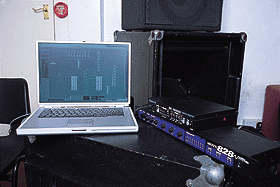 "It leaves us in a position where we can hopefully use Unity, but we have this envelope problem. With this system, you should be able to use any mixture of Unity and EXS24 and so on, just by routing the outputs to wherever we want it to go, and the advantage of that is that in Unity, for example, you can map an envelope to pitch, and there's one particular sound Django uses on the TX802 that's a guitar that bends down, essentially. Things like that you can do in Unity but you can't do in EXS24. So at the moment we're just using Logic to control Unity, but ideally we would like to be able to use Unity for bits, like that bendy guitar sound, and then use EXS24 for other things, because it integrates so much better and you're not running multiple applications. I think the OMS inter‑application link is quite flaky, it seems to complain quite a lot. OMS has been highly problematic. FreeMIDI is great, but it won't work with Logic."
As is so often the way, moreover, the same system that Tim had carefully set up and tested at home promptly fell over when he brought the gear to a band rehearsal. "It was working with my keyboard, but strangely, with Django's keyboard, it doesn't seem to work, and I'm not sure why. I'm not quite sure what's happening, but that keyboard seems to be transmitting the same data twice, so you get two instances of every note, but that doesn't happen with my Yahama synth, so we don't know why that is. Also, I wasn't using a USB hub. Today I did, and it completely messed it all up, you end up with so much latency that it's unusable. If you take the USB hub out of it, and just take the MIDI interface straight into the laptop and the dongle straight into the interface, it's really responsive. They're just teething problems — we'll probably work them out in time."
Django Bates and Tim Adnitt have learned an awful lot — perhaps more than they would have liked to — over the four months they've spent trying to get an apparently straightforward system up and running. What lessons do they feel should be learned by companies making software samplers? "I think the way software samplers have been designed is largely with studio music in mind, rather than live music, and it seems a shame that it's moved away from that whole area, particularly now that computers are fast enought to do these things," says Tim. "Really what we're hoping is that there will come a time when the live aspect of this is thought about more.
"It's also incredibly hard to actually get the information you need about a piece of software. The reason why Unity was our first port of call was that it was the only one that had a demo. I can understand the risks of having a demo in terms of piracy and so forth, but Emagic didn't have a demo. You can read their web site, and it'll tell you all about the great features, but the bottom line is that it doesn't tell you whether it can do what you need it to do, and it's very difficult to find someone who can say 'Yes, it can do that.' And equally, HALion, there's no demo for that. You can travel to see these things demoed, but obviously you're outside your own setup, and often it takes a little time to find that it doesn't work."
Let's hope that Syquest drive doesn't die quite yet...
Controllers & Sound Sources
Although Django Bates' profile is such that he could insist on having an acoustic piano, he's no prima donna when it comes to piano sounds, and seems perfectly content with his Korg SG1D: "We're so used to doing it the way we do it that using a real piano cuts off loads of sight lines, and then you've got drums going into your piano mics, and it's the old hell. I like the piano sound on this Korg, it's really useful, because it's not as glitzy and spiked‑up as the ones you get that are billed as 'the ultimate piano sound', which all sound nothing like a piano! This is quite a flat sound in a way, and that makes it useful for playing the other sounds on top of it, and changing the character that way. After this they did the new SG1D, which was really crap. Everyone says they're crap. Right here where you do most of your 'singing out' playing [he indicates the couple of octaves above middle C], that's the quietest bit of the keyboard, it's really dead there. So we're stuck with this, falling apart at the edges."
The SG1D is used to trigger all of Django's samples, including the sound effects that are prominent in some Human Chain pieces. In this case, he sets the system up so that the notes at the very top and bottom of the keyboard trigger effects instead of the pitched sounds assigned to the bulk of the notes: "Our version of 'New York, New York' is probably the most down that route that we've ever gone. That happened because when we recorded it, I put some sound effects on afterwards, and then we wanted to do it live, and there was just enough room to cram a few sounds on the notes at either end of the keyboard and still leave room to play the tune in the middle. It takes some organising, though. It's good, I think, to start off with an interesting keyboard layout and then write the piece around it. When the new system is up and running and I'm getting used to it, I think I'll do that a lot more. I'm always trying to keep the amount of keyboards down to a minimum, and it is nice to feel like you have one instrument that you feel like you're playing and stab away at something like the sampler or the Control Freak if you want to change what's going on."
Django's Ensoniq ASR10 sampler is his main sound source apart from the SG1D, but he also uses a Yamaha TX802 FM synth module and a Clavia Nord Lead. "I don't know why I ended up with the TX802, I think it's just because of this bendy guitar sound that I really like. Really I'm just carrying it around more or less for that one sound — it's a really quick way of adding a chorus to whatever you've got, it just gives a little curve to the sound. Also there's a couple of micro‑tuning things I use in there. The Nord Lead has its special role. The first proper keyboard I got was a Prophet V, and I got used to the excitement factor that that provides when you whack it in there. It doesn't really matter which sound you go for — in fact I prefer to leaf through the programs until I find a sound that I don't know what it is, bung it in on the mixer, and see what surprises are in store. It takes the music in another direction."