

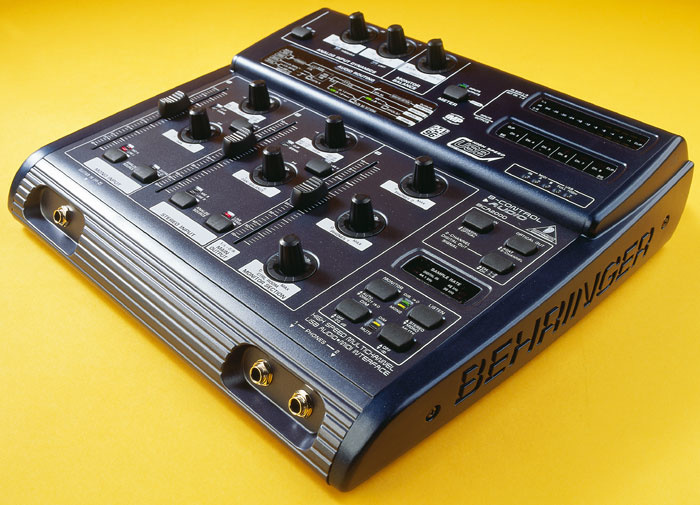
 This is a busy unit for under £200, with dynamics processing (controls are on the left at the top), reasonable metering (top right), a clear indication of signal flow (see the block diagram with LEDs, below the dynamics controls), and built-in mic preamps. There are even dual headphone sockets and a guitar-friendly high-impedance input on the front edge of the unit.Photo: Mike Cameron
Completing Behringer's B-Control family, the BCA2000 combines audio and MIDI interfacing with routing and mixing features, and preamps — and all for under £200.
There's a fairly widespread impression that USB 1.1 may not be up to audio and MIDI interfacing. Although that reputation is largely undeserved these days, it has to be said that those devices which are the most modest in their demands on USB bandwidth are also the most successful.
But what about USB 2.0? This is a much faster format than earlier versions of USB, and if Behringer's latest computer-oriented release is any indication, the newer format is going to be found at the heart of very affordable gear.
The company's BCA2000 is part of their new B-Control family, the first two members of which were reviewed in SOS last month. The BCA seems a little anomalous in the company of these two MIDI controllers; it may be mounted in a box of the same shape, but it offers control of a different kind — over the audio and MIDI data moving in and out of your computer. However, if Behringer's early publicity led you to think that the BCA2000 is also a MIDI hardware controller, it categorically isn't — none of its knobs or faders transmits MIDI data of any kind.
What we have is a device that offers just enough analogue ins, comprehensive digital I/O, and a fair amount of analogue outs. The BCA2000 allows you to record up to eight audio channels, selected (with a few restrictions, of which more in a moment) from three analogue sources and two, four or eight digital audio channels, and routed into your computer via the USB 2.0 connection (if your computer can't handle USB 2.0, operation can take place over USB 1.1, but the slower nature of that protocol means you can interface fewer simulataneous channels — see the box above on the right for details). A maximum of eight channels of audio returning from your ASIO2- or WDM-compatible host software can be monitored in stereo, or in a multi-channel surround mix, via analogue or digital connections. Quality mic preamps, built-in dynamics processing and a zero-latency monitoring option add up to a pretty good spec for what is a budget interface, one that can operate at up to 24-bit/96kHz.
And that's before I make mention of the built-in one-in/two-out MIDI interface, which allows up to 32 MIDI channels to be sent from your host software alongside the audio. Currently, that software will be running only on the PC: no Mac drivers were available at the time of this review (late November 2004), and there's not even basic Core Audio compatibility at the moment. It seems that Mac drivers are on their way, but with no ETA.
USB 1.1 Operation
When using USB 1.1, rather than the faster USB 2.0, only three analogue input signals and one stereo digital signal can be recorded at once, although the analogue audio is actually a mixed stereo signal again, as discussed elsewhere in this review. The ADAT input can still be used, too, but only four of the eight channels are available. All digital formats supported in USB 2.0 mode are available here, bar the 24-bit/96kHz ADAT S/MUX format. Two audio outs are parallelled on the analogue and digital outs; again, four channels of an ADAT stream can be output as an alternative. The MIDI interfacing, in contrast, is available in full — in other words, two 16-channel streams.
Description
As already noted, the BCA2000 adopts the same outward appearance as the rest of the B-Control family: it comes in a compact plastic table-top box, slightly sloped, with a raised panel at the top, and is finished in a gun-metal blue-ish grey, with white highlights. On the top panel, the layout is clearly understandable, with the controls for the analogue inputs, configured as one mono and one stereo, dominating the lower panel. Though superficially simple, there's more going on than you might think. First of all, the mono channel can route a mic-, line- or instrument-level input to your computer: the balanced line and balanced XLR mix inputs are at the rear of the interface, and there's a high-impedance guitar input located handily on the front panel, just under the mono input controls. The three input choices are selected via a pair of buttons. The mono channel is equipped with a trim control and a 100mm level fader, plus a pan pot. A final switch activates 48V phantom power when using the XLR input with a condenser mic, whilst Signal and Clip LEDs keep you visually informed of audio moving through the channel and any overloading that might occur.
The mic-input electronics take the form of Behringer's Invisible Mic Preamp (or IMPs), worthwhile circuitry inherited from the company's UB mixer range. If the first thing you look for on computer audio interfaces is an insert point, in order to integrate your favourite hardware signal processing, then I'll save you the time: the BCA is so-equipped. That's a nice touch on an affordable interface.
At first glance, the stereo input channel looks pretty much like the mono, with its trim control, 100mm fader, simple metering, 48V switch and so on. But it has more cunning flexibility, with routing switches that let you choose a second line or mic input, in mono, or allow you to hijack both line inputs for true stereo operation. Making this choice does throw up some issues, however. For example, this channel's pan pot works as a left/right balance control when working in stereo, and the mono input no longer has access to the (left) line input. It's also not possible to apply insert processing to both sides of the stereo signal appearing at this channel, since the mono channel's insert remains wired to its mic input. Thus it is possible to record a stereo performance, either miked or via the line ins, with insert processing, but only by setting the stereo channel for dual-mono operation. And although the BCA2000 can capture three analogue sources — one mono and the two sides of a stereo input — what goes to your audio software is always stereo. The theoretical three channels remain theoretical, and are always mixed to stereo.
 The rear panel is equally busy, as befits an interface with this many options. The two mic pres are accessed on the right via the XLRs, and the insert points are also to be found here. The multiple analogue outputs are in the centre above, and the digital I/O is to the left of these. Underneath are the USB connection, and the control-room and line-in jacks.Photo: Mike Cameron
For users without external signal processing, Behringer have thoughtfully included some simple 'analogue input dynamics' circuitry which can be switched in and out of the input signal path. This consists of a one-knob noise gate and a one-knob limiter (plus threshold and limit indicator LEDs respectively), and is no less effective for its simplicity. Noisy basses or guitars are kept quiet when you're not playing, and rogue peaks are easily managed, helping you to avoid clipping while recording to your computer.
But there is one small problem: the dynamics processor is a fixed stereo device. All analogue audio passing into the BCA2000 will be processed if the circuitry is enabled, which is not necessarily what you'd want if you were recording two separate parts at once, such as might be the case if guitar and bass were being recorded, or a miked vocalist and stereo keyboards. It doesn't offer a dual-mono option, nor simultaneous stereo plus mono operation. Still, it's worth having.
The BCA's two input channels are joined by a master section, comprising a master level fader, monitor/control room level knob, and two headphone output knobs — the interface is equipped with two headphone outputs, plus monitor outputs, in addition to its main stereo output. One final knob is labelled 'monitor balance'; this rather usefully lets you alter the relative levels of the audio being playing into the BCA and the return from the host audio software, in some modes of operation.
A handful of switches help manage the BCA's digital interfacing, which is actually pretty well specified. Optical and co-axial digital connectors are provided, and between them they can accept or transmit S/PDIF or AES-EBU digital audio; the optical connectors are also compatible with eight-channel ADAT, or four channels of the enhanced 24-bit/96kHz ADAT S/MUX format. Not all choices can be made on the panel: bundled control panel software provides access to the missing parameters. Interestingly, the co-axial output will still function in stereo when the optical interfacing is set to work in ADAT format. Digital channels 1-2 or 7-8 can also be output by the co-axial connection.
Behringer didn't stop there: the front panel offers a mono mix audition button, plus control room/headphone mix dim and mute switches. Further monitoring sophistication, of a digital kind, is provided by a Monitor switch: this enables a 'direct monitoring' option, adding latency-free monitoring of audio returning from your software host.
Metering is simple, with two 12-segment bar-graph meters for analogue audio, and six pairs of signal/overload LEDs for digital audio. The metering responds to input or output audio depending on the position of a switch. Other LEDs show the presence of MIDI data and USB operation, and a few more light up in a helpful front-panel flowchart.
Round the back, there are some interesting discoveries. All the connections I've mentioned are located here: two XLR connectors, with an insert point each (though this functions on the line input as well), a pair of balanced line ins, the control room output (you can connect monitors here), co-axial and optical digital ins and outs, and three MIDI sockets. There are also no fewer than six analogue outputs. Two are balanced jacks, suitable for analogue mastering, while the remainder are simple, unbalanced, phono connectors. This may seem a strange option, in this digital world, but are provided essentially to allow surround monitoring to take place. The digital outs are surround-capable, too, if you have the right hardware. Not bad for a sub-£200 unit.
In Use
Once everything's in place, working with the BCA2000 is straightforward. It'll show up as a MIDI and audio source in all Windows software — it even worked on Open Labs' Neko, from within their shell program. It was instantly available to play back audio from Propellerhead Reason, and was happily hosted by Cakewalk's Sonar and Steinberg's Cubase SX MIDI + Audio sequencers. Of course, you have to play around with settings a bit, to make sure all the audio channels are available, and to adjust latency.
The BCA certainly exibits latency, and rather more than I would have expected. There are two issues: first of all, there's the delay that occurs between playing some audio via the interface and hearing it come back from the target software during recording or overdubbing. Then there's the delay between playing a note on a MIDI controller and hearing the audio output of a software instrument hosted by your target software being played back via the interface. Both types of delay are very much in evidence with everything freshly installed. Luckily, the recording and overdubbing problem can be easily dealt with, since the interface offers latency-free hardware monitoring options, as explained elsewhere. Tweaking the monitor balance knob and the track monitoring features of your host software should eliminate all audible delays. However, I found that although I could create acceptable latency values for playing software instruments via MIDI by tweaking buffers, the additional hit this caused on my CPU brought me closer to audio problems and break-ups than I would normally be happy with. I found settings that provided a compromise, but it wasn't the best.
Should you wish to record more than three analogue sources independently, then adding an ADAT-equipped analogue interface would do the trick. One good candidate would be Behringer's own UltraGain Pro8 ADA8000, which features eight IMP-equipped XLR mic inputs feeding a single ADAT output. It's not expensive (£187 in the UK), and provides an ideal add-on for BCA2000 users. Of course, any ADAT-equipped device could be interfaced with the BCA, not just Behringer's.
Audio coming back from your software can be monitored in stereo, or in a surround mix. Doing so will involve a little fiddling about in your host software, but you'll be able to manage a six-channel surround mix alongside a stereo downmix, plus stereo monitoring (and a switchable mono compatibility audition!). The digital outs support Dolby Digital/AC3 and DTS surround formats, if you have the right decoding hardware.
Conclusion
USB 2.0 interfacing stood up well when I tried everything the BCA is designed to be capable of, recording multiple audio channels, monitoring in surround, and playing virtual instruments while beaming MIDI data out of the host software. Sessions with a normal level of activity were glitch-free once I'd adjusted latency in my hosts and on the BCA.
Lack of Mac OS X drivers aside, the BCA2000 is a fine mid- to low-price audio interface, and the use of USB 2.0 allows more simultaneous audio channels to be interfaced than you would achieve with a USB 1.1 interface, to say nothing of the dual-channel MIDI stream. The input and output circuitry sounds great, too — I was a fan of the IMPs.
The unit is very flexible, though serious users may need to add an external box or two to get the most out of the BCA: those eight channels of digital audio really do cry out to be exploited, and require further hardware. Some of the apparent flexibility is also compromised by the steadfast stereo nature of the analogue input.
Niggles placed firmly to one side, the BCA2000 shows what USB 2.0 can do for music, and offers a lot of interface for the money. And if the retail price seems keen, some of the UK street prices have to be seen to be believed! Mac users excepted, be prepared to want it once you've tried it.
Software & Installation
There are a handful of functions that can't be accessed from the front panel, requiring a little software widget. This is supplied, along with drivers, on a CD-ROM. Installing the ASIO-compatible driver can be a little odd: a couple of errors will arise on most users' systems, but according to Behringer, this is normal, and we're supposed to simply ignore them.
Once installed, the driver works fine, and plants a little control panel icon on the Windows XP task bar. This panel lets you customise latency, select the digital clock source, choose an ASIO monitoring mode, and set up the two-channel digital output format (either AES-EBU or S/PDIF). In addition, you can customise the meter ballistics to offer peak hold or faster decay reading.
The rest of the control panel offers information: a second page summarises what ins and outs are available with USB 2.0 and USB 1.1, and a third is simply a useful block diagram.
Pros
- Very good value.
- Has insert points.
- |ncludes a pair of Behringer's good Invisible Mic Preamps, with independent phantom power.
- Surround monitoring option.
Cons
- PC-only at the time of writing (late 2004).
- Built-in dynamics processing compromised.
- Analogue inputs always mixed to stereo en route to host software.
Summary
It's a shame about the current lack of Mac compatibility, and the compromises on the analogue inputs, but at what would be considered a fair price for an older-style USB 1.1 audio interface of this spec, the BCA2000 offers great value for money.