

 Craig Connor (left) and Allan Walker (right) of Rockstar Games. Photo: Richard Ecclestone
Imagine selling a million copies of your music in just over a week, with no video, no radio play and no touring. Impossible? Not if it's the soundtrack to one of the most successful computer games of all time...
When the Playstation 2 game Grand Theft Auto: San Andreas was released in the UK at the end of October 2004, it took just nine days for sales to reach the one million mark. With 677,000 copies sold in its opening weekend, GTA: SA became the fastest-selling games title ever in the UK, breaking the record set by its predecessor, Grand Theft Auto: Vice City, which has sold over 10 million copies worldwide. It would be a rare thing indeed for an album or DVD release to sell a million in a little over a week, and, at £40 a pop, GTA: SA saw more money changing hands than most blockbusters can expect to bank in the same period. It's just one of many signs that computer games have risen to the level of, and may already have surpassed, films as the diversion of choice of the masses. And in terms of production values and time spent in development, today's blockbuster games are creeping up on their movie counterparts.
Having worked for Rockstar North in Dundee, and now Edinburgh, for the past 10 years, Allan Walker and Craig Connor have seen the transformation of the games console from children's toy to grown-up's hobby at first hand and, in overseeing the music and audio for all of the five GTA games to date, they've played their part in it — the GTA franchise was aimed at adults from the off, and has arguably done more than any other to make it OK for adults to talk about gaming. This change in attitudes is not lost on the pair. "I remember even six years ago people would kind of laugh and say 'Oh, so you do bleepy bloppy noises,'" says Craig. "That's what people used to think of sound for games. The Playstation 2 has changed that now."
"It isn't like we're doing the sound for a game any more," Allan adds. "We're trying to make an imaginary world come alive. That's where the game becomes immersive, when you believe you're there, and the sound can really let you down on that front — it's all got to be believable. Working within the limitations of the machine, that gets pretty tricky." Given the scale of the game, with its hundreds of square miles of virtual cityscapes and countryside to explore, and hundreds of individual interactive characters, I'd say this was something of an understatement.
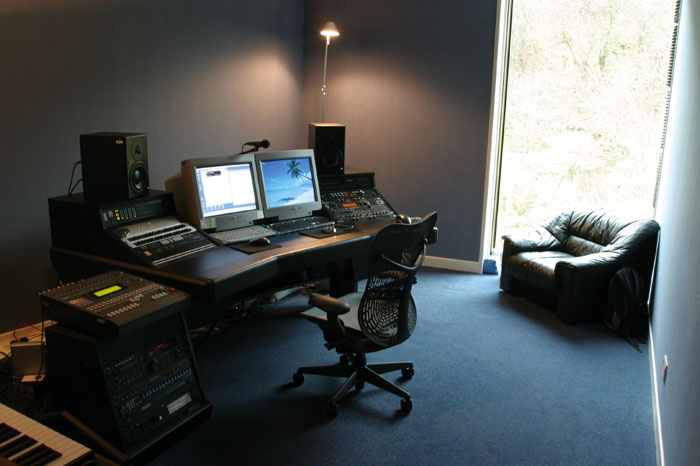 Craig Connor's studio at Rockstar North.Photo: Richard Ecclestone
Station To Station
All five GTA games share the same essential premise. Starting out as a lowly petty crook, the player must work his way (it's always a he, incidentally) up the underworld ladder by stealing cars and performing a variety of unsavoury tasks for a colourful cast of mobsters, pimps and hustlers. Crammed full of movie and pop culture references, the games bombard the player with an irreverent, mischievious and downright sick sense of humour, manifested in the characters you encounter and the commercials and DJ chatter on the car radio.
The car radio provides the bulk of the musical content of the game, and any time the player is inside a car, there are 11 different stations to choose from. The mammoth task of mastering this material, all of it existing music licensed by Rockstar, fell to Craig. "In total, there's 155 tracks in the game and I had to master all of them, plus the ones that didn't get used, as well as 70 commercials and the DJs' dialogue. I think it's about 12 albums' worth of stuff, and not 12 separate albums — it all had to work together. You can flick between the different stations in the game at any time, so getting a consistent level was really important. I did the mastering in Pro Tools, mainly using Waves compressor and limiter plug-ins, Focusrite Red EQs and sometimes a BBE Sonic Maximizer. The game is set in 1992, so there's a lot of music from around then — lots of hip-hop and new jack swing — but there's also a rare grooves station which is all '60s stuff, there's some '80s stuff, some classic rock, even a country and western station. There's all these different styles of music that needed to be mastered into one game, so that was a bit of a nightmare. I used different compressor and EQ settings on the DJ dialogue, too, because I wanted them all to sound different, to sound like they were coming from different stations, so the DJs on the hip-hop stations had really fat bass and the country one would sound like it was a shitty mic in a shitty studio."
 Allan's studio is also Pro Tools-based, with further outboard gear including Avalon DI box, TC Electronic Reverb 4000, Behringer Tube Ultra Q equaliser, SPL Vitalizer enhancer and Drawmer DS231 dynamics.Photo: Richard Ecclestone
The task of mastering all of the material for the different radio stations was made more complex by the fact that much of it is interchangeable. "In all the previous titles, each radio station was a loop of about an hour and a half with the adverts and the DJs all mixed in, so I could just EQ the whole thing the way I wanted. This time the tracks are selected randomly from each station's playlist and there are three different DJ intros and outros for each track. Most of the ads appear on several different stations too. We wanted people to be able to play the game for a long time before hearing anything repeated. We knew that there was going to be about 100 hours of gameplay in the game, so we wanted to really break it up so everyone gets their own experience from the game. But it meant that if I made an advert really bassy to fit in with a hip-hop station, when it's played on a station that sounds much more tinny it'll really pop out at you. So I had to keep a level head and not go overboard on that front."
Different cars even offer different qualities of radio reproduction, and as the player progresses through the game they can purchase subwoofers and other upgrades for certain vehicles. Colin Entwistle, Matthew Smith and Alastair McGregor were in charge of programming the audio elements of the game engine. "Basically we come up with creative stuff and say 'Can you do this?' and they say 'No,' and we say 'Why not?' but eventually they'd find a way to do it," Craig jokes. "They're really keen to push the boundaries of what we can do with the Playstation 2, as are we."
Genie In A Bottle
Perhaps the most unexpected tool in the Rockstar North studio is an empty water bottle. "When we need to create sound effects from scratch," says Allan, "somehow we always end up finding a way to use a water bottle! For example, in San Andreas, we used the sound of an empty bottle being jiggled up and down in the opening of a desk drawer to create the sound of a blown-out car tyre flapping along the road."
"And for Manhunt," Craig adds, "when we needed to get that spooky pizzicato sound from The Shining, we did that just by plucking rubber bands stretched out around a water bottle, and then putting on really nice reverbs and a bit of distortion — it adds such a great sound."
Into The Buffers
Battling with the constraints of the format is a recurring theme in Allan and Craig's line of work. One might have thought that with the capabilities of the current generation of games consoles and a whole DVD game disc to store data on, such limitations would be less pressing, especially when compared to the early days of computer games where the audio designer had only a few bytes and a hardware sound chip to play with. Not so, according to Allan. "You had to work down to the last byte in those days and it's amazing but we're still working down to the byte now, literally trimming down the tail of every sample. The job hasn't got easier — it's just as hard but it's a bigger job. There's more space to fill but there's so much to fit in there. And with the next generation of consoles it'll be the same — the first thing we'll do is up the quality of all the samples and that'll eat up a lot of space.
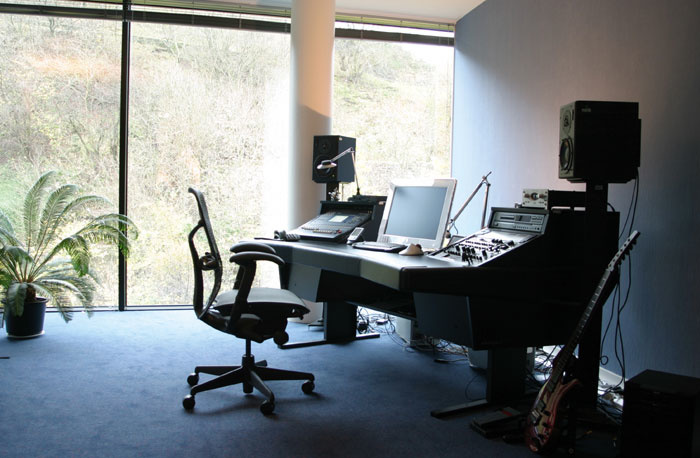 Allan Walker's studio, with Parker Fly guitar "for stress relief".Photo: Richard Ecclestone
"The main constraint in the past has always been the amount of memory you've got to play with. In this case there's a seperate audio RAM. When we take into account all buffers required for specific tasks, what we have left could store around nine seconds of CD audio. So we have to fit whatever could be going on in terms of audio at any one time, which is often an awful lot, into that nine seconds. We're also careful to arrange groups of sounds associated with specific things into packets to minimise reading off the disc. For example, when you jack a car in the game, we've got the time between the player pressing the button and the character on screen getting to the car to load all the sounds that go with it — the sounds of the door opening, pulling the driver out of the car, any dialogue they might have, slamming the door again and so on. So while memory was previously the main constraint, now it's actually the disc — apart from anything, there's so much dialogue in there the disc isn't big enough, and it's a DVD!" Most of GTA: SA's spoken parts were recorded in the US, but this vocal booth at Rockstar North's Edinburgh studios was used for recording jingles for the game's fake radio commercials, with the Rode Classic mic. Photo: Richard Ecclestone
Ped Power
He's not kidding. Some 4000 lines of scripted dialogue advance the plot of the game, voiced by an impressive cast of movie and music stars from Samuel L Jackson and James Woods to Ice T and Shaun Ryder, while the lead character, CJ, has 7700 different comments he can make according to the situation at hand. San Andreas is also populated by 300 different types of 'ped' who'll interact with CJ according to his actions as he makes his way through the game, and can even strike up conversations with each other, using 60,000 possible responses.
"Every ped was given his or her own personality," Allan explains, "and that dictated what we needed to provide for them in the way of audio. They'll react in different ways if you get in their way on the street or start a fight with them — they'll even comment on CJ's clothes or his haircut. But when there are 300 peds who can talk about the colour of your shoes or whatever, you can't just have them all saying one thing because you'd hear it all the time, so you need variations. So that's 300 peds times three or four variations on the comment, or eight or nine if you count the versions that didn't get used. So just a little detail like that would flow into hundreds of samples. CJ's also got about 10 different moods which govern his comments. So if something happens in the game which he's going to say something about, the version of that comment you'll get will depend on his mood. If you've just failed a mission in the game, he might be angry and you'll get the pissed-off version, or if you've just completed one he'll be wisecracking and being a bit pleased with himself. A lot of code had to be written to make all that work and the game can track 150 of the last bits of dialogue, so that covers most repetition — it can really break the illusion if you hear something then you hear it again straight away."
"We did two sessions in New York and one in LA to record the ped comments, each with 100 actors coming into the studio in four days," adds Craig. "That was pretty manic — getting the actors to scream 'Get out of the way!', 'Move it, asshole!' and that sort of thing. Then we brought everything back here on an iPod and on Lacie drives as well as extra backups, and set about editing it all with the rest of the team [audio designers Will Morton and John McCavish]. There's a wide dynamic range between the really loud shouting and the quiet chatting, and we had to keep it all consistent. We also had to bear in mind that there might or might not be all sorts of things happening at the same time — guns going off, the car radio and so on. Thankfully we kept up close communication on what everybody was doing. We also used an Excel spreadsheet to keep track of what was finished and what we still needed — with tens of thousands of bits of dialogue, we had to."
Mood Music
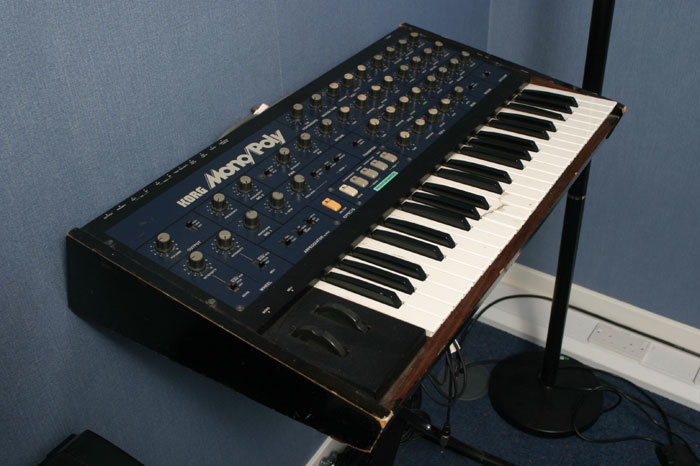 Photo: Richard Ecclestone
Craig's Korg Mono/Poly formed the backbone of the Manhunt soundtrack. For Rockstar's horror-themed stealth/action game Manhunt, Craig was called on to create a more traditional movie-style soundtrack, while Allan oversaw the game's range of alternately gory and unnerving sound effects. "Basically," Craig explains, "we sat and watched every horror film we could find so that we could get a feel for the format and see what made horror movies scary. Because it's not the man who's sneaking up behind you or hiding in the bushes or whatever else, it's the music that tells you how to feel. So we just separated out all of the different elements of soundtracks and then thought 'Right, how can we put this into a game?'"
The idea they hit upon in the end was to design four pieces of music for each level which could be looped and layered one on top of the other to incrementally raise the levels of tension and excitement according to the action. Allan explains: "Once we'd broken down the elements of the music that we needed for the game, we were listening to horror soundtracks on their own, and you can tell what's going on just from the music — you know, now they're hiding, now they're being chased, that's the fight bit. So we had these four different moods for the soundtrack that are dictated by what's happening in the game, five if you include the times when you're hiding in the shadows, when the music drops out entirely and you just hear a heartbeat. There was this sort of mellow wandering-around music, then when you've been spotted it goes up another notch, then again when you're being chased and finally when it turns into the final fight the whole tune comes together, and all four stereo loops are streaming at the same time. The crossfades going from one piece of music to next were all done in code and the timing of them was something that we really had to work on, checking if this bit was going to work with that bit and setting up the volume fades, but somehow whenever it went into code and we could test it in the game it just worked so much better."
The music itself was created almost exclusively on a battered old Korg Mono/Poly analogue synth which was passed through some distortion and lo-fi effects, combined with some similarly grimy drum samples, and sometimes truncated to eight-bit for good measure. The soundtrack's unrelentingly dark and sinister mood perfectly reflects the content of the game, and also struck a chord with a number of drum & bass and electronica producers — an entire album of Manhunt remixes from up-and-coming producers was released on Aphex Twin's Rephlex label. As pleased as Craig is to see his music recognised, he wasn't sorry to move on from the project: "I loved doing the Manhunt stuff but I'm glad that I've finished it now — I got to a very dark place by the end!"
Two Billion Conversations
Because of the interactive nature of the game and its environment, it's impossible for any one player to hear everything that has been put into the game, but this doesn't seem to bother the creators. "We're basically supplying the world with a library of sound," says Allan. "It isn't like we're making a film which is linear, we're just putting options and possibilities into the game allowing the world to do what it does — it doesn't matter if you don't hear everything. Just the fact that you can just wander about listening to peds talking to each other, and they'll talk to you and you can talk back, brings the whole thing to life. That alone adds another couple of hours of gameplay. There's two billion conversations that can happen, so nobody'll ever hear everything — we worked out that if one happens every two minutes it would take 76 centuries for them all to take place!"
"It seemed insane at the start," says Craig. "When we started talking about all the things we wanted to put in, we were thinking 'Will you actually see, will you ever hear it?', but then it started to make sense. For instance, the DJs will sometimes comment on the weather and other things that are happening in the city. Getting that to work was a huge task for the programmers, and maybe people won't notice it until they've been playing a few hours, but then I was walking past one of the game testers and he was like 'Craig, I think the DJ just said it was raining — how does that happen?' and I thought, 'It's worked, and it's worth it.' It's little things like that that make the game feel more real."
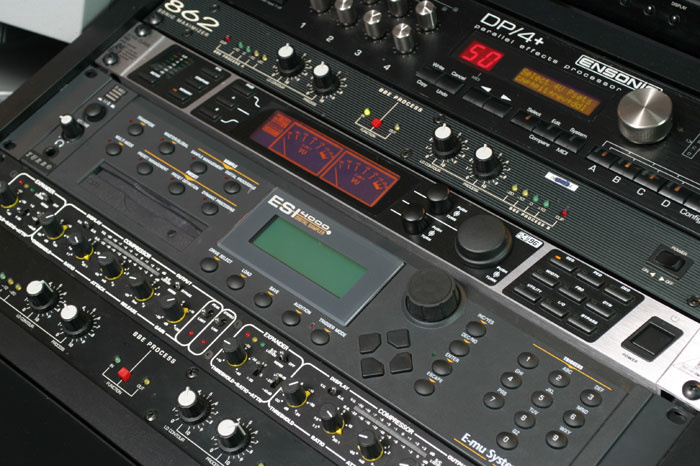 Some of the rack gear in Craig's studio. From top right: Ensoniq DP4 effects, BBS 862 Sonic Maximizer, Behringer Ultracurve Pro EQ, Emu ESI4000 sampler, Drawmer DL231 dynamics and BBE 462 Sonic Maximizer.Photo: Richard Ecclestone
Breaking Down
The sound effects, another crucial element in the game, which range from car engine and tyre noises, gunshots and explosions to rain and other atmospheric sounds, are rendered in 5.1 surround, panned to correspond with the action taking place on the screen. Allan explains: "We use Pro Logic II to do the surround stuff — we used to use DTS but that actually halved our channel count so we gave up on that. The Playstation 2 has 48 hardware audio channels. We use four to stream the radio and the background ambience, so we end up with 44 channels to cater for everything else that's going on in the world — all the sound effects and dialogue that might be going on at any one time. But once again, our amazing programmers have come up with some awesome stuff where the game keeps track of up to 200 channels in memory, and you only hear the 44 loudest ones. If a sound gets pushed out by louder sounds, this means that, whether it's a loop or a one-shot, it'll be tracked for its duration until the louder sounds fade and it can come back in in the right place. So, you'd never notice it while playing the game, but if a character is talking and there's a much louder sound, that dialogue would be cut and then come straight back in at the right time. The sentence would seem like it was getting played back all along, but there was maybe a gunshot in the middle which voided the need to hear it at that moment."
The sounds themselves were mostly culled from commercial sound libraries, but were then split into much smaller constituent parts which could then be controlled by the game engine, giving maximum flexibility from as little data as possible. Allan continues: "The sound effects are broken down to a level where there are so many small samples and so much code going into controlling them that they're almost being synthesized. The rain sound, for example, uses nine channels, with two loops and seven little one-shot samples that play all around you in surround. It sounds like rain but it's actually coming out of tiny little samples so that we can squeeze all of them on and have that happening at the same time as streaming radio off the disc. If a car drives by you, you'll hear the different sound of the rain on the roof of the car as compared to the road, and that's all programmed in surround as well."
This deceptively complex approach to incidental sounds is exemplified perfectly in the treatment of gunfire, a frequent occurrence on the streets of San Andreas. "The gunshots use up to eight or nine audio channels each — as far as I know this hasn't been done in a game before. We've got five different sounds that will be attached to a single gunshot so it can be rendered in surround, and the dynamics of the sound change depending how close the character you're controlling is to the gun being fired. The gunshot itself is made up of several different sounds — a little bass sound, a dry 'click' sound and so on — and these all get mixed differently depending on the distance from the shot. So if your point of view is far away from the shot, all you'd really hear is the shot's echo — the reverb tail of the gun that'll fade in on its own. As you get closer to it there are other sounds that are layered and crossfaded. When you're right up close to it you can almost hear the air getting sucked out of your ear, there's such a nice pop on it. Then there's the bullet itself — we've got different sounds for the bullets hitting concrete or metal and even just going through the air near you. We also use a slightly random pitch element just so it doesn't sound completely repetitive and mechanical when someone's firing repeatedly."
 Craig's recording and editing system is based around a Digidesign Pro Tools rig with 888/24, HD96 and 882 interfaces. Between those are Behringer Ultrafex II and Ultra Q, and the Dolby Pro Logic II Gaming Encoder used to render the surround elements for the GTA: SA soundtrack.Photo: Richard Ecclestone
Checks & Balances
Besides monitoring via the Dynaudio BM6s in their office studios, Allan and Craig were sure to check all the audio in the game on a variety of domestic hi-fi and TV systems. "I'm religious like that," says Craig. "I check with the same TV that I've had since 1982 and the same speakers. You've got to do it because once the game's finished, you're always going to hear it somewhere coming out of the worst setup in the world." Testing for bugs in the game was equally thorough. "We've recently got a new tester, George Williamson, specifically for audio, so he'll play the game all day and report all of the bugs he finds. We've got a debug setup here where we can do some nasty things to the game just to see what'll happen. But the sheer scale of the game was really scary — it's absolutely massive and there's bound to be things that we're going to miss. The scariest thing of all is when it's done and it's in the shops, and you know your mates are going to come round and tell you the truth!"
It's not just what's in the game: what was left out is also a cause for sleepless nights. "It does just come down to time constraints at the end of the day," says Allan. "We could go on forever — we could easily have kept working on the game and improving it for months, but you have to draw the line at some point and start putting things on the list for next time."
"Normally we'd come up with really crazy ideas when we were working late," says Craig, "and then in the morning we'd come in and say 'You know what, that's a stupid idea, that's fucking insane.'"
"Yeah," agrees Allan. "Let's do it!"
Career Options
As in all areas of the music industry, there are lots of people wanting to get into audio design for computer games and a relatively small number of jobs available. When I ask Allan and Craig if they've any advice to offer, they're definitely clear on what not to do. "Don't just send in a music CD to show off your music abilities. It is a major part of the job, but there's a whole lot of other stuff as well. Go out and play the games that are out there at the moment and see what's happening. A lot of the CVs we'll get sent are attached to a CD with a note saying 'Here's some background music I thought you would like to use in your game.' Come on! Do you know what year it is? Do you know how far games have come since then?"
Allan agrees: "We sent them a tape — don't do that any more. That was 10 years ago! Try and understand what's going on the music and audio side of games these days. When you write a letter and a CV you need to show that you've at least some idea about what's involved in the job. There's musical ability, and knowledge of equipment but there's a lot more to it than that — it's all about creativity and ideas."